

 Add to Google calendar
 Add to Outlook calendar
Abstract
This talk gives a big picture view of world order over the last two centuries. It offers new periodisations, aims to make listeners understand how we got to where we now are, and where we might be heading. The focus is on the political, economic and social transition from a world order dominated by the West – the first world order on a global scale – to a second global scale world order marked by a much wider diffusion of wealth, power, knowledge, agency, and political and cultural authority.
The Western world order (WWO) kicked in on a global scale during the 1840s. The small group of countries that mastered modernity during the mid-19th century (Western Europe, the US, Japan and Russia), easily took over the world. The WWO had a European dominated phase up to 1945 marked by colonialism, racism, and great power hot wars. Then from 1945 to 2014, a US led phase marked by decolonisation, cold war, and neoliberal globalisation. Its features were a durable gap of wealth and power between a core of first round of modernisers and a periphery of the rest. The core set up a global political economy to suit its own interests. It had command of the oceans, and of trade and finance. It generated a number of rival ideologies about how the political economy of modernity should be organised (nationalism, racism, liberalism, communism, and fascism).
The WWO began to lose its grip during the 1970s when a second round of modernity took off in Asia, and the core powers lost the capacity to easily occupy the periphery. A major further blow was the economic crisis beginning in 2007-8, and the subsequent crisis of liberal ideology. By 2014 Russia, China, India and others were operating outside of the WWO. The WWO ended definitively in 2025 when Trump 2.0 broke up the West, and abandoned liberal ideology.
The post-Western world order now in the driving seat is deeply pluralist. It rests on a strong revival of civilisational identities repressed under the WWO, and an ongoing resentment against the West for the humiliations and harms inflicted by it against the rest. It is dominated by the social and political values of the far right including cultural differentiation, social conservatism, hatred of globalisation and multilateralism, regional spheres of influence for great powers, economic nationalism, authoritarian capitalism, and transactional/multialignment foreign policies based on assumptions of no friends and no trust. Given the collapse of its liberal and communist rivals, this far-right world order looks durable. It will have several great powers, a lot of regional powers, and probably no superpowers. It is currently locked into a Third Cold War which also looks durable. But it could reach a cold peace if agreement could be reached on both a strong principle of anti-hegemony, and settlement of various disputed civilisational boundaries.
This new world order is deeply divided on the question of climate change and the unfolding Anthropocene crisis. How that conjunction between a socio-political transformation in global politics, and a mounting crisis between the development of humankind and the carrying capacity of the planet, works out is the defining question for the future.
About the Speaker
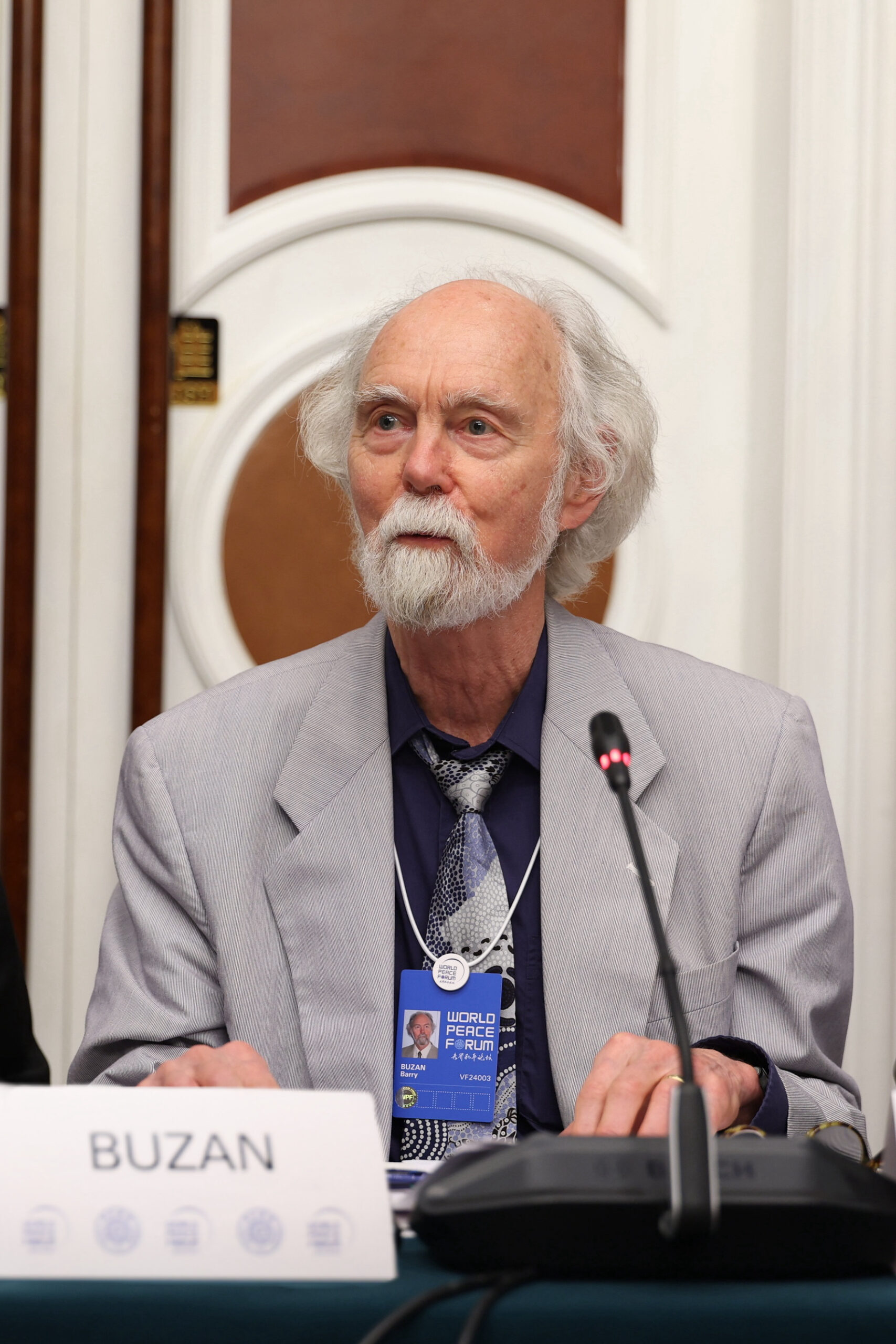
Barry Buzan is Emeritus Professor of International Relations at the LSE (formerly Montague Burton Professor), honorary professor at Copenhagen. Jilin, and China Foreign Affairs Universities, and University of International Relations (Beijing), and a Senior Fellow at LSE Ideas. In 1998 he was elected a fellow of the British Academy. From 1999-2011 he was general coordinator of a project to reconvene the English school of International Relations, and from 2004-8 he was editor of the European Journal of International Relations. His recent books include: with Robert Falkner (eds.) Great Power Responsibility and Global Environmental Politics (2022); Making Global Society: A Study of Humankind Across Three Eras (2023); with Robert Falkner (2025) The Market and Global International Society: An English School Approach to International Political Economy; Timelines for Modernity: Rethinking Periodization for Global International Relations (2025); with Mathias Albert (eds.) The Anthropocene Crisis: A World System Science Approach (forthcoming 2026).