


05 January 2026
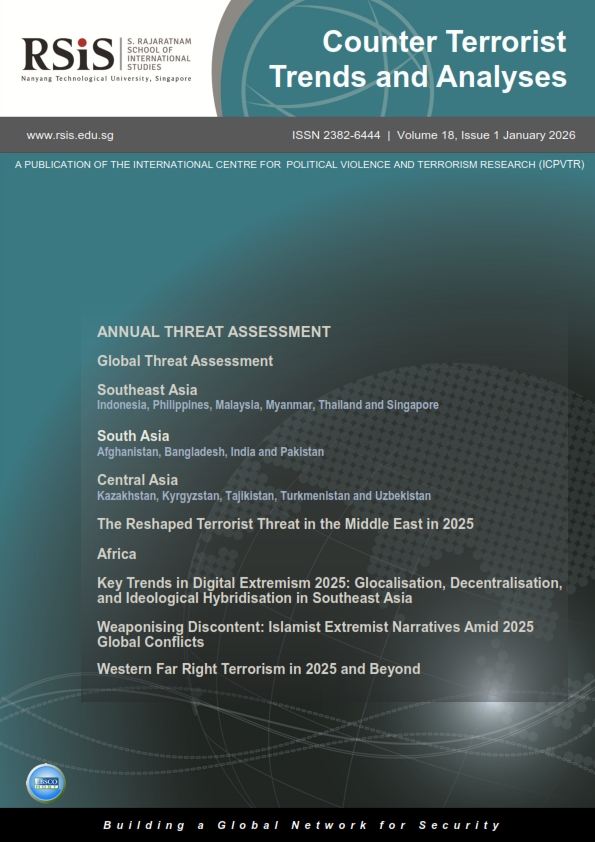
Counter Terrorist Trends and Analyses (CTTA) – Volume 18 Issue 01

Annual Threat Assessment
This volume covers the following three broad themes for 2025’s terrorism landscape: significant global developments and trends; notable operational trends and developments; and the enduring salience of a holistic, integrated approach in dealing with violent extremism.
A notable event was Israel’s sustained military campaign against Hamas in Gaza, that extended further into the Middle East. Israel severely degraded the militant group Hezbollah in Lebanon, including via tactically innovative “pager explosions” targeting its leaders. Offensives were also maintained against Hezbollah remnants in Syria, and the Houthis to dismantle Iran’s ‘Axis of Resistance’”. In June 2025, Israel directly engaged Iran in a 12-day air and missile war.
The impact of the ongoing Israel-Hamas conflict continued to reverberate in Southeast Asia, amid a spike in antisemitic attacks around the world. In Singapore, the authorities reported that several individuals had been self-radicalised by the conflict. Moreover, in mid-December, a horrific terrorist attack carried out by two gunmen against Jewish Australians celebrating Hannukah at Sydney’s Bondi Beach, left at least 16 people dead.
The evolving geopolitical and strategic picture in the AF-Pak region also remained relevant regionally and further afield. The Taliban authorities enjoyed improving relations with neighbouring states. But while it seemed able to “constrain” IS Khorasan (ISK), the TTP (Tehreek-e-Taliban Pakistan) continued to gain in strength. The TTP, Pakistan’s largest and most organised militant network, has attempted to absorb like-minded jihadist factions to forge a unified struggle to bring about a “Taliban style Shariah state” in Pakistan.
The AF-Pak threat picture also impacted the regional fortunes of the Sunni Islamist extremist rivals Islamic State (IS), Al Qaeda, and their respective affiliates. These networks remained functional to varying degrees, with some facing major challenges. ISK in Afghanistan, for example, has seen its operational fortunes decline. Crucially, with the fall of the Assad regime in Syria in December 2024, the IS global leadership apparently redirected funding originally earmarked for ISK towards Syria, where IS sees a strategic opportunity for a relaunch.
Al Qaeda continued operating training camps in Afghanistan in 2025, with its de facto leader, Saif ul Adl, even inviting “would-be radicals” worldwide to travel there for training. Al Qaeda poses a less potent and immediate threat globally than the IS in terms of external operations. However, in Africa, particularly the Sahel and Somalia, Al Qaeda’s regional branches are more lethal than IS affiliates.
The year was not short of Far-Right Extremism (FRE) incidents in the West, South Asia and even Southeast Asia. In the United States, the authoritative 2025 Murder and Extremism in the United States report observed that extremist-related murders were primarily committed by right-wing extremists of various kinds, including white supremacists. Additionally, far-right terrorism remained a distinct threat in Canada, Australia, and New Zealand, as well as in Europe.
FRE ideologies also remained a concern in non-Western Southeast Asia. In Singapore, four FRE inspired cases were identified between 2020 and June 2025. In November, a 17-year-old Indonesian student launched a bomb attack against a high school mosque in Jakarta, injuring 96 people. While not found to possess “extremist” motives, the attacker had carried two airsoft guns inscribed with various Western FRE references.
Malaysia was also not immune to growing far-right sentiments online, with the potential to deepen social divides and fuel exclusivism or even extremism. Such “glocalisation” of far-right ideologies to reflect local sentiments was evinced in memes and social media content across Southeast Asia, and even East Asia, fuelled by social media and targeting impressionable youth. At times, sustained exposure to a range of not just FRE but other ideologies, produced idiosyncratic cases of youth radicalisation.
In 2025, Islamist extremist and far-right actors alike continued to rely on decentralised supporter networks and localised online content-sharing ecosystems, allowing them to sustain online activity despite intensified moderation efforts. These online networks and ecosystems in turn proliferated, increasingly becoming key vehicles for threat actors to carry out their radicalisation and community-building efforts. Another significant development was IS’ gradual integration of artificial intelligence (AI) into its media strategy.
In terms of operational trends and developments, several key themes stood out in the 2025 survey. The increased weaponisation and deployment of Unmanned Aerial Systems (UAS), or drones, were evident in conflict zones globally. Threat and armed groups globally also employed a variety of attack modalities against a range of diverse targets. In Africa, IS-Somalia adopted highly deadly asymmetric guerrilla tactics, including improvised explosive devices (IEDs), landmines and mobile ambushes,
Finally, the year’s developments affirmed that a judicious mix of hard and soft approaches, involving calibrated application of force together with a serious multi-dimensional effort to address the underlying conditions that drive violent extremism, remained crucial.
The International Centre for Political Violence and Terrorism Research (ICPVTR) would like to dedicate this Annual Report to the late Mr Richard Chua, our former Coordinating Director, who passed away in August 2025. His wise guidance and dedication to excellence have shaped our trajectory for much of the past decade and will continue to inspire us all.
HTML Article Versions
Global Threat Situation in 2025
Western Far-Right Terrorism in 2025 and Beyond
Weaponising Discontent: Islamist Extremist Narratives Amid 2025 Global Conflicts
Annual Threat Assessment
This volume covers the following three broad themes for 2025’s terrorism landscape: significant global developments and trends; notable operational trends and developments; and the enduring salience of a holistic, integrated approach in dealing with violent extremism.
A notable event was Israel’s sustained military campaign against Hamas in Gaza, that extended further into the Middle East. Israel severely degraded the militant group Hezbollah in Lebanon, including via tactically innovative “pager explosions” targeting its leaders. Offensives were also maintained against Hezbollah remnants in Syria, and the Houthis to dismantle Iran’s ‘Axis of Resistance’”. In June 2025, Israel directly engaged Iran in a 12-day air and missile war.
The impact of the ongoing Israel-Hamas conflict continued to reverberate in Southeast Asia, amid a spike in antisemitic attacks around the world. In Singapore, the authorities reported that several individuals had been self-radicalised by the conflict. Moreover, in mid-December, a horrific terrorist attack carried out by two gunmen against Jewish Australians celebrating Hannukah at Sydney’s Bondi Beach, left at least 16 people dead.
The evolving geopolitical and strategic picture in the AF-Pak region also remained relevant regionally and further afield. The Taliban authorities enjoyed improving relations with neighbouring states. But while it seemed able to “constrain” IS Khorasan (ISK), the TTP (Tehreek-e-Taliban Pakistan) continued to gain in strength. The TTP, Pakistan’s largest and most organised militant network, has attempted to absorb like-minded jihadist factions to forge a unified struggle to bring about a “Taliban style Shariah state” in Pakistan.
The AF-Pak threat picture also impacted the regional fortunes of the Sunni Islamist extremist rivals Islamic State (IS), Al Qaeda, and their respective affiliates. These networks remained functional to varying degrees, with some facing major challenges. ISK in Afghanistan, for example, has seen its operational fortunes decline. Crucially, with the fall of the Assad regime in Syria in December 2024, the IS global leadership apparently redirected funding originally earmarked for ISK towards Syria, where IS sees a strategic opportunity for a relaunch.
Al Qaeda continued operating training camps in Afghanistan in 2025, with its de facto leader, Saif ul Adl, even inviting “would-be radicals” worldwide to travel there for training. Al Qaeda poses a less potent and immediate threat globally than the IS in terms of external operations. However, in Africa, particularly the Sahel and Somalia, Al Qaeda’s regional branches are more lethal than IS affiliates.
The year was not short of Far-Right Extremism (FRE) incidents in the West, South Asia and even Southeast Asia. In the United States, the authoritative 2025 Murder and Extremism in the United States report observed that extremist-related murders were primarily committed by right-wing extremists of various kinds, including white supremacists. Additionally, far-right terrorism remained a distinct threat in Canada, Australia, and New Zealand, as well as in Europe.
FRE ideologies also remained a concern in non-Western Southeast Asia. In Singapore, four FRE inspired cases were identified between 2020 and June 2025. In November, a 17-year-old Indonesian student launched a bomb attack against a high school mosque in Jakarta, injuring 96 people. While not found to possess “extremist” motives, the attacker had carried two airsoft guns inscribed with various Western FRE references.
Malaysia was also not immune to growing far-right sentiments online, with the potential to deepen social divides and fuel exclusivism or even extremism. Such “glocalisation” of far-right ideologies to reflect local sentiments was evinced in memes and social media content across Southeast Asia, and even East Asia, fuelled by social media and targeting impressionable youth. At times, sustained exposure to a range of not just FRE but other ideologies, produced idiosyncratic cases of youth radicalisation.
In 2025, Islamist extremist and far-right actors alike continued to rely on decentralised supporter networks and localised online content-sharing ecosystems, allowing them to sustain online activity despite intensified moderation efforts. These online networks and ecosystems in turn proliferated, increasingly becoming key vehicles for threat actors to carry out their radicalisation and community-building efforts. Another significant development was IS’ gradual integration of artificial intelligence (AI) into its media strategy.
In terms of operational trends and developments, several key themes stood out in the 2025 survey. The increased weaponisation and deployment of Unmanned Aerial Systems (UAS), or drones, were evident in conflict zones globally. Threat and armed groups globally also employed a variety of attack modalities against a range of diverse targets. In Africa, IS-Somalia adopted highly deadly asymmetric guerrilla tactics, including improvised explosive devices (IEDs), landmines and mobile ambushes,
Finally, the year’s developments affirmed that a judicious mix of hard and soft approaches, involving calibrated application of force together with a serious multi-dimensional effort to address the underlying conditions that drive violent extremism, remained crucial.
The International Centre for Political Violence and Terrorism Research (ICPVTR) would like to dedicate this Annual Report to the late Mr Richard Chua, our former Coordinating Director, who passed away in August 2025. His wise guidance and dedication to excellence have shaped our trajectory for much of the past decade and will continue to inspire us all.
HTML Article Versions
Global Threat Situation in 2025
Western Far-Right Terrorism in 2025 and Beyond
Weaponising Discontent: Islamist Extremist Narratives Amid 2025 Global Conflicts