


13 March 2026
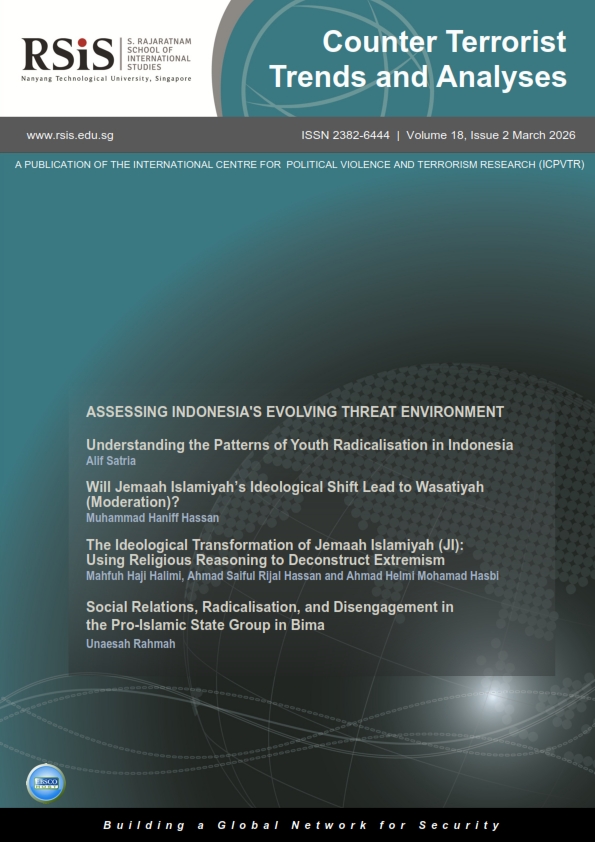
Counter Terrorist Trends and Analyses (CTTA) – Volume 18 Issue 02

Assessing Indonesia’s Evolving Threat Environment
Indonesia’s terrorism landscape continues to defy simplistic narratives of rise or decline. Rather than dramatic ruptures, the current phase is characterised by recalibration and diffusion—of ideology, actors, and participation across multiple strands of extremism. The contributions in this issue collectively demonstrate that militant movements are neither monolithic nor static; they are shaped by internal debate, doctrinal reassessment, generational turnover, and shifting strategic environments. The evolution and eventual dissolution of Jemaah Islamiyah (JI), for instance, underscores how even entrenched organisations can undergo profound ideological re-evaluation. At the same time, emerging anxieties over far-right and ultra-nationalist currents—though less operationally visible—signal that Indonesia’s extremism landscape is diversifying in ways that warrant early attention.
Patterns of radicalisation further reveal a complex interplay between digital ecosystems and enduring social ties. Online propaganda, including content inspired by networks aligned with the Islamic State (IS), continues to circulate widely and resonates with segments of youth. Yet the broader evidence tempers alarmist conclusions: radicalisation rarely occurs in isolation from offline relationships, and youth participation, while increasing, remains proportionally limited relative to adult involvement. These dynamics point not to a wholesale generational takeover or purely online phenomenon, but to hybrid pathways in which virtual exposure and face-to-face trust networks reinforce one another.
As the threat spectrum widens—from jihadist networks to nascent far-right expressions—the task ahead lies in developing responses that are proportionate, evidence-based, and attentive to the evolving social foundations of extremism itself. Against this backdrop, this edition comprises four articles that collectively scope the ideological, generational, and relational dynamics shaping Indonesia’s extremism landscape, highlighting both the internal transformations within militant movements and the emerging contours of future threat trajectories.
In the first article, Alif Satria draws on his own dataset to analyse patterns of youth radicalisation and involvement in jihadist terrorist organisations in Indonesia. He explores three issues in particular. Namely, the frequency of youth involvement in terrorist groups, the platforms through which youths are drawn into extremist organisations, and the positions youths may fulfil upon joining such networks. The author also highlights the phenomenon of memetic, far-right inspired violence among youths as an emerging issue.
Next, Muhammad Haniff Hassan examines the impact and implications of Jemaah Islamiyah (JI)’s dissolution in June 2024, and explores the significance of its evolution from violent jihadism to non-violent Islamism. While a significant development, the author argues that its actual transformation into a wasatiyah (moderation) and mainstream actor largely depends on its conduct in Indonesia’s socio-political scene in the coming years.
Third, Mahfuh Haji Halimi, Ahmad Saiful Rijal Hassan and Ahmad Helmi Mohamad Hasbi examine the conditions for JI’s ideological transformation following its dissolution in June 2024. They identify internal ijtihad (independent, expert reasoning) and theological reflection as instrumental to this process. By analysing key JI documents, they demonstrate how Islamic hermeneutics can dismantle extremist ideologies from within.
Lastly, Unaesah Rahmah surveys the role which social relations may play in pathways into and out of terrorist groups, using the case study of a pro-Islamic State (IS) group in Bima, West Nusa Tenggara, Indonesia. She argues that while social relations were a significant factor, these interpersonal ties were not sufficient to drive disengagement from the group, with the latter requiring additional conditions such as ideological justification and physical separation.
HTML Article Versions
Understanding the Patterns of Youth Radicalisation in Indonesia
Will Jemaah Islamiyah’s Ideological Shift Lead to Wasatiyah (Moderation)?
Social Relations, Radicalisation, and Disengagement in the Pro-Islamic State Group in Bima
Assessing Indonesia’s Evolving Threat Environment
Indonesia’s terrorism landscape continues to defy simplistic narratives of rise or decline. Rather than dramatic ruptures, the current phase is characterised by recalibration and diffusion—of ideology, actors, and participation across multiple strands of extremism. The contributions in this issue collectively demonstrate that militant movements are neither monolithic nor static; they are shaped by internal debate, doctrinal reassessment, generational turnover, and shifting strategic environments. The evolution and eventual dissolution of Jemaah Islamiyah (JI), for instance, underscores how even entrenched organisations can undergo profound ideological re-evaluation. At the same time, emerging anxieties over far-right and ultra-nationalist currents—though less operationally visible—signal that Indonesia’s extremism landscape is diversifying in ways that warrant early attention.
Patterns of radicalisation further reveal a complex interplay between digital ecosystems and enduring social ties. Online propaganda, including content inspired by networks aligned with the Islamic State (IS), continues to circulate widely and resonates with segments of youth. Yet the broader evidence tempers alarmist conclusions: radicalisation rarely occurs in isolation from offline relationships, and youth participation, while increasing, remains proportionally limited relative to adult involvement. These dynamics point not to a wholesale generational takeover or purely online phenomenon, but to hybrid pathways in which virtual exposure and face-to-face trust networks reinforce one another.
As the threat spectrum widens—from jihadist networks to nascent far-right expressions—the task ahead lies in developing responses that are proportionate, evidence-based, and attentive to the evolving social foundations of extremism itself. Against this backdrop, this edition comprises four articles that collectively scope the ideological, generational, and relational dynamics shaping Indonesia’s extremism landscape, highlighting both the internal transformations within militant movements and the emerging contours of future threat trajectories.
In the first article, Alif Satria draws on his own dataset to analyse patterns of youth radicalisation and involvement in jihadist terrorist organisations in Indonesia. He explores three issues in particular. Namely, the frequency of youth involvement in terrorist groups, the platforms through which youths are drawn into extremist organisations, and the positions youths may fulfil upon joining such networks. The author also highlights the phenomenon of memetic, far-right inspired violence among youths as an emerging issue.
Next, Muhammad Haniff Hassan examines the impact and implications of Jemaah Islamiyah (JI)’s dissolution in June 2024, and explores the significance of its evolution from violent jihadism to non-violent Islamism. While a significant development, the author argues that its actual transformation into a wasatiyah (moderation) and mainstream actor largely depends on its conduct in Indonesia’s socio-political scene in the coming years.
Third, Mahfuh Haji Halimi, Ahmad Saiful Rijal Hassan and Ahmad Helmi Mohamad Hasbi examine the conditions for JI’s ideological transformation following its dissolution in June 2024. They identify internal ijtihad (independent, expert reasoning) and theological reflection as instrumental to this process. By analysing key JI documents, they demonstrate how Islamic hermeneutics can dismantle extremist ideologies from within.
Lastly, Unaesah Rahmah surveys the role which social relations may play in pathways into and out of terrorist groups, using the case study of a pro-Islamic State (IS) group in Bima, West Nusa Tenggara, Indonesia. She argues that while social relations were a significant factor, these interpersonal ties were not sufficient to drive disengagement from the group, with the latter requiring additional conditions such as ideological justification and physical separation.
HTML Article Versions
Understanding the Patterns of Youth Radicalisation in Indonesia
Will Jemaah Islamiyah’s Ideological Shift Lead to Wasatiyah (Moderation)?
Social Relations, Radicalisation, and Disengagement in the Pro-Islamic State Group in Bima