


11 November 2025
IP25105 | Unpacking the Façade of Indonesia’s Decentralised System

KEY TAKEAWAYS
• What appears to be a rapid recentralisation of powers under President Prabowo Subianto reflects not just his leadership style, but also the structural limits of Indonesia’s decentralised system.
• Limited fiscal autonomy of local governments heightens their dependence on central fiscal transfers, reinforcing Jakarta’s influence and eventually leading to the August 2025 protests.
• Preventing recentralisation requires overhauling existing central–local fiscal frameworks to heighten local governments’ fiscal autonomy.
COMMENTARY
20 October 2025 marks one year since Prabowo Subianto became President of Indonesia – a significant milestone in his decades-long political journey. After two failed bids for the presidency against former President Joko Widodo, Prabowo’s ascent to power fulfilled a long-time ambition. Yet, his first year has not been a rosy picture for Indonesians. Widespread protests erupted across the nation in August 2025, fuelled by rising property taxes and high youth unemployment. The protests are seen by some as symbolising broader frustrations over the government’s management of the country and the persistent hardships faced by the populace.
A key structural source of public dissatisfaction lies in what appears to be a rapid recentralisation of authority within Indonesia’s central–local governance framework under Prabowo, which has rolled back several key elements of the landmark 2004 Regional Autonomy Law. He has successfully diverted resources from various state bodies to fund his national priority initiatives, such as his universal Free Nutritious Meals Programme for Indonesian schoolchildren. Consequently, local governments possessed limited fiscal resources to effectively run their public services. It appears that, within a year, Indonesia has experienced a shift towards the recentralisation of local fiscal and governance frameworks, echoing the dynamics of the pre-Reformasi administrations.
However, this phenomenon is precisely what Indonesia’s decentralisation reforms were designed to prevent – by devolving greater powers from central to local authorities. This raises the question: how has Prabowo’s administration managed to recentralise control over state resources within a year of his presidency, despite Indonesia’s decentralised governance structure? This article argues that Indonesia’s tilt towards centralised governance predates Prabowo. The local governments’ structural dependence on fiscal support from the central government and the enactment of the 2022 Fiscal Decentralisation Law – which further enhanced central control over local budgets – have facilitated Prabowo’s recentralisation efforts.
A Brief History of Decentralisation
In 2004, Indonesia embarked on a decentralisation reform to overhaul its centralised governance structure. The government aimed to mitigate separatist pressures and improve public service delivery by granting greater autonomy to local governments better attuned to local conditions. The central government focused on national priorities, like finance, defence, and foreign relations, while local governments assumed new public service responsibilities, including health, education, and infrastructure development. The decentralisation process was also accompanied by fiscal reforms, providing various income streams for local governments to carry out their new responsibilities. Income sources included local government revenue (PAD) and central government fiscal transfers in the form of the General Allocation Fund (DAU), Special Allocation Fund (DAK), and Revenue Sharing Fund (DBH).
How These Fiscal Structures Facilitated Recentralisation
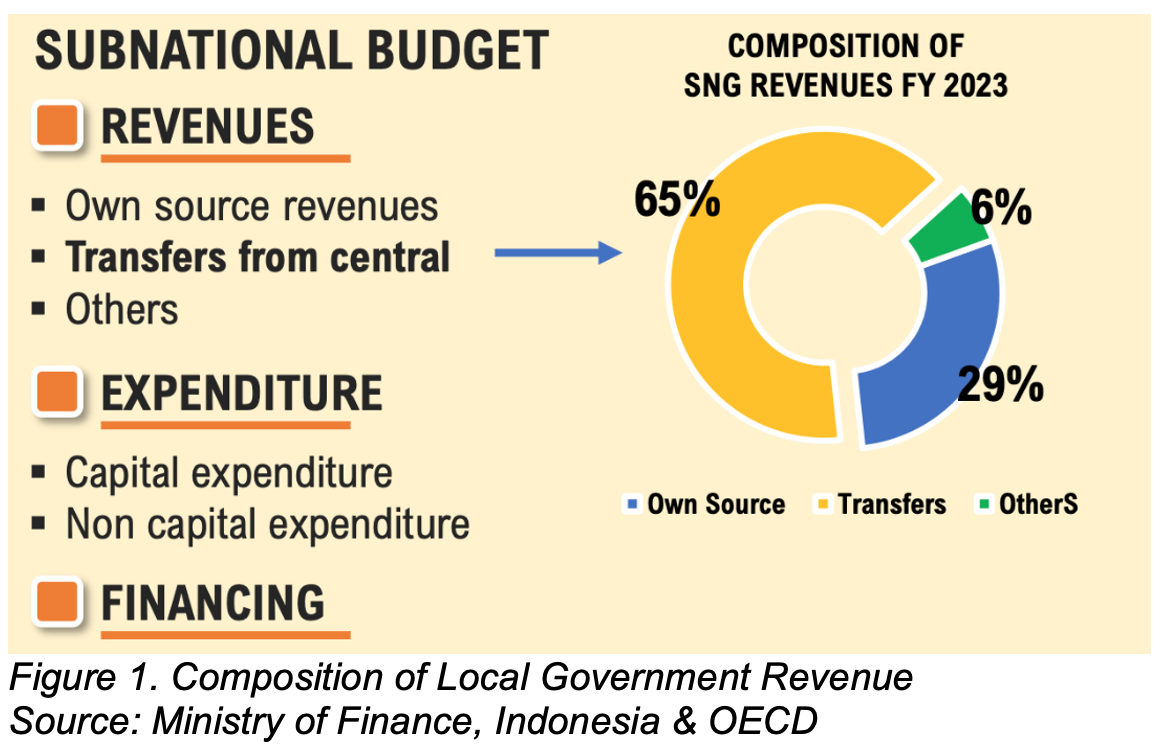
While possessing multiple income streams, local governments’ limited local revenues increased their dependence on central transfers. Consequently, this reinforced central control over regional governments through institutionalised fiscal dependency. Figure 1 shows that, as of 2023, central government transfers, on average, comprised 65% of local government income, while local revenues only accounted for 29%. This phenomenon arose as local governments, following decentralisation, were not provided with adequate resources to generate substantial PAD, even as their administrative responsibilities expanded. This imbalance left them dependent on central transfers to run local public services effectively. As a result, there is an imperative for local government leaders to sustain political allegiance to the centre to ensure their localities continue to receive sufficient state funding.
While it would be rational for local governments to increase their PAD to enhance fiscal autonomy, they lack the political will and structural capacity to do so. Compared to the central government, which collects substantial revenues from major taxes, such as income, corporate, and value-added taxes, local governments rely on PAD taxes – like property, hotel, and restaurant levies – which yield limited revenue. Thus, when the Prabowo administration streamlined central transfers by US$3.05 billion in January 2025 and proposed a further US$40 billion cut in the 2026 budget, regional governments had no choice but to ramp up local taxes to inordinately high levels to keep public services afloat. This phenomenon was seen in Pati, Cirebon and Jombang, where land and building taxes (PBB-P2) increased by 250% to 1000%. The resulting public discontent, fuelled by rising living costs, sparked widespread protests. Under mounting pressures, regional administrations eventually rolled back the tax hikes, revealing the immense political sway residents have over local authorities. These events highlight that local governments are caught in a catch-22 as their ability to achieve fiscal autonomy is restricted by top-down and bottom-up pressures.

The sudden reduction of central transfers is also worth noting, as it was legally backed by the new Fiscal Decentralisation Law No. 1/2022. The law was implemented during Joko Widodo’s presidency to align central–local fiscal structures with the 2020 Omnibus Law. While the Omnibus law was presented as a reform to establish a more investment-friendly environment, in practice, it curtailed the autonomy of local governments and bureaucracies. The 2022 law reinforced this trend by removing a provision under the 2004 Decentralisation Law that required 26% of the national budget to be allocated to the DAU. Thereafter, the allocated budget for central transfers is to be determined on an ad-hoc basis, based on the central government’s assessment of national priorities. The new fiscal decentralisation law also introduced performance indicators that central authorities could use to dictate regional budget allocations, thereby granting them greater discretionary powers.
Overall, the new fiscal law granted the central government greater discretion over local budget distribution. This imbalanced power structure allowed Prabowo to reduce central transfers in order to create fiscal space for his Free Meals Programmes, which he considers a national priority despite reported inefficiencies.
Concluding Thoughts
In conclusion, prior to President Prabowo’s term, Indonesia’s fiscal structures had already been altered in ways that restricted fiscal transfers to the regions and weakened the country’s decentralised governance system. This made local governments more dependent on central government support, enhancing Jakarta’s ability to shape local dynamics.
For Prabowo, these existing structures supported his recentralisation efforts. Indonesia’s pre-existing tilt towards centralisation reduced the bureaucratic and political backlash he might otherwise face in a truly decentralised system. Consequently, his approach represents not a major overhaul of existing local fiscal structures but an extension of his predecessor’s centralising initiatives.
Thus, to answer this article’s central question, one must look beyond the past year of Prabowo’s presidency and examine the deeper structural foundations of Indonesia’s governance. In essence, the legislative architecture for recentralisation was already in place – Prabowo merely needed to turn the key.
Looking ahead, Indonesia must reform its existing central–local government fiscal framework if it wants a robust decentralised system. There must be additional high-yielding sources of PAD for local governments to generate revenue independently and at a scale proportionate to their administrative responsibilities. Doing so will ensure that local governments can provide the necessary services to their people without fear of recentralisation.
Tharmendran Vatatheeswaran is in his final year of study at the National University of Singapore (NUS). He is studying for a Bachelor of Social Science degree, with a major in Political Science. He is focusing his study on Indonesian politics and society and at RSIS was mentored by Dr Alexander R. Arifianto. Alexander R. Arifianto is a Senior Fellow and Coordinator of the Indonesia Programme at the Institute of Defence and Strategic Studies (IDSS), S. Rajaratnam School of International Studies (RSIS).
KEY TAKEAWAYS
• What appears to be a rapid recentralisation of powers under President Prabowo Subianto reflects not just his leadership style, but also the structural limits of Indonesia’s decentralised system.
• Limited fiscal autonomy of local governments heightens their dependence on central fiscal transfers, reinforcing Jakarta’s influence and eventually leading to the August 2025 protests.
• Preventing recentralisation requires overhauling existing central–local fiscal frameworks to heighten local governments’ fiscal autonomy.
COMMENTARY
20 October 2025 marks one year since Prabowo Subianto became President of Indonesia – a significant milestone in his decades-long political journey. After two failed bids for the presidency against former President Joko Widodo, Prabowo’s ascent to power fulfilled a long-time ambition. Yet, his first year has not been a rosy picture for Indonesians. Widespread protests erupted across the nation in August 2025, fuelled by rising property taxes and high youth unemployment. The protests are seen by some as symbolising broader frustrations over the government’s management of the country and the persistent hardships faced by the populace.
A key structural source of public dissatisfaction lies in what appears to be a rapid recentralisation of authority within Indonesia’s central–local governance framework under Prabowo, which has rolled back several key elements of the landmark 2004 Regional Autonomy Law. He has successfully diverted resources from various state bodies to fund his national priority initiatives, such as his universal Free Nutritious Meals Programme for Indonesian schoolchildren. Consequently, local governments possessed limited fiscal resources to effectively run their public services. It appears that, within a year, Indonesia has experienced a shift towards the recentralisation of local fiscal and governance frameworks, echoing the dynamics of the pre-Reformasi administrations.
However, this phenomenon is precisely what Indonesia’s decentralisation reforms were designed to prevent – by devolving greater powers from central to local authorities. This raises the question: how has Prabowo’s administration managed to recentralise control over state resources within a year of his presidency, despite Indonesia’s decentralised governance structure? This article argues that Indonesia’s tilt towards centralised governance predates Prabowo. The local governments’ structural dependence on fiscal support from the central government and the enactment of the 2022 Fiscal Decentralisation Law – which further enhanced central control over local budgets – have facilitated Prabowo’s recentralisation efforts.
A Brief History of Decentralisation
In 2004, Indonesia embarked on a decentralisation reform to overhaul its centralised governance structure. The government aimed to mitigate separatist pressures and improve public service delivery by granting greater autonomy to local governments better attuned to local conditions. The central government focused on national priorities, like finance, defence, and foreign relations, while local governments assumed new public service responsibilities, including health, education, and infrastructure development. The decentralisation process was also accompanied by fiscal reforms, providing various income streams for local governments to carry out their new responsibilities. Income sources included local government revenue (PAD) and central government fiscal transfers in the form of the General Allocation Fund (DAU), Special Allocation Fund (DAK), and Revenue Sharing Fund (DBH).
How These Fiscal Structures Facilitated Recentralisation
While possessing multiple income streams, local governments’ limited local revenues increased their dependence on central transfers. Consequently, this reinforced central control over regional governments through institutionalised fiscal dependency. Figure 1 shows that, as of 2023, central government transfers, on average, comprised 65% of local government income, while local revenues only accounted for 29%. This phenomenon arose as local governments, following decentralisation, were not provided with adequate resources to generate substantial PAD, even as their administrative responsibilities expanded. This imbalance left them dependent on central transfers to run local public services effectively. As a result, there is an imperative for local government leaders to sustain political allegiance to the centre to ensure their localities continue to receive sufficient state funding.
While it would be rational for local governments to increase their PAD to enhance fiscal autonomy, they lack the political will and structural capacity to do so. Compared to the central government, which collects substantial revenues from major taxes, such as income, corporate, and value-added taxes, local governments rely on PAD taxes – like property, hotel, and restaurant levies – which yield limited revenue. Thus, when the Prabowo administration streamlined central transfers by US$3.05 billion in January 2025 and proposed a further US$40 billion cut in the 2026 budget, regional governments had no choice but to ramp up local taxes to inordinately high levels to keep public services afloat. This phenomenon was seen in Pati, Cirebon and Jombang, where land and building taxes (PBB-P2) increased by 250% to 1000%. The resulting public discontent, fuelled by rising living costs, sparked widespread protests. Under mounting pressures, regional administrations eventually rolled back the tax hikes, revealing the immense political sway residents have over local authorities. These events highlight that local governments are caught in a catch-22 as their ability to achieve fiscal autonomy is restricted by top-down and bottom-up pressures.
The sudden reduction of central transfers is also worth noting, as it was legally backed by the new Fiscal Decentralisation Law No. 1/2022. The law was implemented during Joko Widodo’s presidency to align central–local fiscal structures with the 2020 Omnibus Law. While the Omnibus law was presented as a reform to establish a more investment-friendly environment, in practice, it curtailed the autonomy of local governments and bureaucracies. The 2022 law reinforced this trend by removing a provision under the 2004 Decentralisation Law that required 26% of the national budget to be allocated to the DAU. Thereafter, the allocated budget for central transfers is to be determined on an ad-hoc basis, based on the central government’s assessment of national priorities. The new fiscal decentralisation law also introduced performance indicators that central authorities could use to dictate regional budget allocations, thereby granting them greater discretionary powers.
Overall, the new fiscal law granted the central government greater discretion over local budget distribution. This imbalanced power structure allowed Prabowo to reduce central transfers in order to create fiscal space for his Free Meals Programmes, which he considers a national priority despite reported inefficiencies.
Concluding Thoughts
In conclusion, prior to President Prabowo’s term, Indonesia’s fiscal structures had already been altered in ways that restricted fiscal transfers to the regions and weakened the country’s decentralised governance system. This made local governments more dependent on central government support, enhancing Jakarta’s ability to shape local dynamics.
For Prabowo, these existing structures supported his recentralisation efforts. Indonesia’s pre-existing tilt towards centralisation reduced the bureaucratic and political backlash he might otherwise face in a truly decentralised system. Consequently, his approach represents not a major overhaul of existing local fiscal structures but an extension of his predecessor’s centralising initiatives.
Thus, to answer this article’s central question, one must look beyond the past year of Prabowo’s presidency and examine the deeper structural foundations of Indonesia’s governance. In essence, the legislative architecture for recentralisation was already in place – Prabowo merely needed to turn the key.
Looking ahead, Indonesia must reform its existing central–local government fiscal framework if it wants a robust decentralised system. There must be additional high-yielding sources of PAD for local governments to generate revenue independently and at a scale proportionate to their administrative responsibilities. Doing so will ensure that local governments can provide the necessary services to their people without fear of recentralisation.
Tharmendran Vatatheeswaran is in his final year of study at the National University of Singapore (NUS). He is studying for a Bachelor of Social Science degree, with a major in Political Science. He is focusing his study on Indonesian politics and society and at RSIS was mentored by Dr Alexander R. Arifianto. Alexander R. Arifianto is a Senior Fellow and Coordinator of the Indonesia Programme at the Institute of Defence and Strategic Studies (IDSS), S. Rajaratnam School of International Studies (RSIS).