


02 December 2025
IP25111 | South Korea-Southeast Asia Relations: Steady Strides amid Great Power Competition?

KEY TAKEAWAYS
• The United States is now viewed more cautiously in Seoul though the ROK-US alliance is still seen as a foundational cornerstone of Seoul’s security posture.
• South Koreans view Chinese assertiveness primarily through the lens of domestic stability, including that of the Korean peninsula, where the threat posed by North Korea remains serious.
• While Seoul’s relations with Southeast Asia as a whole have strengthened, in Southeast Asia the relationship is viewed as steady and steadfast but not spectacular.
COMMENTARY
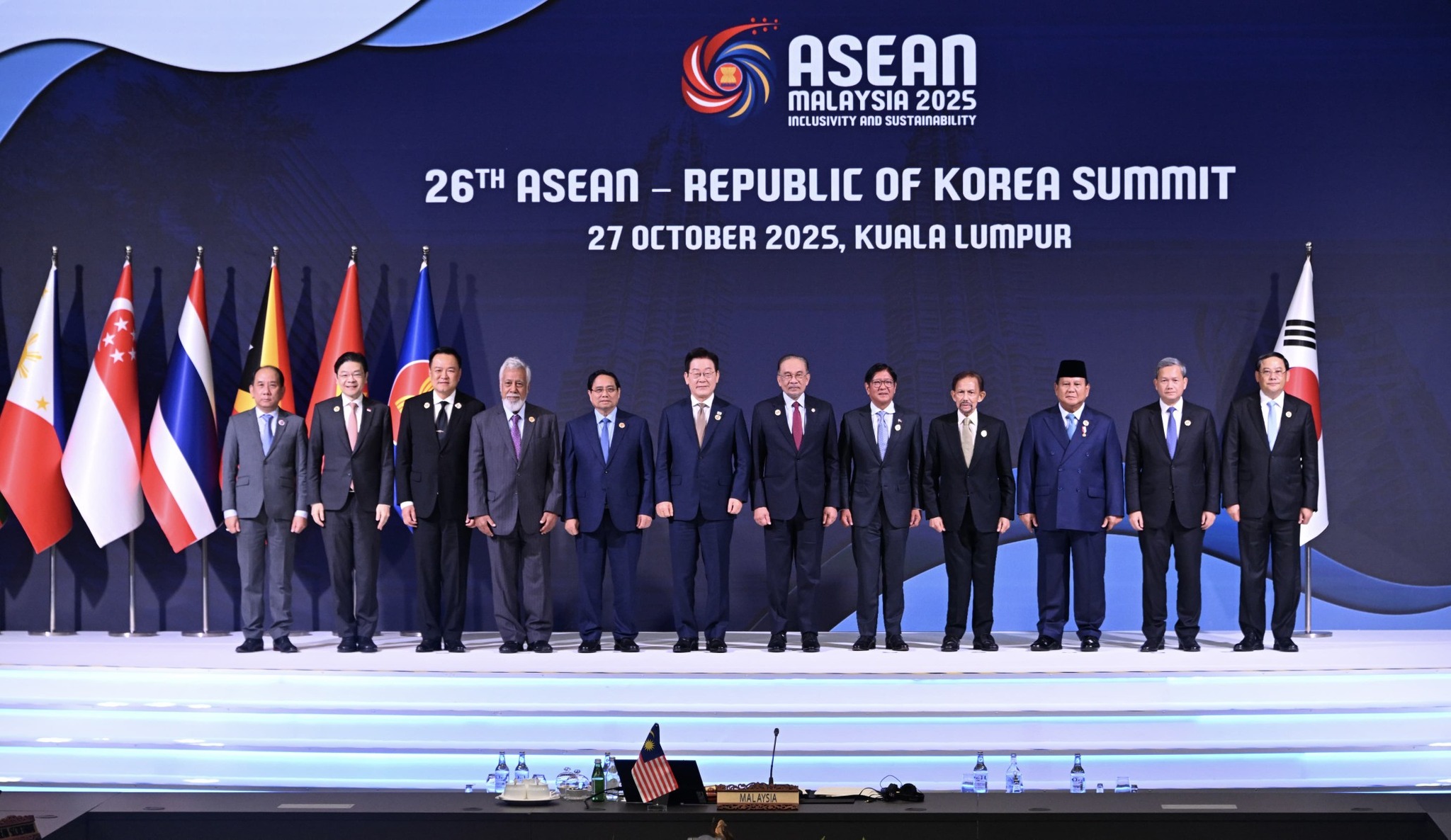
In December 2022, then South Korean President Yoon Suk Yeol unveiled Seoul’s Indo-Pacific Strategy, emphasising the need for a “free, peaceful and prosperous Indo-Pacific region”, including solidarity and cooperation with major countries and ASEAN. In 2024, Seoul elevated ties with ASEAN to a comprehensive strategic partnership, and as of 2025, South Korea is ASEAN’s second largest trading partner after China. Notwithstanding the change of administration in Seoul, these positive relations with ASEAN look to continue. During the October 2025 ROK-ASEAN Summit in Kuala Lumpur, President Lee Jae-myung outlined a vision of cooperation between Seoul and Southeast Asia in which South Korea was positioned as a “contributor”, “springboard” and “partner” for ASEAN.
All these developments raise the question of whether the coming years will see closer ties and strategic relations between South Korea and Southeast Asia. Based on my fieldwork conducted in Seoul between September and October 2025, the majority of the academics, public intellectuals, public officials and graduate students whom I spoke with expressed the view that relations with the United States and China still occupied pride of place in South Korea’s foreign policy. At the same time, most also acknowledged that greater cooperation with Southeast Asia was necessary to ensure that Seoul was able to expand its space for manoeuvre, given the current deadlock in US-China relations.
America: Foremost and Utmost
A central feature of South Korea’s security pillar is the importance of the US-ROK alliance, which is generally considered highly central to ensuring Seoul’s security and prosperity. In fact, all of the people I spoke to remained supportive of the alliance relationship notwithstanding some personal misgivings over the tariff policies of President Donald Trump. Some of my interviewees told me that “Trump is Trump, America is America; America is not Trump”, suggesting that in their minds, whatever the policies of the Trump administration, they ought not to be viewed as synonymous with broader US-ROK ties. In other words, the alliance relationship would survive whatever challenges posed by the current administration and it was built upon deeper, more strategic calculations. One scholar observed that given that the US-ROK alliance was not built on trade, it would also “not be unmade because of trade”.
Another observation was that the general population supports the United States, believing that the US force presence was important to safeguard the security and prosperity of South Korea. According to a survey conducted in March 2025 by the Seoul-based ASAN Institute for Policy Studies, South Korean views of the United States improved to a record high compared to previous years: the survey showed that 74.2% viewed the United States as the most important country for South Korea’s economy, 85.8% considered the United States the country’s preferred future partner, and 71.2% supported maintaining current US troop levels. Admittedly the survey was done before Trump’s “liberation day” tariffs (and current sentiments may be less favourable), yet the figures reaffirm the bipartisan consensus about the centrality of the United States to South Korea’s security and prosperity. Hence, in the absence of any fundamental shift in the alliance relationship, Seoul’s foreign policy is largely related to Washington’s strategic calculations towards the region. For instance, deteriorating US-China relations will make it more challenging for South Korea as Washington would naturally expect Seoul to take a more explicit position against Beijing in support of American interests.
China: Coercion and Capitulation
A second observation I made was the strong anti-Chinese sentiment pervading South Korean society. Regular protests against the Chinese Communist Party (CCP) took place every weekend in central Seoul, as many South Koreans took to the streets to express anger against what they viewed as the current administration’s unwillingness to stand up to Communist forces. While such protests reflected continuity from popular support for Yoon’s declaration of martial law on grounds that the country was facing security threats from communist elements (from North Korea and China), my conversations with intellectuals and policymakers also reflected the fact that China was not well liked in South Korea as a whole. The same ASAN survey also revealed a downward trend in Seoul’s perceptions of China since 2015, when it was ranked behind the United States (and ahead of Japan) as most favoured country to being now on the same level as Russia (and only slightly ahead of North Korea). This negative perception was attributed to three main reasons: (i) Beijing’s economic sanctions against Seoul in 2016 following the planned deployment of US THAAD missiles to South Korea; (ii) Beijing’s ongoing support for North Korea (evinced by North Korean leader Kim Jong-un’s front-page photo with President Xi Jinping and Russian President Vladimir Putin during China’s 2025 Victory Day parade) and (iii) accusations that Beijing was undermining South Korean culture and tradition by claiming that South Korean products like the hanbok and kimchi were of Chinese origin.
Taken together, all these grievances suggest a deep-rooted anxiety and unhappiness over Beijing’s policies. Comparing both the United States and China, Korean interviewees told me that the United States was straightforward in its application of economic tools (as evidenced by its sanctions on Russia) while China was more “coercive” and manipulative in its use of sanctions. In this respect, Beijing’s accusation that Washington was weaponising the economy through its tariff war for political reasons sounded hollow given Beijing’s own economic sanctions against Seoul over the THAAD missile issue.
Southeast Asia: Steady but not Spectacular
On Southeast Asia, South Korean assessments remain largely positive, yet at the same time mostly non-spectacular. During a conference that I attended, which involved participation from 10 Southeast Asian countries, several participants made mention of the region’s “steady” and “steadfast”, but not entirely memorable, support for South Korea. Indeed, a closer reading of Seoul’s relations with Southeast Asia is not inconsistent with such an assessment. Several eminent scholars of South Korea-Southeast Asia relations have observed that while Seoul represents an actor of relative importance in ASEAN’s regional network, ultimately it is not more crucial than the association’s other dialogue partners. This is not for a lack of want as South Korean leaders across both administrations have recognised the value of ASEAN in Seoul’s foreign relations. South Korean diplomats I spoke to often said that South Korea’s engagement policy with ASEAN has remained consistent through various administrations despite being branded differently by each new administration. Due to the polarised domestic political environment in South Korea, new presidents who are only granted a single term tend to “leave an indelible personal mark” to distinguish their administration through key policy initiatives. Issues such as the South China Sea issue – which matter greatly to Southeast Asia – are not likely to be surfaced by Seoul given that it has enough on its plate within Northeast Asia to be worried about. This means that South Korea’s relationship with the region, in the coming years, is likely to be characterised more by a steady-state situation than by anything spectacular or politically decisive.
Conclusion
While the Trump-Xi meeting on the sidelines of the APEC meeting on 30 October may have placed some kind of temporary truce in the US-China competition, it is unlikely to change in any substantial way the manner to which both countries continue to eye one another. Like most Southeast Asian countries, South Korea finds itself having to hedge its bets and ensure that it gets the best deal out of the current situation. In this respect, sustaining strong relations with Southeast Asia would create more manoeuvring room for Seoul to act in its own interests amid great power rivalry and to safeguard the future of both Southeast Asia and Northeast Asia.
Benjamin Ho is an Assistant Professor in the China Programme, Institute of Defence and Strategic Studies (IDSS), S. Rajaratnam School of International Studies (RSIS). He teaches a course on Northeast Asia International Relations in the RSIS Masters programme. He spent two months in Seoul (September–October 2025) on an ASEAN-ROK fellowship.
KEY TAKEAWAYS
• The United States is now viewed more cautiously in Seoul though the ROK-US alliance is still seen as a foundational cornerstone of Seoul’s security posture.
• South Koreans view Chinese assertiveness primarily through the lens of domestic stability, including that of the Korean peninsula, where the threat posed by North Korea remains serious.
• While Seoul’s relations with Southeast Asia as a whole have strengthened, in Southeast Asia the relationship is viewed as steady and steadfast but not spectacular.
COMMENTARY
In December 2022, then South Korean President Yoon Suk Yeol unveiled Seoul’s Indo-Pacific Strategy, emphasising the need for a “free, peaceful and prosperous Indo-Pacific region”, including solidarity and cooperation with major countries and ASEAN. In 2024, Seoul elevated ties with ASEAN to a comprehensive strategic partnership, and as of 2025, South Korea is ASEAN’s second largest trading partner after China. Notwithstanding the change of administration in Seoul, these positive relations with ASEAN look to continue. During the October 2025 ROK-ASEAN Summit in Kuala Lumpur, President Lee Jae-myung outlined a vision of cooperation between Seoul and Southeast Asia in which South Korea was positioned as a “contributor”, “springboard” and “partner” for ASEAN.
All these developments raise the question of whether the coming years will see closer ties and strategic relations between South Korea and Southeast Asia. Based on my fieldwork conducted in Seoul between September and October 2025, the majority of the academics, public intellectuals, public officials and graduate students whom I spoke with expressed the view that relations with the United States and China still occupied pride of place in South Korea’s foreign policy. At the same time, most also acknowledged that greater cooperation with Southeast Asia was necessary to ensure that Seoul was able to expand its space for manoeuvre, given the current deadlock in US-China relations.
America: Foremost and Utmost
A central feature of South Korea’s security pillar is the importance of the US-ROK alliance, which is generally considered highly central to ensuring Seoul’s security and prosperity. In fact, all of the people I spoke to remained supportive of the alliance relationship notwithstanding some personal misgivings over the tariff policies of President Donald Trump. Some of my interviewees told me that “Trump is Trump, America is America; America is not Trump”, suggesting that in their minds, whatever the policies of the Trump administration, they ought not to be viewed as synonymous with broader US-ROK ties. In other words, the alliance relationship would survive whatever challenges posed by the current administration and it was built upon deeper, more strategic calculations. One scholar observed that given that the US-ROK alliance was not built on trade, it would also “not be unmade because of trade”.
Another observation was that the general population supports the United States, believing that the US force presence was important to safeguard the security and prosperity of South Korea. According to a survey conducted in March 2025 by the Seoul-based ASAN Institute for Policy Studies, South Korean views of the United States improved to a record high compared to previous years: the survey showed that 74.2% viewed the United States as the most important country for South Korea’s economy, 85.8% considered the United States the country’s preferred future partner, and 71.2% supported maintaining current US troop levels. Admittedly the survey was done before Trump’s “liberation day” tariffs (and current sentiments may be less favourable), yet the figures reaffirm the bipartisan consensus about the centrality of the United States to South Korea’s security and prosperity. Hence, in the absence of any fundamental shift in the alliance relationship, Seoul’s foreign policy is largely related to Washington’s strategic calculations towards the region. For instance, deteriorating US-China relations will make it more challenging for South Korea as Washington would naturally expect Seoul to take a more explicit position against Beijing in support of American interests.
China: Coercion and Capitulation
A second observation I made was the strong anti-Chinese sentiment pervading South Korean society. Regular protests against the Chinese Communist Party (CCP) took place every weekend in central Seoul, as many South Koreans took to the streets to express anger against what they viewed as the current administration’s unwillingness to stand up to Communist forces. While such protests reflected continuity from popular support for Yoon’s declaration of martial law on grounds that the country was facing security threats from communist elements (from North Korea and China), my conversations with intellectuals and policymakers also reflected the fact that China was not well liked in South Korea as a whole. The same ASAN survey also revealed a downward trend in Seoul’s perceptions of China since 2015, when it was ranked behind the United States (and ahead of Japan) as most favoured country to being now on the same level as Russia (and only slightly ahead of North Korea). This negative perception was attributed to three main reasons: (i) Beijing’s economic sanctions against Seoul in 2016 following the planned deployment of US THAAD missiles to South Korea; (ii) Beijing’s ongoing support for North Korea (evinced by North Korean leader Kim Jong-un’s front-page photo with President Xi Jinping and Russian President Vladimir Putin during China’s 2025 Victory Day parade) and (iii) accusations that Beijing was undermining South Korean culture and tradition by claiming that South Korean products like the hanbok and kimchi were of Chinese origin.
Taken together, all these grievances suggest a deep-rooted anxiety and unhappiness over Beijing’s policies. Comparing both the United States and China, Korean interviewees told me that the United States was straightforward in its application of economic tools (as evidenced by its sanctions on Russia) while China was more “coercive” and manipulative in its use of sanctions. In this respect, Beijing’s accusation that Washington was weaponising the economy through its tariff war for political reasons sounded hollow given Beijing’s own economic sanctions against Seoul over the THAAD missile issue.
Southeast Asia: Steady but not Spectacular
On Southeast Asia, South Korean assessments remain largely positive, yet at the same time mostly non-spectacular. During a conference that I attended, which involved participation from 10 Southeast Asian countries, several participants made mention of the region’s “steady” and “steadfast”, but not entirely memorable, support for South Korea. Indeed, a closer reading of Seoul’s relations with Southeast Asia is not inconsistent with such an assessment. Several eminent scholars of South Korea-Southeast Asia relations have observed that while Seoul represents an actor of relative importance in ASEAN’s regional network, ultimately it is not more crucial than the association’s other dialogue partners. This is not for a lack of want as South Korean leaders across both administrations have recognised the value of ASEAN in Seoul’s foreign relations. South Korean diplomats I spoke to often said that South Korea’s engagement policy with ASEAN has remained consistent through various administrations despite being branded differently by each new administration. Due to the polarised domestic political environment in South Korea, new presidents who are only granted a single term tend to “leave an indelible personal mark” to distinguish their administration through key policy initiatives. Issues such as the South China Sea issue – which matter greatly to Southeast Asia – are not likely to be surfaced by Seoul given that it has enough on its plate within Northeast Asia to be worried about. This means that South Korea’s relationship with the region, in the coming years, is likely to be characterised more by a steady-state situation than by anything spectacular or politically decisive.
Conclusion
While the Trump-Xi meeting on the sidelines of the APEC meeting on 30 October may have placed some kind of temporary truce in the US-China competition, it is unlikely to change in any substantial way the manner to which both countries continue to eye one another. Like most Southeast Asian countries, South Korea finds itself having to hedge its bets and ensure that it gets the best deal out of the current situation. In this respect, sustaining strong relations with Southeast Asia would create more manoeuvring room for Seoul to act in its own interests amid great power rivalry and to safeguard the future of both Southeast Asia and Northeast Asia.
Benjamin Ho is an Assistant Professor in the China Programme, Institute of Defence and Strategic Studies (IDSS), S. Rajaratnam School of International Studies (RSIS). He teaches a course on Northeast Asia International Relations in the RSIS Masters programme. He spent two months in Seoul (September–October 2025) on an ASEAN-ROK fellowship.