


09 December 2025
IP25115 | No Peace Without Pause: Why Ceasefires Must Precede Negotiation in Ukraine

KEY TAKEAWAYS
• The Korean War experience holds important lessons for current efforts to end the Ukraine-Russia war: ceasefires change both the psychology and the politics of wartime negotiation.
• When negotiating during active fire, even modest concessions may be seen as conceding what soldiers are defending at high cost.
• When a ceasefire is in place, however, leaders are better able to consider a wider range of outcomes and trade-offs without each step being judged against the latest loss on the battlefield.
COMMENTARY
Ceasefires do more than halt bullets. They reset the mental frames through which leaders and publics interpret concessions. This observation has gained renewed relevance as diplomatic activity intensifies around the Ukraine-Russia war. On 2 December 2025, Russian President Vladimir Putin met for several hours in the Kremlin with US envoys Steve Witkoff and Jared Kushner to discuss a revised American proposal to end the conflict. Russian officials later suggested that recent battlefield gains had strengthened Moscow’s hand, particularly around contested areas like Pokrovsk.
At the same time, Ukrainian President Volodymyr Zelensky has turned to Europe to secure support and to signal that Ukraine must be present in any talks about its future. European foreign ministers have reacted cautiously to Moscow’s signals. Estonia’s Margus Tsahkna has argued that Putin is “pushing more aggressively on the battlefield” and “doesn’t want to have any kind of peace”, while Finland’s Elina Valtonen has stressed that “the best confidence-building measure would be to start with a full ceasefire”. Her point raises a practical issue: how does a ceasefire change the ways in which negotiations proceed?
Why Ceasefires Enable Real Negotiation
Negotiations held during active fighting are often shaped by the most recent battle rather than by longer-term political calculations. Under fire, leaders evaluate proposals through the lens of immediate losses and gains. Prospect theory, a psychological account of decision-making under risk, shows that actors generally weigh losses more heavily than equivalent gains. In wartime, this means that even modest concessions can be framed as conceding what soldiers are currently defending at high cost. A ceasefire changes the reference point. It removes the sense of an imminent loss on the battlefield and lowers the domestic pressure on leaders to reject compromise in order to appear resolute.
A pause also affects how options are processed. Stress research suggests that when individuals appraise situations as acute threats, their attention narrows and zero-sum thinking becomes more likely. When immediate danger is reduced, people are better able to consider a wider range of outcomes and trade-offs. In political terms, a ceasefire does not make compromise easy, but it makes it thinkable: leaders can explore alternatives without each step being judged against the last artillery exchange.
The Korean War in the 1950s illustrates how these mechanisms interact. Early armistice contacts took place while each side still believed that further movement along the front might improve their position. Large-scale offensives in 1950 and early 1951 carried heavy casualties, yet commanders on both sides continued to test the line. By mid-1951, however, the front had largely stabilised near the 38th parallel. Major manoeuvre operations had failed to produce decisive gains, and the expectation of further breakthroughs declined. The military situation became one of attrition rather than movement.
That stabilisation changed the bargaining environment. With little realistic prospect of altering the line significantly through force, the perceived “loss” involved in accepting a settlement close to the status quo diminished. Negotiations at Kaesong and later Panmunjom became more substantive once both sides understood that the front was unlikely to shift far. When the armistice was finally signed in July 1953, the line of control closely matched the stabilised front of 1951. The ceasefire did not solve all political problems, but it removed the distortion created by ongoing attempts to change facts on the ground.
Lessons for the Ukraine-Russia War
The same tension between battlefield movement and negotiation is visible in Ukraine today, though under very different political conditions. Russian forces have made incremental advances along sections of the eastern front, including around Pokrovsk and Kupiansk. Russia claims these gains have improved its position in talks with US envoys, while Ukraine disputes some of the territorial claims and continues to contest key areas. The result is a fluid front line at the very moment when diplomatic initiatives are being explored.
This situation creates two risks. First, every local advance risks becoming political currency. If negotiations proceed while the front remains in motion, there is a danger that the eventual shape of a settlement will reflect the latest episode of fighting rather than a considered political compromise. Second, concessions become harder to defend domestically. As long as Russian forces keep gaining ground, any Ukrainian territorial concession risks being seen as validating those gains.
A ceasefire-first sequence would address both problems. Militarily, freezing the lines would prevent further accumulation of bargaining chips while talks are under way. Politically and psychologically, it would reduce the sense of immediate loss and make it easier for Ukrainian and Russian leaders alike to explain any concessions to their respective constituencies. For Ukraine and its European partners, it would also align practice with stated principles: that no agreement should legitimise conquest and that Ukraine must participate directly in decisions about its territory.
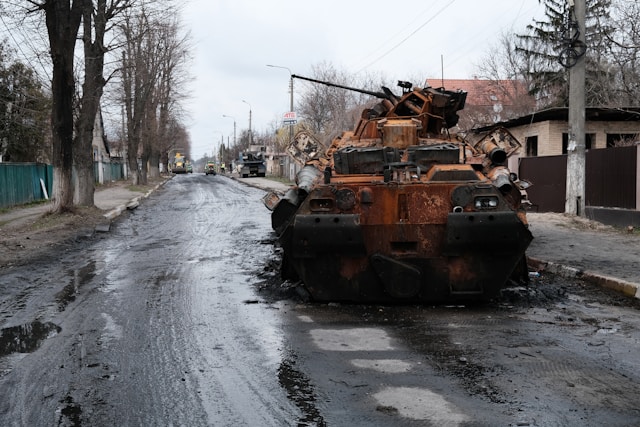
The Korean armistice process showed that negotiations became more productive only after the battlefield had effectively frozen. Ukraine today risks the reverse: political movement without a corresponding military pause. A ceasefire will not, by itself, resolve the fundamental disputes over territory, security guarantees or reconstruction. It would, however, reduce the distortions created by fighting during talks and give all parties a more stable basis on which to test possible arrangements.
Wendy He is a Research Fellow with the Military Studies Programme, S. Rajaratnam School of International Studies (RSIS), a Hans J. Morgenthau Fellow in Grand Strategy at the Notre Dame International Security Center (2024–25), and an incoming Global Encounters Fellow at the University of Tübingen’s College of Fellows (2026–27). Her research examines how leader–adviser dynamics and psychological mechanisms shape judgements of threat credibility, with a focus on US–China relations and war decision-making.
KEY TAKEAWAYS
• The Korean War experience holds important lessons for current efforts to end the Ukraine-Russia war: ceasefires change both the psychology and the politics of wartime negotiation.
• When negotiating during active fire, even modest concessions may be seen as conceding what soldiers are defending at high cost.
• When a ceasefire is in place, however, leaders are better able to consider a wider range of outcomes and trade-offs without each step being judged against the latest loss on the battlefield.
COMMENTARY
Ceasefires do more than halt bullets. They reset the mental frames through which leaders and publics interpret concessions. This observation has gained renewed relevance as diplomatic activity intensifies around the Ukraine-Russia war. On 2 December 2025, Russian President Vladimir Putin met for several hours in the Kremlin with US envoys Steve Witkoff and Jared Kushner to discuss a revised American proposal to end the conflict. Russian officials later suggested that recent battlefield gains had strengthened Moscow’s hand, particularly around contested areas like Pokrovsk.
At the same time, Ukrainian President Volodymyr Zelensky has turned to Europe to secure support and to signal that Ukraine must be present in any talks about its future. European foreign ministers have reacted cautiously to Moscow’s signals. Estonia’s Margus Tsahkna has argued that Putin is “pushing more aggressively on the battlefield” and “doesn’t want to have any kind of peace”, while Finland’s Elina Valtonen has stressed that “the best confidence-building measure would be to start with a full ceasefire”. Her point raises a practical issue: how does a ceasefire change the ways in which negotiations proceed?
Why Ceasefires Enable Real Negotiation
Negotiations held during active fighting are often shaped by the most recent battle rather than by longer-term political calculations. Under fire, leaders evaluate proposals through the lens of immediate losses and gains. Prospect theory, a psychological account of decision-making under risk, shows that actors generally weigh losses more heavily than equivalent gains. In wartime, this means that even modest concessions can be framed as conceding what soldiers are currently defending at high cost. A ceasefire changes the reference point. It removes the sense of an imminent loss on the battlefield and lowers the domestic pressure on leaders to reject compromise in order to appear resolute.
A pause also affects how options are processed. Stress research suggests that when individuals appraise situations as acute threats, their attention narrows and zero-sum thinking becomes more likely. When immediate danger is reduced, people are better able to consider a wider range of outcomes and trade-offs. In political terms, a ceasefire does not make compromise easy, but it makes it thinkable: leaders can explore alternatives without each step being judged against the last artillery exchange.
The Korean War in the 1950s illustrates how these mechanisms interact. Early armistice contacts took place while each side still believed that further movement along the front might improve their position. Large-scale offensives in 1950 and early 1951 carried heavy casualties, yet commanders on both sides continued to test the line. By mid-1951, however, the front had largely stabilised near the 38th parallel. Major manoeuvre operations had failed to produce decisive gains, and the expectation of further breakthroughs declined. The military situation became one of attrition rather than movement.
That stabilisation changed the bargaining environment. With little realistic prospect of altering the line significantly through force, the perceived “loss” involved in accepting a settlement close to the status quo diminished. Negotiations at Kaesong and later Panmunjom became more substantive once both sides understood that the front was unlikely to shift far. When the armistice was finally signed in July 1953, the line of control closely matched the stabilised front of 1951. The ceasefire did not solve all political problems, but it removed the distortion created by ongoing attempts to change facts on the ground.
Lessons for the Ukraine-Russia War
The same tension between battlefield movement and negotiation is visible in Ukraine today, though under very different political conditions. Russian forces have made incremental advances along sections of the eastern front, including around Pokrovsk and Kupiansk. Russia claims these gains have improved its position in talks with US envoys, while Ukraine disputes some of the territorial claims and continues to contest key areas. The result is a fluid front line at the very moment when diplomatic initiatives are being explored.
This situation creates two risks. First, every local advance risks becoming political currency. If negotiations proceed while the front remains in motion, there is a danger that the eventual shape of a settlement will reflect the latest episode of fighting rather than a considered political compromise. Second, concessions become harder to defend domestically. As long as Russian forces keep gaining ground, any Ukrainian territorial concession risks being seen as validating those gains.
A ceasefire-first sequence would address both problems. Militarily, freezing the lines would prevent further accumulation of bargaining chips while talks are under way. Politically and psychologically, it would reduce the sense of immediate loss and make it easier for Ukrainian and Russian leaders alike to explain any concessions to their respective constituencies. For Ukraine and its European partners, it would also align practice with stated principles: that no agreement should legitimise conquest and that Ukraine must participate directly in decisions about its territory.
The Korean armistice process showed that negotiations became more productive only after the battlefield had effectively frozen. Ukraine today risks the reverse: political movement without a corresponding military pause. A ceasefire will not, by itself, resolve the fundamental disputes over territory, security guarantees or reconstruction. It would, however, reduce the distortions created by fighting during talks and give all parties a more stable basis on which to test possible arrangements.
Wendy He is a Research Fellow with the Military Studies Programme, S. Rajaratnam School of International Studies (RSIS), a Hans J. Morgenthau Fellow in Grand Strategy at the Notre Dame International Security Center (2024–25), and an incoming Global Encounters Fellow at the University of Tübingen’s College of Fellows (2026–27). Her research examines how leader–adviser dynamics and psychological mechanisms shape judgements of threat credibility, with a focus on US–China relations and war decision-making.