


10 December 2025

IP25118 | Brunei–France Relations: A Bilateral Reset Grounded in Defence Cooperation

KEY TAKEAWAYS
• Relations between Brunei and France, historically shaped by hydrocarbon cooperation and TotalEnergies’ long-standing presence, entered a period of uncertainty when the French company exited the Sultanate in 2024.
• However, the bilateral partnership is undergoing a revival, with defence cooperation emerging as the cornerstone of the relationship.
• Recent French naval and air visits to Brunei underscore this renewed momentum.
COMMENTARY
Established in 1984, relations between France and Brunei are modest but meaningful. France is one of only three European countries – alongside Germany and the United Kingdom – with an embassy in the Sultanate. For decades, the bilateral relationship was strongly marked by the presence of TotalEnergies, a French multinational oil company, operating in Brunei since 1987 and employing several dozen staff, contributing to the development of a wider economic ecosystem. Its departure in 2024 could have left a vacuum, but political ties have instead gained new traction. In that same year, Brunei and France celebrated the 40th anniversary of diplomatic relations, with Brunei signalling its intention to broaden the cooperation and gradually elevate it to a strategic partnership.
Political Momentum
Indeed, bilateral political relations have strengthened in recent years. In 2023, the Sultan of Brunei travelled to France – his first official visit in 15 years – and met with French President Emmanuel Macron. The two heads of state agreed on the need to revive and deepen bilateral relations, establishing a regular strategic dialogue and exploring new areas of cooperation. In line with its Indo-Pacific strategy, Paris seeks to demonstrate its renewed commitment to the Southeast Asian region and reinforce its ties with ASEAN countries. Accordingly, the French president visited three Southeast Asian countries (Indonesia, Singapore and Vietnam) in 2025, and another regional tour is expected in 2026 for the Francophonie Summit in Cambodia.
France and Brunei share converging interests in the region. Both promote a multilateral approach to upholding an international order based on the rule of law. They reject bloc-based rivalries and support strategic autonomy for both EU and ASEAN countries. They also insist on the equal respect for national sovereignties – essential conditions for a stable, free and open Indo-Pacific.
Building on these shared principles, France’s status as an ASEAN Development Partner and its sovereign presence in the Indian and Pacific Oceans create opportunities for targeted cooperation in domains such as port development, climate resilience and sustainable agriculture – sectors where France offers relevant expertise.
But above all, it is in the defence sector that the relationship has deepened most significantly.
Defence Cooperation: A Growing Pillar of the Relationship
Since 2023, defence cooperation has been marked by a dynamic sequence of interactions that reflects growing mutual confidence. Brunei first participated as an observer in the 2023 edition of Exercise Croix du Sud, a French-led multilateral humanitarian assistance and disaster rescue (HADR) exercise held every two years in New Caledonia. The 2023 edition gathered together 19 nations, 3,000 soldiers, 10 vessels and 15 aircraft.
In the same year, the admiral commanding all French forces in the Pacific (ALPACI) visited Brunei and was received by the highest authorities, including the Sultan himself – underscoring Brunei’s recognition of France as a serious and enduring security partner in the region.
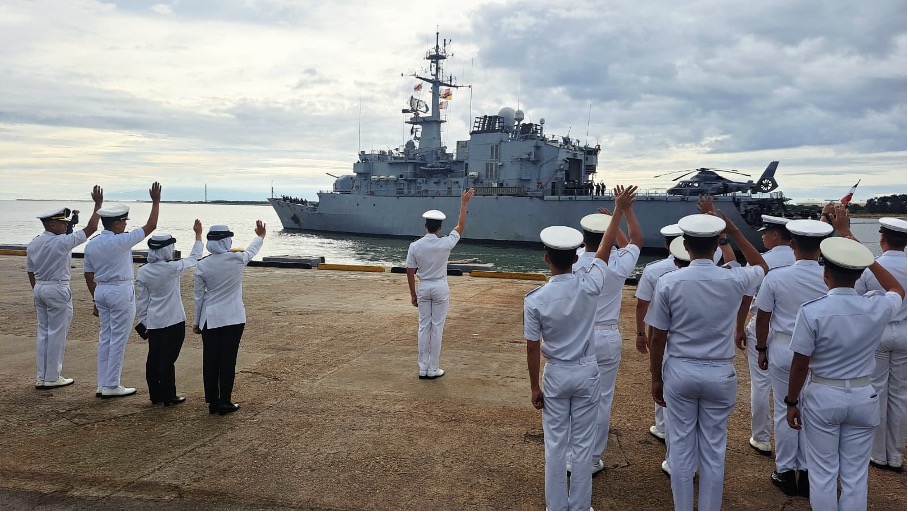
Since then, Brunei has emerged as a reliable transit point for French deployments in the Indo-Pacific. French aircraft – the Falcon 200 and the Falcon 50M – conducted stopovers in the Sultanate in 2023 and in 2025, while the frigates Vendémiaire and Prairial carried out port calls in 2024 and 2025, respectively. On land, cooperation continues through limited but regular jungle-warfare training activities at the British Army Jungle Warfare Training School located in Brunei, adding further depth to this steadily expanding defence relationship.
Brunei is also a long-standing customer of French defence equipment. Its acquisitions include Exocet anti-ship missiles, Mistral surface-to-air missiles, unmanned underwater vehicles, VAB armoured vehicles, as well as material from European group Airbus (partially French), such as four Casa C-295 transport aircraft and six H145 helicopters.
Brunei’s Diversification Strategy
France’s recent pivot to Southeast Asia presents a significant strategic opportunity for Brunei as it quietly expands its relations beyond its traditional, like-minded partners. Brunei’s security relations with the United Kingdom have been the strategic anchor since the Treaty of Friendship in 1979, with a permanent British garrison stationed in the country, as well as regular military exercises between the two states. With its advisory links and access to world-class military education, the United Kingdom has served Brunei well, providing the Sultanate with a small but well-trained military of high professionalism.
As such, expanding its defence relations with other European middle powers such as France is a natural step for the small Sultanate. As the geostrategic space in the Indo-Pacific has widened, it is also becoming increasingly congested, with less room to manoeuvre, especially as the geopolitical rivalry between the United States and China continues to unravel. On balance, Paris’s strategy on the Indo-Pacific complements Brunei’s strategic preference for the ASEAN Outlook on the Indo-Pacific (AOIP), which emphasises openness, inclusivity and transparency. Equally important is that strengthening relations with France offers a strategic network that is less contentious without signalling that Brunei is picking sides.
Avenues for Further Cooperation
Brunei’s armed forces place a strong emphasis on combating illegal fishing and the illicit exploitation of rare timber species, two priority areas in which French forces have experience and are well positioned to provide operational, technical and technological support.
Additional promising areas for deepened cooperation include cybersecurity, climate-related security challenges, expanded jungle-warfare training, enhanced maritime domain awareness, satellite-based maritime and environmental surveillance solutions, as well as an unmanned underwater vehicle system.
The forthcoming ASEAN Centre for Climate Change will be hosted in Bandar Seri Begawan. This provides Brunei and France, particularly in light of the latter’s Climate & Defence Strategy, with an excellent opportunity to launch a sustained bilateral dialogue on the growing nexus between climate change and security – an issue of increasing strategic importance to both nations.
Overall, the strengthening Franco-Bruneian relationship can act as a catalyst for broader EU-ASEAN cooperation, helping to unlock the full potential of collaboration between Southeast Asia’s 700 million citizens and Europe’s 450 million. Conveniently, Brunei occupies a pivotal position in this evolving regional architecture, serving as coordinator for ASEAN-EU Dialogue Relations from 2024 to 2027.
Paco Milhiet is a Visiting Fellow with the South Asia Programme at the S. Rajaratnam School of International Studies (RSIS). Hafiizh Hashim is an Assistant Lecturer at the Academy of Brunei Studies, University of Brunei Darussalam.
KEY TAKEAWAYS
• Relations between Brunei and France, historically shaped by hydrocarbon cooperation and TotalEnergies’ long-standing presence, entered a period of uncertainty when the French company exited the Sultanate in 2024.
• However, the bilateral partnership is undergoing a revival, with defence cooperation emerging as the cornerstone of the relationship.
• Recent French naval and air visits to Brunei underscore this renewed momentum.
COMMENTARY
Established in 1984, relations between France and Brunei are modest but meaningful. France is one of only three European countries – alongside Germany and the United Kingdom – with an embassy in the Sultanate. For decades, the bilateral relationship was strongly marked by the presence of TotalEnergies, a French multinational oil company, operating in Brunei since 1987 and employing several dozen staff, contributing to the development of a wider economic ecosystem. Its departure in 2024 could have left a vacuum, but political ties have instead gained new traction. In that same year, Brunei and France celebrated the 40th anniversary of diplomatic relations, with Brunei signalling its intention to broaden the cooperation and gradually elevate it to a strategic partnership.
Political Momentum
Indeed, bilateral political relations have strengthened in recent years. In 2023, the Sultan of Brunei travelled to France – his first official visit in 15 years – and met with French President Emmanuel Macron. The two heads of state agreed on the need to revive and deepen bilateral relations, establishing a regular strategic dialogue and exploring new areas of cooperation. In line with its Indo-Pacific strategy, Paris seeks to demonstrate its renewed commitment to the Southeast Asian region and reinforce its ties with ASEAN countries. Accordingly, the French president visited three Southeast Asian countries (Indonesia, Singapore and Vietnam) in 2025, and another regional tour is expected in 2026 for the Francophonie Summit in Cambodia.
France and Brunei share converging interests in the region. Both promote a multilateral approach to upholding an international order based on the rule of law. They reject bloc-based rivalries and support strategic autonomy for both EU and ASEAN countries. They also insist on the equal respect for national sovereignties – essential conditions for a stable, free and open Indo-Pacific.
Building on these shared principles, France’s status as an ASEAN Development Partner and its sovereign presence in the Indian and Pacific Oceans create opportunities for targeted cooperation in domains such as port development, climate resilience and sustainable agriculture – sectors where France offers relevant expertise.
But above all, it is in the defence sector that the relationship has deepened most significantly.
Defence Cooperation: A Growing Pillar of the Relationship
Since 2023, defence cooperation has been marked by a dynamic sequence of interactions that reflects growing mutual confidence. Brunei first participated as an observer in the 2023 edition of Exercise Croix du Sud, a French-led multilateral humanitarian assistance and disaster rescue (HADR) exercise held every two years in New Caledonia. The 2023 edition gathered together 19 nations, 3,000 soldiers, 10 vessels and 15 aircraft.
In the same year, the admiral commanding all French forces in the Pacific (ALPACI) visited Brunei and was received by the highest authorities, including the Sultan himself – underscoring Brunei’s recognition of France as a serious and enduring security partner in the region.
Since then, Brunei has emerged as a reliable transit point for French deployments in the Indo-Pacific. French aircraft – the Falcon 200 and the Falcon 50M – conducted stopovers in the Sultanate in 2023 and in 2025, while the frigates Vendémiaire and Prairial carried out port calls in 2024 and 2025, respectively. On land, cooperation continues through limited but regular jungle-warfare training activities at the British Army Jungle Warfare Training School located in Brunei, adding further depth to this steadily expanding defence relationship.
Brunei is also a long-standing customer of French defence equipment. Its acquisitions include Exocet anti-ship missiles, Mistral surface-to-air missiles, unmanned underwater vehicles, VAB armoured vehicles, as well as material from European group Airbus (partially French), such as four Casa C-295 transport aircraft and six H145 helicopters.
Brunei’s Diversification Strategy
France’s recent pivot to Southeast Asia presents a significant strategic opportunity for Brunei as it quietly expands its relations beyond its traditional, like-minded partners. Brunei’s security relations with the United Kingdom have been the strategic anchor since the Treaty of Friendship in 1979, with a permanent British garrison stationed in the country, as well as regular military exercises between the two states. With its advisory links and access to world-class military education, the United Kingdom has served Brunei well, providing the Sultanate with a small but well-trained military of high professionalism.
As such, expanding its defence relations with other European middle powers such as France is a natural step for the small Sultanate. As the geostrategic space in the Indo-Pacific has widened, it is also becoming increasingly congested, with less room to manoeuvre, especially as the geopolitical rivalry between the United States and China continues to unravel. On balance, Paris’s strategy on the Indo-Pacific complements Brunei’s strategic preference for the ASEAN Outlook on the Indo-Pacific (AOIP), which emphasises openness, inclusivity and transparency. Equally important is that strengthening relations with France offers a strategic network that is less contentious without signalling that Brunei is picking sides.
Avenues for Further Cooperation
Brunei’s armed forces place a strong emphasis on combating illegal fishing and the illicit exploitation of rare timber species, two priority areas in which French forces have experience and are well positioned to provide operational, technical and technological support.
Additional promising areas for deepened cooperation include cybersecurity, climate-related security challenges, expanded jungle-warfare training, enhanced maritime domain awareness, satellite-based maritime and environmental surveillance solutions, as well as an unmanned underwater vehicle system.
The forthcoming ASEAN Centre for Climate Change will be hosted in Bandar Seri Begawan. This provides Brunei and France, particularly in light of the latter’s Climate & Defence Strategy, with an excellent opportunity to launch a sustained bilateral dialogue on the growing nexus between climate change and security – an issue of increasing strategic importance to both nations.
Overall, the strengthening Franco-Bruneian relationship can act as a catalyst for broader EU-ASEAN cooperation, helping to unlock the full potential of collaboration between Southeast Asia’s 700 million citizens and Europe’s 450 million. Conveniently, Brunei occupies a pivotal position in this evolving regional architecture, serving as coordinator for ASEAN-EU Dialogue Relations from 2024 to 2027.
Paco Milhiet is a Visiting Fellow with the South Asia Programme at the S. Rajaratnam School of International Studies (RSIS). Hafiizh Hashim is an Assistant Lecturer at the Academy of Brunei Studies, University of Brunei Darussalam.