


12 December 2025
IP25120 | Turning Tides in the Indo-Pacific: UK and India’s Leap of Faith

KEY TAKEAWAYS
• UK–India defence ties are transitioning from symbolism to substance as political and diplomatic outreach is being reinforced by meaningful strategic cooperation, marked by several agreements concluded during UK Prime Minister Keir Starmer’s recent visit to India.
• The evolving relationship is anchored in the Indo-Pacific, where converging interests create a theatre-specific security alignment that boosts London’s relevance and gives New Delhi a key partner without the constraints of a formal alliance.
• Military cooperation and emerging technologies are surfacing as key drivers, with both sides exploring joint R&D and shared tech ecosystems that reinforce long-term strategic trust.
COMMENTARY
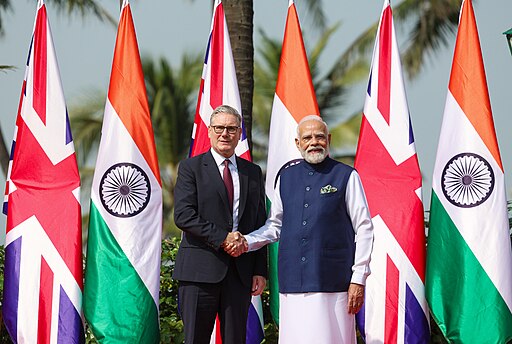
From 8 to 9 October, UK Prime Minister Keir Starmer led the largest-ever British delegation to India. Simultaneously, the aircraft carriers HMS Prince of Wales and INS Vikrant engaged in a combined exercise in the Indian Ocean, setting the stage for deepening ties. Notably, Starmer’s visit came in quick succession of Indian Prime Minister Narendra Modi’s July 2025 visit to London and accelerated the political momentum for an enhanced strategic partnership. Starmer’s two-day visit marked a milestone, with notable advances in defence that arguably signal a strategic pivot, placing the United Kingdom firmly in the Indo-Pacific landscape. These advances indicate the realisation of a closer UK–India strategic relationship, which had been identified as a key element of the United Kingdom’s “Indo-Pacific tilt”, first espoused in the Integrated Review of 2021 and reiterated in the subsequent Strategic Defence Review this year.
Starmer’s visit reflects both sides moving beyond the traditional facets of the relationship, such as trade, immigration and culture, and overcoming historical inhibitions like the United Kingdom’s position on Kashmir and India’s ties with Russia. For London, the visit represented a resolute step in its post-Brexit promise for an Indo-Pacific presence, backed by defence and technology transfers and operational commitments over white papers and press statements. A £350m deal is set to deliver lightweight multirole missiles for the Indian Army, supporting 700 jobs in the United Kingdom, while demonstrating support for a key partner in the Indo-Pacific. Meanwhile, for New Delhi, a deeper partnership with the United Kingdom serves as a hedge against over-reliance on any great power. It is in line with India’s characteristic aversion to binding alliances and has been catalysed by the unpredictable behaviour from the White House. This approach underlines modernisation to foster resilience – by facilitating access to advanced technology, robust training and new supply chains – while preserving strategic autonomy and acknowledging India’s rising ambitions as well as post-Brexit UK’s role beyond Europe.
Defence-in-depth: Operational Trust and Strategic Integration
For decades, India–UK relations were structured by habit rather than operational need, with legacy issues, trade and the global diaspora framing interactions, while strategic cooperation remained largely symbolic. Coming after the signing of a bilateral free trade agreement in July this year, Starmer’s delegation and accompanying agreements laid the foundations for an ambitious and forward-looking partnership responding to the rising technological disruptions and strategic contestation in the Indo-Pacific. For the United Kingdom, India had been hitherto viewed through the lens of a market for British defence equipment rather than a co-creator, while the overall bilateral relationship punched much below its weight. Significantly, the defence domain is no longer peripheral; the newly signed agreements and initiatives reflect a deliberate shift from rhetoric to actionable collaboration, rooted in mutual trust and a shared understanding of the strategic complexity of the Indo-Pacific.
Operational integration among the respective armed forces provides the clearest evidence of this strategic shift. For the first time, Indian Air Force instructors will embed within the Royal Air Force, signalling the United Kingdom’s confidence in India’s professional capabilities and fostering doctrinal exchange. The move suggests the emergence of deeper military ties that go beyond existing engagements such as joint exercises and professional military education networks, potentially laying the foundation for mechanisms to explore interoperability and readiness in high-end military operations. Similarly, India is now treated as a co-developer and collaborator rather than a passive buyer of defence technologies. This shift, combined with agreements on co-designed naval vessels and maritime electric propulsion, indicates an approach to purposefully synthesise British engineering heritage with Indian industrial scale to create capabilities that are globally competitive and strategically relevant.
Walking the Talk: Signalling Credibility in the Indo-Pacific?
Unsurprisingly, the United Kingdom and India, being legatees of considerable maritime history and interest, are now demonstrating signs of expanded naval cooperation. Notably, the 2021 Konkan Shakti exercise marked the first-ever tri-service engagement between the two nations, featuring the Royal Navy’s Carrier Strike Group led by HMS Queen Elizabeth and representing a turning point in bilateral military engagements. This trajectory culminated in Konkan 2025, where India’s INS Vikrant operated alongside the United Kingdom’s HMS Prince of Wales in the first dual-carrier operation between the two navies – an event that underscored technological parity, procedural compatibility and shared commitment to a free and open Indo-Pacific. The creation of a Regional Maritime Security Centre of Excellence under India’s Indo-Pacific Oceans Initiative institutionalises these exchanges, enabling the movement of personnel, information, and platforms – a prerequisite for credible deterrence in a complex maritime environment.
The Indo-Pacific’s geopolitical dynamism and strategic volatility impel maritime cooperation. Joint ISR (intelligence, surveillance, and reconnaissance) operations, data-sharing and the integration of Indian and British naval assets create the foundations for a credible deterrent posture with much potential. The two navies have already coordinated on anti-piracy missions in the Indian Ocean and Gulf of Aden, drawing lessons from India’s long-standing Operation Sankalp and the Royal Navy’s contributions to international patrols under Operation Ocean Shield. This partnership now extends beyond exercises and port calls to include doctrinal development and maritime sanctions enforcement. Bilateral efforts like Konkan 2025 and the joint carrier strike group operations have involved combined doctrine refinement and operational planning, reflecting a transition towards synergistic maritime command practices. These maritime engagements have transcended symbolism and align with broader regional frameworks such as the QUAD’s maritime coordination agenda, reinforcing readiness and interoperability against both conventional and non-traditional threats in the Indo-Pacific.
Ploughshares to Swords: Techno-Industrial Convergence and Geoeconomic Synergy
The United Kingdom’s post-Brexit foreign policy emphasis on reliable, capable partners met its match in India’s Atmanirbhar Bharat initiative, which seeks co-investment, technology transfer and capability development. Bilateral agreements from Starmer’s visit encompass AI, quantum technologies, semiconductors, secure communications and green naval propulsion, and reflect the progressive evolution of bilateral ties. Institutional structures such as the India–UK Connectivity and Innovation Centre and the Joint AI Research Centre serve as operational nodes where strategic technologies can be incubated, tested and scaled collaboratively. Further, supply chain resilience has been addressed explicitly through the Critical Minerals Processing and Downstream Collaboration Guild, anchored at India’s IIT‑ISM Dhanbad. These institutionalised mechanisms secure inputs vital to strategic industrial ecosystems. In an era of sanctions, supply chain disruptions and heightened competition for critical minerals, this initiative directly underwrites operational capability, economic security and strategic autonomy. It assumes significance as India and the United Kingdom navigate the unfolding Fourth Industrial Revolution with complementary strengths in various industrial sectors and is in turn linked to evolving geopolitical and security imperatives.
Light at the End of the Tunnel: The Way Ahead
Prime Minister Starmer’s unprecedented visit to India in October 2025 reflected a wider recognition of the Indo-Pacific as the epicentre of global politics, and the United Kingdom is eager to be an active player in this region. This desire has been demonstrated through a new strategic partnership, collaboration in innovation, and growing alignment in trade, technology and security priorities that had been first envisioned in the UK-India Roadmap 2030. London is using India as a pivot for its Indo-Pacific tilt, while New Delhi is diversifying strategic partnerships beyond historical alignments. Institutional mechanisms for monitoring, review and dispute resolution are essential for translating the strategic vision of this partnership into operational readiness. The coming decade will put this to the test, given the possibility of economic divergence, bureaucratic inertia and expectation mismanagement. Yet this moment represents a significant milestone that cannot and should not be underestimated.
Gaurav Kumar, a defence analyst based in New Delhi, is affiliated with the Courses Section at United Service Institution of India (USI) and focuses on analysing geopolitics and modern warfare, with an emphasis on India’s military strategy and defence policy. Shounak Set is a Research Fellow with the South Asia Programme at the S. Rajaratnam School of International Studies (RSIS), specialising in technology, strategy and geopolitics with a focus on South Asia and the Indo-Pacific. He is also a Fellow of the Higher Education Academy, UK. Previously, he was a Lecturer in Defence Studies at King’s College London and the UK Defence Academy and a Marie-Sklodowska Curie Fellow of the European Commission.
KEY TAKEAWAYS
• UK–India defence ties are transitioning from symbolism to substance as political and diplomatic outreach is being reinforced by meaningful strategic cooperation, marked by several agreements concluded during UK Prime Minister Keir Starmer’s recent visit to India.
• The evolving relationship is anchored in the Indo-Pacific, where converging interests create a theatre-specific security alignment that boosts London’s relevance and gives New Delhi a key partner without the constraints of a formal alliance.
• Military cooperation and emerging technologies are surfacing as key drivers, with both sides exploring joint R&D and shared tech ecosystems that reinforce long-term strategic trust.
COMMENTARY
From 8 to 9 October, UK Prime Minister Keir Starmer led the largest-ever British delegation to India. Simultaneously, the aircraft carriers HMS Prince of Wales and INS Vikrant engaged in a combined exercise in the Indian Ocean, setting the stage for deepening ties. Notably, Starmer’s visit came in quick succession of Indian Prime Minister Narendra Modi’s July 2025 visit to London and accelerated the political momentum for an enhanced strategic partnership. Starmer’s two-day visit marked a milestone, with notable advances in defence that arguably signal a strategic pivot, placing the United Kingdom firmly in the Indo-Pacific landscape. These advances indicate the realisation of a closer UK–India strategic relationship, which had been identified as a key element of the United Kingdom’s “Indo-Pacific tilt”, first espoused in the Integrated Review of 2021 and reiterated in the subsequent Strategic Defence Review this year.
Starmer’s visit reflects both sides moving beyond the traditional facets of the relationship, such as trade, immigration and culture, and overcoming historical inhibitions like the United Kingdom’s position on Kashmir and India’s ties with Russia. For London, the visit represented a resolute step in its post-Brexit promise for an Indo-Pacific presence, backed by defence and technology transfers and operational commitments over white papers and press statements. A £350m deal is set to deliver lightweight multirole missiles for the Indian Army, supporting 700 jobs in the United Kingdom, while demonstrating support for a key partner in the Indo-Pacific. Meanwhile, for New Delhi, a deeper partnership with the United Kingdom serves as a hedge against over-reliance on any great power. It is in line with India’s characteristic aversion to binding alliances and has been catalysed by the unpredictable behaviour from the White House. This approach underlines modernisation to foster resilience – by facilitating access to advanced technology, robust training and new supply chains – while preserving strategic autonomy and acknowledging India’s rising ambitions as well as post-Brexit UK’s role beyond Europe.
Defence-in-depth: Operational Trust and Strategic Integration
For decades, India–UK relations were structured by habit rather than operational need, with legacy issues, trade and the global diaspora framing interactions, while strategic cooperation remained largely symbolic. Coming after the signing of a bilateral free trade agreement in July this year, Starmer’s delegation and accompanying agreements laid the foundations for an ambitious and forward-looking partnership responding to the rising technological disruptions and strategic contestation in the Indo-Pacific. For the United Kingdom, India had been hitherto viewed through the lens of a market for British defence equipment rather than a co-creator, while the overall bilateral relationship punched much below its weight. Significantly, the defence domain is no longer peripheral; the newly signed agreements and initiatives reflect a deliberate shift from rhetoric to actionable collaboration, rooted in mutual trust and a shared understanding of the strategic complexity of the Indo-Pacific.
Operational integration among the respective armed forces provides the clearest evidence of this strategic shift. For the first time, Indian Air Force instructors will embed within the Royal Air Force, signalling the United Kingdom’s confidence in India’s professional capabilities and fostering doctrinal exchange. The move suggests the emergence of deeper military ties that go beyond existing engagements such as joint exercises and professional military education networks, potentially laying the foundation for mechanisms to explore interoperability and readiness in high-end military operations. Similarly, India is now treated as a co-developer and collaborator rather than a passive buyer of defence technologies. This shift, combined with agreements on co-designed naval vessels and maritime electric propulsion, indicates an approach to purposefully synthesise British engineering heritage with Indian industrial scale to create capabilities that are globally competitive and strategically relevant.
Walking the Talk: Signalling Credibility in the Indo-Pacific?
Unsurprisingly, the United Kingdom and India, being legatees of considerable maritime history and interest, are now demonstrating signs of expanded naval cooperation. Notably, the 2021 Konkan Shakti exercise marked the first-ever tri-service engagement between the two nations, featuring the Royal Navy’s Carrier Strike Group led by HMS Queen Elizabeth and representing a turning point in bilateral military engagements. This trajectory culminated in Konkan 2025, where India’s INS Vikrant operated alongside the United Kingdom’s HMS Prince of Wales in the first dual-carrier operation between the two navies – an event that underscored technological parity, procedural compatibility and shared commitment to a free and open Indo-Pacific. The creation of a Regional Maritime Security Centre of Excellence under India’s Indo-Pacific Oceans Initiative institutionalises these exchanges, enabling the movement of personnel, information, and platforms – a prerequisite for credible deterrence in a complex maritime environment.
The Indo-Pacific’s geopolitical dynamism and strategic volatility impel maritime cooperation. Joint ISR (intelligence, surveillance, and reconnaissance) operations, data-sharing and the integration of Indian and British naval assets create the foundations for a credible deterrent posture with much potential. The two navies have already coordinated on anti-piracy missions in the Indian Ocean and Gulf of Aden, drawing lessons from India’s long-standing Operation Sankalp and the Royal Navy’s contributions to international patrols under Operation Ocean Shield. This partnership now extends beyond exercises and port calls to include doctrinal development and maritime sanctions enforcement. Bilateral efforts like Konkan 2025 and the joint carrier strike group operations have involved combined doctrine refinement and operational planning, reflecting a transition towards synergistic maritime command practices. These maritime engagements have transcended symbolism and align with broader regional frameworks such as the QUAD’s maritime coordination agenda, reinforcing readiness and interoperability against both conventional and non-traditional threats in the Indo-Pacific.
Ploughshares to Swords: Techno-Industrial Convergence and Geoeconomic Synergy
The United Kingdom’s post-Brexit foreign policy emphasis on reliable, capable partners met its match in India’s Atmanirbhar Bharat initiative, which seeks co-investment, technology transfer and capability development. Bilateral agreements from Starmer’s visit encompass AI, quantum technologies, semiconductors, secure communications and green naval propulsion, and reflect the progressive evolution of bilateral ties. Institutional structures such as the India–UK Connectivity and Innovation Centre and the Joint AI Research Centre serve as operational nodes where strategic technologies can be incubated, tested and scaled collaboratively. Further, supply chain resilience has been addressed explicitly through the Critical Minerals Processing and Downstream Collaboration Guild, anchored at India’s IIT‑ISM Dhanbad. These institutionalised mechanisms secure inputs vital to strategic industrial ecosystems. In an era of sanctions, supply chain disruptions and heightened competition for critical minerals, this initiative directly underwrites operational capability, economic security and strategic autonomy. It assumes significance as India and the United Kingdom navigate the unfolding Fourth Industrial Revolution with complementary strengths in various industrial sectors and is in turn linked to evolving geopolitical and security imperatives.
Light at the End of the Tunnel: The Way Ahead
Prime Minister Starmer’s unprecedented visit to India in October 2025 reflected a wider recognition of the Indo-Pacific as the epicentre of global politics, and the United Kingdom is eager to be an active player in this region. This desire has been demonstrated through a new strategic partnership, collaboration in innovation, and growing alignment in trade, technology and security priorities that had been first envisioned in the UK-India Roadmap 2030. London is using India as a pivot for its Indo-Pacific tilt, while New Delhi is diversifying strategic partnerships beyond historical alignments. Institutional mechanisms for monitoring, review and dispute resolution are essential for translating the strategic vision of this partnership into operational readiness. The coming decade will put this to the test, given the possibility of economic divergence, bureaucratic inertia and expectation mismanagement. Yet this moment represents a significant milestone that cannot and should not be underestimated.
Gaurav Kumar, a defence analyst based in New Delhi, is affiliated with the Courses Section at United Service Institution of India (USI) and focuses on analysing geopolitics and modern warfare, with an emphasis on India’s military strategy and defence policy. Shounak Set is a Research Fellow with the South Asia Programme at the S. Rajaratnam School of International Studies (RSIS), specialising in technology, strategy and geopolitics with a focus on South Asia and the Indo-Pacific. He is also a Fellow of the Higher Education Academy, UK. Previously, he was a Lecturer in Defence Studies at King’s College London and the UK Defence Academy and a Marie-Sklodowska Curie Fellow of the European Commission.