


19 December 2025
IP25125 | France–China Relations: An Asymmetrical and Limited Partnership

KEY TAKEAWAYS
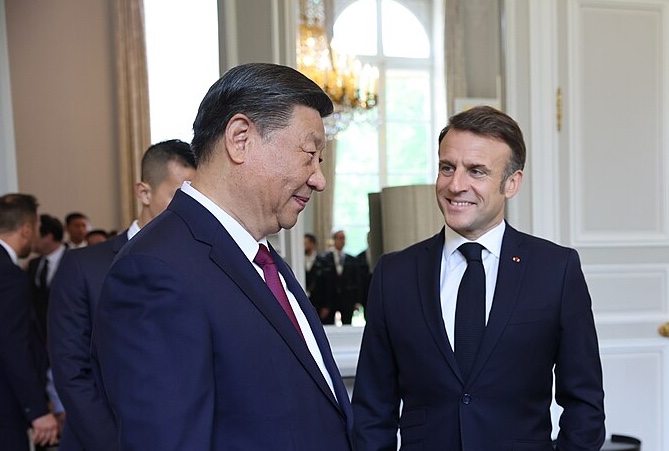
• From 3 to 5 December 2025, French President Emmanuel Macron paid a state visit to China – his fourth since 2017, emphasising the dense interactions between the French leader and his Chinese counterpart.
• Despite both being permanent members of the UN Security Council, the bilateral relationship has become significantly imbalanced in the past two decades, tilting heavily in Beijing’s favour.
• Emmanuel Macron again attempted to persuade Chinese President Xi Jinping to proactively strive for peace in Ukraine, without success.
COMMENTARY
The long-standing relationship between France and China has oscillated between collaboration and confrontation.
Collaboration began as early as the 17th century, when Jesuits were dispatched by King Louis XIV to serve in the Qing court. Competition and confrontation followed in the 19th century during the Second Opium War, in which France played an active role. This conflict opened a “100-year” period of rivalry, notably over the control of Vietnam, which until then had been a Chinese tributary. French Indochina would exist until the fall of Điện Biên Phủ in 1954.
A new phase of cooperation emerged in 1964 when Charles de Gaulle established diplomatic relations with the People’s Republic of China, 15 years ahead of the United States. This decision remains celebrated in Beijing as an emblem of French strategic independence and non-alignment.
Although both Beijing and Paris sit on the United Nations Security Council (UNSC) as its permanent members, the balance of power has shifted significantly over the past two decades, tilting in China’s favour in terms of their comprehensive national strength. In economic terms, France suffers from an abysmal trade deficit, reaching €47 billion in 2024 – its largest bilateral deficit. While French multinationals continue to generate substantial profits in China (particularly in aeronautics and space, agribusiness, luxury goods, and cosmetics), the benefit for the broader national economic ecosystem is questionable.
Since China’s accession to the World Trade Organisation in 2001, systemic economic cooperation with Chinese “state capitalism” has fostered de-industrialisation in Europe and the loss of competitive advantages in various sectors. This dependence will be hard to reverse, particularly within strategic supply chains, such as IT, electronics batteries, rare earths, and others.
Following President Emmanuel Macron’s fourth visit to China (3–5 December 2025), it remains uncertain whether the relationship is entering a phase of renewed cooperation or drifting toward greater competition.
Ineffective Strategic Dialogue over Ukraine
France and China are, de facto, invested with responsibility for international security as nuclear powers and permanent members of the UNSC. This shared responsibility, coupled with mutual commitment to multilateralism, has led Macron to urge Chinese President Xi Jinping to push for peace in the ongoing war in Ukraine – first, by ensuring that Beijing refrains from supporting Moscow; and second, by using his influence on Russian President Vladimir Putin to facilitate a diplomatic solution.
Unsurprisingly, this latest attempt by the French president has not been successful, with his Chinese counterpart merely calling for “a strengthening of cooperation” and to “avoid any interference.” The two countries have diametrically opposed views on Ukraine: with Paris being one of Kyiv’s main supporters, whereas Beijing, despite its façade of neutrality, contributing – discreetly, but significantly – to the Russian war effort with its continued export of dual-use goods. To be sure, the Chinese foreign minister already told the European Union’s top diplomat in July this year of Beijing’s preference.
No Engagement on Challenges in the Asia-Pacific Region
Beyond Ukraine, regional challenges were also not discussed at the meeting. Although China had sought France’s support in its recent dispute with Japan over Taiwan’s status, Macron was careful to avoid any explicit statement. On this, the French leader has been walking on eggshells and has often found himself in an uncomfortable position. In 2023, his remarks urging Europeans not to be “followers” on Taiwan sparked criticisms by his Western partners. This year, in Singapore, the comparison he drew at the Shangri-La Dialogue between Ukraine and Taiwan was deemed unacceptable – this time by Beijing.
Possessing the second-largest maritime territory and exclusive economic zone after the US, France has, since 2018, developed its own Indo-Pacific strategy. As the most active European nation in the Asia-Pacific region, the French armed forces have conducted multiple naval deployments, including involving its aircraft carrier, the Charles de Gaulle. Cognisant of China’s growing assertiveness, France in its 2025 National Strategic Review, also called out Chinese influence efforts on the French territory of New Caledonia.
Still, Paris’ approach has been more inclusive and less confrontational toward Beijing compared with that of other Western powers in the region. It is perhaps on this account that, other than a sharp rebuke by a People’s Liberation Army admiral at the 2013 Shangri-La Dialogue – “For us, France is in Europe” – Chinese authorities have largely turned a blind eye to French activities in this part of the world, careful not to jeopardise the bilateral relationship with a key European partner.
In the wake of the shifting trajectory in the trans-Atlantic security partnership since the second term of US President Donald Trump, France – like its NATO allies – has come under added pressure of dealing with the threat of US unreliability. Under the growing sense of American retreat from its decades-long role as the security guarantor in the region, France has instead turned towards striving for strategic convergence with other countries to safeguard its interests both in the Indo-Pacific and in Europe against the potentially detrimental effects of Sino-US great power competition.
Systemic Rivals or Strategic Partners?
The space for manoeuvre in Sino-French dialogue also appears highly limited. Specifically, French diplomacy simultaneously labels China as a “systemic rival” within the European framework, but refers to Beijing as a “strategic partner” in the bilateral context – a dual discourse that is sometimes difficult to decipher. For instance, just after his trip to China, where he sought to attract investments to France, Macron threatened to impose European tariffs on Chinese goods should the trade imbalance persist.
In China, Gaullist France continues to be celebrated as a model of independence and non-alignment. But Beijing also knows how to flatter EU member states bilaterally in order to divide the regional bloc and preserve the structural advantages it enjoys. While the European Union remains China’s second-largest trading partner (after the Association of Southeast Asian Nations), and as such, an indispensable trading bloc, the European trade deficit amounted to nearly €350 billion in 2024. Beijing intends to fully exploit this asymmetry, while ensuring that European states do not unite against it.
Pandas and Ping-Pong: A Small Win for Paris
Despite mounting economic and geopolitical challenges, Emmanuel Macron can at least take satisfaction in being received as a distinguished head of state, with President Xi Jinping sparing no effort to “give face.” As an exceptional gesture towards a European leader, the French president was invited to a major Chinese city for a third time – after Xi’an in 2018 and Guangzhou in 2023 – this time to Chengdu.
Home to the largest giant panda research and conservation centre, Macron’s visit there has at least yielded some success for France–China relations. As part of China’s panda diplomacy, Macron’s wife, Brigitte, was able to reunite with her panda “godson”: Yuan Meng, the first giant panda born in France. After this latest French overture, China is expected to send a new pair of giant pandas to France’s Beauval ZooPark in 2027.
At the same time, Macron exchanged a few ping-pong shots alongside a French Olympic medallist, against two Chinese table tennis champions, who were all gathered in Chengdu for an international tournament.
Such symbolic gestures of soft power dynamics reflect a longstanding and close Sino–French partnership. However, they fail to obscure the profound power asymmetries between Beijing and Paris or the persistent ineffectiveness of France’s efforts to secure tangible outcomes in its strategic dialogue with China.
Paco Milhiet is a Visiting Fellow with the South Asia Programme at the S. Rajaratnam School of International Studies (RSIS). James Char is Assistant Professor with the China Programme at RSIS. He recently attended the 5th International Session for the Indopacific (SIIP) organised by France’s Ministry for Europe and Foreign Affairs.
KEY TAKEAWAYS
• From 3 to 5 December 2025, French President Emmanuel Macron paid a state visit to China – his fourth since 2017, emphasising the dense interactions between the French leader and his Chinese counterpart.
• Despite both being permanent members of the UN Security Council, the bilateral relationship has become significantly imbalanced in the past two decades, tilting heavily in Beijing’s favour.
• Emmanuel Macron again attempted to persuade Chinese President Xi Jinping to proactively strive for peace in Ukraine, without success.
COMMENTARY
The long-standing relationship between France and China has oscillated between collaboration and confrontation.
Collaboration began as early as the 17th century, when Jesuits were dispatched by King Louis XIV to serve in the Qing court. Competition and confrontation followed in the 19th century during the Second Opium War, in which France played an active role. This conflict opened a “100-year” period of rivalry, notably over the control of Vietnam, which until then had been a Chinese tributary. French Indochina would exist until the fall of Điện Biên Phủ in 1954.
A new phase of cooperation emerged in 1964 when Charles de Gaulle established diplomatic relations with the People’s Republic of China, 15 years ahead of the United States. This decision remains celebrated in Beijing as an emblem of French strategic independence and non-alignment.
Although both Beijing and Paris sit on the United Nations Security Council (UNSC) as its permanent members, the balance of power has shifted significantly over the past two decades, tilting in China’s favour in terms of their comprehensive national strength. In economic terms, France suffers from an abysmal trade deficit, reaching €47 billion in 2024 – its largest bilateral deficit. While French multinationals continue to generate substantial profits in China (particularly in aeronautics and space, agribusiness, luxury goods, and cosmetics), the benefit for the broader national economic ecosystem is questionable.
Since China’s accession to the World Trade Organisation in 2001, systemic economic cooperation with Chinese “state capitalism” has fostered de-industrialisation in Europe and the loss of competitive advantages in various sectors. This dependence will be hard to reverse, particularly within strategic supply chains, such as IT, electronics batteries, rare earths, and others.
Following President Emmanuel Macron’s fourth visit to China (3–5 December 2025), it remains uncertain whether the relationship is entering a phase of renewed cooperation or drifting toward greater competition.
Ineffective Strategic Dialogue over Ukraine
France and China are, de facto, invested with responsibility for international security as nuclear powers and permanent members of the UNSC. This shared responsibility, coupled with mutual commitment to multilateralism, has led Macron to urge Chinese President Xi Jinping to push for peace in the ongoing war in Ukraine – first, by ensuring that Beijing refrains from supporting Moscow; and second, by using his influence on Russian President Vladimir Putin to facilitate a diplomatic solution.
Unsurprisingly, this latest attempt by the French president has not been successful, with his Chinese counterpart merely calling for “a strengthening of cooperation” and to “avoid any interference.” The two countries have diametrically opposed views on Ukraine: with Paris being one of Kyiv’s main supporters, whereas Beijing, despite its façade of neutrality, contributing – discreetly, but significantly – to the Russian war effort with its continued export of dual-use goods. To be sure, the Chinese foreign minister already told the European Union’s top diplomat in July this year of Beijing’s preference.
No Engagement on Challenges in the Asia-Pacific Region
Beyond Ukraine, regional challenges were also not discussed at the meeting. Although China had sought France’s support in its recent dispute with Japan over Taiwan’s status, Macron was careful to avoid any explicit statement. On this, the French leader has been walking on eggshells and has often found himself in an uncomfortable position. In 2023, his remarks urging Europeans not to be “followers” on Taiwan sparked criticisms by his Western partners. This year, in Singapore, the comparison he drew at the Shangri-La Dialogue between Ukraine and Taiwan was deemed unacceptable – this time by Beijing.
Possessing the second-largest maritime territory and exclusive economic zone after the US, France has, since 2018, developed its own Indo-Pacific strategy. As the most active European nation in the Asia-Pacific region, the French armed forces have conducted multiple naval deployments, including involving its aircraft carrier, the Charles de Gaulle. Cognisant of China’s growing assertiveness, France in its 2025 National Strategic Review, also called out Chinese influence efforts on the French territory of New Caledonia.
Still, Paris’ approach has been more inclusive and less confrontational toward Beijing compared with that of other Western powers in the region. It is perhaps on this account that, other than a sharp rebuke by a People’s Liberation Army admiral at the 2013 Shangri-La Dialogue – “For us, France is in Europe” – Chinese authorities have largely turned a blind eye to French activities in this part of the world, careful not to jeopardise the bilateral relationship with a key European partner.
In the wake of the shifting trajectory in the trans-Atlantic security partnership since the second term of US President Donald Trump, France – like its NATO allies – has come under added pressure of dealing with the threat of US unreliability. Under the growing sense of American retreat from its decades-long role as the security guarantor in the region, France has instead turned towards striving for strategic convergence with other countries to safeguard its interests both in the Indo-Pacific and in Europe against the potentially detrimental effects of Sino-US great power competition.
Systemic Rivals or Strategic Partners?
The space for manoeuvre in Sino-French dialogue also appears highly limited. Specifically, French diplomacy simultaneously labels China as a “systemic rival” within the European framework, but refers to Beijing as a “strategic partner” in the bilateral context – a dual discourse that is sometimes difficult to decipher. For instance, just after his trip to China, where he sought to attract investments to France, Macron threatened to impose European tariffs on Chinese goods should the trade imbalance persist.
In China, Gaullist France continues to be celebrated as a model of independence and non-alignment. But Beijing also knows how to flatter EU member states bilaterally in order to divide the regional bloc and preserve the structural advantages it enjoys. While the European Union remains China’s second-largest trading partner (after the Association of Southeast Asian Nations), and as such, an indispensable trading bloc, the European trade deficit amounted to nearly €350 billion in 2024. Beijing intends to fully exploit this asymmetry, while ensuring that European states do not unite against it.
Pandas and Ping-Pong: A Small Win for Paris
Despite mounting economic and geopolitical challenges, Emmanuel Macron can at least take satisfaction in being received as a distinguished head of state, with President Xi Jinping sparing no effort to “give face.” As an exceptional gesture towards a European leader, the French president was invited to a major Chinese city for a third time – after Xi’an in 2018 and Guangzhou in 2023 – this time to Chengdu.
Home to the largest giant panda research and conservation centre, Macron’s visit there has at least yielded some success for France–China relations. As part of China’s panda diplomacy, Macron’s wife, Brigitte, was able to reunite with her panda “godson”: Yuan Meng, the first giant panda born in France. After this latest French overture, China is expected to send a new pair of giant pandas to France’s Beauval ZooPark in 2027.
At the same time, Macron exchanged a few ping-pong shots alongside a French Olympic medallist, against two Chinese table tennis champions, who were all gathered in Chengdu for an international tournament.
Such symbolic gestures of soft power dynamics reflect a longstanding and close Sino–French partnership. However, they fail to obscure the profound power asymmetries between Beijing and Paris or the persistent ineffectiveness of France’s efforts to secure tangible outcomes in its strategic dialogue with China.
Paco Milhiet is a Visiting Fellow with the South Asia Programme at the S. Rajaratnam School of International Studies (RSIS). James Char is Assistant Professor with the China Programme at RSIS. He recently attended the 5th International Session for the Indopacific (SIIP) organised by France’s Ministry for Europe and Foreign Affairs.