22 December 2025
IP25126 | Singapore–South Korea Strategic Partnership: Onward to a Whole-of-Society Approach

KEY TAKEAWAYS
• Singapore and South Korea upgraded bilateral ties to a strategic partnership in November 2025.
• The growing cooperation between Singapore and South Korea reflects the evolution of bilateral ties through three overlapping periods since diplomatic relations were established in 1975.
• Future efforts should focus on strengthening bilateral cooperation through a broader, whole-of-society approach.
COMMENTARY
During Singapore Prime Minister Lawrence Wong’s visit to Seoul in November 2025, he and South Korean President Lee Jae Myung agreed to upgrade bilateral ties to a strategic partnership, coinciding with the 50th anniversary of diplomatic relations.
For Singapore, the upgrade positions South Korea alongside other strategic partners including the United Kingdom and Germany. For South Korea, Singapore now sits in the same category as other important partners such as the European Union, Mexico and Turkey.
Over the past five decades, relations between South Korea and Singapore have grown progressively closer, underpinned by shared interests in regional stability and continued economic prosperity. The strategic partnership signals both countries’ intention to broaden the scope and ambition of their bilateral cooperation.
In addition to strengthening cooperation in areas like defence technology, artificial intelligence (AI), and energy, the two countries agreed for Singapore to import beef and pork from South Korea’s Jeju Island for the first time – a symbol of growing cultural ties between Seoul and Singapore manifested in K-food’s growing popularity in the latter.
Amid ongoing trade uncertainties and supply chain vulnerabilities, this move underscores the commitment of both countries to ensure resilient and reliable food supplies. More broadly, it illustrates their shared effort to diversify partnerships and strengthen collaboration across new fronts – a “whole-of-society” approach to bilateral cooperation.
The Road to the Strategic Partnership
The growing cooperation between Singapore and South Korea is best understood against the backdrop of how bilateral ties have evolved over time – through three overlapping periods thus far, each marked by distinctive circumstances and factors.
The first period was characterised by a cautious icebreaking between the two relatively young countries against the backdrop of the Cold War. Bilateral diplomatic relations were established in August 1975 amid concerns over the Nixon administration’s disengagement from Asia following the Vietnam War, which prompted regional countries to strengthen ties among themselves.
Once the political relationship was established, the nascent partnership between the two “Asian Tigers” soon translated into increasing trade, more options for direct flights and a series of high-level visits and meetings, laying the foundation for a closer bilateral relationship in the next era.
The second phase of Singapore–South Korea relations unfolded from the early 1990s following the end of the Cold War and continued through to the mid-2010s, marking a period of deeper engagement and expanding cooperation centred around economic issues.
The strength of bilateral relations was especially apparent in robust trade, investment and tourism exchanges. Singapore was the first Asian country to establish a free trade agreement (FTA) with South Korea in 2006, and two-way foreign direct investment (FDI) rose steadily from the late 1990s to the mid-2010s.
Alongside economic cooperation, tourism and cultural exchanges also gained prominence. K-pop enthusiasts in the early 2010s may remember SKarf, a girl group that included Singaporeans Tasha Low and Ferlyn G in its lineup alongside Korean and Japanese members.
Air connectivity too was enhanced as the number of weekly passenger flights between South Korea and Singapore nearly doubled – from 33 in 2010 to 64 in 2019 – reflecting the growing people-to-people ties between the two countries.
These exchanges have deepened in the third and current phase, with South Korea’s introduction of its New Southern Policy (NSP) in 2017, under which Seoul’s relations with ASEAN and its member states stepped up significantly. Such efforts culminated in a comprehensive strategic partnership between ASEAN and South Korea last year.
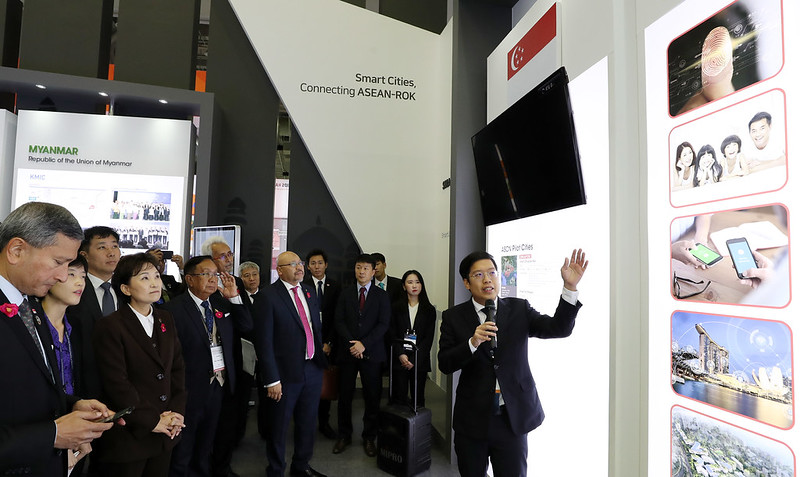
Against this backdrop, Singapore and South Korea have expanded cooperation to emerging areas such as digital transformation, smart cities and climate change.
More recently, the convergence of traditional and non-traditional issues, as manifested by the outbreak of COVID-19 and Russia’s invasion of Ukraine, has necessitated a more flexible and broader cooperation to manage shared global risks.
This is reflected in the new bilateral initiatives under the strategic partnership, notably in AI governance, supply chain resilience and defence technology. Indeed, as unconventional challenges and opportunities emerge, the two countries will have to continue adapting and recalibrating their relationship going forward.
Realising the Strategic Partnership through a Whole-of-Society Approach
A common perception – even during the height of the NSP – is that South Korea’s approach to Southeast Asia has largely been motivated by economic interests rather than a strategic imperative. This is understandable since Seoul’s primary security threats have come from the north, whereas ASEAN countries have their own regional dynamics and concerns.
The same could certainly be said of relations between South Korea and Singapore. Even as Singapore’s hosting of the US-North Korea Summit in 2018 attracted much attention in Seoul, the above outline of bilateral relations demonstrates, nevertheless, that overall cooperation has traditionally leaned more towards economics and people-to-people ties.
Although there has been engagement in defence and security, progress has arguably been limited, epitomising the persistence of geographically bounded, traditional security issues on both sides. The strategic partnership looks set to address this to some extent, by incorporating defence and security cooperation in selected areas such as technology and microelectronics.
In this brave new world, moreover, governments should anticipate and cope with unconventional challenges that could potentially strain their broader societies. By doing so, they could uncover additional avenues for cooperation between countries such as Singapore and South Korea that share many of these concerns.
Scam centres, for example, have emerged as a growing concern in both nations, affecting citizens, businesses and financial institutions alike. Collaboration in this area – from sharing information to coordinating enforcement and public awareness campaigns – offers a tangible way to strengthen bilateral ties while protecting the wider population. The two countries are increasingly adopting “community policing”, which may contribute to the identification of scam centres and other transnational crimes operating in their countries and beyond.
Beyond fraud prevention, there are other emerging areas for joint action, including securing critical resources and preparing for the societal impacts of rapidly advancing technologies such as AI – which the strategic partnership agreement alludes to. These require adaptive policies to safeguard employment and social stability.
As important as such adaptations are, however, governments, narrowly defined as national security apparatuses, will have limited bandwidth to take effective measures against all emerging and non-traditional issues. Both sides should therefore identify areas where societal actors, such as businesses, universities and the like, can be encouraged to deepen cooperation to meet these challenges collaboratively.
By approaching security through a broader, whole-of-society lens, Singapore and South Korea can fully realise the potential of their strategic partnership to tackle the complex challenges that lie ahead.
Jaehan Park and Sarah Teo are Assistant Professors at the S. Rajaratnam School of International Studies (RSIS). Park is also a Non-Resident Fellow with the Asia Program at the Foreign Policy Research Institute (FPRI).
KEY TAKEAWAYS
• Singapore and South Korea upgraded bilateral ties to a strategic partnership in November 2025.
• The growing cooperation between Singapore and South Korea reflects the evolution of bilateral ties through three overlapping periods since diplomatic relations were established in 1975.
• Future efforts should focus on strengthening bilateral cooperation through a broader, whole-of-society approach.
COMMENTARY
During Singapore Prime Minister Lawrence Wong’s visit to Seoul in November 2025, he and South Korean President Lee Jae Myung agreed to upgrade bilateral ties to a strategic partnership, coinciding with the 50th anniversary of diplomatic relations.
For Singapore, the upgrade positions South Korea alongside other strategic partners including the United Kingdom and Germany. For South Korea, Singapore now sits in the same category as other important partners such as the European Union, Mexico and Turkey.
Over the past five decades, relations between South Korea and Singapore have grown progressively closer, underpinned by shared interests in regional stability and continued economic prosperity. The strategic partnership signals both countries’ intention to broaden the scope and ambition of their bilateral cooperation.
In addition to strengthening cooperation in areas like defence technology, artificial intelligence (AI), and energy, the two countries agreed for Singapore to import beef and pork from South Korea’s Jeju Island for the first time – a symbol of growing cultural ties between Seoul and Singapore manifested in K-food’s growing popularity in the latter.
Amid ongoing trade uncertainties and supply chain vulnerabilities, this move underscores the commitment of both countries to ensure resilient and reliable food supplies. More broadly, it illustrates their shared effort to diversify partnerships and strengthen collaboration across new fronts – a “whole-of-society” approach to bilateral cooperation.
The Road to the Strategic Partnership
The growing cooperation between Singapore and South Korea is best understood against the backdrop of how bilateral ties have evolved over time – through three overlapping periods thus far, each marked by distinctive circumstances and factors.
The first period was characterised by a cautious icebreaking between the two relatively young countries against the backdrop of the Cold War. Bilateral diplomatic relations were established in August 1975 amid concerns over the Nixon administration’s disengagement from Asia following the Vietnam War, which prompted regional countries to strengthen ties among themselves.
Once the political relationship was established, the nascent partnership between the two “Asian Tigers” soon translated into increasing trade, more options for direct flights and a series of high-level visits and meetings, laying the foundation for a closer bilateral relationship in the next era.
The second phase of Singapore–South Korea relations unfolded from the early 1990s following the end of the Cold War and continued through to the mid-2010s, marking a period of deeper engagement and expanding cooperation centred around economic issues.
The strength of bilateral relations was especially apparent in robust trade, investment and tourism exchanges. Singapore was the first Asian country to establish a free trade agreement (FTA) with South Korea in 2006, and two-way foreign direct investment (FDI) rose steadily from the late 1990s to the mid-2010s.
Alongside economic cooperation, tourism and cultural exchanges also gained prominence. K-pop enthusiasts in the early 2010s may remember SKarf, a girl group that included Singaporeans Tasha Low and Ferlyn G in its lineup alongside Korean and Japanese members.
Air connectivity too was enhanced as the number of weekly passenger flights between South Korea and Singapore nearly doubled – from 33 in 2010 to 64 in 2019 – reflecting the growing people-to-people ties between the two countries.
These exchanges have deepened in the third and current phase, with South Korea’s introduction of its New Southern Policy (NSP) in 2017, under which Seoul’s relations with ASEAN and its member states stepped up significantly. Such efforts culminated in a comprehensive strategic partnership between ASEAN and South Korea last year.
Against this backdrop, Singapore and South Korea have expanded cooperation to emerging areas such as digital transformation, smart cities and climate change.
More recently, the convergence of traditional and non-traditional issues, as manifested by the outbreak of COVID-19 and Russia’s invasion of Ukraine, has necessitated a more flexible and broader cooperation to manage shared global risks.
This is reflected in the new bilateral initiatives under the strategic partnership, notably in AI governance, supply chain resilience and defence technology. Indeed, as unconventional challenges and opportunities emerge, the two countries will have to continue adapting and recalibrating their relationship going forward.
Realising the Strategic Partnership through a Whole-of-Society Approach
A common perception – even during the height of the NSP – is that South Korea’s approach to Southeast Asia has largely been motivated by economic interests rather than a strategic imperative. This is understandable since Seoul’s primary security threats have come from the north, whereas ASEAN countries have their own regional dynamics and concerns.
The same could certainly be said of relations between South Korea and Singapore. Even as Singapore’s hosting of the US-North Korea Summit in 2018 attracted much attention in Seoul, the above outline of bilateral relations demonstrates, nevertheless, that overall cooperation has traditionally leaned more towards economics and people-to-people ties.
Although there has been engagement in defence and security, progress has arguably been limited, epitomising the persistence of geographically bounded, traditional security issues on both sides. The strategic partnership looks set to address this to some extent, by incorporating defence and security cooperation in selected areas such as technology and microelectronics.
In this brave new world, moreover, governments should anticipate and cope with unconventional challenges that could potentially strain their broader societies. By doing so, they could uncover additional avenues for cooperation between countries such as Singapore and South Korea that share many of these concerns.
Scam centres, for example, have emerged as a growing concern in both nations, affecting citizens, businesses and financial institutions alike. Collaboration in this area – from sharing information to coordinating enforcement and public awareness campaigns – offers a tangible way to strengthen bilateral ties while protecting the wider population. The two countries are increasingly adopting “community policing”, which may contribute to the identification of scam centres and other transnational crimes operating in their countries and beyond.
Beyond fraud prevention, there are other emerging areas for joint action, including securing critical resources and preparing for the societal impacts of rapidly advancing technologies such as AI – which the strategic partnership agreement alludes to. These require adaptive policies to safeguard employment and social stability.
As important as such adaptations are, however, governments, narrowly defined as national security apparatuses, will have limited bandwidth to take effective measures against all emerging and non-traditional issues. Both sides should therefore identify areas where societal actors, such as businesses, universities and the like, can be encouraged to deepen cooperation to meet these challenges collaboratively.
By approaching security through a broader, whole-of-society lens, Singapore and South Korea can fully realise the potential of their strategic partnership to tackle the complex challenges that lie ahead.
Jaehan Park and Sarah Teo are Assistant Professors at the S. Rajaratnam School of International Studies (RSIS). Park is also a Non-Resident Fellow with the Asia Program at the Foreign Policy Research Institute (FPRI).