


12 January 2026
IP26006 | US–Indonesia Relations: Navigating Power in a Shifting World Order

KEY TAKEAWAYS
• The US–Indonesia relationship under the Trump administration has become highly transactional, focused mainly on immediate economic interests.
• While economic diplomacy dominates US–Indonesia relations, security cooperation remains constrained by structural and strategic factors.
• Indonesia’s approach to the relationship continues to reflect its long-standing non-alignment principle.
COMMENTARY
In the first year of Prabowo Subianto’s presidency, the US–Indonesia relationship has been focused primarily on economic matters rather than defence and security cooperation. Defence and security collaboration is expected to remain largely routine, with limited new initiatives, while economic diplomacy presents a significant challenge for Indonesia’s foreign policy amid growing global economic uncertainty.
President Prabowo and US President Donald Trump share a vision of prioritising national interests, but they employ different strategies to achieve it. Prabowo emphasises market diversification and a downstream industrialisation (hilirisasi) agenda to reduce Indonesia’s reliance on raw material exports and increase domestic value-added production. In contrast, Trump has pursued a retrenchment policy, pulling back from global security commitments to concentrate resources domestically. This approach reflects his belief that the United States has spent too much in shouldering much of the world’s security burden without receiving sufficient benefits.
Market diversification and downstream industrialisation are central to Prabowo’s long-term agenda. This strategy relies on stable access to international markets and foreign investment. However, the time-consuming nature of diplomatic engagement to gain market access and foreign investment, and the arduous process of building domestic production capacity limit the pace of progress. As the global trading environment becomes increasingly protectionist and uncertain, Indonesia’s ability to achieve its targets will be tested. In the meantime, the country continues to maintain strong relations with major powers, including the United States and China, to sustain its economic performance. The balancing act involved in engaging the two adversaries is becoming more complex as Trump’s assertive and unpredictable trade policies reignite global tensions.
The Trump Tariffs and US–Indonesia Economic Relations
In July 2025, Trump imposed reciprocal tariffs on nearly every country, including Indonesia. Although tariff negotiations were temporarily paused owing to a US government shutdown, a 19% tariff on Indonesia has been in effect since early August. In response, Indonesia offered substantial trade concessions to the United States, including over US$22 billion in purchase commitments and comprehensive market access measures, notably through the removal of tariff and non-tariff barriers for US products.
James Castle, a long-time American business consultant based in Jakarta, believes that Indonesia’s trade concessions primarily serve to preserve Indonesia’s access to the US market rather than to attract new American investments. He explained that Trump’s tariff policies are intended to incentivise US companies to produce locally in serving the American domestic market rather than to produce their goods elsewhere. While US companies exporting to Indonesia would be exempted from paying Indonesian tariffs, those with production facilities in Indonesia would have to bear production costs when serving the US market, such as transport costs from Indonesia to the United States. These higher costs do not justify relocating their factories to Indonesia. Consequently, while the agreement reduces Indonesian tariffs and non-tariff barriers for US products, it does not substantially change the Indonesian domestic investment climate.
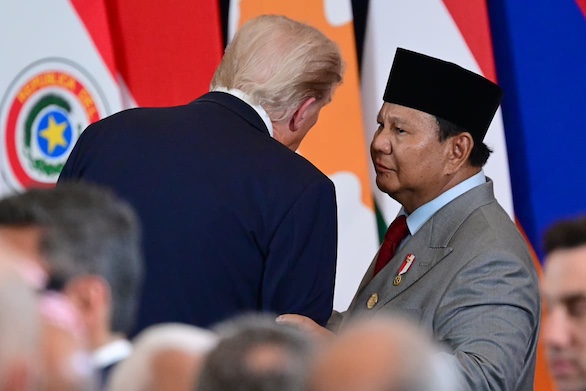
In light of Trump’s unpredictable approach, the US–Indonesia relationship has become highly transactional, focused mainly on immediate economic interests rather than long-term strategic alignment. Indonesia’s foreign policy must therefore navigate this transactional framework carefully, balancing the need to secure US market access with broader goals of economic development and strategic autonomy.
Prospects for US–Indonesia Security Cooperation
While economic diplomacy dominates US–Indonesia relations under Prabowo, security cooperation remains constrained by structural and strategic factors. US retrenchment from Europe and Asia, driven by a focus on domestic priorities, has reduced funding and attention for defence partnerships that are not central to American national interests. This will change the character of US–Indonesia defence cooperation to be increasingly shaped by trade tensions and tariff politics than by genuine strategic convergence.
The cooperation between the two countries has been largely confined to low-cost, symbolic activities such as joint training exercises, humanitarian assistance, disaster relief, or search and rescue missions. These engagements allow the United States to maintain regional visibility while minimising commitments. For example, in 2025, the Super Garuda Shield, a major international joint military exercise organised annually by Indonesia and the United States, involved 6,000 military personnel from 13 countries, including Indonesia and the United States. While the overall number of personnel increased compared to the previous year, the number of American troops participating in the joint training exercise dropped from 2,500 to 1,300 personnel. This restrained pattern of defence cooperation between Indonesia and the United States, in fact, aligns with Prabowo’s strategy of keeping security cooperation low-profile and avoiding dependence on hard power support, whether from the United States or China. This strategy is in line with Jakarta’s long-standing non-alignment principle.
However, the reduced American presence in Southeast Asia has broader regional implications. China’s growing assertiveness in the South China Sea raises the risk of tensions among claimant states, placing Indonesia in a delicate position as a regional leader. In this sense, Indonesia’s foreign policy requires a careful balance between maintaining economic relations with major powers and managing security risks in an increasingly uncertain regional landscape.
James Fligo, an expert in corporate security based in Jakarta, argues that the US–Indonesia relationship will remain strong despite global uncertainty and the emergence of various conflicts across the world. However, the US retrenchment policy is expected to generate regional challenges that Prabowo cannot ignore, particularly as reduced American engagement shifts the regional balance of power and amplifies the influence of other major actors.
The vacuum left by diminished US diplomatic mediation has already triggered escalating intra-ASEAN conflicts that threaten regional stability. The 2025 Thailand–Cambodia border conflict exemplifies this challenge: escalating clashes left 500,000 displaced, while the temporary ceasefire co-brokered by Trump collapsed by December. Myanmar’s civil war similarly destabilises the country and its border regions in the absence of effective US intervention. Meanwhile, China fills the vacuum by supporting the military junta in Yangon. As these conflicts linger on without effective regional or multilateral resolutions, Indonesia faces mounting pressure to take a leading role to manage regional security issues; yet questions persist regarding its capability and willingness to take such a lead.
Conclusion
Indonesia’s foreign policy and security relations with the United States under Prabowo are defined by strategic pragmatism and transactional diplomacy. The relationship prioritises immediate economic interests over long-term strategic alignment, with defence cooperation remaining deliberately limited to preserve Indonesia’s non-alignment principles and strategic autonomy. The low-key defence relationship is further influenced by the Trump administration’s policy of reducing US involvement in external conflicts that do not serve its national interests. While the US–Indonesia defence and security partnership is likely to remain stable, Indonesia should remain cautious as the declining US presence in the region may contribute to increasing regional tensions. On the economic front, although Prabowo managed to secure US market access through a reciprocal tariffs deal with Trump, reconciling Indonesia’s development goals with unpredictable US policy remains a delicate task.
Ultimately, the US–Indonesia relationship under Prabowo exemplifies the core challenge facing middle powers: extracting economic benefits while preserving strategic flexibility in an international system increasingly characterised by great power competition and transnationalism.
Alexander R. Arifianto is Senior Fellow and Coordinator of the Indonesia Programme at the Institute of Defence and Strategic Studies (IDSS), S. Rajaratnam School of International Studies (RSIS). Prasetia Pratama and Rama Daru Jati are independent researchers based in Cimahi, West Java, Indonesia.
KEY TAKEAWAYS
• The US–Indonesia relationship under the Trump administration has become highly transactional, focused mainly on immediate economic interests.
• While economic diplomacy dominates US–Indonesia relations, security cooperation remains constrained by structural and strategic factors.
• Indonesia’s approach to the relationship continues to reflect its long-standing non-alignment principle.
COMMENTARY
In the first year of Prabowo Subianto’s presidency, the US–Indonesia relationship has been focused primarily on economic matters rather than defence and security cooperation. Defence and security collaboration is expected to remain largely routine, with limited new initiatives, while economic diplomacy presents a significant challenge for Indonesia’s foreign policy amid growing global economic uncertainty.
President Prabowo and US President Donald Trump share a vision of prioritising national interests, but they employ different strategies to achieve it. Prabowo emphasises market diversification and a downstream industrialisation (hilirisasi) agenda to reduce Indonesia’s reliance on raw material exports and increase domestic value-added production. In contrast, Trump has pursued a retrenchment policy, pulling back from global security commitments to concentrate resources domestically. This approach reflects his belief that the United States has spent too much in shouldering much of the world’s security burden without receiving sufficient benefits.
Market diversification and downstream industrialisation are central to Prabowo’s long-term agenda. This strategy relies on stable access to international markets and foreign investment. However, the time-consuming nature of diplomatic engagement to gain market access and foreign investment, and the arduous process of building domestic production capacity limit the pace of progress. As the global trading environment becomes increasingly protectionist and uncertain, Indonesia’s ability to achieve its targets will be tested. In the meantime, the country continues to maintain strong relations with major powers, including the United States and China, to sustain its economic performance. The balancing act involved in engaging the two adversaries is becoming more complex as Trump’s assertive and unpredictable trade policies reignite global tensions.
The Trump Tariffs and US–Indonesia Economic Relations
In July 2025, Trump imposed reciprocal tariffs on nearly every country, including Indonesia. Although tariff negotiations were temporarily paused owing to a US government shutdown, a 19% tariff on Indonesia has been in effect since early August. In response, Indonesia offered substantial trade concessions to the United States, including over US$22 billion in purchase commitments and comprehensive market access measures, notably through the removal of tariff and non-tariff barriers for US products.
James Castle, a long-time American business consultant based in Jakarta, believes that Indonesia’s trade concessions primarily serve to preserve Indonesia’s access to the US market rather than to attract new American investments. He explained that Trump’s tariff policies are intended to incentivise US companies to produce locally in serving the American domestic market rather than to produce their goods elsewhere. While US companies exporting to Indonesia would be exempted from paying Indonesian tariffs, those with production facilities in Indonesia would have to bear production costs when serving the US market, such as transport costs from Indonesia to the United States. These higher costs do not justify relocating their factories to Indonesia. Consequently, while the agreement reduces Indonesian tariffs and non-tariff barriers for US products, it does not substantially change the Indonesian domestic investment climate.
In light of Trump’s unpredictable approach, the US–Indonesia relationship has become highly transactional, focused mainly on immediate economic interests rather than long-term strategic alignment. Indonesia’s foreign policy must therefore navigate this transactional framework carefully, balancing the need to secure US market access with broader goals of economic development and strategic autonomy.
Prospects for US–Indonesia Security Cooperation
While economic diplomacy dominates US–Indonesia relations under Prabowo, security cooperation remains constrained by structural and strategic factors. US retrenchment from Europe and Asia, driven by a focus on domestic priorities, has reduced funding and attention for defence partnerships that are not central to American national interests. This will change the character of US–Indonesia defence cooperation to be increasingly shaped by trade tensions and tariff politics than by genuine strategic convergence.
The cooperation between the two countries has been largely confined to low-cost, symbolic activities such as joint training exercises, humanitarian assistance, disaster relief, or search and rescue missions. These engagements allow the United States to maintain regional visibility while minimising commitments. For example, in 2025, the Super Garuda Shield, a major international joint military exercise organised annually by Indonesia and the United States, involved 6,000 military personnel from 13 countries, including Indonesia and the United States. While the overall number of personnel increased compared to the previous year, the number of American troops participating in the joint training exercise dropped from 2,500 to 1,300 personnel. This restrained pattern of defence cooperation between Indonesia and the United States, in fact, aligns with Prabowo’s strategy of keeping security cooperation low-profile and avoiding dependence on hard power support, whether from the United States or China. This strategy is in line with Jakarta’s long-standing non-alignment principle.
However, the reduced American presence in Southeast Asia has broader regional implications. China’s growing assertiveness in the South China Sea raises the risk of tensions among claimant states, placing Indonesia in a delicate position as a regional leader. In this sense, Indonesia’s foreign policy requires a careful balance between maintaining economic relations with major powers and managing security risks in an increasingly uncertain regional landscape.
James Fligo, an expert in corporate security based in Jakarta, argues that the US–Indonesia relationship will remain strong despite global uncertainty and the emergence of various conflicts across the world. However, the US retrenchment policy is expected to generate regional challenges that Prabowo cannot ignore, particularly as reduced American engagement shifts the regional balance of power and amplifies the influence of other major actors.
The vacuum left by diminished US diplomatic mediation has already triggered escalating intra-ASEAN conflicts that threaten regional stability. The 2025 Thailand–Cambodia border conflict exemplifies this challenge: escalating clashes left 500,000 displaced, while the temporary ceasefire co-brokered by Trump collapsed by December. Myanmar’s civil war similarly destabilises the country and its border regions in the absence of effective US intervention. Meanwhile, China fills the vacuum by supporting the military junta in Yangon. As these conflicts linger on without effective regional or multilateral resolutions, Indonesia faces mounting pressure to take a leading role to manage regional security issues; yet questions persist regarding its capability and willingness to take such a lead.
Conclusion
Indonesia’s foreign policy and security relations with the United States under Prabowo are defined by strategic pragmatism and transactional diplomacy. The relationship prioritises immediate economic interests over long-term strategic alignment, with defence cooperation remaining deliberately limited to preserve Indonesia’s non-alignment principles and strategic autonomy. The low-key defence relationship is further influenced by the Trump administration’s policy of reducing US involvement in external conflicts that do not serve its national interests. While the US–Indonesia defence and security partnership is likely to remain stable, Indonesia should remain cautious as the declining US presence in the region may contribute to increasing regional tensions. On the economic front, although Prabowo managed to secure US market access through a reciprocal tariffs deal with Trump, reconciling Indonesia’s development goals with unpredictable US policy remains a delicate task.
Ultimately, the US–Indonesia relationship under Prabowo exemplifies the core challenge facing middle powers: extracting economic benefits while preserving strategic flexibility in an international system increasingly characterised by great power competition and transnationalism.
Alexander R. Arifianto is Senior Fellow and Coordinator of the Indonesia Programme at the Institute of Defence and Strategic Studies (IDSS), S. Rajaratnam School of International Studies (RSIS). Prasetia Pratama and Rama Daru Jati are independent researchers based in Cimahi, West Java, Indonesia.