


14 January 2026
IP26009 | The Sumatra Floods as a Governance Stress Test

KEY TAKEAWAYS
• The severe flooding across multiple provinces in Sumatra poses an early governance challenge for the Prabowo administration on whether Indonesia’s disaster management system should remain decentralised or move towards greater central coordination.
• Indonesia has only declared national disaster status twice, during the 2004 Aceh tsunami and the COVID-19 pandemic, which explains the reluctance to apply this status for cross-province flooding as it is tied to broader political considerations.
• A whole-of-government approach is required to address the issue. The government would be well advised to pursue urban redevelopment strategies to refurbish dilapidated urban landscapes and adopt a sponge city concept that is better suited to absorb and manage excessive surface water run-off.
COMMENTARY
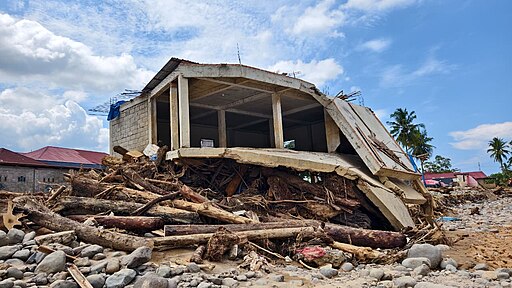
The floods that ravaged Indonesia in December have killed at least 1,170 people across North Sumatra, West Sumatra and Aceh provinces. Weeks since the disaster, numerous displaced victims continue to shelter in temporary tents.
Severe flooding is not simply an environmental shock. It is a governance stress test for Jakarta. While extreme rainfall serves as the immediate trigger, the deeper drivers lie in longstanding deforestation, land conversion policies and weak regulatory enforcement. These structural vulnerabilities have accumulated over time, turning predictable weather events into systemic disruption. Climate change may further exacerbate such disruptions by causing more intense and frequent extreme weather events in coming years.
Under the new Prabowo administration, the floods expose more than environmental mismanagement. They intersect with elite competition, bureaucratic fragmentation and unresolved tensions between decentralised disaster governance and a growing impulse to reassert central control.
The core issue is not whether floods are a natural phenomenon. It is whether Jakarta recognises the political consequences of treating large-scale flooding in a strategic economic region like Sumatra as a routine local problem rather than a national emergency. How the centre frames this crisis will shape fiscal priorities, centre–region relations, and the credibility of a more centralised governing style without formal recentralisation.
Why National Disaster Status Matters Politically
Granting national disaster status to the Sumatra floods is a political decision because it determines the speed and scale of response. Its primary function is not symbolism, but rather acceleration. National designation facilitates a faster, centrally coordinated response led by the National Disaster Management Agency (BNPB), broader access to emergency financing, and the legal basis to mobilise international assistance, thereby alleviating immediate pressures on state coffers.
Official definitions of “disaster” might be outdated, failing to match the escalating realities of flood damage and leading to delayed or insufficient support. While the Prabowo administration has signalled that regional designation remains sufficient for now, this stance prioritises administrative restraint over recovery momentum. Considering the scale of disruption facing Sumatra, incremental response mechanisms slow down relief delivery, fragment coordination and delay reconstruction timelines.
This is where fiscal risk enters, not as the starting point but as the consequence of delay. Large-scale flooding creates cascading economic disruption regardless of sector. Prolonged recovery uncertainty increases expenditure inefficiencies, disrupts production and logistics, and complicates national budget planning.
In Indonesia’s political economy, competence is measured by coordination speed and recovery outcomes. The question is not whether Sumatra – or North Sulawesi, where 16 people were killed by flash floods in early January – deserves special treatment. It is whether Jakarta is willing to prioritise accelerated recovery over procedural minimalism when disruption has already crossed regional thresholds.
Post-Disaster Recovery as an Entry Point for Structural Adaptation
President Prabowo Subianto has moved to centralise post-disaster coordination by establishing a Special Task Force for Post-Disaster Rehabilitation and Reconstruction in Sumatra, chaired by Home Affairs Minister Tito Karnavian. This move signals an early preference for executive coordination over institutional restructuring, creating a policy window to link recovery with longer-term risk management rather than treating floods as isolated shocks.
Empirical evidence underscores the structural nature of the problem. A recent NTU-led study on Aceh shows that flood exposure is closely associated with deforestation, plantation expansion and higher poverty levels, with flood incidents increasing steadily over time and producing large-scale displacement and asset loss. This pattern suggests that post-disaster reconstruction focused solely on restoring damaged infrastructure risks locking in existing vulnerabilities.
One option worth piloting at the recovery stage is the sponge city model developed in China, which integrates blue and green urban infrastructure into land use planning to absorb and regulate surface water rather than relying exclusively on grey drainage systems. Used strategically, post-disaster reconstruction can serve as a controlled entry point for the Prabowo administration to demonstrate executive coordination and long-term risk management, embedding flood resilience into urban redevelopment without reopening contentious debates over recentralisation.
Conclusion
Indonesia requires a new national development approach that builds upon, rather than merely inherits, the urban landscape established during the Soeharto era. Much of the urban infrastructure developed in that period, particularly in the outer provinces, is now in urgent need of refurbishment and rejuvenation. In this context, urban redevelopment models such as the sponge city concept offer a practical way to address the challenges posed by periodic flooding in cities located in lowlands, valleys and along major rivers, and should be prioritised at the national level.
The Sumatra floods illustrate a practical governance dilemma rather than a contest over political power. The question is not whether Indonesia should abandon decentralisation, but how the centre should respond when disruption exceeds provincial capacity and produces national-level consequences.
Formal recentralisation remains politically costly. It invites resistance from regional elites and revives concerns over autonomy rollback. However, crisis-driven coordination offers a narrower and more defensible pathway. National disaster designation allows Jakarta to exercise leadership through existing legal instruments without reopening institutional debates. Budget mobilisation, inter-ministry coordination, military logistics support and national-level enforcement can be activated without altering the decentralised framework.
This approach shifts the function of central authority from command to coordination. The centre sets priorities, timelines and accountability parameters, while local governments remain operational partners rather than administrative subordinates. Authority is exercised through problem-solving capacity rather than legal dominance.
If applied consistently, this model will reduce fragmentation during large-scale crises and strengthen centre–region confidence without provoking structural backlash. It will also lower the long-term political cost of governance reform by demonstrating that central intervention is conditional, targeted and risk-based.
The Sumatra floods therefore represent an early test for the Prabowo administration. The outcome will signal whether Jakarta can consolidate authority through performance and recovery outcomes, rather than through formal institutional restructuring. In this sense, disaster governance becomes a proxy for broader state capacity and political credibility.
Leonard C. Sebastian is Senior Fellow and Nauval El Ghifari is Student Research Assistant with the Indonesia Programme, S Rajaratnam School of International Studies (RSIS).
KEY TAKEAWAYS
• The severe flooding across multiple provinces in Sumatra poses an early governance challenge for the Prabowo administration on whether Indonesia’s disaster management system should remain decentralised or move towards greater central coordination.
• Indonesia has only declared national disaster status twice, during the 2004 Aceh tsunami and the COVID-19 pandemic, which explains the reluctance to apply this status for cross-province flooding as it is tied to broader political considerations.
• A whole-of-government approach is required to address the issue. The government would be well advised to pursue urban redevelopment strategies to refurbish dilapidated urban landscapes and adopt a sponge city concept that is better suited to absorb and manage excessive surface water run-off.
COMMENTARY
The floods that ravaged Indonesia in December have killed at least 1,170 people across North Sumatra, West Sumatra and Aceh provinces. Weeks since the disaster, numerous displaced victims continue to shelter in temporary tents.
Severe flooding is not simply an environmental shock. It is a governance stress test for Jakarta. While extreme rainfall serves as the immediate trigger, the deeper drivers lie in longstanding deforestation, land conversion policies and weak regulatory enforcement. These structural vulnerabilities have accumulated over time, turning predictable weather events into systemic disruption. Climate change may further exacerbate such disruptions by causing more intense and frequent extreme weather events in coming years.
Under the new Prabowo administration, the floods expose more than environmental mismanagement. They intersect with elite competition, bureaucratic fragmentation and unresolved tensions between decentralised disaster governance and a growing impulse to reassert central control.
The core issue is not whether floods are a natural phenomenon. It is whether Jakarta recognises the political consequences of treating large-scale flooding in a strategic economic region like Sumatra as a routine local problem rather than a national emergency. How the centre frames this crisis will shape fiscal priorities, centre–region relations, and the credibility of a more centralised governing style without formal recentralisation.
Why National Disaster Status Matters Politically
Granting national disaster status to the Sumatra floods is a political decision because it determines the speed and scale of response. Its primary function is not symbolism, but rather acceleration. National designation facilitates a faster, centrally coordinated response led by the National Disaster Management Agency (BNPB), broader access to emergency financing, and the legal basis to mobilise international assistance, thereby alleviating immediate pressures on state coffers.
Official definitions of “disaster” might be outdated, failing to match the escalating realities of flood damage and leading to delayed or insufficient support. While the Prabowo administration has signalled that regional designation remains sufficient for now, this stance prioritises administrative restraint over recovery momentum. Considering the scale of disruption facing Sumatra, incremental response mechanisms slow down relief delivery, fragment coordination and delay reconstruction timelines.
This is where fiscal risk enters, not as the starting point but as the consequence of delay. Large-scale flooding creates cascading economic disruption regardless of sector. Prolonged recovery uncertainty increases expenditure inefficiencies, disrupts production and logistics, and complicates national budget planning.
In Indonesia’s political economy, competence is measured by coordination speed and recovery outcomes. The question is not whether Sumatra – or North Sulawesi, where 16 people were killed by flash floods in early January – deserves special treatment. It is whether Jakarta is willing to prioritise accelerated recovery over procedural minimalism when disruption has already crossed regional thresholds.
Post-Disaster Recovery as an Entry Point for Structural Adaptation
President Prabowo Subianto has moved to centralise post-disaster coordination by establishing a Special Task Force for Post-Disaster Rehabilitation and Reconstruction in Sumatra, chaired by Home Affairs Minister Tito Karnavian. This move signals an early preference for executive coordination over institutional restructuring, creating a policy window to link recovery with longer-term risk management rather than treating floods as isolated shocks.
Empirical evidence underscores the structural nature of the problem. A recent NTU-led study on Aceh shows that flood exposure is closely associated with deforestation, plantation expansion and higher poverty levels, with flood incidents increasing steadily over time and producing large-scale displacement and asset loss. This pattern suggests that post-disaster reconstruction focused solely on restoring damaged infrastructure risks locking in existing vulnerabilities.
One option worth piloting at the recovery stage is the sponge city model developed in China, which integrates blue and green urban infrastructure into land use planning to absorb and regulate surface water rather than relying exclusively on grey drainage systems. Used strategically, post-disaster reconstruction can serve as a controlled entry point for the Prabowo administration to demonstrate executive coordination and long-term risk management, embedding flood resilience into urban redevelopment without reopening contentious debates over recentralisation.
Conclusion
Indonesia requires a new national development approach that builds upon, rather than merely inherits, the urban landscape established during the Soeharto era. Much of the urban infrastructure developed in that period, particularly in the outer provinces, is now in urgent need of refurbishment and rejuvenation. In this context, urban redevelopment models such as the sponge city concept offer a practical way to address the challenges posed by periodic flooding in cities located in lowlands, valleys and along major rivers, and should be prioritised at the national level.
The Sumatra floods illustrate a practical governance dilemma rather than a contest over political power. The question is not whether Indonesia should abandon decentralisation, but how the centre should respond when disruption exceeds provincial capacity and produces national-level consequences.
Formal recentralisation remains politically costly. It invites resistance from regional elites and revives concerns over autonomy rollback. However, crisis-driven coordination offers a narrower and more defensible pathway. National disaster designation allows Jakarta to exercise leadership through existing legal instruments without reopening institutional debates. Budget mobilisation, inter-ministry coordination, military logistics support and national-level enforcement can be activated without altering the decentralised framework.
This approach shifts the function of central authority from command to coordination. The centre sets priorities, timelines and accountability parameters, while local governments remain operational partners rather than administrative subordinates. Authority is exercised through problem-solving capacity rather than legal dominance.
If applied consistently, this model will reduce fragmentation during large-scale crises and strengthen centre–region confidence without provoking structural backlash. It will also lower the long-term political cost of governance reform by demonstrating that central intervention is conditional, targeted and risk-based.
The Sumatra floods therefore represent an early test for the Prabowo administration. The outcome will signal whether Jakarta can consolidate authority through performance and recovery outcomes, rather than through formal institutional restructuring. In this sense, disaster governance becomes a proxy for broader state capacity and political credibility.
Leonard C. Sebastian is Senior Fellow and Nauval El Ghifari is Student Research Assistant with the Indonesia Programme, S Rajaratnam School of International Studies (RSIS).