


19 January 2026
IP26012 | Targeting Tankers: Reasons, Risks and Consequences

KEY TAKEAWAYS
• Heightened international tensions have led to growing attacks on, and seizures of, tankers and other vessels that are at the heart of the global economy.
• While often legal and justified, these attacks carry global economic risks and the potential for escalation to open conflict and warfare.
• To avoid heading into very “dangerous waters”, clear thinking is needed.
COMMENTARY
The recent American seizure of the Russian tanker Marinera is but one example of an escalating campaign against oil tankers and other vessels. They have been attacked with drones and missiles in the Black Sea, subjected to mysterious explosions, impounded in the Caribbean and in the Baltic, and sunk and damaged in ports. Given heightened international tensions, such attacks are not surprising.
Economic strength is critical to strategic success, and shipping is key to that strength. Targeting tankers to impose disproportionate cost on an adversary in times of war and contested peace makes sense. While navies may win battles, economies win wars. But navies and coastguards can nevertheless influence the global economy.
The methods of attacks and interceptions are becoming more varied and potentially hazardous. In wartime, most countries accept the attack of merchant ships and port facilities if the latter support the adversary’s war economy or serve quasi-military purposes. Attacks on ships and ports by both sides in the Russia-Ukraine war, though deadly, are legal and expected.
Neutral shipping in the Russia-Ukraine war makes the situation more complex. The notion of “belligerent rights” allows the interception and inspection of neutral ships to ensure that they are not aiding the adversary’s war effort. Hence, despite Kyiv’s outrage, Moscow’s inspection of the Palau-registered Sukru Okran en route to Odesa last year was perfectly legal.
Next along the spectrum is the interception of, or attacks on, shipping when one side considers itself to be at war but the other does not. The Houthis considered their Red Sea campaign to be legitimately aimed at “neutral shipping” supporting the Israeli war effort in Gaza since due warnings were given and inspection at sea was impractical. Their victims, however, did not consider themselves at war with the Houthis and were themselves fatally divided on whether the attacks justified retaliation ashore. The result was a cost-imposition campaign won by the Houthis, which temporarily upended trade, worsened international relations, and led to major assaults on Houthi ports and missile facilities, but had little discernible effect on the Gaza war itself.
Last come coercive acts by third parties not at war, but who nonetheless seek to apply economic pressure on belligerents and other adversaries through partial sanctions. These complicate the matter further. The potentially acute strategic effect of sanctions incentivises countries such as Russia, North Korea and Iran to evade them through so-called “dark fleet” operations. These involve covert ship passages and illicit ship-to-ship oil transfers, using probably old, poorly maintained vessels, flag-hopping between inconsequential registries, and obscuring beneficial ownership, responsibility and intent. In Russia’s case, the success of these evasive techniques in maintaining crucial oil exports that fund its war efforts has prompted responses from sanctioning countries. Despite carrying clear risks, such coercive attacks must be weighed against the risks of inaction.
Risks and Consequences
The primary risk in intercepting or attacking oil tankers and other vessels is that this further blurs the line between contested peace and war, increasing the likelihood of unintended escalation. After the US Coast Guard (USCG) seized the apparently Russian-registered Marinera in the North Atlantic, Russia demanded that the USCG desist, despatched ships and a submarine to assist, and complained loudly that the action violated international law. The Russian Ministry of Foreign Affairs called the seizure “a gross violation of fundamental principles of international maritime law and freedom of navigation.” A pro-government Russian journalist, Alexander Kots, warned that “nuclear war could be just one step away”, adding that a limited response would convince US President Donald Trump that Russia, like Venezuela, could be pushed around without any real consequences.
Moreover, the deployment of US Navy SEALs and the US Army’s elite “Night Stalker” 160th Special Operations Aviation Regiment to back up the USCG, supported by British bases and forces, demonstrated American determination even if the Russians saw it as a gross violation of their sovereign immunity. This was a difficult and high-stakes operation. In this case, Russia’s wider hope that Trump will help it win the Ukraine war may temporarily mute Moscow’s response, but it highlights a growing problem as other dark fleet ships seek the sanctuary of the Russian flag, and the Russians are now less easily caught by surprise.
The same escalatory tendency is clear in the Baltic. In May 2025, Russian fighters warned off an Estonian attempt to intercept a dark fleet tanker. More recently, alarm has been raised about the presence of uniformed personnel on dark fleet vessels that would make boarding operations more hazardous – but necessary, given their quasi-military role. The Finnish impoundment of the Fitberg on New Year’s Day is the latest example of “neutral” dark fleet vessels suspected of cable-cutting. Last year, other such vessels were suspected of launching drones that temporarily closed down Berlin and Copenhagen airports and monitored NATO bases. Such grey zone incidents have led many Europeans to argue that Russia is already at a kind of war with Europe and to urge stronger, more resolute responses to such provocations. When those tankers fly the Russian flag and are escorted by Russian ships and aircraft, the dangers will greatly increase, not least because this opens them up to legal Ukrainian attack.
This escalatory tendency is also visible in the treatment of neutral vessels by countries that are at war. Russia was widely suspected of releasing illegal free-floating sea mines to interfere with neutral shipping carrying Ukrainian oil, wheat and fertiliser out of the Black Sea. Russia’s port attacks, for all the alleged accuracy of its reconnaissance and strike systems, have not spared neutral shipping in the area. Perhaps frustrated by the limitations of sanctions, Ukraine, for its part, appeared to have taken matters into its own hands last year by arranging a series of mysterious explosions on neutral ships departing Russian ports, sometimes well away from the battle area. More recently, drones have attacked neutral ships carrying Russian oil near the Bosphorus. According to The Moscow Times, such attacks have made neutral third parties wary of trading with Russia. Whether or not Ukraine was behind these attacks, their outcome probably pleases Kyiv.
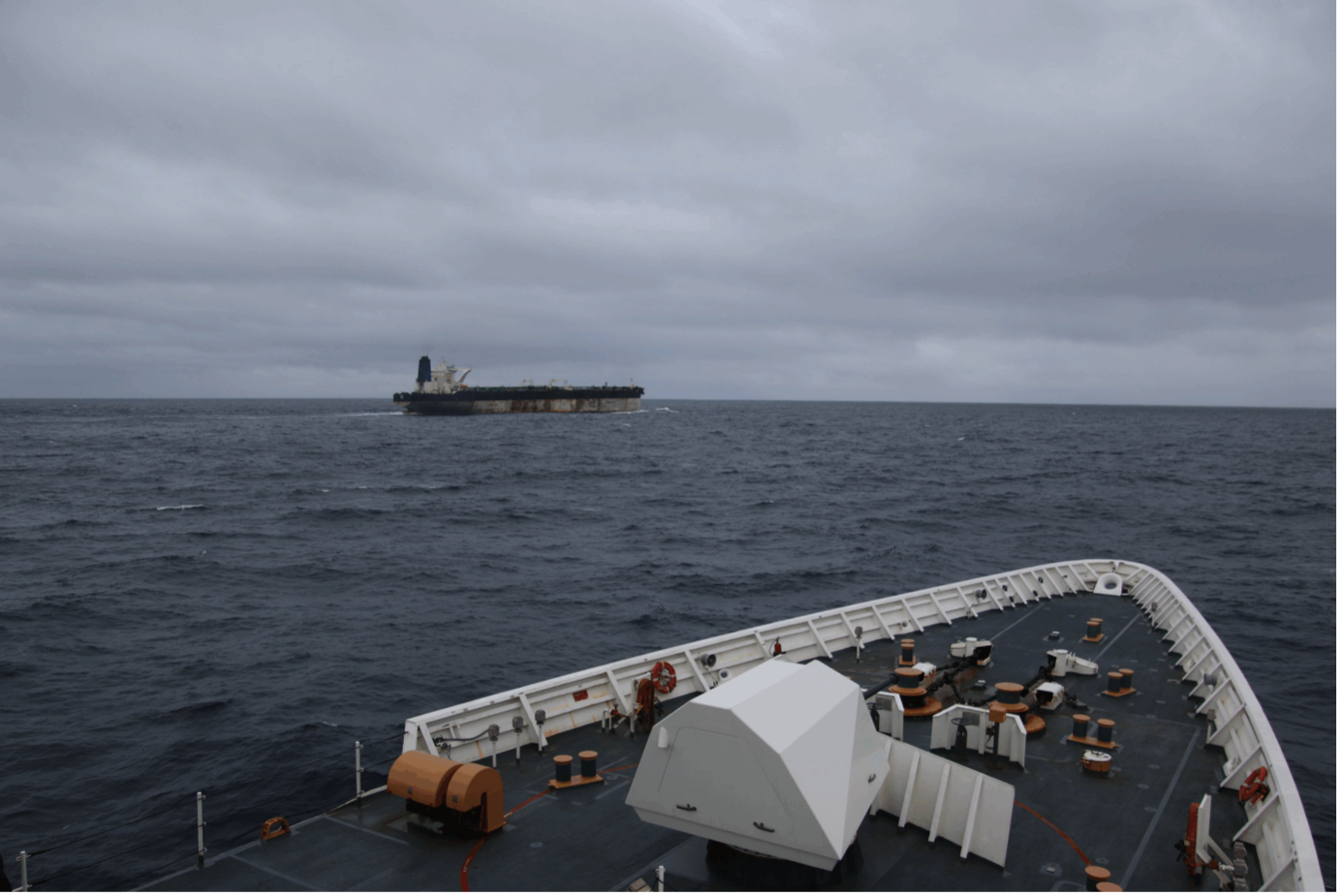
Image source: Wikimedia Commons.
The trajectory towards sea-based escalation not only increases the prospect of war by narrowing the gap between grey zone operations and straightforward combat operations, it also paradoxically widens it by extending their effects to everyone else – from those involved in the less obvious aspects of the shipping industry (such as ship brokerage and marine insurance) to broader economic actors. The fact that Mexico has become a key supplier of oil to Cuba following the US blockade on Venezuelan oil shipments shows how easily these things spread. Such operations increase market volatility and distort trade patterns at a time when growth expectations for the shipping industry in 2026 are less than stellar, with a marked “newbuild slump” and the fading urge to “get ahead” of Trump’s tariffs.
The overall economic consequences of such potentially deadly quarrels at sea are unclear. For example, the impacts of the American oil embargo and “incursion” into Venezuela are anybody’s guess. Given the likely need for heavy direct and indirect investment in Venezuela before its difficult “sour” oil can be fully exploited, coupled with uncertainty about the ultimate effects on America’s domestic oil industry, the outcome may not live up to White House expectations – especially as it continues to push for cheaper and more accessible oil supplies while other countries are down-scaling oil use.
More generally, the legal manoeuvring associated with attacks on alleged drug boats and at-sea vessel-seizures, along with the shadowy and sneaky skulduggery that seems inevitably associated with these operations, may chip away at the very idea of the “rules” and conventions essential to effective sea-based trade. Ambiguity is inherently and dangerously destabilising because it increases unpredictability and reduces constraints on illicit behaviour. Clarifying and observing the rules becomes ever more necessary. As with much of the tanker targeting, we shall probably have to wait and see, but it seems fair to conclude that we may be heading into waters that are getting very dangerous indeed.
Geoffrey Till is S. Rajaratnam Professor of Strategic Studies and Adviser to the Maritime Security Programme at the S. Rajaratnam School of International Studies (RSIS).
KEY TAKEAWAYS
• Heightened international tensions have led to growing attacks on, and seizures of, tankers and other vessels that are at the heart of the global economy.
• While often legal and justified, these attacks carry global economic risks and the potential for escalation to open conflict and warfare.
• To avoid heading into very “dangerous waters”, clear thinking is needed.
COMMENTARY
The recent American seizure of the Russian tanker Marinera is but one example of an escalating campaign against oil tankers and other vessels. They have been attacked with drones and missiles in the Black Sea, subjected to mysterious explosions, impounded in the Caribbean and in the Baltic, and sunk and damaged in ports. Given heightened international tensions, such attacks are not surprising.
Economic strength is critical to strategic success, and shipping is key to that strength. Targeting tankers to impose disproportionate cost on an adversary in times of war and contested peace makes sense. While navies may win battles, economies win wars. But navies and coastguards can nevertheless influence the global economy.
The methods of attacks and interceptions are becoming more varied and potentially hazardous. In wartime, most countries accept the attack of merchant ships and port facilities if the latter support the adversary’s war economy or serve quasi-military purposes. Attacks on ships and ports by both sides in the Russia-Ukraine war, though deadly, are legal and expected.
Neutral shipping in the Russia-Ukraine war makes the situation more complex. The notion of “belligerent rights” allows the interception and inspection of neutral ships to ensure that they are not aiding the adversary’s war effort. Hence, despite Kyiv’s outrage, Moscow’s inspection of the Palau-registered Sukru Okran en route to Odesa last year was perfectly legal.
Next along the spectrum is the interception of, or attacks on, shipping when one side considers itself to be at war but the other does not. The Houthis considered their Red Sea campaign to be legitimately aimed at “neutral shipping” supporting the Israeli war effort in Gaza since due warnings were given and inspection at sea was impractical. Their victims, however, did not consider themselves at war with the Houthis and were themselves fatally divided on whether the attacks justified retaliation ashore. The result was a cost-imposition campaign won by the Houthis, which temporarily upended trade, worsened international relations, and led to major assaults on Houthi ports and missile facilities, but had little discernible effect on the Gaza war itself.
Last come coercive acts by third parties not at war, but who nonetheless seek to apply economic pressure on belligerents and other adversaries through partial sanctions. These complicate the matter further. The potentially acute strategic effect of sanctions incentivises countries such as Russia, North Korea and Iran to evade them through so-called “dark fleet” operations. These involve covert ship passages and illicit ship-to-ship oil transfers, using probably old, poorly maintained vessels, flag-hopping between inconsequential registries, and obscuring beneficial ownership, responsibility and intent. In Russia’s case, the success of these evasive techniques in maintaining crucial oil exports that fund its war efforts has prompted responses from sanctioning countries. Despite carrying clear risks, such coercive attacks must be weighed against the risks of inaction.
Risks and Consequences
The primary risk in intercepting or attacking oil tankers and other vessels is that this further blurs the line between contested peace and war, increasing the likelihood of unintended escalation. After the US Coast Guard (USCG) seized the apparently Russian-registered Marinera in the North Atlantic, Russia demanded that the USCG desist, despatched ships and a submarine to assist, and complained loudly that the action violated international law. The Russian Ministry of Foreign Affairs called the seizure “a gross violation of fundamental principles of international maritime law and freedom of navigation.” A pro-government Russian journalist, Alexander Kots, warned that “nuclear war could be just one step away”, adding that a limited response would convince US President Donald Trump that Russia, like Venezuela, could be pushed around without any real consequences.
Moreover, the deployment of US Navy SEALs and the US Army’s elite “Night Stalker” 160th Special Operations Aviation Regiment to back up the USCG, supported by British bases and forces, demonstrated American determination even if the Russians saw it as a gross violation of their sovereign immunity. This was a difficult and high-stakes operation. In this case, Russia’s wider hope that Trump will help it win the Ukraine war may temporarily mute Moscow’s response, but it highlights a growing problem as other dark fleet ships seek the sanctuary of the Russian flag, and the Russians are now less easily caught by surprise.
The same escalatory tendency is clear in the Baltic. In May 2025, Russian fighters warned off an Estonian attempt to intercept a dark fleet tanker. More recently, alarm has been raised about the presence of uniformed personnel on dark fleet vessels that would make boarding operations more hazardous – but necessary, given their quasi-military role. The Finnish impoundment of the Fitberg on New Year’s Day is the latest example of “neutral” dark fleet vessels suspected of cable-cutting. Last year, other such vessels were suspected of launching drones that temporarily closed down Berlin and Copenhagen airports and monitored NATO bases. Such grey zone incidents have led many Europeans to argue that Russia is already at a kind of war with Europe and to urge stronger, more resolute responses to such provocations. When those tankers fly the Russian flag and are escorted by Russian ships and aircraft, the dangers will greatly increase, not least because this opens them up to legal Ukrainian attack.
This escalatory tendency is also visible in the treatment of neutral vessels by countries that are at war. Russia was widely suspected of releasing illegal free-floating sea mines to interfere with neutral shipping carrying Ukrainian oil, wheat and fertiliser out of the Black Sea. Russia’s port attacks, for all the alleged accuracy of its reconnaissance and strike systems, have not spared neutral shipping in the area. Perhaps frustrated by the limitations of sanctions, Ukraine, for its part, appeared to have taken matters into its own hands last year by arranging a series of mysterious explosions on neutral ships departing Russian ports, sometimes well away from the battle area. More recently, drones have attacked neutral ships carrying Russian oil near the Bosphorus. According to The Moscow Times, such attacks have made neutral third parties wary of trading with Russia. Whether or not Ukraine was behind these attacks, their outcome probably pleases Kyiv.
Image source: Wikimedia Commons.
The trajectory towards sea-based escalation not only increases the prospect of war by narrowing the gap between grey zone operations and straightforward combat operations, it also paradoxically widens it by extending their effects to everyone else – from those involved in the less obvious aspects of the shipping industry (such as ship brokerage and marine insurance) to broader economic actors. The fact that Mexico has become a key supplier of oil to Cuba following the US blockade on Venezuelan oil shipments shows how easily these things spread. Such operations increase market volatility and distort trade patterns at a time when growth expectations for the shipping industry in 2026 are less than stellar, with a marked “newbuild slump” and the fading urge to “get ahead” of Trump’s tariffs.
The overall economic consequences of such potentially deadly quarrels at sea are unclear. For example, the impacts of the American oil embargo and “incursion” into Venezuela are anybody’s guess. Given the likely need for heavy direct and indirect investment in Venezuela before its difficult “sour” oil can be fully exploited, coupled with uncertainty about the ultimate effects on America’s domestic oil industry, the outcome may not live up to White House expectations – especially as it continues to push for cheaper and more accessible oil supplies while other countries are down-scaling oil use.
More generally, the legal manoeuvring associated with attacks on alleged drug boats and at-sea vessel-seizures, along with the shadowy and sneaky skulduggery that seems inevitably associated with these operations, may chip away at the very idea of the “rules” and conventions essential to effective sea-based trade. Ambiguity is inherently and dangerously destabilising because it increases unpredictability and reduces constraints on illicit behaviour. Clarifying and observing the rules becomes ever more necessary. As with much of the tanker targeting, we shall probably have to wait and see, but it seems fair to conclude that we may be heading into waters that are getting very dangerous indeed.
Geoffrey Till is S. Rajaratnam Professor of Strategic Studies and Adviser to the Maritime Security Programme at the S. Rajaratnam School of International Studies (RSIS).