


22 January 2026
IP26014 | 2026 Outlook for KEPRI: Fiscal Pressure and Political Centralisation Test Resilience

KEY TAKEAWAYS
• KEPRI faces a major funding cut in 2026, forcing it to slash regional spending and stall local development projects.
• Fiscal consolidation by Jakarta and centralised prioritisation are constraining the scope of provincial coordination and agenda-setting, even as political expectations of provincial leadership remain high.
• The province is pressured to formalise its economy and boost local revenue, yet lacks the necessary authority and resources to govern effectively, especially against the persistent presence of informal sectors.
COMMENTARY
In 2026, the Riau Islands province (KEPRI) faces a critical stress test between national strategic priorities and regional autonomy. Aggressive fiscal centralisation and political integration pressures from Jakarta threaten to strain the province’s governance and economic ambitions. KEPRI’s trajectory will serve as a key indicator of the pressures facing other provinces.
The Governors’ Protest: A Symptom of Systemic Strain
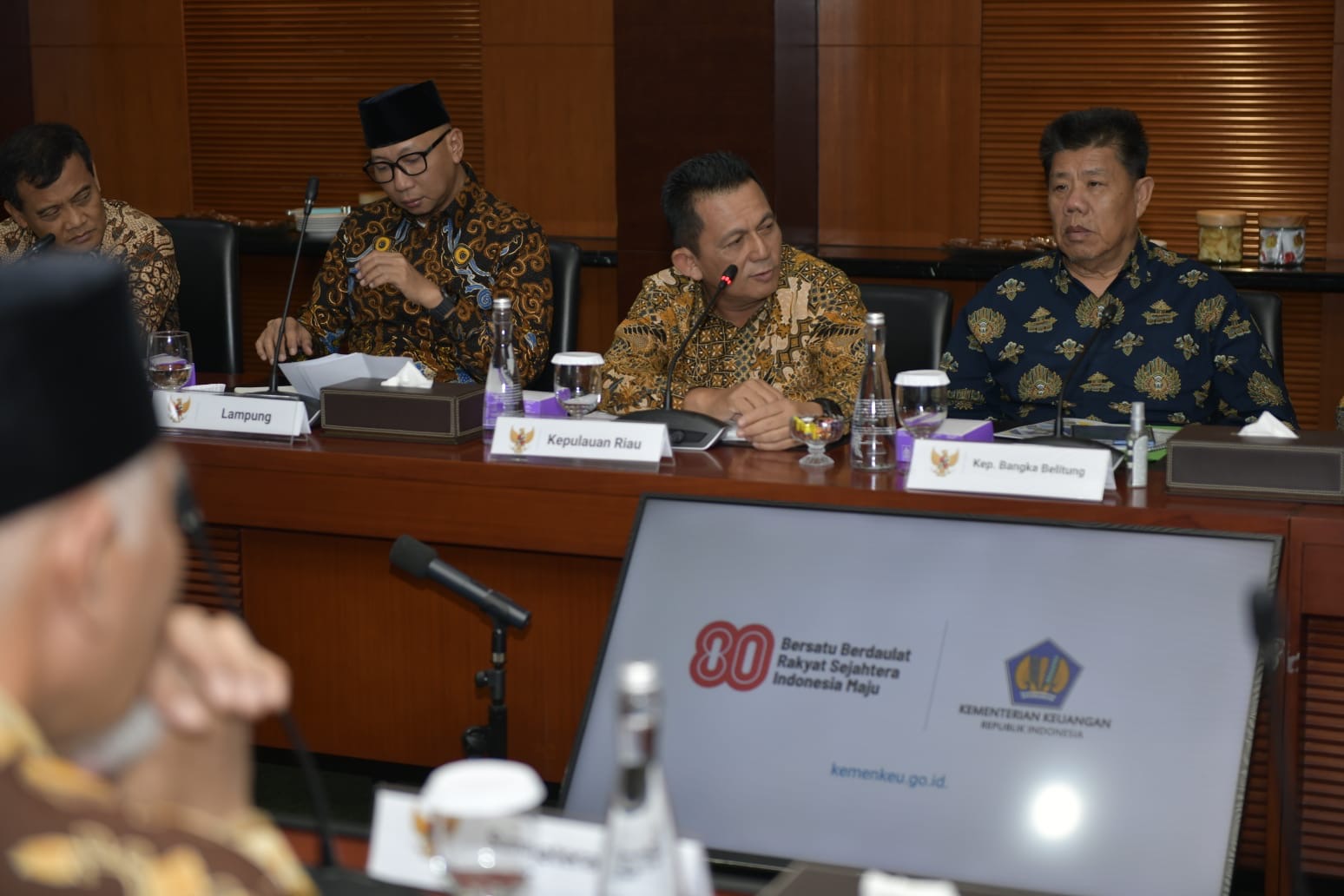
Jakarta’s fiscal squeeze culminated in October 2025, when 18 governors, including KEPRI’s, met with Finance Minister Purbaya Yudhi Sadewa. They warned that sharp reductions in central government transfers (Transfer ke Daerah, TKD) would cripple local budgets, stall infrastructure and disproportionately hit smaller regions. This was more than a budget dispute; it reflected a deeper demand for meaningful regional input into fiscal frameworks that define autonomy.
The Redrawing of Strategic Projects
The budget constraints coincide with a recalibration of national development priorities. In February 2025, President Prabowo Subianto released the National Strategic Projects (Proyek Strategis Nasional, PSN) list. For KEPRI, this reassessment meant the delisting of several legacy projects from the Joko Widodo administration, such as the Rempang Eco City and Pulau Tanjung Sauh developments.
Only four KEPRI projects retained PSN status: the Galang Batang Special Economic Zone, an industrial zone on Ladi Island, the Wiraraja Green Renewable Energy & Smart-Eco Industrial Park on Galang Island, and heavy-industry sites in Toapaya. Meanwhile, locally crucial projects, such as the estimated Rp16–17 trillion (US$0.94–$1 billion) Batam–Bintan bridge, were left to pursue funding through complex public–private partnership (PPP) schemes, placing the onus for financing core infrastructure squarely on the region.
The Mechanics of Budget Constriction
The national budget efficiency directive has placed KEPRI in a critically constrained position. The province’s 2025 revenue was projected at Rp3.918 trillion, with 55% (Rp2.157 trillion) derived from central transfers. Nationwide cuts to TKD, amounting to roughly Rp50 trillion, have hit provinces hard.
For KEPRI, the 2026 impact is acute. The TKD allocation is set to be reduced by a further Rp534 billion, bringing the total down to Rp1.467 trillion, significantly lower than the 2025 figure. Governor Ansar Ahmad stated that this forces a major downward revision of the 2026 Regional Revenue and Expenditure Budget (Anggaran Pendapatan dan Belanja Daerah, APBD), revising it down from a planned Rp3.967 trillion to Rp3.471 trillion. He warned that the cuts could extend to civil servant allowances (TPP), directly affecting administrative stability and morale.
The ripple effects will be profound. In KEPRI’s outer islands, civil servant salaries are a vital source of local demand, helping to sustain small businesses. Cuts risk stifling these economies, highlighting a disconnect between headline growth and local vulnerability.
This fiscal pressure is clear in KEPRI’s budget allocations. Local governments bear a customary burden of supporting central government entities via Belanja Hibah (Grant Expenditures). In 2025, these grants reached Rp84.55 billion by mid-year. This stands in stark contrast to the Rp5.69 billion budgeted for direct social assistance, which reportedly saw 0% disbursement over the same period. The nearly 15-to-1 ratio forces a trade-off between funding central entities and local welfare, a dilemma that forced Vice Governor Nyanyang Haris to publicly defend provincial spending.
The 2026 Tightrope Walk
Faced with this multifaceted pressure, the KEPRI provincial government’s necessary strategy for 2026 is to strive for increased Locally Generated Revenue (Pendapatan Asli Daerah, PAD) to reduce dependence on unpredictable TKD. This imperative, however, confronts the reality that boosting PAD often requires upfront investment in economic enablers, which the current austere budget can ill afford. Consequently, the 2026 APBD will be narrowly focused on mandatory expenditures such as education, health, employee salaries and poverty reduction, along with support for the president’s “Asta Cita” programme and other national initiatives. This creates a circular bind. To achieve future fiscal independence, the province must first survive the present fiscal squeeze. This leaves little room for the strategic investments that could break the cycle. The path ahead for KEPRI is undeniably steep.
This fiscal consolidation places all social spending under intense scrutiny. Officials have acknowledged that Presidential Instruction No. 1 of 2025 necessitates “efficiency” across the budget, including social aid and grant programmes. While provincial leaders have publicly committed to maintaining core social protection programmes, they have also admitted to “reductions”, primarily in ancillary areas like administrative travel and support activities. This managed retrenchment reduces the discretionary resources available to sustain long-term engagement with community organisations, many of which rely on predictable funding cycles for planning and operations. While provincial leaders have sought to protect core social protection programmes, reductions in ancillary spending limit the province’s capacity to support locally designed initiatives. Rather than signalling a formal loss of authority, this reflects tighter operational constraints that prioritise compliance with central efficiency directives over locally adaptive social policy.
The Quiet Hollowing of Provincial Leadership
Centralised development planning offers clear advantages, including reduced duplication, accelerated flagship projects and strategic coherence. However, it systematically reshapes how local concerns are valued. Projects critical to local identity and economy, but lacking national scale or symbolism, are invariably deprioritised, forcing local governments to subordinate their agendas. The message is subtle but powerful: local priorities matter only insofar as they align with central directives.
This dynamic triggers a dangerous erosion of provincial leadership. When governors cannot advance salient local projects, their political relevance diminishes. They become intermediaries explaining central decisions rather than decision-makers shaping outcomes. For 2026 and beyond, this has several corrosive consequences. Local leaders remain electorally accountable for development outcomes they do not control, undermining the purpose of local elections. Provincial offices retain administrative duties but lose agenda-setting power, weakening their ability to respond credibly to local concerns. Furthermore, as local initiatives are repeatedly sidelined, administrations become risk-averse and dependent, focusing on compliance over innovation.
This erosion of leadership is perhaps most starkly visible in a core governance dilemma. On one hand, KEPRI is compelled to foster a formal, compliant economy to increase its own revenue, a central tenet of the autonomy it is supposed to exercise. On the other, the province’s significant informal economic activities continue to flourish, operating in the shadows of the national strategic infrastructure deployed to protect state assets. This creates a debilitating gap: provincial authorities are held accountable for economic formalisation, yet lack the integrated authority, resources, or perhaps political capital to effectively police their own jurisdictions in a way that aligns with local socio-economic complexities. They are thus rendered spectators to an economic reality they are officially tasked with transforming.
In 2026, KEPRI’s leadership risks being reduced to a hollow shell of governance, managing procedures without substantive power. This is a stark prospect for a province vital to Indonesia’s growth and heritage. While national coordination is necessary, it must not render provincial governments irrelevant. In a diverse archipelago, effective development requires local leaders who can champion locally resonant initiatives. This year will test whether KEPRI can balance its national strategic role with local imperatives. The outcome will offer a crucial signal for the future of effective regional governance in Indonesia.
Syed Huzaifah Bin Othman Alkaff is an Associate Research Fellow of the Indonesia Programme at the Institute of Defence and Strategic Studies (IDSS), S. Rajaratnam School of International Studies (RSIS). Sayed Fauzan Riyadi is an Associate Professor, International Relations Department, Raja Ali Haji Maritim University (UMRAH), Riau Islands.
KEY TAKEAWAYS
• KEPRI faces a major funding cut in 2026, forcing it to slash regional spending and stall local development projects.
• Fiscal consolidation by Jakarta and centralised prioritisation are constraining the scope of provincial coordination and agenda-setting, even as political expectations of provincial leadership remain high.
• The province is pressured to formalise its economy and boost local revenue, yet lacks the necessary authority and resources to govern effectively, especially against the persistent presence of informal sectors.
COMMENTARY
In 2026, the Riau Islands province (KEPRI) faces a critical stress test between national strategic priorities and regional autonomy. Aggressive fiscal centralisation and political integration pressures from Jakarta threaten to strain the province’s governance and economic ambitions. KEPRI’s trajectory will serve as a key indicator of the pressures facing other provinces.
The Governors’ Protest: A Symptom of Systemic Strain
Jakarta’s fiscal squeeze culminated in October 2025, when 18 governors, including KEPRI’s, met with Finance Minister Purbaya Yudhi Sadewa. They warned that sharp reductions in central government transfers (Transfer ke Daerah, TKD) would cripple local budgets, stall infrastructure and disproportionately hit smaller regions. This was more than a budget dispute; it reflected a deeper demand for meaningful regional input into fiscal frameworks that define autonomy.
The Redrawing of Strategic Projects
The budget constraints coincide with a recalibration of national development priorities. In February 2025, President Prabowo Subianto released the National Strategic Projects (Proyek Strategis Nasional, PSN) list. For KEPRI, this reassessment meant the delisting of several legacy projects from the Joko Widodo administration, such as the Rempang Eco City and Pulau Tanjung Sauh developments.
Only four KEPRI projects retained PSN status: the Galang Batang Special Economic Zone, an industrial zone on Ladi Island, the Wiraraja Green Renewable Energy & Smart-Eco Industrial Park on Galang Island, and heavy-industry sites in Toapaya. Meanwhile, locally crucial projects, such as the estimated Rp16–17 trillion (US$0.94–$1 billion) Batam–Bintan bridge, were left to pursue funding through complex public–private partnership (PPP) schemes, placing the onus for financing core infrastructure squarely on the region.
The Mechanics of Budget Constriction
The national budget efficiency directive has placed KEPRI in a critically constrained position. The province’s 2025 revenue was projected at Rp3.918 trillion, with 55% (Rp2.157 trillion) derived from central transfers. Nationwide cuts to TKD, amounting to roughly Rp50 trillion, have hit provinces hard.
For KEPRI, the 2026 impact is acute. The TKD allocation is set to be reduced by a further Rp534 billion, bringing the total down to Rp1.467 trillion, significantly lower than the 2025 figure. Governor Ansar Ahmad stated that this forces a major downward revision of the 2026 Regional Revenue and Expenditure Budget (Anggaran Pendapatan dan Belanja Daerah, APBD), revising it down from a planned Rp3.967 trillion to Rp3.471 trillion. He warned that the cuts could extend to civil servant allowances (TPP), directly affecting administrative stability and morale.
The ripple effects will be profound. In KEPRI’s outer islands, civil servant salaries are a vital source of local demand, helping to sustain small businesses. Cuts risk stifling these economies, highlighting a disconnect between headline growth and local vulnerability.
This fiscal pressure is clear in KEPRI’s budget allocations. Local governments bear a customary burden of supporting central government entities via Belanja Hibah (Grant Expenditures). In 2025, these grants reached Rp84.55 billion by mid-year. This stands in stark contrast to the Rp5.69 billion budgeted for direct social assistance, which reportedly saw 0% disbursement over the same period. The nearly 15-to-1 ratio forces a trade-off between funding central entities and local welfare, a dilemma that forced Vice Governor Nyanyang Haris to publicly defend provincial spending.
The 2026 Tightrope Walk
Faced with this multifaceted pressure, the KEPRI provincial government’s necessary strategy for 2026 is to strive for increased Locally Generated Revenue (Pendapatan Asli Daerah, PAD) to reduce dependence on unpredictable TKD. This imperative, however, confronts the reality that boosting PAD often requires upfront investment in economic enablers, which the current austere budget can ill afford. Consequently, the 2026 APBD will be narrowly focused on mandatory expenditures such as education, health, employee salaries and poverty reduction, along with support for the president’s “Asta Cita” programme and other national initiatives. This creates a circular bind. To achieve future fiscal independence, the province must first survive the present fiscal squeeze. This leaves little room for the strategic investments that could break the cycle. The path ahead for KEPRI is undeniably steep.
This fiscal consolidation places all social spending under intense scrutiny. Officials have acknowledged that Presidential Instruction No. 1 of 2025 necessitates “efficiency” across the budget, including social aid and grant programmes. While provincial leaders have publicly committed to maintaining core social protection programmes, they have also admitted to “reductions”, primarily in ancillary areas like administrative travel and support activities. This managed retrenchment reduces the discretionary resources available to sustain long-term engagement with community organisations, many of which rely on predictable funding cycles for planning and operations. While provincial leaders have sought to protect core social protection programmes, reductions in ancillary spending limit the province’s capacity to support locally designed initiatives. Rather than signalling a formal loss of authority, this reflects tighter operational constraints that prioritise compliance with central efficiency directives over locally adaptive social policy.
The Quiet Hollowing of Provincial Leadership
Centralised development planning offers clear advantages, including reduced duplication, accelerated flagship projects and strategic coherence. However, it systematically reshapes how local concerns are valued. Projects critical to local identity and economy, but lacking national scale or symbolism, are invariably deprioritised, forcing local governments to subordinate their agendas. The message is subtle but powerful: local priorities matter only insofar as they align with central directives.
This dynamic triggers a dangerous erosion of provincial leadership. When governors cannot advance salient local projects, their political relevance diminishes. They become intermediaries explaining central decisions rather than decision-makers shaping outcomes. For 2026 and beyond, this has several corrosive consequences. Local leaders remain electorally accountable for development outcomes they do not control, undermining the purpose of local elections. Provincial offices retain administrative duties but lose agenda-setting power, weakening their ability to respond credibly to local concerns. Furthermore, as local initiatives are repeatedly sidelined, administrations become risk-averse and dependent, focusing on compliance over innovation.
This erosion of leadership is perhaps most starkly visible in a core governance dilemma. On one hand, KEPRI is compelled to foster a formal, compliant economy to increase its own revenue, a central tenet of the autonomy it is supposed to exercise. On the other, the province’s significant informal economic activities continue to flourish, operating in the shadows of the national strategic infrastructure deployed to protect state assets. This creates a debilitating gap: provincial authorities are held accountable for economic formalisation, yet lack the integrated authority, resources, or perhaps political capital to effectively police their own jurisdictions in a way that aligns with local socio-economic complexities. They are thus rendered spectators to an economic reality they are officially tasked with transforming.
In 2026, KEPRI’s leadership risks being reduced to a hollow shell of governance, managing procedures without substantive power. This is a stark prospect for a province vital to Indonesia’s growth and heritage. While national coordination is necessary, it must not render provincial governments irrelevant. In a diverse archipelago, effective development requires local leaders who can champion locally resonant initiatives. This year will test whether KEPRI can balance its national strategic role with local imperatives. The outcome will offer a crucial signal for the future of effective regional governance in Indonesia.
Syed Huzaifah Bin Othman Alkaff is an Associate Research Fellow of the Indonesia Programme at the Institute of Defence and Strategic Studies (IDSS), S. Rajaratnam School of International Studies (RSIS). Sayed Fauzan Riyadi is an Associate Professor, International Relations Department, Raja Ali Haji Maritim University (UMRAH), Riau Islands.


