


02 February 2026
IP26019 | China’s Vision of South Asian Order

KEY TAKEAWAYS
• Recently China has shifted its approach to engagement with its periphery, including South Asia, aiming to structurally tie countries closer to itself.
• Along with its close ties to Pakistan, China has increased engagement with India’s smaller South Asian neighbours.
• While Beijing is increasingly desiring to shape the regional order, its ability to steer outcomes remains uneven and contingent on local political dynamics and the agency of regional actors.
COMMENTARY
The year 2025 marked a distinct shift in China’s engagement with its periphery. Addressing a symposium at the end of the year, Chinese Foreign Minister Wang Yi argued that while China’s relations with states along its periphery were “at their best since modern times”, regional dynamics were increasingly “deeply affected by the changes in the international landscape” and “maintaining prosperity and stability” across the periphery required “persistent efforts”. Earlier, in April, the Chinese leadership held its first-ever Central Conference on Peripheral Work. The meeting recognised that the periphery was a “vital foundation” for China’s development and prosperity and needed to be viewed from a “global perspective”.
Analysing this language, Chinese scholars like Zhai Kun and Li Kaisheng concluded that strategic competition with the United States was increasingly weighing heavily on China’s engagement with neighbouring countries. Faced with the threat of integrated containment, they contended that Beijing was devising a strategy of integrated engagement. The goal of this approach is to structurally tie countries closer to China in a more holistic sense, ensuring that they lean towards it. In essence, the conference presaged the evolution of a more broad-based and proactive diplomatic approach towards neighbouring states.
This has been particularly evident when it comes to Chinese engagement with states across the Indian subcontinent. China is already a critical trade and investment partner for countries in the region, with overall trade estimated at around US$200 billion. Beijing is now also increasingly positioning itself as a builder of regional order. For instance, addressing the media during a visit to Islamabad in August 2025, Wang described the region as “an important direction for China to build a community with a shared future in its neighbourhood”. He argued that China would be a “trustworthy partner and a strong support for South Asian countries” as they prioritised development and contended with “unilateral and bullying acts” of the United States. That said, events over the past year have also showcased the limits of Chinese influence in the region.
After over five years of friction, the India-China relationship appears to be moving towards a process of cautious re-engagement. The meetings between Indian Prime Minister Narendra Modi and Chinese President Xi Jinping in Kazan in October 2024 and Tianjin in September 2025 provided the necessary impetus. Since the Kazan meeting, the two countries have restored direct air connectivity, resumed bilateral ministerial dialogues, and eased visa processes. Wang’s visit to India in August 2025 also yielded agreements to establish an expert group to explore early harvest in boundary delimitation in the India-China border areas, a working group to advance effective border management, and the creation of General Level Mechanisms in the Eastern and Middle Sectors of the boundary.
Trade between the two countries has thrived despite political acrimony and security challenges, and New Delhi now appears to be re-evaluating its restrictive posture towards Chinese investments. This positive momentum is as much a product of bilateral dynamics as it is driven by changes in the broader geopolitical environment since the re-election of Donald Trump as US president. Nevertheless, it would be premature to characterise this re-engagement as a strategic thaw. Diplomatic sparring over the Shaksgam Valley and Arunachal Pradesh in recent months underscores the deep fault lines between the two sides. Rather, this phase reflects an effort by both to put a floor under the relationship amid persistent structural frictions and adverse geopolitical currents.
The May 2025 conflict between India and Pakistan was another example of the limitations of Beijing’s influence in the region. While Indian officials said that China provided Pakistan with live intelligence support and Wang indicated that China played a role in managing tensions between Pakistan and India, there is little evidence that Beijing had any substantial influence over unfolding events. The only public engagement that the Chinese side had with both India and Pakistan was following their ceasefire announcement. The episode, however, underscored the threat that rapid conflict escalation and instability could pose for Chinese economic and security interests in the region.
The aftermath of the conflict also coincided with Pakistani army chief Asim Munir’s consolidation of power and intense courting of Washington. Munir publicly credited Trump with facilitating the ceasefire between India and Pakistan. In June, he became the first serving Pakistani army chief to be formally hosted by a US president. Soon after, the two sides inked a bilateral trade deal, expanding their engagement on the issue of critical minerals. In September, US Strategic Metals signed a US$500 million investment deal with Pakistan’s Frontier Works Organization. Later in the year, the US EXIM Bank agreed to provide a US$1.25 billion loan for the Reko Diq mine being developed in Pakistan by Barrick Gold Mining. Apart from its deepening ties with the United States, Pakistan also found itself far more deeply engaged in the turmoil across West Asia. In September, Pakistan and Saudi Arabia announced the inking of a Strategic Mutual Defence Agreement. Beijing’s response to the deal was muted, and Chinese analysts remain divided about the impact of the deal on China’s broader interests.
From the perspective of China’s engagement with Pakistan, however, the cumulative signal from these developments was clear. Islamabad has demonstrated an ability to broaden its external partnerships and diversify its strategic patrons. This diversification does not necessarily dilute the China–Pakistan relationship; after all, Pakistan’s Mohammad Ishaq Dar was the first foreign minister to visit China in 2026. But it does underscore Pakistan’s growing room for manoeuvre and introduces a more complex external environment for Beijing’s long-standing assumptions about its leverage over Pakistan.
Finally, across the smaller states in the Indian subcontinent, Beijing has clearly expanded its influence in Sri Lanka and Bangladesh. January 2025 saw Sri Lankan President Anura Kumara Dissanayake visit China, with the two sides inking several deals in areas such as economic development, education, media and culture. In October 2025, Sri Lankan Prime Minister Harini Amarasuriya travelled to Beijing and held talks focusing on closer cooperation in law enforcement. It is, however, important to highlight that Dissanayake’s visit to China followed his visit to India, and Amarasuriya’s visit to Beijing was followed by a trip to Delhi. In that sense, despite the political churn in Colombo, there remains a policy of balancing ties with India and China.
Bangladesh and Nepal, meanwhile, represent two points on the spectrum when it comes to evaluating Beijing’s responsiveness to sudden crises. The Chinese government was quick to adapt to the ouster of Sheikh Hasina in Dhaka in August 2024, engaging with the new centres of power in the country. By March 2025, Bangladesh’s new Chief Adviser Muhammad Yunus travelled to Beijing for a substantive visit. A few months later, the first meeting of the China–Pakistan–Bangladesh trilateral group was held in Kunming, with the three countries pursuing a wide-ranging cooperation agenda. Beijing is also likely supportive of the deepening defence cooperation between Dhaka and Islamabad. The two countries are reportedly discussing a deal for Bangladesh to procure the Pakistani-made JF-17 Thunder fighter jet.
In stark contrast to how it navigated the violent upheaval in Bangladesh, Beijing was caught rather flat-footed when the protests in Nepal toppled Prime Minister KP Sharma Oli’s government in September 2025. What was worse was that Oli had just returned after a visit to Tianjin, where he met with Xi Jinping. Beijing called for stability, terming the protests a “domestic issue”. It also remained rather cautious in its approach towards the interim government led by Sushila Karki, with no outreach by the senior Chinese leadership.
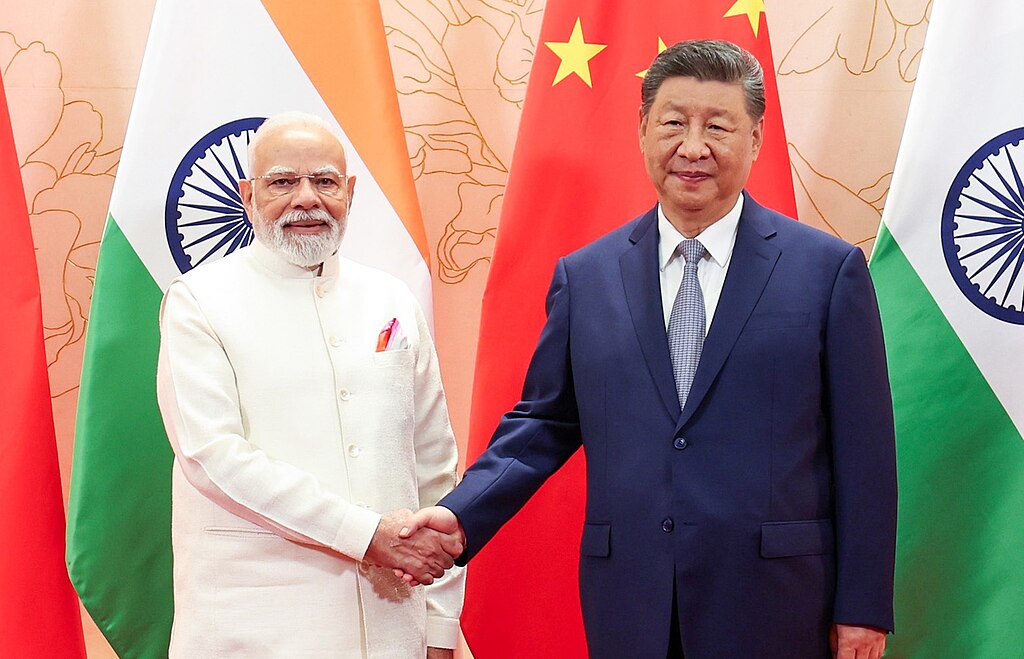
Image credit: Prime Minister’s Office (GODL-India), GODL-India, via Wikimedia Commons.
In conclusion, from a composite perspective, China’s more proactive peripheral diplomacy, thus far, reveals both ambition and constraint. While Beijing is increasingly keen on shaping the regional order, its ability to steer outcomes remains uneven and contingent on local political dynamics, along with the agency of regional actors.
Manoj Kewalramani is the chairperson of the Indo-Pacific Research Programme and a China studies fellow at the Takshashila Institution, Bengaluru, India. He was a Visiting Fellow with the South Asia Programme at the S. Rajaratnam School of International Studies (RSIS).
KEY TAKEAWAYS
• Recently China has shifted its approach to engagement with its periphery, including South Asia, aiming to structurally tie countries closer to itself.
• Along with its close ties to Pakistan, China has increased engagement with India’s smaller South Asian neighbours.
• While Beijing is increasingly desiring to shape the regional order, its ability to steer outcomes remains uneven and contingent on local political dynamics and the agency of regional actors.
COMMENTARY
The year 2025 marked a distinct shift in China’s engagement with its periphery. Addressing a symposium at the end of the year, Chinese Foreign Minister Wang Yi argued that while China’s relations with states along its periphery were “at their best since modern times”, regional dynamics were increasingly “deeply affected by the changes in the international landscape” and “maintaining prosperity and stability” across the periphery required “persistent efforts”. Earlier, in April, the Chinese leadership held its first-ever Central Conference on Peripheral Work. The meeting recognised that the periphery was a “vital foundation” for China’s development and prosperity and needed to be viewed from a “global perspective”.
Analysing this language, Chinese scholars like Zhai Kun and Li Kaisheng concluded that strategic competition with the United States was increasingly weighing heavily on China’s engagement with neighbouring countries. Faced with the threat of integrated containment, they contended that Beijing was devising a strategy of integrated engagement. The goal of this approach is to structurally tie countries closer to China in a more holistic sense, ensuring that they lean towards it. In essence, the conference presaged the evolution of a more broad-based and proactive diplomatic approach towards neighbouring states.
This has been particularly evident when it comes to Chinese engagement with states across the Indian subcontinent. China is already a critical trade and investment partner for countries in the region, with overall trade estimated at around US$200 billion. Beijing is now also increasingly positioning itself as a builder of regional order. For instance, addressing the media during a visit to Islamabad in August 2025, Wang described the region as “an important direction for China to build a community with a shared future in its neighbourhood”. He argued that China would be a “trustworthy partner and a strong support for South Asian countries” as they prioritised development and contended with “unilateral and bullying acts” of the United States. That said, events over the past year have also showcased the limits of Chinese influence in the region.
After over five years of friction, the India-China relationship appears to be moving towards a process of cautious re-engagement. The meetings between Indian Prime Minister Narendra Modi and Chinese President Xi Jinping in Kazan in October 2024 and Tianjin in September 2025 provided the necessary impetus. Since the Kazan meeting, the two countries have restored direct air connectivity, resumed bilateral ministerial dialogues, and eased visa processes. Wang’s visit to India in August 2025 also yielded agreements to establish an expert group to explore early harvest in boundary delimitation in the India-China border areas, a working group to advance effective border management, and the creation of General Level Mechanisms in the Eastern and Middle Sectors of the boundary.
Trade between the two countries has thrived despite political acrimony and security challenges, and New Delhi now appears to be re-evaluating its restrictive posture towards Chinese investments. This positive momentum is as much a product of bilateral dynamics as it is driven by changes in the broader geopolitical environment since the re-election of Donald Trump as US president. Nevertheless, it would be premature to characterise this re-engagement as a strategic thaw. Diplomatic sparring over the Shaksgam Valley and Arunachal Pradesh in recent months underscores the deep fault lines between the two sides. Rather, this phase reflects an effort by both to put a floor under the relationship amid persistent structural frictions and adverse geopolitical currents.
The May 2025 conflict between India and Pakistan was another example of the limitations of Beijing’s influence in the region. While Indian officials said that China provided Pakistan with live intelligence support and Wang indicated that China played a role in managing tensions between Pakistan and India, there is little evidence that Beijing had any substantial influence over unfolding events. The only public engagement that the Chinese side had with both India and Pakistan was following their ceasefire announcement. The episode, however, underscored the threat that rapid conflict escalation and instability could pose for Chinese economic and security interests in the region.
The aftermath of the conflict also coincided with Pakistani army chief Asim Munir’s consolidation of power and intense courting of Washington. Munir publicly credited Trump with facilitating the ceasefire between India and Pakistan. In June, he became the first serving Pakistani army chief to be formally hosted by a US president. Soon after, the two sides inked a bilateral trade deal, expanding their engagement on the issue of critical minerals. In September, US Strategic Metals signed a US$500 million investment deal with Pakistan’s Frontier Works Organization. Later in the year, the US EXIM Bank agreed to provide a US$1.25 billion loan for the Reko Diq mine being developed in Pakistan by Barrick Gold Mining. Apart from its deepening ties with the United States, Pakistan also found itself far more deeply engaged in the turmoil across West Asia. In September, Pakistan and Saudi Arabia announced the inking of a Strategic Mutual Defence Agreement. Beijing’s response to the deal was muted, and Chinese analysts remain divided about the impact of the deal on China’s broader interests.
From the perspective of China’s engagement with Pakistan, however, the cumulative signal from these developments was clear. Islamabad has demonstrated an ability to broaden its external partnerships and diversify its strategic patrons. This diversification does not necessarily dilute the China–Pakistan relationship; after all, Pakistan’s Mohammad Ishaq Dar was the first foreign minister to visit China in 2026. But it does underscore Pakistan’s growing room for manoeuvre and introduces a more complex external environment for Beijing’s long-standing assumptions about its leverage over Pakistan.
Finally, across the smaller states in the Indian subcontinent, Beijing has clearly expanded its influence in Sri Lanka and Bangladesh. January 2025 saw Sri Lankan President Anura Kumara Dissanayake visit China, with the two sides inking several deals in areas such as economic development, education, media and culture. In October 2025, Sri Lankan Prime Minister Harini Amarasuriya travelled to Beijing and held talks focusing on closer cooperation in law enforcement. It is, however, important to highlight that Dissanayake’s visit to China followed his visit to India, and Amarasuriya’s visit to Beijing was followed by a trip to Delhi. In that sense, despite the political churn in Colombo, there remains a policy of balancing ties with India and China.
Bangladesh and Nepal, meanwhile, represent two points on the spectrum when it comes to evaluating Beijing’s responsiveness to sudden crises. The Chinese government was quick to adapt to the ouster of Sheikh Hasina in Dhaka in August 2024, engaging with the new centres of power in the country. By March 2025, Bangladesh’s new Chief Adviser Muhammad Yunus travelled to Beijing for a substantive visit. A few months later, the first meeting of the China–Pakistan–Bangladesh trilateral group was held in Kunming, with the three countries pursuing a wide-ranging cooperation agenda. Beijing is also likely supportive of the deepening defence cooperation between Dhaka and Islamabad. The two countries are reportedly discussing a deal for Bangladesh to procure the Pakistani-made JF-17 Thunder fighter jet.
In stark contrast to how it navigated the violent upheaval in Bangladesh, Beijing was caught rather flat-footed when the protests in Nepal toppled Prime Minister KP Sharma Oli’s government in September 2025. What was worse was that Oli had just returned after a visit to Tianjin, where he met with Xi Jinping. Beijing called for stability, terming the protests a “domestic issue”. It also remained rather cautious in its approach towards the interim government led by Sushila Karki, with no outreach by the senior Chinese leadership.
Image credit: Prime Minister’s Office (GODL-India), GODL-India, via Wikimedia Commons.
In conclusion, from a composite perspective, China’s more proactive peripheral diplomacy, thus far, reveals both ambition and constraint. While Beijing is increasingly keen on shaping the regional order, its ability to steer outcomes remains uneven and contingent on local political dynamics, along with the agency of regional actors.
Manoj Kewalramani is the chairperson of the Indo-Pacific Research Programme and a China studies fellow at the Takshashila Institution, Bengaluru, India. He was a Visiting Fellow with the South Asia Programme at the S. Rajaratnam School of International Studies (RSIS).