


03 February 2026
IP26020 | The Trump Battleship Controversy: Big Ships and Battle Systems

KEY TAKEAWAYS
• The recently announced Trump-class battleship has attracted much sceptical comment and has yet to be authorised by Congress.
• Nonetheless, the fleet design issues it raises are complicated and deserve balanced thought.
COMMENTARY
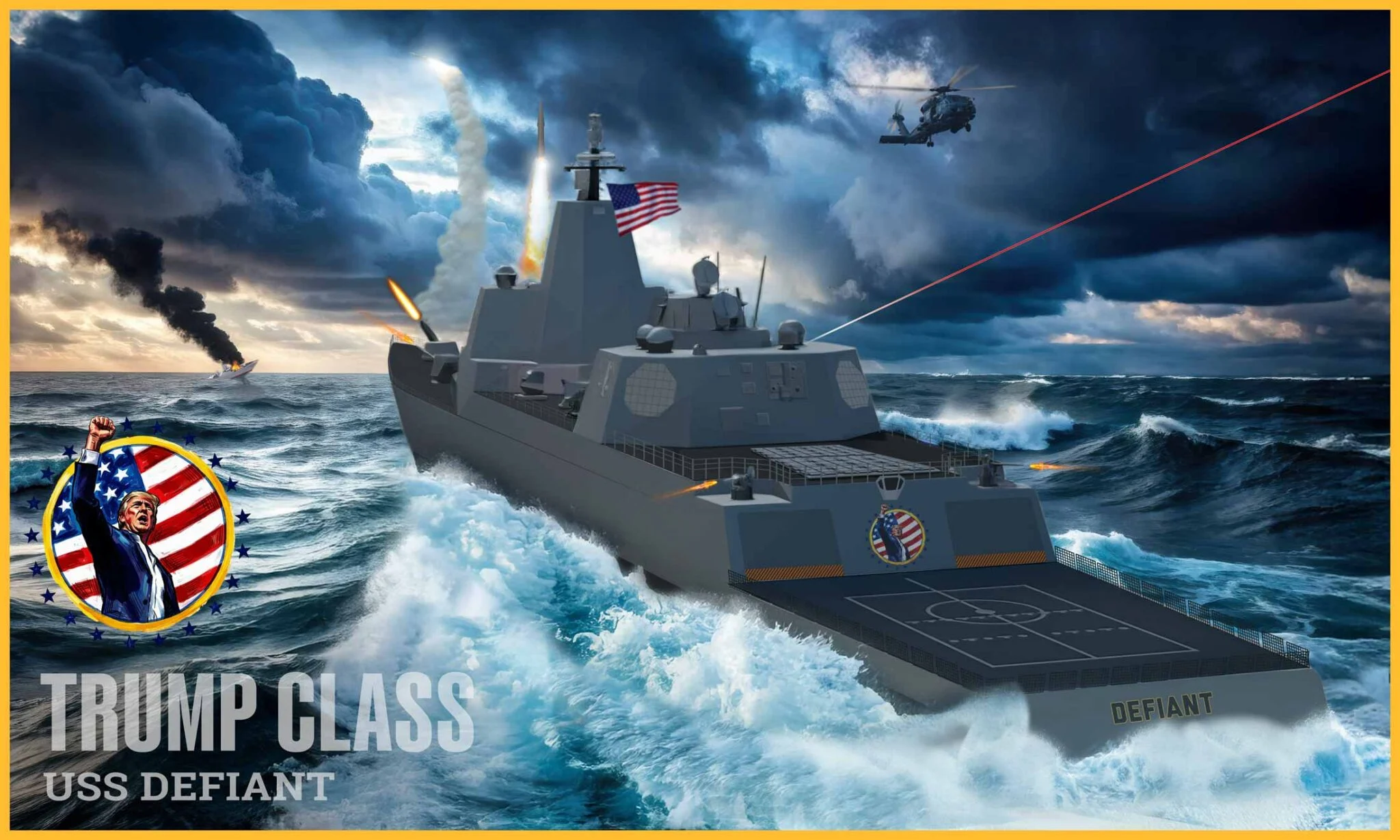
The US Navy’s recent announcement of its intention to build a new class of battleship BBG(X) named after US President Donald Trump as the backbone of its future Golden Fleet has attracted much global controversy and debate, even a degree of ridicule. Most of it has focused on the characteristics of the ship itself, not least its unofficial class name. Trump, as “a very aesthetic person” involved in the design process, claims responsibility for the fact that at some 35,000 tons, the ship looks “cool”. Perception matters, of course; apart from its symbolic appeal, the BBG(X) is indeed impressively large and powerful, but expensive too.
Targeting the BBG(X)
Some critics have accused the project, however, of confusing size with strength and theatre with strategy. Others have pointed out potential faults in the ship’s construction, weapons or sensors. Some argue that an equivalent tonnage of existing ships (like the third flight Arleigh Burke destroyers) could deploy more than the 128 vertical launch cells (for Tomahawk and other such missiles) borne by the BBG(X). Its 5-inch guns are pretty standard; its projected rail gun and advanced lasers will demand extraordinary electrical power generation, although its 12 conventional prompt strike long-range hypersonic missiles and nuclear-armed cruise missiles do seem a significant offering.
This focus on the ship’s individual characteristics, however, needs to be balanced against the operational reality that in a serious conflict at sea, any ship, submarine or aircraft has to be seen as a component in a wide-ranging battle system in which fighting power is diffused among a large number of varied and networked units. Because they are closely linked digitally, each unit can contribute to the overall capacity of the system to locate, fix and destroy the adversary. The Russians aptly call this a “Reconnaissance Strike Complex”, the point being that the system’s kill-chain effectiveness depends on its connectivity in order to layer multiple mutually reinforcing effects on the opponent.
Moreover, this kind of distributed maritime operations usefully spreads both firepower and vulnerability among a larger number of units, thus avoiding the all-the-eggs-in-one-basket kind of problem. Single points of failure are to be avoided, particularly ones whose physical size increases their operational visibility. We should not have a few great ships, critics conclude; instead, navies should invest in many more smaller platforms that disperse the risk while multiplying the sources of lethality as far as the adversary is concerned. Because cyber warfare is so important in all this, the Americans are investing heavily in it, even considering making it a separate command like the Navy and Air Force, but this costs money and effort.
From this perspective, investing in perhaps a dozen hugely expensive capital ships, armed to the teeth with exquisite sensors and weaponry, looks decidedly anachronistic. It harks back to the days before and into World War 2, when there was controversy about the vulnerability of large battleships to swarms of aircraft of the sort that did indeed sink the Prince of Wales and the Repulse off Malaysia in December 1941 and the super-battleship Yamato off Okinawa in 1945. The Russo-Ukrainian War, and in particular the fate of the Moskva, flagship of the Russian Black Sea Fleet, surely underlines the point that today’s trend is towards networked unmanned systems that are getting steadily faster, more intelligent and more deadly. How then, the sceptics ask, can investment in the Trump-class battleship possibly be justified?
Counter-balancing the Criticisms
Persuasive though this argument seems, it is only part of the story. Battle systems have their vulnerabilities too, in particular their absolute reliance on digital connectivity. Around the world, networked communications systems are being brought down with depressing regularity, whether through mechanical failure or through physical or cyber attack. What if that happens to a battle system? Even if it does not, command and control, resupply and logistical support of systems comprising multiple and highly varied units continuously on the move will be difficult. The extent to which even the closest of partners can log into such systems may also prove problematic.
Should such systems fail, the BBG(X)’s supporters argue, there are advantages in concentrated firepower, as proposed by the Arsenal ship project of the 1990s. It provides extra options for a “hedging strategy” of tailoring force packages for contingencies, perhaps far away from the Western Pacific. Being large, the ship is able to carry a plethora of different sensors and weaponry, providing an impressive range of defensive and offensive options, while offering much better resilience through its capacity to absorb damage. As a rule, big ships are more difficult to sink than little ones. In 1941, after all, it took the firing of 19 torpedoes and two heavy air attacks to sink the old, under-armed and ill-escorted battlecruiser Repulse.
A further argument against too quick a dismissal of the great ship is that such vessels usually operate in company as a small battle system in its own right; other accompanying aircraft, ships, submarines and unmanned systems are intended to provide a range of complementary defensive and offensive options for the force package as a whole. In the old days, the battleship was often referred to as the “Queen of the Battlefield”, an analogy that should usefully remind sceptics that all the other pieces of the chess-set have their important roles to play as well. The operational validity of one unit, in short, cannot be properly judged in isolation from its intended entourage.
Trade-offs in Fleet Design
But here is the rub. Would the Trump battleship package provide useful cost-effective capabilities that justify an eye-watering cost of anything from US$5 to US$15 billion and the effort required to defend it? Could those capabilities be delivered by other, cheaper means? The BBG(X)’s design, acquisition and maintenance costs will absorb a big chunk of the US Navy’s budget for the foreseeable future and beyond. The effort to design and build them will absorb so much skilled manpower and shipyard capacity that it is hard to see how a balanced ship-building revival, which is already struggling, can be sustained. “All of our programs are a mess”, Navy Secretary John Phelan told Congress in June. Other expensive projects are under way as well, not least the Navy’s essential nuclear submarine programmes. Can US industry really deliver everything the Navy feels it must have, even with the help of the South Koreans, Australians and Finns? And then there is the question that if these ships only start to be commissioned at the end of the 2030s or even later, what happens in the meantime? Should the United States really be investing in readiness that far ahead if that is at the price of readiness now or in a few years’ time? Given the loss of the old Ticonderoga missile cruisers and the first generations of Arleigh Burke destroyers, a shortfall in heavy surface combatants in the 2030s would seem worryingly possible.
These are complex questions and some of the project’s greatest critics suspect that the decision to proceed has been taken too fast, with too little rounded consideration of its feasibility or even desirability – and perhaps in response to impulses more performative than substantive. Congress has been urged to consider the decision process closely before authorising the project. This is not to say that the Trump battleship project is right or wrong. Instead, this review illustrates just how complex and difficult fleet design issues like this actually are. There are no easy answers to such challenges; they have plagued navies since time immemorial, and probably always will. Technological innovation in warfare is rarely so transformational as to make previous experience irrelevant. Instead, that experience suggests a balanced approach that efficiently integrates the familiar and the novel, concentration and dispersal, quality and quantity, the exquisite and the “good enough”. It would combine incremental upgrades of proven systems and new build, small battle systems and big ones. Such a balance may again prove the surest way forward.
In the BBG(X) project, the intuitive and capricious approach of the White House seems actually to have struck a chord with the considered policy processes of independent thinking in the Navy. Accordingly, the Trump battleship may, despite its manifest problems, have something to offer in future fleet designs.
Geoffrey Till is S. Rajaratnam Professor of Strategic Studies and Adviser to the Maritime Security Programme at the S. Rajaratnam School of International Studies (RSIS).
KEY TAKEAWAYS
• The recently announced Trump-class battleship has attracted much sceptical comment and has yet to be authorised by Congress.
• Nonetheless, the fleet design issues it raises are complicated and deserve balanced thought.
COMMENTARY
The US Navy’s recent announcement of its intention to build a new class of battleship BBG(X) named after US President Donald Trump as the backbone of its future Golden Fleet has attracted much global controversy and debate, even a degree of ridicule. Most of it has focused on the characteristics of the ship itself, not least its unofficial class name. Trump, as “a very aesthetic person” involved in the design process, claims responsibility for the fact that at some 35,000 tons, the ship looks “cool”. Perception matters, of course; apart from its symbolic appeal, the BBG(X) is indeed impressively large and powerful, but expensive too.
Targeting the BBG(X)
Some critics have accused the project, however, of confusing size with strength and theatre with strategy. Others have pointed out potential faults in the ship’s construction, weapons or sensors. Some argue that an equivalent tonnage of existing ships (like the third flight Arleigh Burke destroyers) could deploy more than the 128 vertical launch cells (for Tomahawk and other such missiles) borne by the BBG(X). Its 5-inch guns are pretty standard; its projected rail gun and advanced lasers will demand extraordinary electrical power generation, although its 12 conventional prompt strike long-range hypersonic missiles and nuclear-armed cruise missiles do seem a significant offering.
This focus on the ship’s individual characteristics, however, needs to be balanced against the operational reality that in a serious conflict at sea, any ship, submarine or aircraft has to be seen as a component in a wide-ranging battle system in which fighting power is diffused among a large number of varied and networked units. Because they are closely linked digitally, each unit can contribute to the overall capacity of the system to locate, fix and destroy the adversary. The Russians aptly call this a “Reconnaissance Strike Complex”, the point being that the system’s kill-chain effectiveness depends on its connectivity in order to layer multiple mutually reinforcing effects on the opponent.
Moreover, this kind of distributed maritime operations usefully spreads both firepower and vulnerability among a larger number of units, thus avoiding the all-the-eggs-in-one-basket kind of problem. Single points of failure are to be avoided, particularly ones whose physical size increases their operational visibility. We should not have a few great ships, critics conclude; instead, navies should invest in many more smaller platforms that disperse the risk while multiplying the sources of lethality as far as the adversary is concerned. Because cyber warfare is so important in all this, the Americans are investing heavily in it, even considering making it a separate command like the Navy and Air Force, but this costs money and effort.
From this perspective, investing in perhaps a dozen hugely expensive capital ships, armed to the teeth with exquisite sensors and weaponry, looks decidedly anachronistic. It harks back to the days before and into World War 2, when there was controversy about the vulnerability of large battleships to swarms of aircraft of the sort that did indeed sink the Prince of Wales and the Repulse off Malaysia in December 1941 and the super-battleship Yamato off Okinawa in 1945. The Russo-Ukrainian War, and in particular the fate of the Moskva, flagship of the Russian Black Sea Fleet, surely underlines the point that today’s trend is towards networked unmanned systems that are getting steadily faster, more intelligent and more deadly. How then, the sceptics ask, can investment in the Trump-class battleship possibly be justified?
Counter-balancing the Criticisms
Persuasive though this argument seems, it is only part of the story. Battle systems have their vulnerabilities too, in particular their absolute reliance on digital connectivity. Around the world, networked communications systems are being brought down with depressing regularity, whether through mechanical failure or through physical or cyber attack. What if that happens to a battle system? Even if it does not, command and control, resupply and logistical support of systems comprising multiple and highly varied units continuously on the move will be difficult. The extent to which even the closest of partners can log into such systems may also prove problematic.
Should such systems fail, the BBG(X)’s supporters argue, there are advantages in concentrated firepower, as proposed by the Arsenal ship project of the 1990s. It provides extra options for a “hedging strategy” of tailoring force packages for contingencies, perhaps far away from the Western Pacific. Being large, the ship is able to carry a plethora of different sensors and weaponry, providing an impressive range of defensive and offensive options, while offering much better resilience through its capacity to absorb damage. As a rule, big ships are more difficult to sink than little ones. In 1941, after all, it took the firing of 19 torpedoes and two heavy air attacks to sink the old, under-armed and ill-escorted battlecruiser Repulse.
A further argument against too quick a dismissal of the great ship is that such vessels usually operate in company as a small battle system in its own right; other accompanying aircraft, ships, submarines and unmanned systems are intended to provide a range of complementary defensive and offensive options for the force package as a whole. In the old days, the battleship was often referred to as the “Queen of the Battlefield”, an analogy that should usefully remind sceptics that all the other pieces of the chess-set have their important roles to play as well. The operational validity of one unit, in short, cannot be properly judged in isolation from its intended entourage.
Trade-offs in Fleet Design
But here is the rub. Would the Trump battleship package provide useful cost-effective capabilities that justify an eye-watering cost of anything from US$5 to US$15 billion and the effort required to defend it? Could those capabilities be delivered by other, cheaper means? The BBG(X)’s design, acquisition and maintenance costs will absorb a big chunk of the US Navy’s budget for the foreseeable future and beyond. The effort to design and build them will absorb so much skilled manpower and shipyard capacity that it is hard to see how a balanced ship-building revival, which is already struggling, can be sustained. “All of our programs are a mess”, Navy Secretary John Phelan told Congress in June. Other expensive projects are under way as well, not least the Navy’s essential nuclear submarine programmes. Can US industry really deliver everything the Navy feels it must have, even with the help of the South Koreans, Australians and Finns? And then there is the question that if these ships only start to be commissioned at the end of the 2030s or even later, what happens in the meantime? Should the United States really be investing in readiness that far ahead if that is at the price of readiness now or in a few years’ time? Given the loss of the old Ticonderoga missile cruisers and the first generations of Arleigh Burke destroyers, a shortfall in heavy surface combatants in the 2030s would seem worryingly possible.
These are complex questions and some of the project’s greatest critics suspect that the decision to proceed has been taken too fast, with too little rounded consideration of its feasibility or even desirability – and perhaps in response to impulses more performative than substantive. Congress has been urged to consider the decision process closely before authorising the project. This is not to say that the Trump battleship project is right or wrong. Instead, this review illustrates just how complex and difficult fleet design issues like this actually are. There are no easy answers to such challenges; they have plagued navies since time immemorial, and probably always will. Technological innovation in warfare is rarely so transformational as to make previous experience irrelevant. Instead, that experience suggests a balanced approach that efficiently integrates the familiar and the novel, concentration and dispersal, quality and quantity, the exquisite and the “good enough”. It would combine incremental upgrades of proven systems and new build, small battle systems and big ones. Such a balance may again prove the surest way forward.
In the BBG(X) project, the intuitive and capricious approach of the White House seems actually to have struck a chord with the considered policy processes of independent thinking in the Navy. Accordingly, the Trump battleship may, despite its manifest problems, have something to offer in future fleet designs.
Geoffrey Till is S. Rajaratnam Professor of Strategic Studies and Adviser to the Maritime Security Programme at the S. Rajaratnam School of International Studies (RSIS).