


06 February 2026
IP26021 | China–South Korea Relations: Strategic Imperatives Amid a Changing Asia-Pacific Geopolitical Landscape

KEY TAKEAWAYS
• The recent high-level meeting between President Lee Jae-myung and President Xi Jinping reflects a common desire for both Seoul and Beijing to maintain a peaceful and stable Northeast Asia region amid strained ties with Japan and uncertainty towards American commitment.
• South Korea seeks to ensure it retains political agency, especially on affairs of the Korean Peninsula, regardless of what the Trump administration does on the North Korean nuclear issue.
• China needs to keep Seoul on board to prevent a worst-case scenario of a US–Japan–South Korea containment strategy.
COMMENTARY
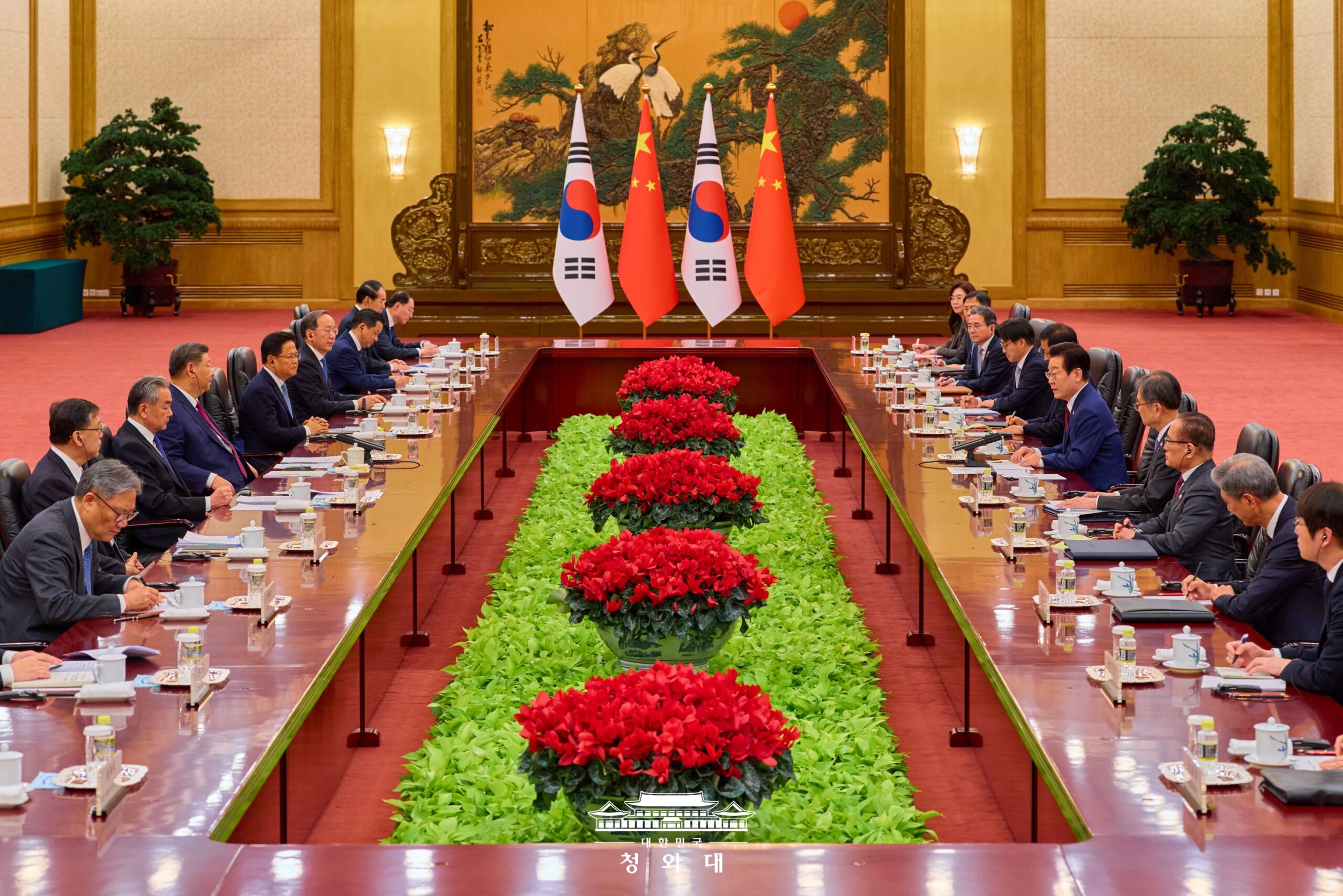
South Korean President Lee Jae-myung paid a state visit to China on 5 January 2026, at the invitation of Chinese President Xi Jinping, and held the second Korea–China summit in Beijing. Coming just two months after their first meeting in Gyeongju in November 2025, the unusually short interval symbolised that bilateral relations – strained since the THAAD dispute – have entered a new phase in which leaders can meet whenever necessary. What, then, are the implications for both Seoul and Beijing?
Seoul’s Strategic Calculation: Keeping the Korean Peninsula “Korean”
Although the summit was held without a joint statement or press conference, making it difficult to assess specific agreements, the visit nonetheless carries important strategic implications when viewed against the broader diplomatic calendar and evolving regional dynamics. Lee’s designation of 2026 as the “year of the full restoration of Korea–China relations” meant that Seoul’s relations with Beijing are likely to improve following the more hawkish approach of his predecessor, Yoon Suk Yeol.
First, the visit represented a pre-emptive diplomatic response to the possibility of renewed US–North Korea dialogue and rapid changes on the Korean Peninsula. At a time when discussions of a visit by US President Donald Trump and a potential resumption of US–North Korea summitry were gaining traction, Seoul’s proactive engagement with Beijing helped ensure that South Korea would remain a central actor rather than a passive observer in peninsula affairs. In other words, keeping South Korea firmly in charge of the affairs of the Korean Peninsula, and to prevent any potential arrangements between Washington and Pyongyang that would undermine its importance and value.
Notably, Seoul and Beijing currently share relatively similar approaches. Lee’s “exchange, normalisation and denuclearisation” (E.N.D.) initiative and China’s dual-track, phased, and synchronised principles both emphasise dialogue without preconditions and discussions on a peace regime, while maintaining the long-term goal of denuclearisation. The fact that both leaders stressed “practical peace” and “regional stability”, rather than foregrounding denuclearisation, reflects this shared realism.
Second, the visit served as a political catalyst to move the restoration of Korea–China relations into a more irreversible phase. In recent years, intensifying US–China strategic competition and supply-chain realignments have constrained bilateral ties. However, as Washington increasingly signals a preference for managing rather than escalating rivalry with Beijing, new space has opened for deeper Korea–China engagement.
Against this backdrop, Lee’s state visit reaffirmed both countries’ commitment to stabilising relations and revitalising economic and technological cooperation. The personal greeting by China’s minister of science and technology and the signing of multiple memoranda of understanding in areas such as AI and digital technology underscored Beijing’s high priority placed on technological cooperation with Seoul.
Third, the visit expanded South Korea’s room to manoeuvre as a regional balancer amid intensifying Sino–Japanese tensions. Lee’s visit to Japan following his trip to China highlighted Seoul’s intention to avoid alignment with any single camp and instead pursue regional stability through coordination. His remarks emphasising peace and stability, while acknowledging historical experiences, conveyed a balanced diplomatic posture that avoids exacerbating current tensions.
Finally, the summit clarified the broader direction of South Korea’s foreign policy in an era of growing multipolarity and spheres-of-influence politics. Lee’s emphasis on “strategic autonomy” reflects a sober recognition that excessive alignment with either Washington or Beijing could constrain national interests. To translate this visit into lasting gains, Seoul must institutionalise strategic autonomy in its national security strategy, strengthen coordination among South Korea, the United States, China, and North Korea, and deliver tangible outcomes in advanced cooperation. In this sense, the second Korea–China summit marks not just a restoration of ties, but a milestone in redefining South Korea’s role in a changing international order.
China’s Calculated Game: Splitting the American Alliance
For China, improving relations with the Republic of Korea is borne out of strategic necessity to ensure that it is not encircled by a potential Washington–Tokyo–Seoul triumvirate. Given the deteriorating state of relations between itself and Japan, and ongoing strategic competition with the United States, Beijing can hardly afford to have a third hostile partner in Seoul. Indeed, the worst-case scenario for China is a democratic alliance of US–Japan–South Korea at its doorstep.
Fortunately for Beijing, South Korea – under a new Democratic administration – appears to have reversed some of the more hawkish positions taken by its previous leader towards China. As argued previously, China does not enjoy a favourable image among South Korean citizens; however, this does not mean that relations cannot improve. Indeed, the recent tariffs placed by the Trump administration on South Korea suggest that being a US ally is no guarantee of favourable American treatment as far as tariffs are concerned.
It is likely, then, that Beijing sees an opportunity to split the American alliance with Tokyo being staunchly onside with Washington (Japanese Prime Minister Sanae Takaichi’s most recent statements about coming to the aid of American and Japanese citizens in the event of a Taiwan contingency would not have gone unnoticed) while Seoul slides towards Beijing.
Indeed, this is part and parcel of Beijing’s United Front approach to geopolitics, in which states are viewed as friends or enemies at different times to maximise China’s leverage in political relations. To be certain, Lee’s subsequent visit to Tokyo and his public display of friendliness with Takaichi are a clear sign that Seoul continues to hedge in its relations with both superpowers. For Beijing however, having Seoul adopt a less confrontational posture represents a win, given the internal and external challenges China currently faces. Whether the uptick in relations can be sustained beyond these initial stages is an open question.
Can Northeast Asia Remain Stable if the United States Disengages?
If the historical presence of the United States in Northeast Asia is largely viewed in favourable terms as contributing to a stable and peaceful environment, then what happens next – should the United States decide to disengage – would be equally consequential. There are concerns that Japan and South Korea would eventually develop their own nuclear weapons should US extended deterrence fail, and that China may sooner rather than later make a move on Taiwan if it senses an opportunity created by American distraction. Together, these developments would reshape the precarious status quo that countries in the region are keen to preserve.
Benjamin Ho is an Assistant Professor and Coordinator of the China Programme at the Institute of Defense and Strategic Studies, RSIS. He was a 2025 ASEAN-ROK Fellow and currently also teaches the RSIS Masters course on the International Relations of Northeast Asia. Hyunjung Yoo is a Senior Research Fellow and Director of the China Research Center at the Institute for National Security Strategy (INSS), South Korea.
KEY TAKEAWAYS
• The recent high-level meeting between President Lee Jae-myung and President Xi Jinping reflects a common desire for both Seoul and Beijing to maintain a peaceful and stable Northeast Asia region amid strained ties with Japan and uncertainty towards American commitment.
• South Korea seeks to ensure it retains political agency, especially on affairs of the Korean Peninsula, regardless of what the Trump administration does on the North Korean nuclear issue.
• China needs to keep Seoul on board to prevent a worst-case scenario of a US–Japan–South Korea containment strategy.
COMMENTARY
South Korean President Lee Jae-myung paid a state visit to China on 5 January 2026, at the invitation of Chinese President Xi Jinping, and held the second Korea–China summit in Beijing. Coming just two months after their first meeting in Gyeongju in November 2025, the unusually short interval symbolised that bilateral relations – strained since the THAAD dispute – have entered a new phase in which leaders can meet whenever necessary. What, then, are the implications for both Seoul and Beijing?
Seoul’s Strategic Calculation: Keeping the Korean Peninsula “Korean”
Although the summit was held without a joint statement or press conference, making it difficult to assess specific agreements, the visit nonetheless carries important strategic implications when viewed against the broader diplomatic calendar and evolving regional dynamics. Lee’s designation of 2026 as the “year of the full restoration of Korea–China relations” meant that Seoul’s relations with Beijing are likely to improve following the more hawkish approach of his predecessor, Yoon Suk Yeol.
First, the visit represented a pre-emptive diplomatic response to the possibility of renewed US–North Korea dialogue and rapid changes on the Korean Peninsula. At a time when discussions of a visit by US President Donald Trump and a potential resumption of US–North Korea summitry were gaining traction, Seoul’s proactive engagement with Beijing helped ensure that South Korea would remain a central actor rather than a passive observer in peninsula affairs. In other words, keeping South Korea firmly in charge of the affairs of the Korean Peninsula, and to prevent any potential arrangements between Washington and Pyongyang that would undermine its importance and value.
Notably, Seoul and Beijing currently share relatively similar approaches. Lee’s “exchange, normalisation and denuclearisation” (E.N.D.) initiative and China’s dual-track, phased, and synchronised principles both emphasise dialogue without preconditions and discussions on a peace regime, while maintaining the long-term goal of denuclearisation. The fact that both leaders stressed “practical peace” and “regional stability”, rather than foregrounding denuclearisation, reflects this shared realism.
Second, the visit served as a political catalyst to move the restoration of Korea–China relations into a more irreversible phase. In recent years, intensifying US–China strategic competition and supply-chain realignments have constrained bilateral ties. However, as Washington increasingly signals a preference for managing rather than escalating rivalry with Beijing, new space has opened for deeper Korea–China engagement.
Against this backdrop, Lee’s state visit reaffirmed both countries’ commitment to stabilising relations and revitalising economic and technological cooperation. The personal greeting by China’s minister of science and technology and the signing of multiple memoranda of understanding in areas such as AI and digital technology underscored Beijing’s high priority placed on technological cooperation with Seoul.
Third, the visit expanded South Korea’s room to manoeuvre as a regional balancer amid intensifying Sino–Japanese tensions. Lee’s visit to Japan following his trip to China highlighted Seoul’s intention to avoid alignment with any single camp and instead pursue regional stability through coordination. His remarks emphasising peace and stability, while acknowledging historical experiences, conveyed a balanced diplomatic posture that avoids exacerbating current tensions.
Finally, the summit clarified the broader direction of South Korea’s foreign policy in an era of growing multipolarity and spheres-of-influence politics. Lee’s emphasis on “strategic autonomy” reflects a sober recognition that excessive alignment with either Washington or Beijing could constrain national interests. To translate this visit into lasting gains, Seoul must institutionalise strategic autonomy in its national security strategy, strengthen coordination among South Korea, the United States, China, and North Korea, and deliver tangible outcomes in advanced cooperation. In this sense, the second Korea–China summit marks not just a restoration of ties, but a milestone in redefining South Korea’s role in a changing international order.
China’s Calculated Game: Splitting the American Alliance
For China, improving relations with the Republic of Korea is borne out of strategic necessity to ensure that it is not encircled by a potential Washington–Tokyo–Seoul triumvirate. Given the deteriorating state of relations between itself and Japan, and ongoing strategic competition with the United States, Beijing can hardly afford to have a third hostile partner in Seoul. Indeed, the worst-case scenario for China is a democratic alliance of US–Japan–South Korea at its doorstep.
Fortunately for Beijing, South Korea – under a new Democratic administration – appears to have reversed some of the more hawkish positions taken by its previous leader towards China. As argued previously, China does not enjoy a favourable image among South Korean citizens; however, this does not mean that relations cannot improve. Indeed, the recent tariffs placed by the Trump administration on South Korea suggest that being a US ally is no guarantee of favourable American treatment as far as tariffs are concerned.
It is likely, then, that Beijing sees an opportunity to split the American alliance with Tokyo being staunchly onside with Washington (Japanese Prime Minister Sanae Takaichi’s most recent statements about coming to the aid of American and Japanese citizens in the event of a Taiwan contingency would not have gone unnoticed) while Seoul slides towards Beijing.
Indeed, this is part and parcel of Beijing’s United Front approach to geopolitics, in which states are viewed as friends or enemies at different times to maximise China’s leverage in political relations. To be certain, Lee’s subsequent visit to Tokyo and his public display of friendliness with Takaichi are a clear sign that Seoul continues to hedge in its relations with both superpowers. For Beijing however, having Seoul adopt a less confrontational posture represents a win, given the internal and external challenges China currently faces. Whether the uptick in relations can be sustained beyond these initial stages is an open question.
Can Northeast Asia Remain Stable if the United States Disengages?
If the historical presence of the United States in Northeast Asia is largely viewed in favourable terms as contributing to a stable and peaceful environment, then what happens next – should the United States decide to disengage – would be equally consequential. There are concerns that Japan and South Korea would eventually develop their own nuclear weapons should US extended deterrence fail, and that China may sooner rather than later make a move on Taiwan if it senses an opportunity created by American distraction. Together, these developments would reshape the precarious status quo that countries in the region are keen to preserve.
Benjamin Ho is an Assistant Professor and Coordinator of the China Programme at the Institute of Defense and Strategic Studies, RSIS. He was a 2025 ASEAN-ROK Fellow and currently also teaches the RSIS Masters course on the International Relations of Northeast Asia. Hyunjung Yoo is a Senior Research Fellow and Director of the China Research Center at the Institute for National Security Strategy (INSS), South Korea.