


09 February 2026
IP26022 | FPDA at 55: A Critical Pillar of Malaysia’s Defence Strategy

KEY TAKEAWAYS
• Fifty-five years on, the Five Power Defence Arrangements (FPDA) partnership remains an important element of Malaysia’s defence: despite its loose, consultative format, it is featured in Malaysia’s credible defence partnerships strategy.
• The FPDA’s consultative mechanism provides Malaysia the freedom to practise its neutral foreign policy while retaining close military cooperation with other FPDA member states.
• The FPDA partnership provides the Malaysian Armed Forces access to, and valuable experience in jointly operating with, the modern military technologies employed by the other FPDA members.
COMMENTARY
The Five Power Defence Arrangements (FPDA) partnership involving Australia, Malaysia, New Zealand, Singapore and the United Kingdom will celebrate its 55th anniversary in November this year. The FPDA is an important and credible defence partnership featured in Malaysia’s 2020 Defence White Paper and 2025 Midterm Review of the Defence White Paper. Through the FPDA, Malaysia has gained strategic benefits, including indirect, albeit limited, deterrence, as well as access to capability-building training programmes and joint military operations, which have provided the Malaysian Armed Forces with crucial military knowledge and skills.
Nonetheless, the FPDA presents several challenges for Malaysia’s defence policy and strategy: not being a formal defence pact, its military commitments are questionable but it is still viewed suspiciously by some of Malaysia’s neighbours, and lately by China, as a tool of Western intervention in regional geopolitics. This raises a critical question about the relevance of the FPDA: is it an indirect military partnership today or a vestige of Cold War geopolitics that should be relegated to less importance in Malaysia’s defence posture?
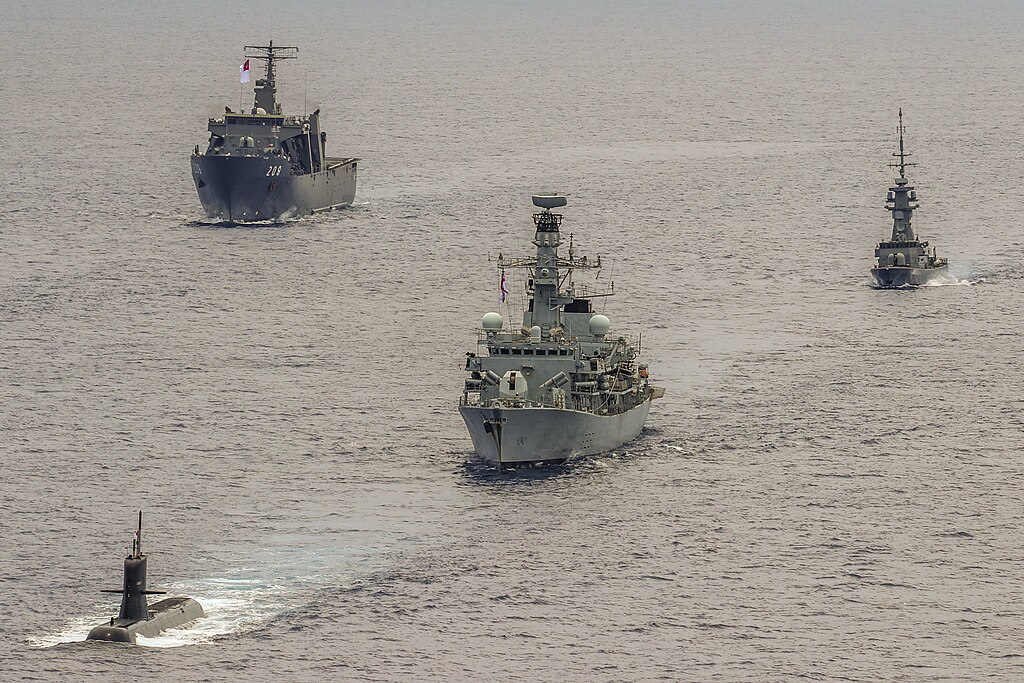
Image credit: UK Ministry of Defence, OGL v1.0OGL v1.0, via Wikimedia Commons.
The Strategic Context of FPDA
The FPDA was formed in the strategic context of the early 1970s, when the world and the Southeast Asian region were experiencing tumultuous geopolitical and ideological rivalries. Konfrontasi, the undeclared war between Indonesia and Malaysia, had just ended in 1966, and the United States had announced the Nixon Doctrine and its decision to withdraw from South Vietnam, prompting widespread fear of the “domino effect”, i.e., that countries in Southeast Asia would fall like dominoes to the communists following the fall of South Vietnam. A series of critical events also took place: Singapore had left the Federation of Malaysia in 1965, and the British, in 1968, announced that they were withdrawing their forces from east of the Suez. It is against this backdrop of multiple strategic threats and uncertainties that the FPDA was conceived and formed to replace the Anglo-Malaya Defence Agreement (AMDA), which was a formal defence treaty that expired in 1970.
The FPDA works on a multilateral consultative framework mechanism. In the event of external threats against Malaysia and Singapore, the five members will consult each other on the next course of action. It is due to this unique approach that the FPDA has faced numerous criticisms about its tangible strategic value in contrast to a formal defence pact. However, for Malaysia, the intrinsic strategic value of the FPDA resides in this unique approach. The consultative nature of the FPDA enabled Malaysia to operate at times when its neighbours still harboured hostile views against Malaysia and Singapore, particularly in the post-Konfrontasi period, and in the context of tumultuous regional Cold War politics. The FPDA’s consultative mechanism enabled Malaysia to maintain its foreign policy of neutrality and non-alignment, while simultaneously providing a useful conventional, albeit limited and indirect, deterrence against potential external threats, giving it the strategic space to build defence capabilities at its own pace.
The FPDA’s format also enabled Malaysia to allay neighbouring states and external powers’ fears of a formal defence pact in Southeast Asia dominated by an ex- colonial power. Additionally, both Malaysia and Singapore, through the FPDA, are geostrategically linked together, providing a platform to facilitate building strategic ties after a tense break-up.
FPDA’s Value in Malaysia’s Defence Development
Over the years, the FPDA has served as an important platform to develop and enhance Malaysia’s military capabilities. An Integrated Area Defence System (IADS) headquarters was set up and based in Butterworth, Penang. Today, it is jointly staffed by officers from all five member countries. Throughout the decades, Australia proved to be one of the most active members of the FPDA, having provided military support for Malaysia. Royal Australian Air Force (RAAF) combat aircraft and an Australian Army rifle company are forward-deployed in Butterworth. The presence of Australian troops and air power assets in Malaysia as part of FPDA obligations serves as an important deterrent for would-be aggressors.
Regular FPDA military training exercises among member states have been conducted to build joint interoperability and enhancement of military skills. Cross-posting of military officers from FPDA member states and attendance at courses run by each other’s staff colleges and defence colleges have helped to build familiarity among them.
FPDA joint exercises, however, also revealed Malaysia’s near-obsolescent military technology and challenges in operating jointly with its counterparts from the United Kingdom, Australia and Singapore, who are equipped with more advanced technologies. For example, in the recent Exercise Bersama Lima 2025 (BL25) held in October 2025, the RAAF deployed F-35A Lightning II 5th-generation fighters and the Royal Navy operated its Carrier Strike Group led by HMS Prince of Wales (also equipped with F-35s). The networked communications and the command-and-control systems, coupled with the latest fighter technology used by its more advanced FPDA partners, may have posed difficulties for Malaysian Armed Forces units to operate jointly and seamlessly.
In this context, the Malaysian Armed Forces would need to expedite its modernisation efforts, as laid out in its “Future Force” plan. For defence partnerships to be viable, even in the case of the FPDA’s consultative arrangement, a member is expected to contribute its equal share in defence commitments. This is to ensure that in the event the FPDA is activated for war, all its members are able to operate jointly and deliver potent combat power.
The Continued Relevance of FPDA
The end of the Cold War and the optimism about a more peaceful future that it generated prompted suggestions that perhaps the FPDA had outlived its value. Nevertheless, that optimistic view of the future ended very soon. The Balkan conflicts, the First and Second Gulf Wars, the Global War on Terror and the ongoing Russia–Ukraine War demonstrated that, while great power ideological rivalry may have ended, the classic realist power struggles among nations and peoples continue.
Today, Malaysia faces a precarious strategic environment – the strategic competition between the United States and China in the Asia-Pacific region, the simmering tensions over the South China Sea, and the threat of a violent reunification of Taiwan with China pose plausible dire strategic risks. While the FPDA has contributed to Malaysia’s defence, the growing tensions emanating from great power rivalries in the region will colour perceptions of Malaysia, given its military ties with close US allies in the FPDA, namely the United Kingdom and Australia. Both of these countries are in a tripartite security pact with the United States, dubbed AUKUS, which, as is widely known, was initiated to balance China.
Despite the challenges, for 55 years the FPDA has been a highly important platform for Malaysia. It has served as a key defence partnership, contributing immensely to building the Malaysian Armed Forces’ capabilities and capacity-building efforts. In view of the emergence of multifaceted contemporary strategic threats and security risks, the FPDA will continue to provide an extremely useful platform to enhance the Malaysian Armed Forces’ combat capability.
Adam Leong Kok Wey, PhD, is a Professor of Strategic Studies and Director of the Centre for Defence and International Security Studies (CDISS) at the National Defence University of Malaysia (NDUM). He is also the Distinguished Fellow at the Malaysian Armed Forces Staff College. This article was written as part of a research project supported by the Malaysia Programme at the S. Rajaratnam School of International Studies (RSIS).
KEY TAKEAWAYS
• Fifty-five years on, the Five Power Defence Arrangements (FPDA) partnership remains an important element of Malaysia’s defence: despite its loose, consultative format, it is featured in Malaysia’s credible defence partnerships strategy.
• The FPDA’s consultative mechanism provides Malaysia the freedom to practise its neutral foreign policy while retaining close military cooperation with other FPDA member states.
• The FPDA partnership provides the Malaysian Armed Forces access to, and valuable experience in jointly operating with, the modern military technologies employed by the other FPDA members.
COMMENTARY
The Five Power Defence Arrangements (FPDA) partnership involving Australia, Malaysia, New Zealand, Singapore and the United Kingdom will celebrate its 55th anniversary in November this year. The FPDA is an important and credible defence partnership featured in Malaysia’s 2020 Defence White Paper and 2025 Midterm Review of the Defence White Paper. Through the FPDA, Malaysia has gained strategic benefits, including indirect, albeit limited, deterrence, as well as access to capability-building training programmes and joint military operations, which have provided the Malaysian Armed Forces with crucial military knowledge and skills.
Nonetheless, the FPDA presents several challenges for Malaysia’s defence policy and strategy: not being a formal defence pact, its military commitments are questionable but it is still viewed suspiciously by some of Malaysia’s neighbours, and lately by China, as a tool of Western intervention in regional geopolitics. This raises a critical question about the relevance of the FPDA: is it an indirect military partnership today or a vestige of Cold War geopolitics that should be relegated to less importance in Malaysia’s defence posture?
Image credit: UK Ministry of Defence, OGL v1.0OGL v1.0, via Wikimedia Commons.
The Strategic Context of FPDA
The FPDA was formed in the strategic context of the early 1970s, when the world and the Southeast Asian region were experiencing tumultuous geopolitical and ideological rivalries. Konfrontasi, the undeclared war between Indonesia and Malaysia, had just ended in 1966, and the United States had announced the Nixon Doctrine and its decision to withdraw from South Vietnam, prompting widespread fear of the “domino effect”, i.e., that countries in Southeast Asia would fall like dominoes to the communists following the fall of South Vietnam. A series of critical events also took place: Singapore had left the Federation of Malaysia in 1965, and the British, in 1968, announced that they were withdrawing their forces from east of the Suez. It is against this backdrop of multiple strategic threats and uncertainties that the FPDA was conceived and formed to replace the Anglo-Malaya Defence Agreement (AMDA), which was a formal defence treaty that expired in 1970.
The FPDA works on a multilateral consultative framework mechanism. In the event of external threats against Malaysia and Singapore, the five members will consult each other on the next course of action. It is due to this unique approach that the FPDA has faced numerous criticisms about its tangible strategic value in contrast to a formal defence pact. However, for Malaysia, the intrinsic strategic value of the FPDA resides in this unique approach. The consultative nature of the FPDA enabled Malaysia to operate at times when its neighbours still harboured hostile views against Malaysia and Singapore, particularly in the post-Konfrontasi period, and in the context of tumultuous regional Cold War politics. The FPDA’s consultative mechanism enabled Malaysia to maintain its foreign policy of neutrality and non-alignment, while simultaneously providing a useful conventional, albeit limited and indirect, deterrence against potential external threats, giving it the strategic space to build defence capabilities at its own pace.
The FPDA’s format also enabled Malaysia to allay neighbouring states and external powers’ fears of a formal defence pact in Southeast Asia dominated by an ex- colonial power. Additionally, both Malaysia and Singapore, through the FPDA, are geostrategically linked together, providing a platform to facilitate building strategic ties after a tense break-up.
FPDA’s Value in Malaysia’s Defence Development
Over the years, the FPDA has served as an important platform to develop and enhance Malaysia’s military capabilities. An Integrated Area Defence System (IADS) headquarters was set up and based in Butterworth, Penang. Today, it is jointly staffed by officers from all five member countries. Throughout the decades, Australia proved to be one of the most active members of the FPDA, having provided military support for Malaysia. Royal Australian Air Force (RAAF) combat aircraft and an Australian Army rifle company are forward-deployed in Butterworth. The presence of Australian troops and air power assets in Malaysia as part of FPDA obligations serves as an important deterrent for would-be aggressors.
Regular FPDA military training exercises among member states have been conducted to build joint interoperability and enhancement of military skills. Cross-posting of military officers from FPDA member states and attendance at courses run by each other’s staff colleges and defence colleges have helped to build familiarity among them.
FPDA joint exercises, however, also revealed Malaysia’s near-obsolescent military technology and challenges in operating jointly with its counterparts from the United Kingdom, Australia and Singapore, who are equipped with more advanced technologies. For example, in the recent Exercise Bersama Lima 2025 (BL25) held in October 2025, the RAAF deployed F-35A Lightning II 5th-generation fighters and the Royal Navy operated its Carrier Strike Group led by HMS Prince of Wales (also equipped with F-35s). The networked communications and the command-and-control systems, coupled with the latest fighter technology used by its more advanced FPDA partners, may have posed difficulties for Malaysian Armed Forces units to operate jointly and seamlessly.
In this context, the Malaysian Armed Forces would need to expedite its modernisation efforts, as laid out in its “Future Force” plan. For defence partnerships to be viable, even in the case of the FPDA’s consultative arrangement, a member is expected to contribute its equal share in defence commitments. This is to ensure that in the event the FPDA is activated for war, all its members are able to operate jointly and deliver potent combat power.
The Continued Relevance of FPDA
The end of the Cold War and the optimism about a more peaceful future that it generated prompted suggestions that perhaps the FPDA had outlived its value. Nevertheless, that optimistic view of the future ended very soon. The Balkan conflicts, the First and Second Gulf Wars, the Global War on Terror and the ongoing Russia–Ukraine War demonstrated that, while great power ideological rivalry may have ended, the classic realist power struggles among nations and peoples continue.
Today, Malaysia faces a precarious strategic environment – the strategic competition between the United States and China in the Asia-Pacific region, the simmering tensions over the South China Sea, and the threat of a violent reunification of Taiwan with China pose plausible dire strategic risks. While the FPDA has contributed to Malaysia’s defence, the growing tensions emanating from great power rivalries in the region will colour perceptions of Malaysia, given its military ties with close US allies in the FPDA, namely the United Kingdom and Australia. Both of these countries are in a tripartite security pact with the United States, dubbed AUKUS, which, as is widely known, was initiated to balance China.
Despite the challenges, for 55 years the FPDA has been a highly important platform for Malaysia. It has served as a key defence partnership, contributing immensely to building the Malaysian Armed Forces’ capabilities and capacity-building efforts. In view of the emergence of multifaceted contemporary strategic threats and security risks, the FPDA will continue to provide an extremely useful platform to enhance the Malaysian Armed Forces’ combat capability.
Adam Leong Kok Wey, PhD, is a Professor of Strategic Studies and Director of the Centre for Defence and International Security Studies (CDISS) at the National Defence University of Malaysia (NDUM). He is also the Distinguished Fellow at the Malaysian Armed Forces Staff College. This article was written as part of a research project supported by the Malaysia Programme at the S. Rajaratnam School of International Studies (RSIS).