


10 February 2026
IP26023 | China’s AI Start-ups as “National Champions”: Advancing China’s Tech Ambitions under Constraint

KEY TAKEAWAYS
• China’s AI start-ups are increasingly being positioned as “national champions” that can help convert China’s manufacturing strength into AI-enabled productivity and technological self-reliance.
• The strategic value of these start-ups lies less in any single breakthrough than in whether they can scale an end-to-end indigenous AI capability comprising chips, cloud platforms, embodied AI and standards, despite persistent hardware, regulatory and geopolitical constraints.
COMMENTARY
In January, Enflame, an AI start-up backed by the Chinese tech conglomerate Tencent, successfully filed for initial public offering (IPO) on the Shanghai Stock Exchange. Other AI chip start-ups, like Moore Threads and MetaX, have been doing the same. Shares surged when the start-up Biren debuted in Hong Kong in early 2026, highlighting investor confidence in rising start-ups within the country’s AI ecosystem.
The recent wave of public listings by these domestic AI chip start-ups signals Beijing’s broader ambition to move from being the “factory of the world” to a technological powerhouse in applied AI capabilities. These IPO moves matter increasingly for China’s AI start-ups because going public signals official and investor confidence, helps win major customers, opens doors to government purchasing, and strengthens partnerships, advantages that are especially important in a capital-intensive industry. In the context of China, start-ups are not peripheral innovators. Instead, they are increasingly treated as instruments for techno-industrial upgrading, particularly in compute, embodied intelligence, and industrial automation.
How Chinese AI Start-ups Advance China’s Industrial Ambitions
China’s AI start-up ecosystem spans the applications, embodied AI and compute layers. At the applications layer, leading computer vision and deep learning firms such as SenseTime and Megvii helped pioneer commercial use cases across finance, healthcare and industrial monitoring.
At the embodied AI and robotics layer, companies such as Unitree reflect a fast-growing ecosystem that ties AI software to physical systems. China’s industrial policy narrative now explicitly elevates “embodied AI” as part of the industries of the future, alongside biomanufacturing, quantum technologies and 6G, underscoring Beijing’s bet that technological leadership will be expressed not only through frontier models, but through deployment in real-world systems.
These dynamics also intersect with China’s dominance in industrial robotics. China is the world’s largest market for industrial robots and a major producer, and this advantage increasingly complements its AI start-up ecosystem as Beijing modernises manufacturing through factory-floor AI and automation. The strategic logic is that if AI is to deliver productivity gains, it must be deployed at scale in sectors where China has depth, in areas like manufacturing, logistics, mobility and public services, rather than remaining limited to frontier R&D labs.
At the compute layer, domestic AI chip start-ups and large tech firms are converging around a shared priority: reducing dependence on foreign graphics processing units (GPUs) and building domestic hardware and software ecosystems. Start-ups are pursuing accelerators and ecosystem tooling, while major players such as Alibaba, Baidu and Huawei invest heavily in proprietary AI chips and cloud integration. The goal is to reduce dependency on US-origin chips like Nvidia.
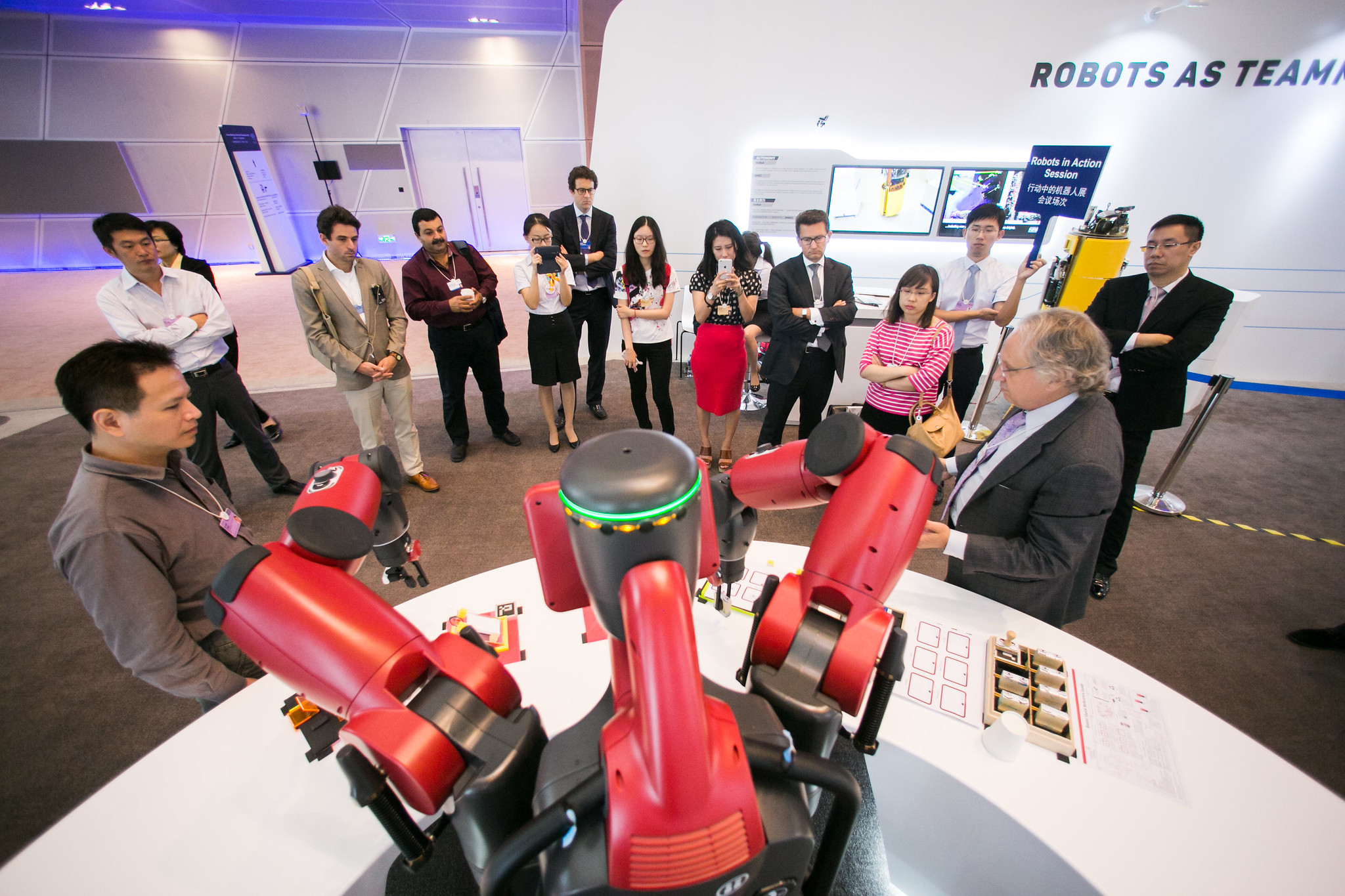
Image credit: World Economic Forum, CC BY-NC-SA 2.0.
Beijing’s evolving AI strategy increasingly depends on the private sector’s ability to translate advanced AI capabilities into practical industrial applications and to fuse China’s strengths in AI software and robotics hardware into a distinctive path to technological leadership.
Opportunities: Demand and State-backed Support
China’s AI start-ups also operate in an ecosystem with distinctive advantages. China’s AI start-ups benefit from demand and support from the Chinese government. Domestic demand for AI in China is expanding, creating a large home market which insulates AI start-ups from some external pressures.
In smart manufacturing, AI is integrated into factories for visual inspection, predictive maintenance and process optimisation, often running inference on factory-floor servers. In autonomous mobility, real-time inference underpins perception and decision-making. In cloud and enterprise services, AI start-ups can grow in China’s cloud market by riding on major providers’ integrations of DeepSeek, China’s leading AI player, thereby using lower AI costs to launch viable services and partnering with smaller cloud firms to rapidly upgrade offerings and win customers. AI start-ups also support domestic governance with fraud detection applications and by supplying local governments with tools for traffic management, surveillance analytics and administrative automation.
China’s national strategies – including the New Generation Artificial Intelligence Development Plan (2017); the AI+ Action Plan (2024; upgraded in 2025); and the ongoing Five-Year Plans and Government Work Reports – position AI start-ups as vehicles for productivity gains across manufacturing, services and governance.
Challenges: Navigating Hardware, Regulatory and Geopolitical Constraints
The primary challenge for China’s AI start-ups is that they operate within a constraint-bound ecosystem in which progress depends on multiple bottlenecks beyond any single firm’s control.
These constraints can raise costs, narrow the scope for experimentation and complicate cross-border collaboration, particularly for firms with international ambitions or data-intensive model development pipelines. While heightened compliance scrutiny can also provide predictability for adoption, the near-term effect for many start-ups is heightened compliance burdens, uncertainty and reduced flexibility.
Even as China’s domestic AI chip firms remain constrained by limited access to advanced-node manufacturing, they are also still dependent on foreign electronic design automation (EDA) toolchains and restrictions on extreme ultraviolet (EUV) lithography equipment that are central to leading-edge chip production. Export-control volatility thus adds additional uncertainty. As Chinese AI firms compete with one another, US-allied constraints (targeting the entire semiconductor supply chain) are also tightening around AI. The Synopsys episode in mid-2025, when services to China were disrupted following new US restrictions before easing later, illustrated how quickly external constraints can disrupt even mature design workflows and support ecosystems.
Chinese firms are exploring alternative routes: pushing deep ultraviolet (DUV) lithography further through home-grown multi-patterning techniques to produce 7 nanometre chips, upgrading older DUV tools, and accelerating partial substitution with domestic EDA solutions. Yet these workarounds often come with trade-offs in terms of higher production costs, lower yields and performance ceilings that become more severe at the frontier. Even when chip designs are competent, it is unclear whether these home-grown AI chips can effectively balance cost-effectiveness and scalability in the long run, or further reinforce a structural compute gap between the United States and China in cutting-edge AI.
A further bottleneck is the availability and retention of top-tier talent, such as elite AI scientists. China produces large numbers of AI graduates, but frontier progress depends disproportionately on a thinner layer of highly experienced researchers and engineers. Persistent talent competition with US labs and firms can slow the diffusion of advanced capabilities domestically and complicate Beijing’s ambition to scale high-end innovation across sectors.
Finally, state-led mobilisation of AI firms itself creates risks. Government incentives can accelerate adoption, but they can also produce overzealous implementation. Reports of low utilisation in government-backed data centres, and subsequent tightening of approvals and efforts to rationalise national computing capacity, underscore that scale does not automatically translate into effective capability.
Conclusion
China’s AI start-ups are increasingly central to Beijing’s industrial upgrading agenda. They are positioned as “national champions” that can strengthen domestic compute, accelerate embodied AI and robotics deployment, and push AI diffusion throughout the real economy. Their challenge is navigating a complicated ecosystem shaped by hardware chokepoints, regulatory constraints, geopolitical volatility and the persistent risk that state-driven scale produces fragmentation and overcapacity.
The key test is whether Beijing’s national champions can translate financing and policy support into a well-integrated domestic AI ecosystem comprising chips, cloud platforms, deployment pipelines and unified standards, all built around high utilisation and adoption rather than subsidised overcapacity. If successful, this would reduce China’s exposure to semiconductor chokepoints and export-control pressure and bring its AI ambitions closer within reach.
Stefanie Kam is an Assistant Professor in the China Programme at the Institute of Defence and Strategic Studies (IDSS), S. Rajaratnam School of International Studies (RSIS).
KEY TAKEAWAYS
• China’s AI start-ups are increasingly being positioned as “national champions” that can help convert China’s manufacturing strength into AI-enabled productivity and technological self-reliance.
• The strategic value of these start-ups lies less in any single breakthrough than in whether they can scale an end-to-end indigenous AI capability comprising chips, cloud platforms, embodied AI and standards, despite persistent hardware, regulatory and geopolitical constraints.
COMMENTARY
In January, Enflame, an AI start-up backed by the Chinese tech conglomerate Tencent, successfully filed for initial public offering (IPO) on the Shanghai Stock Exchange. Other AI chip start-ups, like Moore Threads and MetaX, have been doing the same. Shares surged when the start-up Biren debuted in Hong Kong in early 2026, highlighting investor confidence in rising start-ups within the country’s AI ecosystem.
The recent wave of public listings by these domestic AI chip start-ups signals Beijing’s broader ambition to move from being the “factory of the world” to a technological powerhouse in applied AI capabilities. These IPO moves matter increasingly for China’s AI start-ups because going public signals official and investor confidence, helps win major customers, opens doors to government purchasing, and strengthens partnerships, advantages that are especially important in a capital-intensive industry. In the context of China, start-ups are not peripheral innovators. Instead, they are increasingly treated as instruments for techno-industrial upgrading, particularly in compute, embodied intelligence, and industrial automation.
How Chinese AI Start-ups Advance China’s Industrial Ambitions
China’s AI start-up ecosystem spans the applications, embodied AI and compute layers. At the applications layer, leading computer vision and deep learning firms such as SenseTime and Megvii helped pioneer commercial use cases across finance, healthcare and industrial monitoring.
At the embodied AI and robotics layer, companies such as Unitree reflect a fast-growing ecosystem that ties AI software to physical systems. China’s industrial policy narrative now explicitly elevates “embodied AI” as part of the industries of the future, alongside biomanufacturing, quantum technologies and 6G, underscoring Beijing’s bet that technological leadership will be expressed not only through frontier models, but through deployment in real-world systems.
These dynamics also intersect with China’s dominance in industrial robotics. China is the world’s largest market for industrial robots and a major producer, and this advantage increasingly complements its AI start-up ecosystem as Beijing modernises manufacturing through factory-floor AI and automation. The strategic logic is that if AI is to deliver productivity gains, it must be deployed at scale in sectors where China has depth, in areas like manufacturing, logistics, mobility and public services, rather than remaining limited to frontier R&D labs.
At the compute layer, domestic AI chip start-ups and large tech firms are converging around a shared priority: reducing dependence on foreign graphics processing units (GPUs) and building domestic hardware and software ecosystems. Start-ups are pursuing accelerators and ecosystem tooling, while major players such as Alibaba, Baidu and Huawei invest heavily in proprietary AI chips and cloud integration. The goal is to reduce dependency on US-origin chips like Nvidia.
Image credit: World Economic Forum, CC BY-NC-SA 2.0.
Beijing’s evolving AI strategy increasingly depends on the private sector’s ability to translate advanced AI capabilities into practical industrial applications and to fuse China’s strengths in AI software and robotics hardware into a distinctive path to technological leadership.
Opportunities: Demand and State-backed Support
China’s AI start-ups also operate in an ecosystem with distinctive advantages. China’s AI start-ups benefit from demand and support from the Chinese government. Domestic demand for AI in China is expanding, creating a large home market which insulates AI start-ups from some external pressures.
In smart manufacturing, AI is integrated into factories for visual inspection, predictive maintenance and process optimisation, often running inference on factory-floor servers. In autonomous mobility, real-time inference underpins perception and decision-making. In cloud and enterprise services, AI start-ups can grow in China’s cloud market by riding on major providers’ integrations of DeepSeek, China’s leading AI player, thereby using lower AI costs to launch viable services and partnering with smaller cloud firms to rapidly upgrade offerings and win customers. AI start-ups also support domestic governance with fraud detection applications and by supplying local governments with tools for traffic management, surveillance analytics and administrative automation.
China’s national strategies – including the New Generation Artificial Intelligence Development Plan (2017); the AI+ Action Plan (2024; upgraded in 2025); and the ongoing Five-Year Plans and Government Work Reports – position AI start-ups as vehicles for productivity gains across manufacturing, services and governance.
Challenges: Navigating Hardware, Regulatory and Geopolitical Constraints
The primary challenge for China’s AI start-ups is that they operate within a constraint-bound ecosystem in which progress depends on multiple bottlenecks beyond any single firm’s control.
These constraints can raise costs, narrow the scope for experimentation and complicate cross-border collaboration, particularly for firms with international ambitions or data-intensive model development pipelines. While heightened compliance scrutiny can also provide predictability for adoption, the near-term effect for many start-ups is heightened compliance burdens, uncertainty and reduced flexibility.
Even as China’s domestic AI chip firms remain constrained by limited access to advanced-node manufacturing, they are also still dependent on foreign electronic design automation (EDA) toolchains and restrictions on extreme ultraviolet (EUV) lithography equipment that are central to leading-edge chip production. Export-control volatility thus adds additional uncertainty. As Chinese AI firms compete with one another, US-allied constraints (targeting the entire semiconductor supply chain) are also tightening around AI. The Synopsys episode in mid-2025, when services to China were disrupted following new US restrictions before easing later, illustrated how quickly external constraints can disrupt even mature design workflows and support ecosystems.
Chinese firms are exploring alternative routes: pushing deep ultraviolet (DUV) lithography further through home-grown multi-patterning techniques to produce 7 nanometre chips, upgrading older DUV tools, and accelerating partial substitution with domestic EDA solutions. Yet these workarounds often come with trade-offs in terms of higher production costs, lower yields and performance ceilings that become more severe at the frontier. Even when chip designs are competent, it is unclear whether these home-grown AI chips can effectively balance cost-effectiveness and scalability in the long run, or further reinforce a structural compute gap between the United States and China in cutting-edge AI.
A further bottleneck is the availability and retention of top-tier talent, such as elite AI scientists. China produces large numbers of AI graduates, but frontier progress depends disproportionately on a thinner layer of highly experienced researchers and engineers. Persistent talent competition with US labs and firms can slow the diffusion of advanced capabilities domestically and complicate Beijing’s ambition to scale high-end innovation across sectors.
Finally, state-led mobilisation of AI firms itself creates risks. Government incentives can accelerate adoption, but they can also produce overzealous implementation. Reports of low utilisation in government-backed data centres, and subsequent tightening of approvals and efforts to rationalise national computing capacity, underscore that scale does not automatically translate into effective capability.
Conclusion
China’s AI start-ups are increasingly central to Beijing’s industrial upgrading agenda. They are positioned as “national champions” that can strengthen domestic compute, accelerate embodied AI and robotics deployment, and push AI diffusion throughout the real economy. Their challenge is navigating a complicated ecosystem shaped by hardware chokepoints, regulatory constraints, geopolitical volatility and the persistent risk that state-driven scale produces fragmentation and overcapacity.
The key test is whether Beijing’s national champions can translate financing and policy support into a well-integrated domestic AI ecosystem comprising chips, cloud platforms, deployment pipelines and unified standards, all built around high utilisation and adoption rather than subsidised overcapacity. If successful, this would reduce China’s exposure to semiconductor chokepoints and export-control pressure and bring its AI ambitions closer within reach.
Stefanie Kam is an Assistant Professor in the China Programme at the Institute of Defence and Strategic Studies (IDSS), S. Rajaratnam School of International Studies (RSIS).