


13 February 2026
IP26024 | A Disaster or a Political Test? Performance, Public Acceptance and Electability after the Sumatra Floods

KEY TAKEAWAYS
• Public opinion on flash floods last November that triggered landslides in Sumatra highlights dissatisfaction with the speed of response and coordination, coupled with overwhelming support for the government to declare a national disaster status.
• While President Prabowo Subianto remains the most supported political figure nationally, declining support levels suggest that crisis management performance requires careful attention going forward.
COMMENTARY
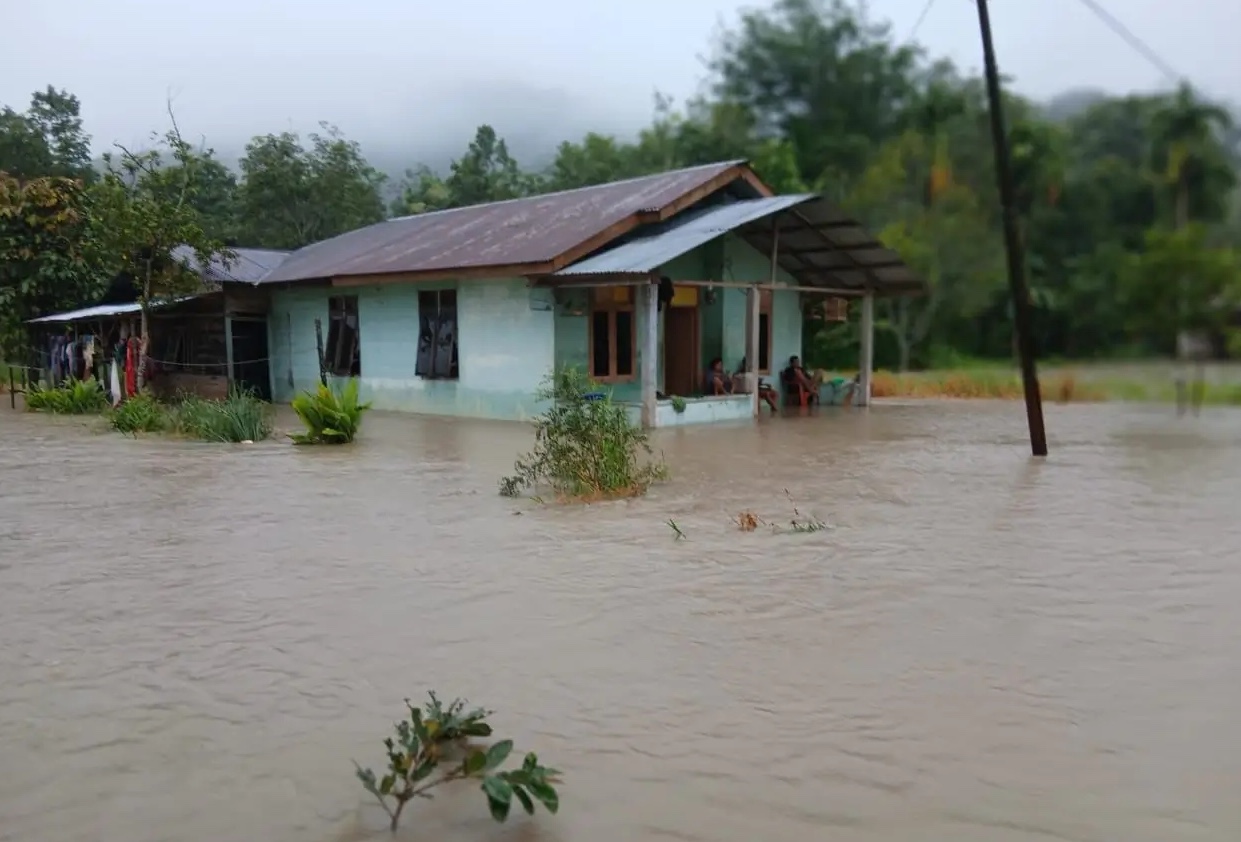
Severe flooding across several provinces in Sumatra in November 2025 triggered not only humanitarian disruption but also intense national debate over the government’s crisis response. With public awareness reaching near national levels, discussions had moved quickly beyond disaster relief to questions of governance effectiveness and executive responsiveness.
Public discourse, amplified through social media, framed the disaster as a test of the central government’s capacity to coordinate relief, mobilise resources and restore affected communities. Calls for elevating the crisis to national disaster status further revealed a perception that provincial mechanisms alone are insufficient to manage the scale of disruption.
In this context, the floods were no longer treated as an environmental catastrophe. They became an early political and administrative credibility test for the new administration, with implications that extend beyond recovery into perceptions of leadership competence.
Understanding Indonesian Public Opinion
Following more than a month of severe flooding across West Sumatra, North Sumatra and Aceh, MEDIAN, a Jakarta-based survey and research company, conducted a nationwide social media survey from 9 to 13 January 2026 to gauge public sentiment. The questionnaire was distributed online to active social media users aged 17 and above, generating responses from 1,000 participants proportionally distributed across 38 provinces.
The survey explored several questions shaping public debate, including whether the Indonesian people were aware of the floods, how they assessed the central government’s response, and whether they supported growing calls to elevate the crisis to national disaster status rather than treating it as a regional emergency.
Performance under Scrutiny: Public Perception of the Crisis Response
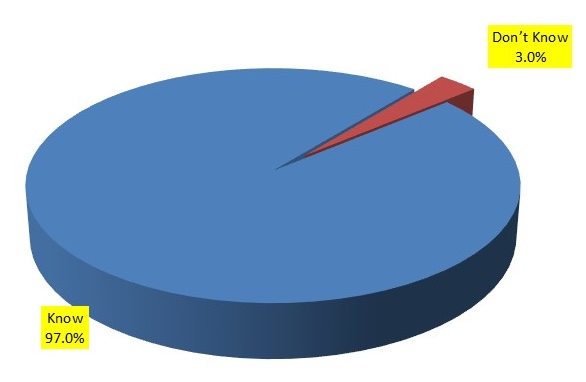
The survey findings indicate that public awareness of the disaster was nearly universal, with 97.0% of respondents stating they were aware of the floods, while only 3.0% reported otherwise (Figure 1). This high level of awareness makes the government’s response highly visible and politically consequential. Public evaluation of crisis management has therefore become part of a broader assessment of state performance rather than merely a reaction to a natural disaster.
Figure 1. Public Awareness of the Sumatra Floods
Are you aware or not aware that extreme floods and landslides recently occurred in several areas of Sumatra, including West Sumatra, Aceh, and North Sumatra?
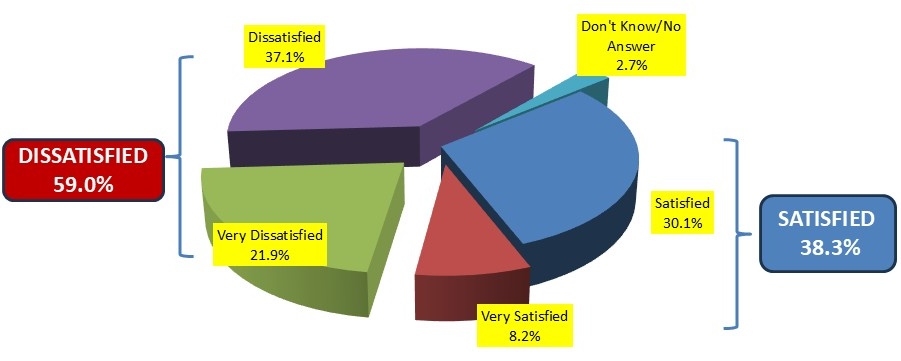
Public assessment of the government’s handling of the disaster reveals a more critical mood. Most respondents, 59.0%, expressed dissatisfaction with the central government’s response, while only 38.3% reported being satisfied, with 2.7% undecided or declining to answer (Figure 2). Dissatisfaction was primarily associated with perceptions of slow response, uneven distribution of assistance, and insufficient preventive measures, indicating that public criticism is directed less at the disaster itself than at how effectively the state responded once disruption occurs.
Figure 2. Public Satisfaction with the Central Government’s Handling of the Sumatra Floods
How satisfied are you with the central government’s performance (the President and relevant ministries) in handling the flood disaster in Sumatra?
While natural disasters are unavoidable, perceived governance shortcomings are not. Public judgement therefore was increasingly focused on coordination speed and recovery delivery, turning disaster response into a practical measure of state competence.
Acceptance Gap: Demand for National Disaster Status
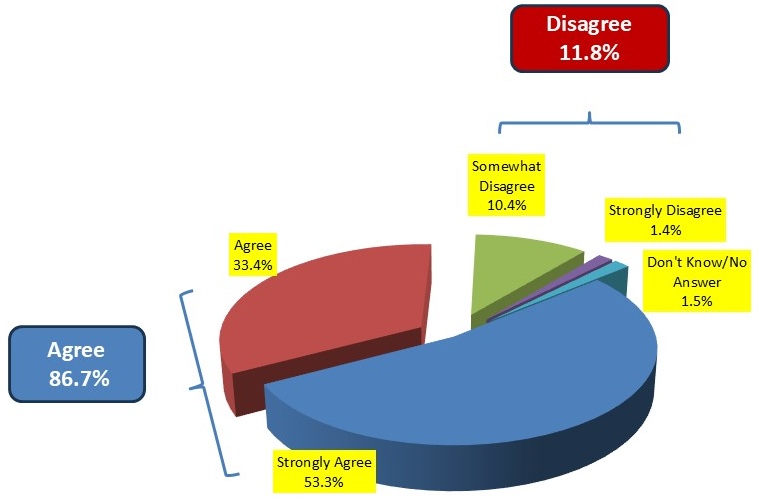
Public support for elevating the floods to national disaster status was overwhelming. The survey findings show that 86.7% of respondents supported the proposal, including 53.3% who strongly agreed and 33.4% who agreed, while only 11.8% opposed the move and 1.5% remained undecided (Figure 3). The results reflect a widespread perception that the scale of disruption had exceeded the regional government’s response capacity and required direct national coordination.
Figure 3. Public Support for Declaring the Sumatra Floods a National Disaster
There have been growing calls from various community groups and activists for the President to designate the floods in Sumatra (West Sumatra, Aceh, and North Sumatra) as a National Disaster rather than merely a regional disaster. To what extent do you agree with this proposal?
Political Impact on Electability
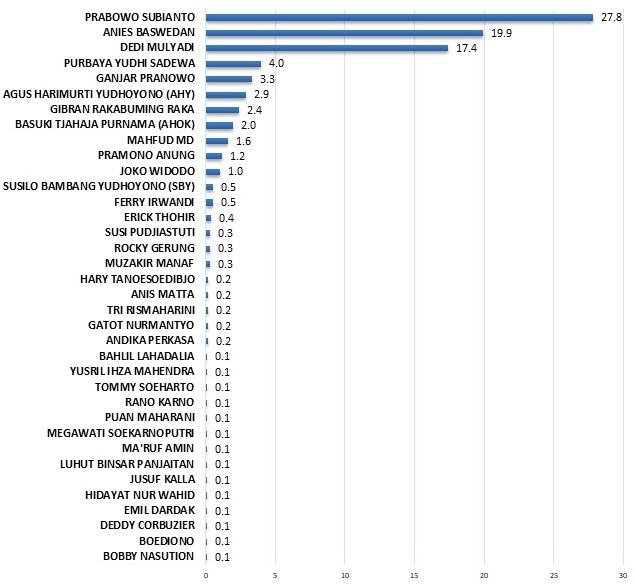
Despite growing criticism of disaster management, President Prabowo Subianto continues to lead in national presidential preference surveys. As shown in Figure 4, Prabowo remains the top choice with 27.8% electability, followed by Anies Baswedan at 19.9% and Dedi Mulyadi at 17.4%. The results suggest that while public scrutiny of government performance has intensified, Prabowo still retains a significant advantage over potential competitors in the emerging political landscape.
Figure 4. Current Presidential Electability Preferences
If a presidential election were held today (January 2026), which candidate would you choose to become President of the Republic of Indonesia?
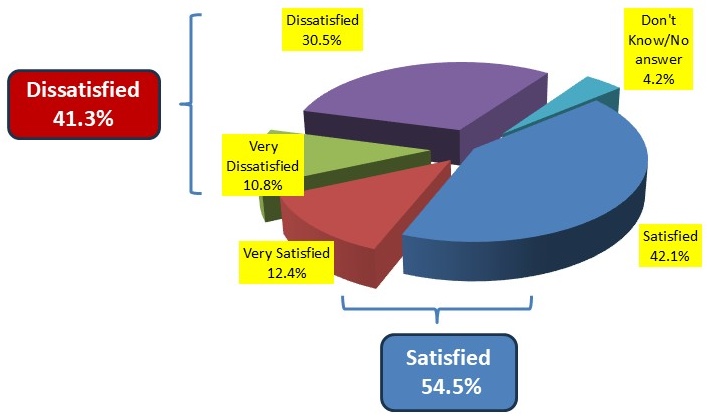
Despite ongoing scrutiny over the government’s handling of the Sumatra floods, Prabowo’s political standing remains relatively resilient. The survey findings show that 54.5% of respondents remain satisfied with the performance of the Prabowo–Gibran administration, while 41.3% express dissatisfaction and 4.2% remain undecided (Figure 5). This suggests that although crisis management performance is increasingly under public examination, overall government approval still outweighs dissatisfaction at the national level.
Figure 5. Public Satisfaction/Dissatisfaction with Government Performance
How satisfied are you with the performance of the Prabowo–Gibran administration at present? Are you very satisfied, satisfied, dissatisfied, or very dissatisfied?
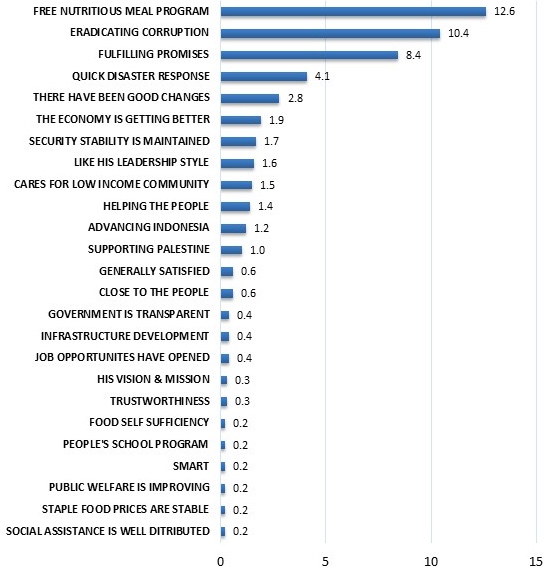
Supporters largely attribute their positive assessment to flagship welfare and governance initiatives. The Free Nutritious Meals (MBG) programme has emerged as the most frequently cited reason for satisfaction at 12.6%, followed by anti-corruption efforts at 10.4% and perceptions that campaign promises are being fulfilled at 8.4%. Meanwhile, rapid disaster response was cited by only 4.1% of satisfied respondents, indicating that although the government’s disaster management contributed to positive perceptions, it was not the primary driver of public approval (Figure 6).
Figure 6. Reasons for Public Satisfaction with Government Performance
Please state the reasons why you feel satisfied or very satisfied with the government’s performance.
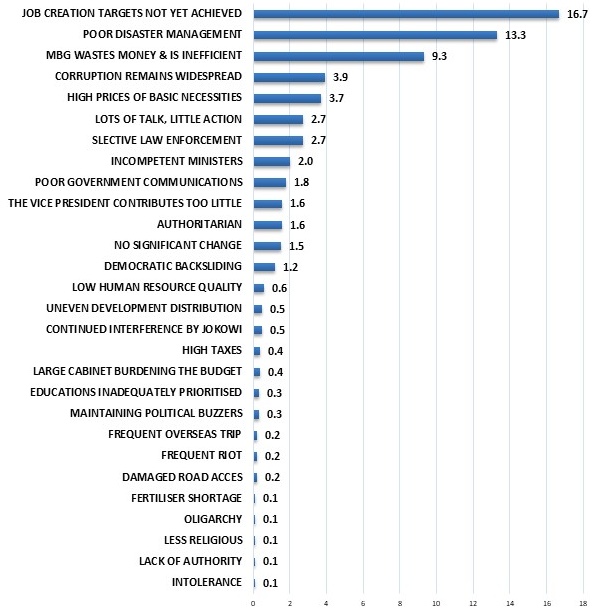
Conversely, dissatisfaction is driven mainly by economic concerns and perceptions of inadequate crisis handling. The most frequently cited reason for dissatisfaction was the perception that employment opportunities remain insufficient (16.7%), followed by criticisms that disaster management remains inadequate (13.3%), and concerns that the MBG programme is inefficient or wasteful (9.3%). Other drivers include perceptions of persistent corruption (3.9%) and rising living costs (3.7%), suggesting that dissatisfaction reflects broader governance and economic anxieties beyond the immediate disaster response (Figure 7).
Figure 7. Reasons for Public Dissatisfaction with Government Performance
Please state the reasons why you feel dissatisfied or very dissatisfied with the government’s performance.
The data shows that while Prabowo continues to command substantial political support, public confidence is increasingly tied to visible governance outcomes. Crisis management performance now stands alongside welfare delivery and economic conditions in shaping electability perceptions, indicating that political durability will depend not only on popular programmes but also on the government’s ability to manage large-scale disruptions effectively.
Conclusion
The Sumatra floods now represent more than a recovery challenge. They have become a credibility test for the Prabowo administration, influencing how citizens assess state responsiveness, leadership competence, and ultimately presidential electability.
Public expectations extend beyond immediate relief towards coordinated national action capable of accelerating recovery and preventing the recurrence of disruption. Where recovery progresses effectively, political credibility and electoral support are reinforced. Where coordination falters, public confidence and electability risk gradual erosion.
Disaster governance has therefore become directly linked to political legitimacy. At the same time, flagship welfare initiatives such as the MBG programme continue to function as a political buffer, sustaining support and enhancing the administration’s popularity even as crisis management performance faces scrutiny. In practice, welfare delivery operates as a reputational harvesting mechanism that helps offset dissatisfaction emerging from crisis response shortcomings.
Disaster management thus functions not only as emergency governance but as a critical test of executive credibility in Indonesia’s evolving political landscape, where electoral strength increasingly depends on the government’s ability to translate programme delivery and crisis performance into sustained public confidence.
Leonard C. Sebastian is Senior Fellow with the Indonesia Programme, S. Rajaratnam School of International Studies (RSIS). Rico Marbun is Executive Director of National Media Survey (MEDIAN), Jakarta. Nauval El Ghifari is a Student Research Assistant with the Indonesia Programme, RSIS.
KEY TAKEAWAYS
• Public opinion on flash floods last November that triggered landslides in Sumatra highlights dissatisfaction with the speed of response and coordination, coupled with overwhelming support for the government to declare a national disaster status.
• While President Prabowo Subianto remains the most supported political figure nationally, declining support levels suggest that crisis management performance requires careful attention going forward.
COMMENTARY
Severe flooding across several provinces in Sumatra in November 2025 triggered not only humanitarian disruption but also intense national debate over the government’s crisis response. With public awareness reaching near national levels, discussions had moved quickly beyond disaster relief to questions of governance effectiveness and executive responsiveness.
Public discourse, amplified through social media, framed the disaster as a test of the central government’s capacity to coordinate relief, mobilise resources and restore affected communities. Calls for elevating the crisis to national disaster status further revealed a perception that provincial mechanisms alone are insufficient to manage the scale of disruption.
In this context, the floods were no longer treated as an environmental catastrophe. They became an early political and administrative credibility test for the new administration, with implications that extend beyond recovery into perceptions of leadership competence.
Understanding Indonesian Public Opinion
Following more than a month of severe flooding across West Sumatra, North Sumatra and Aceh, MEDIAN, a Jakarta-based survey and research company, conducted a nationwide social media survey from 9 to 13 January 2026 to gauge public sentiment. The questionnaire was distributed online to active social media users aged 17 and above, generating responses from 1,000 participants proportionally distributed across 38 provinces.
The survey explored several questions shaping public debate, including whether the Indonesian people were aware of the floods, how they assessed the central government’s response, and whether they supported growing calls to elevate the crisis to national disaster status rather than treating it as a regional emergency.
Performance under Scrutiny: Public Perception of the Crisis Response
The survey findings indicate that public awareness of the disaster was nearly universal, with 97.0% of respondents stating they were aware of the floods, while only 3.0% reported otherwise (Figure 1). This high level of awareness makes the government’s response highly visible and politically consequential. Public evaluation of crisis management has therefore become part of a broader assessment of state performance rather than merely a reaction to a natural disaster.
Figure 1. Public Awareness of the Sumatra Floods
Are you aware or not aware that extreme floods and landslides recently occurred in several areas of Sumatra, including West Sumatra, Aceh, and North Sumatra?
Public assessment of the government’s handling of the disaster reveals a more critical mood. Most respondents, 59.0%, expressed dissatisfaction with the central government’s response, while only 38.3% reported being satisfied, with 2.7% undecided or declining to answer (Figure 2). Dissatisfaction was primarily associated with perceptions of slow response, uneven distribution of assistance, and insufficient preventive measures, indicating that public criticism is directed less at the disaster itself than at how effectively the state responded once disruption occurs.
Figure 2. Public Satisfaction with the Central Government’s Handling of the Sumatra Floods
How satisfied are you with the central government’s performance (the President and relevant ministries) in handling the flood disaster in Sumatra?
While natural disasters are unavoidable, perceived governance shortcomings are not. Public judgement therefore was increasingly focused on coordination speed and recovery delivery, turning disaster response into a practical measure of state competence.
Acceptance Gap: Demand for National Disaster Status
Public support for elevating the floods to national disaster status was overwhelming. The survey findings show that 86.7% of respondents supported the proposal, including 53.3% who strongly agreed and 33.4% who agreed, while only 11.8% opposed the move and 1.5% remained undecided (Figure 3). The results reflect a widespread perception that the scale of disruption had exceeded the regional government’s response capacity and required direct national coordination.
Figure 3. Public Support for Declaring the Sumatra Floods a National Disaster
There have been growing calls from various community groups and activists for the President to designate the floods in Sumatra (West Sumatra, Aceh, and North Sumatra) as a National Disaster rather than merely a regional disaster. To what extent do you agree with this proposal?
Political Impact on Electability
Despite growing criticism of disaster management, President Prabowo Subianto continues to lead in national presidential preference surveys. As shown in Figure 4, Prabowo remains the top choice with 27.8% electability, followed by Anies Baswedan at 19.9% and Dedi Mulyadi at 17.4%. The results suggest that while public scrutiny of government performance has intensified, Prabowo still retains a significant advantage over potential competitors in the emerging political landscape.
Figure 4. Current Presidential Electability Preferences
If a presidential election were held today (January 2026), which candidate would you choose to become President of the Republic of Indonesia?
Despite ongoing scrutiny over the government’s handling of the Sumatra floods, Prabowo’s political standing remains relatively resilient. The survey findings show that 54.5% of respondents remain satisfied with the performance of the Prabowo–Gibran administration, while 41.3% express dissatisfaction and 4.2% remain undecided (Figure 5). This suggests that although crisis management performance is increasingly under public examination, overall government approval still outweighs dissatisfaction at the national level.
Figure 5. Public Satisfaction/Dissatisfaction with Government Performance
How satisfied are you with the performance of the Prabowo–Gibran administration at present? Are you very satisfied, satisfied, dissatisfied, or very dissatisfied?
Supporters largely attribute their positive assessment to flagship welfare and governance initiatives. The Free Nutritious Meals (MBG) programme has emerged as the most frequently cited reason for satisfaction at 12.6%, followed by anti-corruption efforts at 10.4% and perceptions that campaign promises are being fulfilled at 8.4%. Meanwhile, rapid disaster response was cited by only 4.1% of satisfied respondents, indicating that although the government’s disaster management contributed to positive perceptions, it was not the primary driver of public approval (Figure 6).
Figure 6. Reasons for Public Satisfaction with Government Performance
Please state the reasons why you feel satisfied or very satisfied with the government’s performance.
Conversely, dissatisfaction is driven mainly by economic concerns and perceptions of inadequate crisis handling. The most frequently cited reason for dissatisfaction was the perception that employment opportunities remain insufficient (16.7%), followed by criticisms that disaster management remains inadequate (13.3%), and concerns that the MBG programme is inefficient or wasteful (9.3%). Other drivers include perceptions of persistent corruption (3.9%) and rising living costs (3.7%), suggesting that dissatisfaction reflects broader governance and economic anxieties beyond the immediate disaster response (Figure 7).
Figure 7. Reasons for Public Dissatisfaction with Government Performance
Please state the reasons why you feel dissatisfied or very dissatisfied with the government’s performance.
The data shows that while Prabowo continues to command substantial political support, public confidence is increasingly tied to visible governance outcomes. Crisis management performance now stands alongside welfare delivery and economic conditions in shaping electability perceptions, indicating that political durability will depend not only on popular programmes but also on the government’s ability to manage large-scale disruptions effectively.
Conclusion
The Sumatra floods now represent more than a recovery challenge. They have become a credibility test for the Prabowo administration, influencing how citizens assess state responsiveness, leadership competence, and ultimately presidential electability.
Public expectations extend beyond immediate relief towards coordinated national action capable of accelerating recovery and preventing the recurrence of disruption. Where recovery progresses effectively, political credibility and electoral support are reinforced. Where coordination falters, public confidence and electability risk gradual erosion.
Disaster governance has therefore become directly linked to political legitimacy. At the same time, flagship welfare initiatives such as the MBG programme continue to function as a political buffer, sustaining support and enhancing the administration’s popularity even as crisis management performance faces scrutiny. In practice, welfare delivery operates as a reputational harvesting mechanism that helps offset dissatisfaction emerging from crisis response shortcomings.
Disaster management thus functions not only as emergency governance but as a critical test of executive credibility in Indonesia’s evolving political landscape, where electoral strength increasingly depends on the government’s ability to translate programme delivery and crisis performance into sustained public confidence.
Leonard C. Sebastian is Senior Fellow with the Indonesia Programme, S. Rajaratnam School of International Studies (RSIS). Rico Marbun is Executive Director of National Media Survey (MEDIAN), Jakarta. Nauval El Ghifari is a Student Research Assistant with the Indonesia Programme, RSIS.