


25 February 2026
IP26027 | Establishing Maritime Authority: Law, Politics, and Indonesia’s Coastguard

KEY TAKEAWAYS
• Domestic contestation over the formalisation of Indonesia’s coastguard reveals a central constraint of democratic-era governance: even modest reforms – such as establishing a unified coastguard – are repeatedly obstructed by bureaucratic actors protected by long-standing legal mandates.
• The struggle is not only institutional but conceptual. Competing worldviews shape how different agencies claim ownership of Indonesia’s maritime agenda. As a result, major shifts occur not through strategic directives but through slow, hard-fought battles over legal wording and jurisdiction.
• The policy reality is clear: Indonesia will not have a unified coastguard any time soon. The system will remain fragmented and multi-agency for the foreseeable future.
COMMENTARY
Grey-zone tactics in the South China Sea – operations designed to pressure or intimidate without triggering open conflict – have made coastguard forces central to maritime strategy in Southeast Asia. Modern coastguards do far more than ensure safety at sea. They enforce maritime law, deter foreign incursions and assert sovereignty without escalating to the use of force.
Indonesia stands out because it does not have a single coastguard. Instead, several agencies perform coastguard functions: patrols, arrests, escorts, safety inspections and responses to grey-zone threats. Efforts to streamline this system – especially through the creation of the Indonesian Maritime Security Agency (BAKAMLA) in 2014 – have produced the opposite effect. Despite being recognised by regional partners as Indonesia’s de facto coastguard, BAKAMLA is structurally the weakest actor in the system.
Even when BAKAMLA detains offenders under tangkap tangan – the “caught in the act” provision – its authority ends once the vessel and suspects are secured. Investigations and prosecutions must then be transferred to the agency with jurisdiction, whether fisheries (KKP), customs, or the police. BAKAMLA’s operational relevance rests largely on practice and routine presence at sea – not on strong statutory authority.
This raises a fundamental question: if BAKAMLA is not the coastguard, then who is?
Multi-Agency, Multi-Task Maritime Enforcement
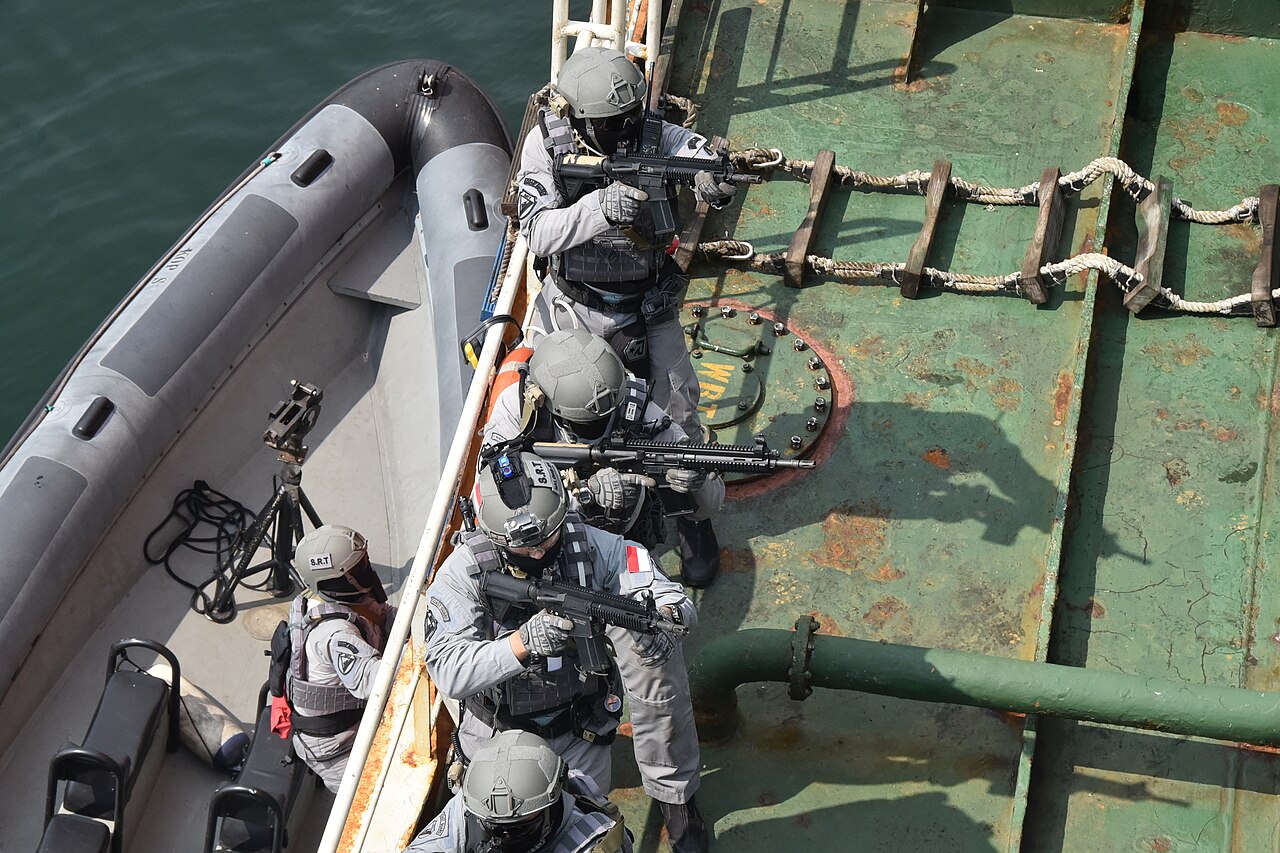
Indonesia’s maritime enforcement system is best understood as a “multi-agency, multi-task” patchwork. Any institution with legal authority to perform coastguard functions is, in practice, part of the coastguard ecosystem.
These institutions include TNI-AL (the navy), KKP, KPLP (shipping and safety), Polairud (the police maritime arm), customs, and BAKAMLA. Their responsibilities span fisheries enforcement, navigation safety, maritime security and defence.
On paper, responsibilities appear divided. TNI-AL secures Indonesia’s exclusive economic zone (EEZ), KKP enforces fisheries law, KPLP oversees shipping safety, and BAKAMLA handles maritime security and grey-zone incidents. In practice, however, overlaps dominate.
Legally, classic coastguard duties – safety, navigation and port control – sit with KPLP under the Navigation/Shipping Law (UU 17/2008), strengthened by its 2024 amendment (UU 66/2024). Yet TNI-AL holds the strongest practical authority. Article 9 of the TNI Law grants the navy broad powers to enforce law and maintain security across Indonesian waters. Fisheries legislation lists navy investigators alongside fisheries officials and police, with few clear limits. The 2025 revision of the TNI Law further expands non-war operations and allows active navy personnel to serve in civilian agencies such as BAKAMLA and KPLP.
TNI-AL dominates because of its political influence, regional command structure and operational capacity, while civilian agencies remain comparatively weak. Yet it remains a military institution. Relying on it to manage grey-zone incidents risks militarisation and escalation – precisely what coastguard forces are meant to avoid.
Among civilian actors, KKP is the most credible. Through the Marine and Fisheries Resources Surveillance general directorate (PSDKP), KKP holds primary fisheries enforcement authority up to 200 nautical miles. However, its capabilities remain modest: shallow-draft vessels, limited personnel and reliance on the navy or police for interdiction. Its regional presence mirrors aspects of the navy’s pesisir (coastal) doctrine, further blurring institutional boundaries. Polairud and KPLP are expanding as well, strengthening their own claims to maritime authority.
The Politics of Legislation
The Navigation/Shipping Law (UU Pelayaran) has long mandated the establishment of a formal coastguard. Because no single body was created, KPLP stepped into the vacuum. Over time, it became the de facto coastguard for safety and navigation – first in practice and now in law.
The latest revision of the Navigation/Shipping Law reinforces KPLP’s mandate and implicitly positions it as the leading coastguard authority in territorial waters. Crucially, the revision also represents a pushback against BAKAMLA. While BAKAMLA has sought a new Maritime Security Law (UU Kamla) to consolidate authority, KPLP and its parent ministry have defended their turf through statutory reinforcement.
Attempts under then-President Joko Widodo (2014–2024) to merge agencies into BAKAMLA – particularly through the Omnibus Law framework – failed. Agencies resisted, citing their legal mandates. The lesson is clear: in Indonesia, institutional power flows from law, not presidential preference. BAKAMLA, despite reporting directly to the president, remains weaker because presidents cannot unilaterally revise legislation, and recent administrations have prioritised economic development over maritime governance reform.
In legislative battles, BAKAMLA has steadily lost ground. Its proposals to revise UU 32/2014 and introduce the Maritime Security Law remain pending, while the Navigation/Shipping amendment – submitted later – advanced and passed. KPLP’s stronger political and industrial backing explains much of this outcome.
The revised law effectively consolidates KPLP’s role and constrains BAKAMLA’s ambitions. Yet BAKAMLA retains one remaining lever: the renewed submission of the Maritime Security Law, a bill with sweeping implications.
BAKAMLA’s Swan Song?
The draft Maritime Security Law has received endorsement from the Coordinating Ministry for Political, Legal and Security Affairs. It represents BAKAMLA’s latest major attempt to redefine its institutional future. The bill could either empower BAKAMLA – or render it obsolete.
The proposal envisions a single-agency, multi-task coastguard: one civilian institution with authority over patrol, interdiction, boarding, and arrest – absorbing all enforcement functions except those of the navy. The new body would operate alongside TNI-AL and serve as a reserve component.
If passed, the bill would override sectoral laws, remove enforcement powers from KKP, KPLP, customs and the police, and transfer their assets to the new coastguard. As a compromise, cases would still be returned to sectoral ministries for prosecution.
Almost all agencies – except TNI-AL – oppose the bill. Consequently, the draft Maritime Security Law was placed in the parliament’s medium-term National Legislation Programme (Prolegnas) (2025–2029) rather than on the 2026 priority list. While inclusion in Prolegnas marks a shift from aspiration to legislative possibility, it offers no guarantee of passage. Placement in the medium-term programme signals limited urgency and leaves the bill vulnerable to political bargaining, time constraints and shifting priorities.
Meanwhile, the Indonesian police have aggressively expanded their maritime mandate. They secured authority over the continental shelf in the 2023 law and are now seeking jurisdiction in the EEZ and fisheries domain. Their strategy is incremental, with a focus being on accumulating mandates.
In principle, the Maritime Security Law offers a coherent solution. In practice, political realities may prevent its adoption. Its fate will depend on how agencies contest specific wording in parliament, mobilise allies and negotiate behind closed doors.
Maritime strategy in Indonesia’s law-enforcement domain therefore emerges not from grand design, but from the interplay between assessments of regional dynamics and domestic politics. Grey-zone challenges create demand for an effective coastguard. Yet institutional rivalry, legal fragmentation, and bureaucratic survival shape outcomes more than strategic intent.
The question of who gets to be the coastguard remains unresolved – and is likely to remain so for the foreseeable future.
Emirza Adi Syailendra is a Research Fellow with the Maritime Security Programme, S. Rajaratnam School of International Studies (RSIS).
KEY TAKEAWAYS
• Domestic contestation over the formalisation of Indonesia’s coastguard reveals a central constraint of democratic-era governance: even modest reforms – such as establishing a unified coastguard – are repeatedly obstructed by bureaucratic actors protected by long-standing legal mandates.
• The struggle is not only institutional but conceptual. Competing worldviews shape how different agencies claim ownership of Indonesia’s maritime agenda. As a result, major shifts occur not through strategic directives but through slow, hard-fought battles over legal wording and jurisdiction.
• The policy reality is clear: Indonesia will not have a unified coastguard any time soon. The system will remain fragmented and multi-agency for the foreseeable future.
COMMENTARY
Grey-zone tactics in the South China Sea – operations designed to pressure or intimidate without triggering open conflict – have made coastguard forces central to maritime strategy in Southeast Asia. Modern coastguards do far more than ensure safety at sea. They enforce maritime law, deter foreign incursions and assert sovereignty without escalating to the use of force.
Indonesia stands out because it does not have a single coastguard. Instead, several agencies perform coastguard functions: patrols, arrests, escorts, safety inspections and responses to grey-zone threats. Efforts to streamline this system – especially through the creation of the Indonesian Maritime Security Agency (BAKAMLA) in 2014 – have produced the opposite effect. Despite being recognised by regional partners as Indonesia’s de facto coastguard, BAKAMLA is structurally the weakest actor in the system.
Even when BAKAMLA detains offenders under tangkap tangan – the “caught in the act” provision – its authority ends once the vessel and suspects are secured. Investigations and prosecutions must then be transferred to the agency with jurisdiction, whether fisheries (KKP), customs, or the police. BAKAMLA’s operational relevance rests largely on practice and routine presence at sea – not on strong statutory authority.
This raises a fundamental question: if BAKAMLA is not the coastguard, then who is?
Multi-Agency, Multi-Task Maritime Enforcement
Indonesia’s maritime enforcement system is best understood as a “multi-agency, multi-task” patchwork. Any institution with legal authority to perform coastguard functions is, in practice, part of the coastguard ecosystem.
These institutions include TNI-AL (the navy), KKP, KPLP (shipping and safety), Polairud (the police maritime arm), customs, and BAKAMLA. Their responsibilities span fisheries enforcement, navigation safety, maritime security and defence.
On paper, responsibilities appear divided. TNI-AL secures Indonesia’s exclusive economic zone (EEZ), KKP enforces fisheries law, KPLP oversees shipping safety, and BAKAMLA handles maritime security and grey-zone incidents. In practice, however, overlaps dominate.
Legally, classic coastguard duties – safety, navigation and port control – sit with KPLP under the Navigation/Shipping Law (UU 17/2008), strengthened by its 2024 amendment (UU 66/2024). Yet TNI-AL holds the strongest practical authority. Article 9 of the TNI Law grants the navy broad powers to enforce law and maintain security across Indonesian waters. Fisheries legislation lists navy investigators alongside fisheries officials and police, with few clear limits. The 2025 revision of the TNI Law further expands non-war operations and allows active navy personnel to serve in civilian agencies such as BAKAMLA and KPLP.
TNI-AL dominates because of its political influence, regional command structure and operational capacity, while civilian agencies remain comparatively weak. Yet it remains a military institution. Relying on it to manage grey-zone incidents risks militarisation and escalation – precisely what coastguard forces are meant to avoid.
Among civilian actors, KKP is the most credible. Through the Marine and Fisheries Resources Surveillance general directorate (PSDKP), KKP holds primary fisheries enforcement authority up to 200 nautical miles. However, its capabilities remain modest: shallow-draft vessels, limited personnel and reliance on the navy or police for interdiction. Its regional presence mirrors aspects of the navy’s pesisir (coastal) doctrine, further blurring institutional boundaries. Polairud and KPLP are expanding as well, strengthening their own claims to maritime authority.
The Politics of Legislation
The Navigation/Shipping Law (UU Pelayaran) has long mandated the establishment of a formal coastguard. Because no single body was created, KPLP stepped into the vacuum. Over time, it became the de facto coastguard for safety and navigation – first in practice and now in law.
The latest revision of the Navigation/Shipping Law reinforces KPLP’s mandate and implicitly positions it as the leading coastguard authority in territorial waters. Crucially, the revision also represents a pushback against BAKAMLA. While BAKAMLA has sought a new Maritime Security Law (UU Kamla) to consolidate authority, KPLP and its parent ministry have defended their turf through statutory reinforcement.
Attempts under then-President Joko Widodo (2014–2024) to merge agencies into BAKAMLA – particularly through the Omnibus Law framework – failed. Agencies resisted, citing their legal mandates. The lesson is clear: in Indonesia, institutional power flows from law, not presidential preference. BAKAMLA, despite reporting directly to the president, remains weaker because presidents cannot unilaterally revise legislation, and recent administrations have prioritised economic development over maritime governance reform.
In legislative battles, BAKAMLA has steadily lost ground. Its proposals to revise UU 32/2014 and introduce the Maritime Security Law remain pending, while the Navigation/Shipping amendment – submitted later – advanced and passed. KPLP’s stronger political and industrial backing explains much of this outcome.
The revised law effectively consolidates KPLP’s role and constrains BAKAMLA’s ambitions. Yet BAKAMLA retains one remaining lever: the renewed submission of the Maritime Security Law, a bill with sweeping implications.
BAKAMLA’s Swan Song?
The draft Maritime Security Law has received endorsement from the Coordinating Ministry for Political, Legal and Security Affairs. It represents BAKAMLA’s latest major attempt to redefine its institutional future. The bill could either empower BAKAMLA – or render it obsolete.
The proposal envisions a single-agency, multi-task coastguard: one civilian institution with authority over patrol, interdiction, boarding, and arrest – absorbing all enforcement functions except those of the navy. The new body would operate alongside TNI-AL and serve as a reserve component.
If passed, the bill would override sectoral laws, remove enforcement powers from KKP, KPLP, customs and the police, and transfer their assets to the new coastguard. As a compromise, cases would still be returned to sectoral ministries for prosecution.
Almost all agencies – except TNI-AL – oppose the bill. Consequently, the draft Maritime Security Law was placed in the parliament’s medium-term National Legislation Programme (Prolegnas) (2025–2029) rather than on the 2026 priority list. While inclusion in Prolegnas marks a shift from aspiration to legislative possibility, it offers no guarantee of passage. Placement in the medium-term programme signals limited urgency and leaves the bill vulnerable to political bargaining, time constraints and shifting priorities.
Meanwhile, the Indonesian police have aggressively expanded their maritime mandate. They secured authority over the continental shelf in the 2023 law and are now seeking jurisdiction in the EEZ and fisheries domain. Their strategy is incremental, with a focus being on accumulating mandates.
In principle, the Maritime Security Law offers a coherent solution. In practice, political realities may prevent its adoption. Its fate will depend on how agencies contest specific wording in parliament, mobilise allies and negotiate behind closed doors.
Maritime strategy in Indonesia’s law-enforcement domain therefore emerges not from grand design, but from the interplay between assessments of regional dynamics and domestic politics. Grey-zone challenges create demand for an effective coastguard. Yet institutional rivalry, legal fragmentation, and bureaucratic survival shape outcomes more than strategic intent.
The question of who gets to be the coastguard remains unresolved – and is likely to remain so for the foreseeable future.
Emirza Adi Syailendra is a Research Fellow with the Maritime Security Programme, S. Rajaratnam School of International Studies (RSIS).