

02 March 2026
IP26032 | Southeast Asia’s Rising Quantum Ecosystem: Implications for Singapore

KEY TAKEAWAYS
• Southeast Asia’s ecosystem for quantum technologies is becoming more competitive as countries in the region roll out national initiatives as well as collaborations with industry and academia.
• Singapore continues to benefit from its early investments and is well positioned with the refreshed Research, Innovation and Enterprise 2030 plan.
• However, its ability to stay ahead regionally will depend on remaining attractive to, and retaining, talent alongside navigating geoeconomic competition.
COMMENTARY
Southeast Asia’s ecosystem for quantum technologies (QTs) is rising. Six out of 11 ASEAN member states have announced national initiatives in recent years, and the first ASEAN Quantum Summit convening regional and international stakeholders took place in Malaysia from 10 to 12 December 2025.
This is not surprising given the potential of QTs across three main application areas – communication, computing, and sensing. McKinsey & Company has estimated that the market for QTs will be worth US$97 billion by 2035, with quantum computing expected to make up the largest share overall.
Singapore has thus far enjoyed a pole position regionally in QTs due to its early investments. While its National Quantum Strategy (NQS), announced in 2024, has outlined a vision to strengthen the city-state’s position as a leading hub, this has yet to be translated into concrete milestones that allow progress on the ground to be assessed in practical terms.
Meanwhile, Singapore’s Research, Innovation and Enterprise (RIE) plan, which guides public sector investment in R&D, was recently updated to 2030. RIE 2030 will be backed by S$37 billion in funding from April 2026, which is S$9 billion more than the S$28 billion allocated for RIE 2025. While it is not yet clear how much of this will be devoted to QTs, the S$300 million allocated under RIE 2025 to support the NQS provides some indication.
Will this be sufficient to keep Singapore ahead regionally in the face of growing competition? Much will depend on attracting and anchoring a strong pool of talent to support the R&D and industry ecosystem for QTs. Besides strengthening its own value proposition, Singapore will also have to navigate an operating environment characterised by intensifying geoeconomic competition.
The Rising Regional Quantum Ecosystem
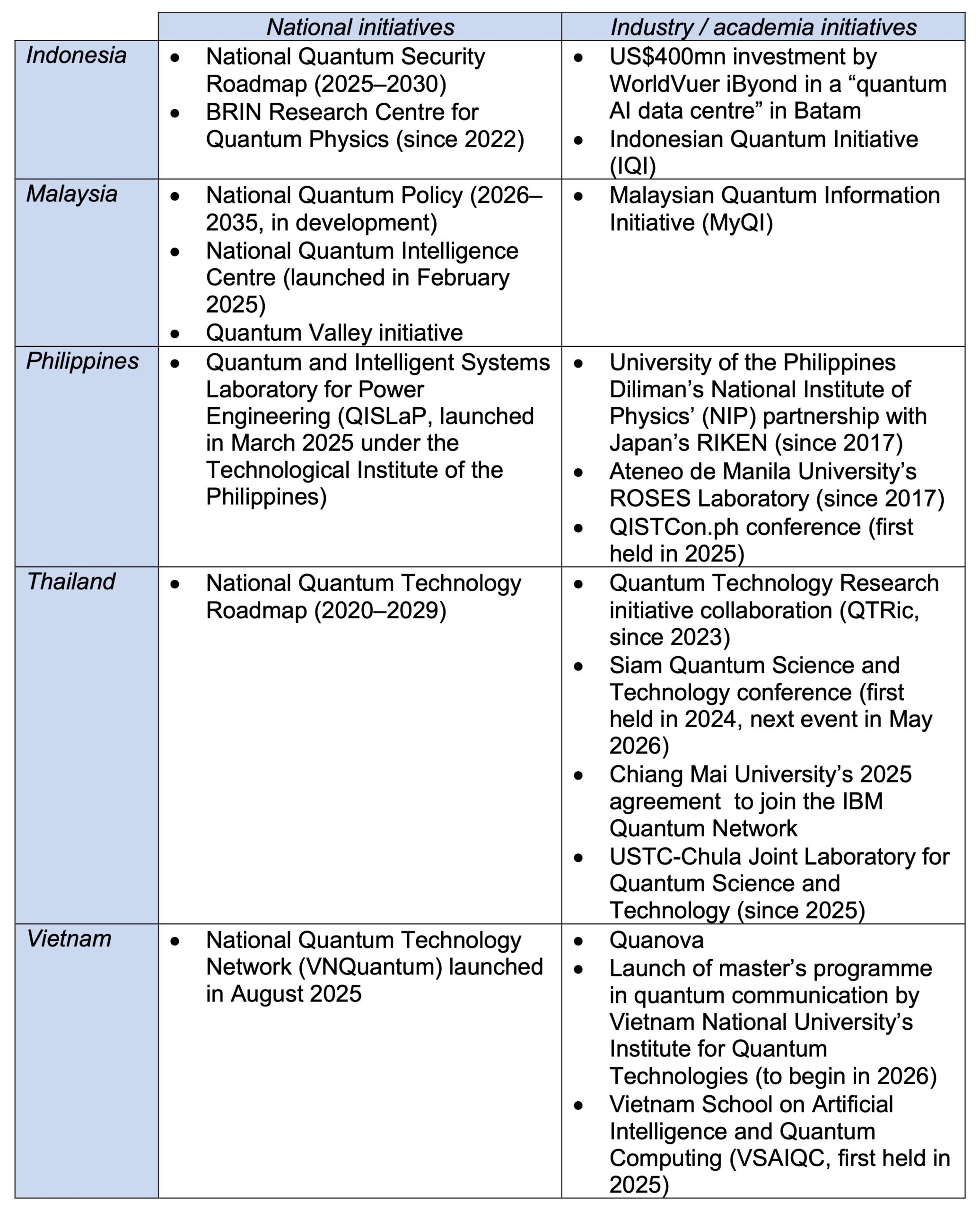
The United Nations’ declaration that 2025 will be the “International Year of Quantum Science and Technology” marked 100 years since the birth of quantum mechanics. The year 2025 also saw several countries in Southeast Asia advancing their ecosystems for QTs. For example, Indonesia and Malaysia announced initiatives to develop national strategies and technology roadmaps for QTs. Meanwhile, Vietnam and the Philippines announced major R&D initiatives related to QTs in 2025, while Thailand is planning to review its existing roadmap that was announced in 2020.
The Talent Challenge
In addition to nurturing home-grown talent, countries across Southeast Asia will also begin to attract talent from elsewhere as their ecosystems for QTs mature. For example, in Indonesia, the BRIN Research Centre for Quantum Physics aims to attract more talent through a national programme that is focused on facilitating research visits, post-doctoral research attachments and mobility programmes for researchers. Similarly, Vietnam’s National Quantum Technology Network, or VNQuantum, has an emphasis on workforce development through education and training.
International partnerships will also play an important role in the talent equation. Joint laboratories between academic institutions, such as the one between the University of Science and Technology of China and Thailand’s Chulalongkorn University announced in 2025, will shape regional flows of talent. Some of these partnerships are also likely to leverage longstanding relationships, such as the ties between the University of the Philippines Diliman’s National Institute of Physics and Japan’s RIKEN that date back to the 1990s.
Singapore has long been an attractive destination for global talent, but the higher cost of living in the city-state has weighed on long-term retention in recent years. Growing regional competition will add to this problem, in addition to socio-cultural factors that workforce development policies do not typically address directly, such as lifestyle and cultural preferences.
Navigating Growing Regional Competition amid a Geoeconomic Turn
Across Southeast Asia, several countries are clearly demonstrating their determination to carve out a niche in QTs, regardless of their size and level of development. The gap between desire and reality, however, will be determined by the scale of their investments, how effectively these investments will be deployed in advancing their ecosystems for QTs, and their ability to attract and anchor talent to support not just R&D, but the corresponding growth of industry through spin-offs and start-ups.

Image source: Ragsxl, CC BY-SA 4.0, via Wikimedia Commons.
Singapore has a clear advantage when it comes to the scale of its investments in QTs, which dwarf investments by the rest of the region. Its RIE plans have also ably sustained the domestic quantum ecosystem and advanced its capabilities over the past two decades. However, while Singapore has been an attractive destination for quantum talent for some time, this cannot be taken for granted as regional QT ecosystems grow.
Moreover, QTs are increasingly entangled in the broader geoeconomic turn that has characterised international relations in recent years, which has seen countries leverage economic tools such as investment screening, export controls, and industrial policy to advance their strategic and geopolitical objectives. This trend is most visible when it comes to China and the United States, but is global in its reach.
For Singapore, this will mean keeping a close watch on the partnerships that other countries in the region are entering into. These will provide an indication of how the geoeconomics of QTs is playing out across Southeast Asia, particularly if countries decide to favour one of the two superpowers. However, the ecosystem for QTs remains quite diverse for now, with multiple players other than China and the United States, such as Australia, the European Union, Japan, and South Korea.
Manoj Harjani is Research Fellow and Coordinator of the Military Transformations Programme (MTP) at the S. Rajaratnam School of International Studies (RSIS). Kashmiraa Pandit is an intern with MTP and a master’s student at RSIS.
KEY TAKEAWAYS
• Southeast Asia’s ecosystem for quantum technologies is becoming more competitive as countries in the region roll out national initiatives as well as collaborations with industry and academia.
• Singapore continues to benefit from its early investments and is well positioned with the refreshed Research, Innovation and Enterprise 2030 plan.
• However, its ability to stay ahead regionally will depend on remaining attractive to, and retaining, talent alongside navigating geoeconomic competition.
COMMENTARY
Southeast Asia’s ecosystem for quantum technologies (QTs) is rising. Six out of 11 ASEAN member states have announced national initiatives in recent years, and the first ASEAN Quantum Summit convening regional and international stakeholders took place in Malaysia from 10 to 12 December 2025.
This is not surprising given the potential of QTs across three main application areas – communication, computing, and sensing. McKinsey & Company has estimated that the market for QTs will be worth US$97 billion by 2035, with quantum computing expected to make up the largest share overall.
Singapore has thus far enjoyed a pole position regionally in QTs due to its early investments. While its National Quantum Strategy (NQS), announced in 2024, has outlined a vision to strengthen the city-state’s position as a leading hub, this has yet to be translated into concrete milestones that allow progress on the ground to be assessed in practical terms.
Meanwhile, Singapore’s Research, Innovation and Enterprise (RIE) plan, which guides public sector investment in R&D, was recently updated to 2030. RIE 2030 will be backed by S$37 billion in funding from April 2026, which is S$9 billion more than the S$28 billion allocated for RIE 2025. While it is not yet clear how much of this will be devoted to QTs, the S$300 million allocated under RIE 2025 to support the NQS provides some indication.
Will this be sufficient to keep Singapore ahead regionally in the face of growing competition? Much will depend on attracting and anchoring a strong pool of talent to support the R&D and industry ecosystem for QTs. Besides strengthening its own value proposition, Singapore will also have to navigate an operating environment characterised by intensifying geoeconomic competition.
The Rising Regional Quantum Ecosystem
The United Nations’ declaration that 2025 will be the “International Year of Quantum Science and Technology” marked 100 years since the birth of quantum mechanics. The year 2025 also saw several countries in Southeast Asia advancing their ecosystems for QTs. For example, Indonesia and Malaysia announced initiatives to develop national strategies and technology roadmaps for QTs. Meanwhile, Vietnam and the Philippines announced major R&D initiatives related to QTs in 2025, while Thailand is planning to review its existing roadmap that was announced in 2020.
The Talent Challenge
In addition to nurturing home-grown talent, countries across Southeast Asia will also begin to attract talent from elsewhere as their ecosystems for QTs mature. For example, in Indonesia, the BRIN Research Centre for Quantum Physics aims to attract more talent through a national programme that is focused on facilitating research visits, post-doctoral research attachments and mobility programmes for researchers. Similarly, Vietnam’s National Quantum Technology Network, or VNQuantum, has an emphasis on workforce development through education and training.
International partnerships will also play an important role in the talent equation. Joint laboratories between academic institutions, such as the one between the University of Science and Technology of China and Thailand’s Chulalongkorn University announced in 2025, will shape regional flows of talent. Some of these partnerships are also likely to leverage longstanding relationships, such as the ties between the University of the Philippines Diliman’s National Institute of Physics and Japan’s RIKEN that date back to the 1990s.
Singapore has long been an attractive destination for global talent, but the higher cost of living in the city-state has weighed on long-term retention in recent years. Growing regional competition will add to this problem, in addition to socio-cultural factors that workforce development policies do not typically address directly, such as lifestyle and cultural preferences.
Navigating Growing Regional Competition amid a Geoeconomic Turn
Across Southeast Asia, several countries are clearly demonstrating their determination to carve out a niche in QTs, regardless of their size and level of development. The gap between desire and reality, however, will be determined by the scale of their investments, how effectively these investments will be deployed in advancing their ecosystems for QTs, and their ability to attract and anchor talent to support not just R&D, but the corresponding growth of industry through spin-offs and start-ups.
Image source: Ragsxl, CC BY-SA 4.0, via Wikimedia Commons.
Singapore has a clear advantage when it comes to the scale of its investments in QTs, which dwarf investments by the rest of the region. Its RIE plans have also ably sustained the domestic quantum ecosystem and advanced its capabilities over the past two decades. However, while Singapore has been an attractive destination for quantum talent for some time, this cannot be taken for granted as regional QT ecosystems grow.
Moreover, QTs are increasingly entangled in the broader geoeconomic turn that has characterised international relations in recent years, which has seen countries leverage economic tools such as investment screening, export controls, and industrial policy to advance their strategic and geopolitical objectives. This trend is most visible when it comes to China and the United States, but is global in its reach.
For Singapore, this will mean keeping a close watch on the partnerships that other countries in the region are entering into. These will provide an indication of how the geoeconomics of QTs is playing out across Southeast Asia, particularly if countries decide to favour one of the two superpowers. However, the ecosystem for QTs remains quite diverse for now, with multiple players other than China and the United States, such as Australia, the European Union, Japan, and South Korea.
Manoj Harjani is Research Fellow and Coordinator of the Military Transformations Programme (MTP) at the S. Rajaratnam School of International Studies (RSIS). Kashmiraa Pandit is an intern with MTP and a master’s student at RSIS.