


03 March 2026
IP26033 | Voluntary Weapons Control: Private Companies and Global Bio-governance

KEY TAKEAWAYS
• Traditionally, bioweapons have been ineffective on the battlefield. As a result, there is limited interest among states in truly regulating new technologies that could be used to develop them.
• New technologies such as DNA synthesis and artificial intelligence – which are overwhelmingly controlled by the private sector – lower the barriers to designing, making and releasing pathogens, and therefore have changed the risk profile.
• The current state of geopolitics and the rapidly changing nature of biotechnologies have left the private sector to govern what could potentially be weapons of mass destruction.
COMMENTARY
For five years, a highly pathogenic strain of avian influenza (H5N1) has swept across the world. Humans have been largely powerless to do anything about it. Wild and domesticated birds and, increasingly, mammals, are being infected. Fortunately, only dozens of humans have so far been infected. But scientists and policymakers are monitoring to see if a wider human outbreak occurs in 2026. H5N1 is a naturally occurring virus. But it shows the power of biology and why human-targeted bioweapons remain a source of great concern.
Global governance of new biotechnologies is a delicate dance between making advancements to address real human suffering and preventing the worst possible uses. Private companies developing biotechnologies – some of which are start-ups – have been charged with voluntarily overseeing the risks. This model is not sustainable; there is a need to sensibly assign responsibility for oversight to governments without creating unsustainable burdens that impede innovation.
Emerging Biotechnologies
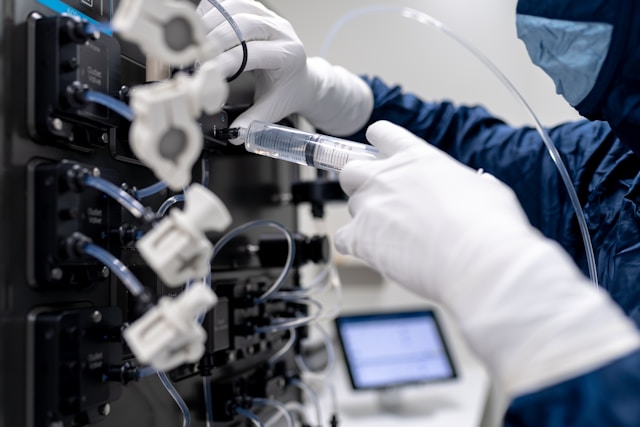
Advances in DNA synthesis, gene editing and computational biological design represent a new generation of biotechnologies that are transforming science and industry. While these biotechnologies have enormous potential for medicine, agriculture and bio-manufacturing, they also carry dual-use risks by reducing the expertise, cost and time once required to manipulate biological systems.
DNA synthesis
Modern DNA synthesis platforms allow rapid, inexpensive, and accurate production of genetic material. Ordering or assembling sequences that once required specialised facilities is increasingly straightforward. This accessibility accelerates beneficial research but also makes it easier for malicious actors to obtain or recreate dangerous genetic material.
DNA synthesis screening is the frontline for monitoring biological weapons. The technologies outlined in the next two sections can design new bioweapons. But for those designs to be translated into actual pathogens, the designs need to be turned into DNA.
In 2023, a MIT research team managed to purchase the necessary DNA to recreate the Spanish Flu. They did it by purchasing sections of DNA code from multiple providers. This problem is well known and still does not have a good solution.
Biological design tools (BDT)
Biological design tools are AI-powered software platforms that help researchers model, simulate and optimise biological systems. A BDT will design thousands of variations of an organism in minutes, which would have previously taken months or been impossible.
BDTs can design harmful variations of known pathogens or create new pathogens. The organisms can be designed to evade the screening protocols of DNA synthesis companies. These organisms could then be manufactured and sold to customers by the synthesis companies.
In October 2025, researchers used BDTs to design protein sequences that would be potentially dangerous, and these went undetected by the DNA synthesis screening software. A machine learning software patch fixed this specific problem, but the potential for misuse remains.
The path we are heading toward is AI-designed organisms being screened by AI-designed software. Humans will increasingly be bystanders.
Gene editing
Gene editing systems such as CRISPR allow users to accurately insert DNA from any organism into another organism. Advanced gene editing sparked the latest round of biotechnology advancement.
This allowed for genes to be inserted into completely new use cases. For example, the United States recently approved a salmon for consumption that has growth hormone genes inserted from a larger fish to make it grow bigger.
The theoretical concern would be that someone inserts features from multiple pathogens into one pathogen. Pathogen organisms are generally viruses or bacteria, much simpler than salmon, so the edits are simpler. The other way to do this would be to design the pathogen from scratch using a BDT and then use a synthesis company to manufacture the DNA.
Challenges for Assessing Bio-risk
Biosecurity governance oscillates between two poles of thought. At one end is the reality that intentional weaponisation of biology has, for the most part, failed because it is hard to deliver in the field. Newly designed human-targeting organisms require significant lab testing on mammals to determine their likely replicability, deadliness and potential evolutionary pathways.
At the other end are the alarming characteristics of bioweapons and bio-accidents that are essentially living organisms: they self-replicate, evolve and can rapidly spread globally. No other weapon – deliberately or accidentally released – can achieve this capacity. It is also difficult to differentiate between human-made and naturally-occurring pathogens.
The reality is somewhere in between these two poles. The actual pathway to a released pathogen is a little more complicated. Anyone working on new viruses or bacteria to harm humanity ideally develops hundreds or thousands of different strains and tests them in an uncontaminated environment. If a lone actor developed a new strain, they would have no way of knowing its impact without testing. They would have most likely – but not certainly – produced a dud, even with computational design tools.
Contradictions in Modern Global Bio-Governance
Traditionally, the Biological Weapons Convention (BWC) has focused on weapons of mass destruction that were developed by state-run facilities. Today, however, most virology and synthetic biology capacity lies in private companies and universities.
Current regulation of DNA synthesis and biological design tools rests on three pillars.
First, government pathogen lists. Certain pathogens or precursors are banned or licensed, but modern synthesis enables multi-use genes to be assembled into pathogens, limiting the lists’ effectiveness.
Second, voluntary industry guidelines. The International Gene Synthesis Consortium (an industry group) has non-binding guidelines. The 2024 U.S. Framework for Nucleic Acid Synthesis Screening was a planned policy to compel screening for DNA synthesis companies that supplied DNA to US federally funded organisations. However, in May 2025, a Presidential Executive Order paused the framework pending revision within 90 days. To date, no revised framework has been released; proposed legislation to codify the order sits unpassed, and while the framework has been referenced in subsequent AI action plans, no rules have followed.
Finally, companies running automated self-screening processes akin to anti-money laundering rules. Higher-risk cases – identified by software – require manual review by the companies involved. But manual checks are costly, and dangerous gene fragments can be purchased for less than a hundred dollars, undermining the economics of screening.
DNA synthesis is an emerging technology. R&D costs are high and the commercial pressure to drop prices is also substantial, which has squeezed margins for years. This is a disincentive for companies to engage in manual screening. Automated screening, however, can lead to overzealous denial of gene purchases. Conversely, it may also lead to erroneous approvals of dangerous sequences.
What Is a Pathway Forward?
Existing automated screening will not be enough on its own. Biotechnologies are evolving fast and determined customers can simply reorder gene fragments in smaller pieces to evade screening.
Regulation is needed in two main areas. First, customer verification. This is currently addressed in voluntary guidelines, but leaving it to companies is a flawed approach. Companies lack the data that governments hold, and customer information is commercially sensitive, creating a conflict of interest. Government-run platforms are needed to verify and track new DNA synthesis customers across providers.
Second, shared order databases. Cross-provider tracking would help law enforcement spot suspicious patterns. The International Gene Synthesis Consortium does this for known pathogens, but it needs to expand to cover all gene orders. And again, moving this out of company hands would reduce conflicts of interest.
Dirk van der Kley is the Head of the Genes and Geopolitics Team at the Australian National University and the co-founder of the India-Australia Hub for Biotech Research. He was Visiting Senior Fellow with the Military Transformations Programme at the S. Rajaratnam School of International Studies (RSIS) in September 2025.
KEY TAKEAWAYS
• Traditionally, bioweapons have been ineffective on the battlefield. As a result, there is limited interest among states in truly regulating new technologies that could be used to develop them.
• New technologies such as DNA synthesis and artificial intelligence – which are overwhelmingly controlled by the private sector – lower the barriers to designing, making and releasing pathogens, and therefore have changed the risk profile.
• The current state of geopolitics and the rapidly changing nature of biotechnologies have left the private sector to govern what could potentially be weapons of mass destruction.
COMMENTARY
For five years, a highly pathogenic strain of avian influenza (H5N1) has swept across the world. Humans have been largely powerless to do anything about it. Wild and domesticated birds and, increasingly, mammals, are being infected. Fortunately, only dozens of humans have so far been infected. But scientists and policymakers are monitoring to see if a wider human outbreak occurs in 2026. H5N1 is a naturally occurring virus. But it shows the power of biology and why human-targeted bioweapons remain a source of great concern.
Global governance of new biotechnologies is a delicate dance between making advancements to address real human suffering and preventing the worst possible uses. Private companies developing biotechnologies – some of which are start-ups – have been charged with voluntarily overseeing the risks. This model is not sustainable; there is a need to sensibly assign responsibility for oversight to governments without creating unsustainable burdens that impede innovation.
Emerging Biotechnologies
Advances in DNA synthesis, gene editing and computational biological design represent a new generation of biotechnologies that are transforming science and industry. While these biotechnologies have enormous potential for medicine, agriculture and bio-manufacturing, they also carry dual-use risks by reducing the expertise, cost and time once required to manipulate biological systems.
DNA synthesis
Modern DNA synthesis platforms allow rapid, inexpensive, and accurate production of genetic material. Ordering or assembling sequences that once required specialised facilities is increasingly straightforward. This accessibility accelerates beneficial research but also makes it easier for malicious actors to obtain or recreate dangerous genetic material.
DNA synthesis screening is the frontline for monitoring biological weapons. The technologies outlined in the next two sections can design new bioweapons. But for those designs to be translated into actual pathogens, the designs need to be turned into DNA.
In 2023, a MIT research team managed to purchase the necessary DNA to recreate the Spanish Flu. They did it by purchasing sections of DNA code from multiple providers. This problem is well known and still does not have a good solution.
Biological design tools (BDT)
Biological design tools are AI-powered software platforms that help researchers model, simulate and optimise biological systems. A BDT will design thousands of variations of an organism in minutes, which would have previously taken months or been impossible.
BDTs can design harmful variations of known pathogens or create new pathogens. The organisms can be designed to evade the screening protocols of DNA synthesis companies. These organisms could then be manufactured and sold to customers by the synthesis companies.
In October 2025, researchers used BDTs to design protein sequences that would be potentially dangerous, and these went undetected by the DNA synthesis screening software. A machine learning software patch fixed this specific problem, but the potential for misuse remains.
The path we are heading toward is AI-designed organisms being screened by AI-designed software. Humans will increasingly be bystanders.
Gene editing
Gene editing systems such as CRISPR allow users to accurately insert DNA from any organism into another organism. Advanced gene editing sparked the latest round of biotechnology advancement.
This allowed for genes to be inserted into completely new use cases. For example, the United States recently approved a salmon for consumption that has growth hormone genes inserted from a larger fish to make it grow bigger.
The theoretical concern would be that someone inserts features from multiple pathogens into one pathogen. Pathogen organisms are generally viruses or bacteria, much simpler than salmon, so the edits are simpler. The other way to do this would be to design the pathogen from scratch using a BDT and then use a synthesis company to manufacture the DNA.
Challenges for Assessing Bio-risk
Biosecurity governance oscillates between two poles of thought. At one end is the reality that intentional weaponisation of biology has, for the most part, failed because it is hard to deliver in the field. Newly designed human-targeting organisms require significant lab testing on mammals to determine their likely replicability, deadliness and potential evolutionary pathways.
At the other end are the alarming characteristics of bioweapons and bio-accidents that are essentially living organisms: they self-replicate, evolve and can rapidly spread globally. No other weapon – deliberately or accidentally released – can achieve this capacity. It is also difficult to differentiate between human-made and naturally-occurring pathogens.
The reality is somewhere in between these two poles. The actual pathway to a released pathogen is a little more complicated. Anyone working on new viruses or bacteria to harm humanity ideally develops hundreds or thousands of different strains and tests them in an uncontaminated environment. If a lone actor developed a new strain, they would have no way of knowing its impact without testing. They would have most likely – but not certainly – produced a dud, even with computational design tools.
Contradictions in Modern Global Bio-Governance
Traditionally, the Biological Weapons Convention (BWC) has focused on weapons of mass destruction that were developed by state-run facilities. Today, however, most virology and synthetic biology capacity lies in private companies and universities.
Current regulation of DNA synthesis and biological design tools rests on three pillars.
First, government pathogen lists. Certain pathogens or precursors are banned or licensed, but modern synthesis enables multi-use genes to be assembled into pathogens, limiting the lists’ effectiveness.
Second, voluntary industry guidelines. The International Gene Synthesis Consortium (an industry group) has non-binding guidelines. The 2024 U.S. Framework for Nucleic Acid Synthesis Screening was a planned policy to compel screening for DNA synthesis companies that supplied DNA to US federally funded organisations. However, in May 2025, a Presidential Executive Order paused the framework pending revision within 90 days. To date, no revised framework has been released; proposed legislation to codify the order sits unpassed, and while the framework has been referenced in subsequent AI action plans, no rules have followed.
Finally, companies running automated self-screening processes akin to anti-money laundering rules. Higher-risk cases – identified by software – require manual review by the companies involved. But manual checks are costly, and dangerous gene fragments can be purchased for less than a hundred dollars, undermining the economics of screening.
DNA synthesis is an emerging technology. R&D costs are high and the commercial pressure to drop prices is also substantial, which has squeezed margins for years. This is a disincentive for companies to engage in manual screening. Automated screening, however, can lead to overzealous denial of gene purchases. Conversely, it may also lead to erroneous approvals of dangerous sequences.
What Is a Pathway Forward?
Existing automated screening will not be enough on its own. Biotechnologies are evolving fast and determined customers can simply reorder gene fragments in smaller pieces to evade screening.
Regulation is needed in two main areas. First, customer verification. This is currently addressed in voluntary guidelines, but leaving it to companies is a flawed approach. Companies lack the data that governments hold, and customer information is commercially sensitive, creating a conflict of interest. Government-run platforms are needed to verify and track new DNA synthesis customers across providers.
Second, shared order databases. Cross-provider tracking would help law enforcement spot suspicious patterns. The International Gene Synthesis Consortium does this for known pathogens, but it needs to expand to cover all gene orders. And again, moving this out of company hands would reduce conflicts of interest.
Dirk van der Kley is the Head of the Genes and Geopolitics Team at the Australian National University and the co-founder of the India-Australia Hub for Biotech Research. He was Visiting Senior Fellow with the Military Transformations Programme at the S. Rajaratnam School of International Studies (RSIS) in September 2025.