


04 March 2026
IP26034 | Indonesia’s Aircraft Carrier Acquisition: A Planned Force Transformation?

KEY TAKEAWAYS
• The acquisition of the Giuseppe Garibaldi aligns with Indonesia’s shift towards an “Optimum Essential Force”, signalling national ambition.
• The aircraft carrier is likely to start operating with naval helicopters, serving as a flagship for humanitarian assistance and disaster relief operations rather than traditional power projection. There is potential for it to evolve into a hybrid manned–unmanned carrier.
• Maintenance, training and operational costs will determine longer-term operations.
COMMENTARY
Significant attention has been directed towards the Indonesian Navy (TNI-AL), since Chief of Navy Admiral (ADM) Muhammad Ali announced the acquisition of the former Italian aircraft carrier Giuseppe Garibaldi on 12 February. Indonesia is poised to become only the second Southeast Asian nation to operate an aircraft carrier when the Giuseppe Garibaldi arrives as planned in October 2026 before the Indonesian National Armed Forces’ (TNI) anniversary. Questions quickly emerged over both cost and purpose: whether it was for power projection and if it fits with Indonesia’s primary mission of archipelagic defence. Brigadier General (BG) Rico Ricardo Sirait from the Indonesian Ministry of Defence (KEMHAN) clarified that the carrier will be used by the TNI-AL for both military operations and humanitarian assistance and disaster relief (HADR) missions, reiterating again on 26 February that the ship will not be used for offensive operations.
Transition from MEF to OEF – Rationale for an Aircraft Carrier?
For the past decade or so, the TNI’s procurement plans followed its Minimum Essential Force (MEF) framework. Building up in stages from 2010 to 2024, the MEF called for 274 vessels for the TNI-AL, comprising strike craft, patrol vessels and support ships. No aircraft carrier was listed. Even though the MEF has yet to be fully fulfilled, a new framework – the Optimum Essential Force (OEF) – was introduced in 2025. The OEF ostensibly reflects the requirements for the TNI to face threat perceptions and geopolitical situations of the future. To be realised in 5-year stages beginning from 2025 to 2029, the OEF will see new assets introduced based on the new “TNI Force Posture 2025–2044” (Postur Kekuatan TNI 2025–2044) strategic plan.
While there is no public information regarding the number or types of assets under the OEF, it is possible that an aircraft carrier might have been a part of the OEF. It is widely known that President Prabowo Subianto had been pushing for the TNI to modernise and acquire new capabilities since his time as defence minister. The delivery of new ships such as the Merah Putih frigate, the Brawijaya-class frigates and new submarine acquisitions bear testament to his ambitions. Though an old ship, the Giuseppe Garibaldi is an opportunistic buy. After all, an aircraft carrier is a strategic signal, projecting national ambition and presence. ADM Ali visited the Giuseppe Garibaldi as early as May 2024 while it was on an exercise in Italy. He mentioned Indonesia’s intent to acquire the carrier in September 2025, a year after Prabowo became president. Size-wise, an aircraft carrier dwarfs any other ship in the TNI-AL’s inventory and can serve as a flagship during operations. Even if offensive roles are downplayed, the timing elevates Indonesia’s stature as a regional maritime power, especially in the current geopolitical environment.
Types of Carriers
The term “aircraft carrier” evokes images of the US Navy’s nuclear-powered carriers, surrounded by the powerful destroyers, frigates and support vessels in a carrier group. In reality, carriers can take on a spectrum of roles and capabilities. Besides power projection using fixed-wing aircraft, carriers can also carry a mix of short take-off and vertical landing (STOVL) fixed-wing aircraft as well as helicopters. More recently, the concept has evolved towards operating drones, such as Turkey’s Anadolu, which flies the locally made Bayraktar TB3 unmanned combat aerial vehicle (UCAV), even though it is capable of operating STOVL aircraft.
Thailand’s Experience
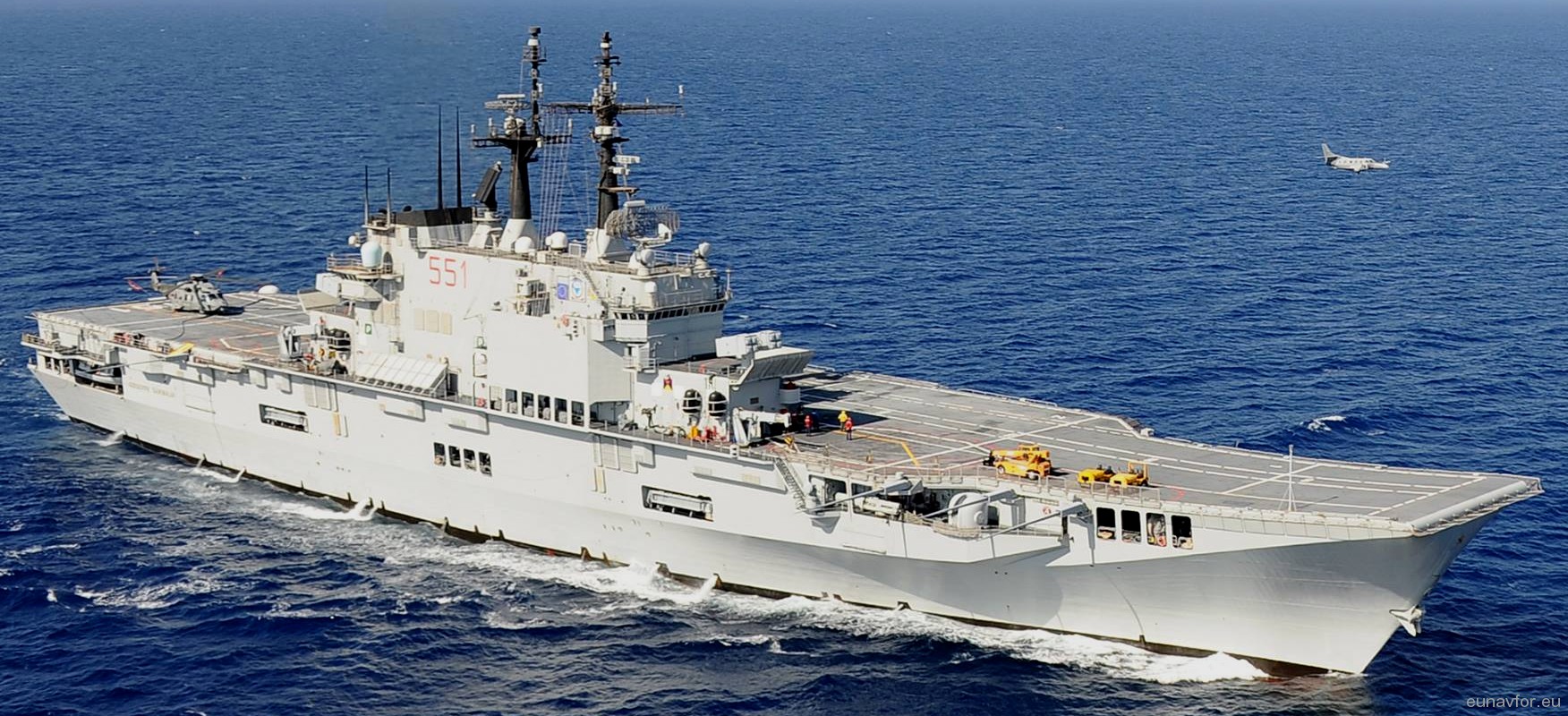
To better understand how the new carrier might be used, we should take a closer look at the design of the Giuseppe Garibaldi. The 180-metre-long carrier can carry up to 18 helicopters. Similar to Thailand’s HTMS Chakri Naruebet (182 metres long), the Giuseppe Garibaldi too lacks a well dock for landing craft. Chakri Naruebet started by operating with a mix of Matador STOVL aircraft and Seahawk helicopters, yet the Thai carrier eventually transitioned to an all-helicopter configuration due to cost issues. Over time, Chakri Naruebet was used predominantly for HADR missions. Its recent deployment for flood relief in Songkhla in 2025 reinforced this pattern. It was estimated that it cost almost two million baht (~US$65,000) to operate the carrier for a three-day deployment, with fuel cost alone being around one million baht.
Possible Aircraft Mix and Operating Concept
It is unlikely that fixed-wing aircraft will be employed on the Giuseppe Garibaldi in the initial period due to the timeline for procurement and training; hence the carrier’s main operations would likely be HADR-related rather than traditional power projection. The operating mix at the start is likely to be limited to “navalised” aircraft, such as the TNI-AL’s utility helicopters (BO-105) and anti-submarine warfare helicopters (AS565 Panther). To maximise its HADR utility, training and certification of the Indonesian army’s Mi-17 or the air force’s H225M for carrier deck operations will be needed. Drones could become part of the carrier’s operating mix in the future. Italian shipbuilder Fincantieri had already proposed modifications to the carrier to enable drone operations. Relatedly, Indonesian defence company Republikorp, which has an agreement with Turkish defence company Baykar for Bayraktar TB3 drones, had shown interest in retrofitting the carrier. Coincidentally, there was also a report of the TNI-AL air wing testing a locally made drone – the Poseindon H10. The longer-term challenge though will not be technical competence but managing a combined manned–unmanned air wing at sea, while supporting logistics operations.
Costs of Acquisition and Retrofitting
In terms of expenditure, BG Rico shared that the carrier will be transferred as a grant and that “there is no cost to purchase the vessel”. He added that “Indonesia’s financial obligations are reduced to retrofitting, system adjustments, and other operational costs from the transfer process”. Unlike Chakri Naruebet, which was a new build, Giuseppe Garibaldi is 40 years old, and the retrofitting costs (such as for the integrated platform management systems) could be between US$20 and US$40 million (using the estimate for Chakri Naruebet). According to some reports, the Indonesian Ministry of National Development Planning (BAPPENAS) had approved a maximum loan amount of US$450 million to fund the acquisition, as well as an additional US$250 million for the acquisition of transport helicopters and US$300 million for utility helicopters. Interestingly, what was not widely reported was that the defence budget for 2025 more than doubled from Rp166 trillion (US$9.8 billion) to Rp364 trillion (US$21.5 billion), perhaps to account for the retrofitting and procurement costs. However, the true cost lies in long-term operations, training and maintenance. Sustaining it will require continuous spending on fuel, repairs, aviation support and specialised crew training, which is estimated by some analysts at US$50–US$80 million annually.
Conclusion
Indonesia’s acquisition of the Giuseppe Garibaldi is as much about strategic signalling as it is about hardware. By acquiring its first carrier, the TNI-AL is showing that it has started the OEF. However, a traditional power projection role is neither sustainable fiscally nor doctrinally aligned with Indonesia’s “non-invasive” stance. Given that the carrier is a 40-year-old hull, it is likely to focus on HADR operations initially as a helicopter-based flagship, potentially evolving into a platform for hybrid manned–unmanned operations. Ultimately, its success will depend on whether it can bridge the gap between the practical demands of archipelagic defence and fiscal and structural realities.
Nicholas Lim is a Senior Fellow with the Institute of Defence and Strategic Studies (IDSS). His research interests are in the maritime and defence domains, after having served more than 30 years in the Republic of Singapore Navy.
KEY TAKEAWAYS
• The acquisition of the Giuseppe Garibaldi aligns with Indonesia’s shift towards an “Optimum Essential Force”, signalling national ambition.
• The aircraft carrier is likely to start operating with naval helicopters, serving as a flagship for humanitarian assistance and disaster relief operations rather than traditional power projection. There is potential for it to evolve into a hybrid manned–unmanned carrier.
• Maintenance, training and operational costs will determine longer-term operations.
COMMENTARY
Significant attention has been directed towards the Indonesian Navy (TNI-AL), since Chief of Navy Admiral (ADM) Muhammad Ali announced the acquisition of the former Italian aircraft carrier Giuseppe Garibaldi on 12 February. Indonesia is poised to become only the second Southeast Asian nation to operate an aircraft carrier when the Giuseppe Garibaldi arrives as planned in October 2026 before the Indonesian National Armed Forces’ (TNI) anniversary. Questions quickly emerged over both cost and purpose: whether it was for power projection and if it fits with Indonesia’s primary mission of archipelagic defence. Brigadier General (BG) Rico Ricardo Sirait from the Indonesian Ministry of Defence (KEMHAN) clarified that the carrier will be used by the TNI-AL for both military operations and humanitarian assistance and disaster relief (HADR) missions, reiterating again on 26 February that the ship will not be used for offensive operations.
Transition from MEF to OEF – Rationale for an Aircraft Carrier?
For the past decade or so, the TNI’s procurement plans followed its Minimum Essential Force (MEF) framework. Building up in stages from 2010 to 2024, the MEF called for 274 vessels for the TNI-AL, comprising strike craft, patrol vessels and support ships. No aircraft carrier was listed. Even though the MEF has yet to be fully fulfilled, a new framework – the Optimum Essential Force (OEF) – was introduced in 2025. The OEF ostensibly reflects the requirements for the TNI to face threat perceptions and geopolitical situations of the future. To be realised in 5-year stages beginning from 2025 to 2029, the OEF will see new assets introduced based on the new “TNI Force Posture 2025–2044” (Postur Kekuatan TNI 2025–2044) strategic plan.
While there is no public information regarding the number or types of assets under the OEF, it is possible that an aircraft carrier might have been a part of the OEF. It is widely known that President Prabowo Subianto had been pushing for the TNI to modernise and acquire new capabilities since his time as defence minister. The delivery of new ships such as the Merah Putih frigate, the Brawijaya-class frigates and new submarine acquisitions bear testament to his ambitions. Though an old ship, the Giuseppe Garibaldi is an opportunistic buy. After all, an aircraft carrier is a strategic signal, projecting national ambition and presence. ADM Ali visited the Giuseppe Garibaldi as early as May 2024 while it was on an exercise in Italy. He mentioned Indonesia’s intent to acquire the carrier in September 2025, a year after Prabowo became president. Size-wise, an aircraft carrier dwarfs any other ship in the TNI-AL’s inventory and can serve as a flagship during operations. Even if offensive roles are downplayed, the timing elevates Indonesia’s stature as a regional maritime power, especially in the current geopolitical environment.
Types of Carriers
The term “aircraft carrier” evokes images of the US Navy’s nuclear-powered carriers, surrounded by the powerful destroyers, frigates and support vessels in a carrier group. In reality, carriers can take on a spectrum of roles and capabilities. Besides power projection using fixed-wing aircraft, carriers can also carry a mix of short take-off and vertical landing (STOVL) fixed-wing aircraft as well as helicopters. More recently, the concept has evolved towards operating drones, such as Turkey’s Anadolu, which flies the locally made Bayraktar TB3 unmanned combat aerial vehicle (UCAV), even though it is capable of operating STOVL aircraft.
Thailand’s Experience
To better understand how the new carrier might be used, we should take a closer look at the design of the Giuseppe Garibaldi. The 180-metre-long carrier can carry up to 18 helicopters. Similar to Thailand’s HTMS Chakri Naruebet (182 metres long), the Giuseppe Garibaldi too lacks a well dock for landing craft. Chakri Naruebet started by operating with a mix of Matador STOVL aircraft and Seahawk helicopters, yet the Thai carrier eventually transitioned to an all-helicopter configuration due to cost issues. Over time, Chakri Naruebet was used predominantly for HADR missions. Its recent deployment for flood relief in Songkhla in 2025 reinforced this pattern. It was estimated that it cost almost two million baht (~US$65,000) to operate the carrier for a three-day deployment, with fuel cost alone being around one million baht.
Possible Aircraft Mix and Operating Concept
It is unlikely that fixed-wing aircraft will be employed on the Giuseppe Garibaldi in the initial period due to the timeline for procurement and training; hence the carrier’s main operations would likely be HADR-related rather than traditional power projection. The operating mix at the start is likely to be limited to “navalised” aircraft, such as the TNI-AL’s utility helicopters (BO-105) and anti-submarine warfare helicopters (AS565 Panther). To maximise its HADR utility, training and certification of the Indonesian army’s Mi-17 or the air force’s H225M for carrier deck operations will be needed. Drones could become part of the carrier’s operating mix in the future. Italian shipbuilder Fincantieri had already proposed modifications to the carrier to enable drone operations. Relatedly, Indonesian defence company Republikorp, which has an agreement with Turkish defence company Baykar for Bayraktar TB3 drones, had shown interest in retrofitting the carrier. Coincidentally, there was also a report of the TNI-AL air wing testing a locally made drone – the Poseindon H10. The longer-term challenge though will not be technical competence but managing a combined manned–unmanned air wing at sea, while supporting logistics operations.
Costs of Acquisition and Retrofitting
In terms of expenditure, BG Rico shared that the carrier will be transferred as a grant and that “there is no cost to purchase the vessel”. He added that “Indonesia’s financial obligations are reduced to retrofitting, system adjustments, and other operational costs from the transfer process”. Unlike Chakri Naruebet, which was a new build, Giuseppe Garibaldi is 40 years old, and the retrofitting costs (such as for the integrated platform management systems) could be between US$20 and US$40 million (using the estimate for Chakri Naruebet). According to some reports, the Indonesian Ministry of National Development Planning (BAPPENAS) had approved a maximum loan amount of US$450 million to fund the acquisition, as well as an additional US$250 million for the acquisition of transport helicopters and US$300 million for utility helicopters. Interestingly, what was not widely reported was that the defence budget for 2025 more than doubled from Rp166 trillion (US$9.8 billion) to Rp364 trillion (US$21.5 billion), perhaps to account for the retrofitting and procurement costs. However, the true cost lies in long-term operations, training and maintenance. Sustaining it will require continuous spending on fuel, repairs, aviation support and specialised crew training, which is estimated by some analysts at US$50–US$80 million annually.
Conclusion
Indonesia’s acquisition of the Giuseppe Garibaldi is as much about strategic signalling as it is about hardware. By acquiring its first carrier, the TNI-AL is showing that it has started the OEF. However, a traditional power projection role is neither sustainable fiscally nor doctrinally aligned with Indonesia’s “non-invasive” stance. Given that the carrier is a 40-year-old hull, it is likely to focus on HADR operations initially as a helicopter-based flagship, potentially evolving into a platform for hybrid manned–unmanned operations. Ultimately, its success will depend on whether it can bridge the gap between the practical demands of archipelagic defence and fiscal and structural realities.
Nicholas Lim is a Senior Fellow with the Institute of Defence and Strategic Studies (IDSS). His research interests are in the maritime and defence domains, after having served more than 30 years in the Republic of Singapore Navy.