


13 March 2026
IP26042 | Strengthening ASEAN-India Ties: Increasing Climate Cooperation in the Maritime Domain

KEY TAKEAWAYS
• Maritime security has traditionally been a key area of cooperation for ASEAN and India.
• Considering the sizeable coastal regions and maritime domains of Southeast Asia and India, climate change is likely to have significant implications for them.
• ASEAN and India could build on pre-existing maritime mechanisms, such as the ADMM-Plus Experts’ Working Groups (EWGs) on Maritime Security and Track II-level interactions, to use as an avenue to share knowledge and enhance cooperation on climate change.
COMMENTARY
In 2027, ASEAN and India will mark 35 years of formal relations. A key focus for this partnership is their shared interest in maritime security, with 2026 having been designated as the “ASEAN-India Year of Maritime Cooperation”. While this encompasses a wide range of issues, from counter-piracy in key shipping lanes to vital blue economy challenges, climate change is climbing up the ranks of shared priorities as a matter of increasing urgency.
Considering their sizeable coastal regions and maritime domain, climate change is likely to have significant implications for ASEAN and India. As traditional donor countries struggle to maintain their previous momentum in global climate action, there is a need for ASEAN and India to look elsewhere to deal with transboundary climate issues. Considering their shared concerns over the impending climate change-induced maritime security challenges in the Indo-Pacific region, this is an opportunity to build on pre-existing partnerships with each other, further developing multinational climate partnerships.
The ASEAN-India Relationship
From being “Sectoral Dialogue Partners” in 1992, to a full “Dialogue Partnership” in 1995 and later, a Comprehensive Strategic Partnership in 2022, the relationship between ASEAN-India has been growing from strength to strength.
For ASEAN, India is a key partner – one of its seven Comprehensive Strategic Partners – with deep ties particularly in terms of trade and security. While the links between ASEAN and India have been relatively restricted – particularly when compared to other ASEAN Dialogue Partners such as Japan and China, this seems to be changing. For ASEAN member states, there has been a shift in their perception, with India’s strategic standing seeming to be on an upward trajectory. In particular, India with its multi-alignment strategy seems to be increasingly attractive as a like-minded “ally” amidst rising tensions and uncertainties in the geopolitical landscape.
For India, ASEAN has been the cornerstone of its “Act East” policy – a foreign policy strategy aimed at deepening ties with ASEAN and its individual member states through various mechanisms, including participation in several multilateral forums such as the ASEAN-India Summit and the ASEAN Defence Ministers’ Meeting Plus (ADMM-Plus). Bilateral engagements, high-level visits and participation in joint military exercises in areas such as maritime security and trade form part of these interactions.
Working together on climate action would therefore be another link between ASEAN and India. This would further shore up India’s credentials as a strategic partner and increase its presence in the region – particularly as climate change is increasingly highlighted as the top challenge faced by Southeast Asia.
Maritime Security: The Climate Angle
It is clear that climate change will alter the security dynamics of the Indo-Pacific region. Southeast Asia has been highlighted as one of the regions most vulnerable to climate change. Along with Myanmar and the Philippines, India is also among the top 10 countries most affected by climate change from 1995 to 2024. Indonesia’s capital, Jakarta, is the fastest-sinking city in the world. Bangkok and Manila in Southeast Asia, as well as Chennai and Mumbai in India, are not far behind.
Militaries themselves are no less affected, with naval bases and other critical maritime infrastructure becoming increasingly vulnerable to inundation and erosion. Rising sea levels could potentially alter physical formations marking political boundaries such as exclusive economic zones. The implications are significant – affecting livelihoods, increasing the likelihood of mass displacement, and challenging international norms. If not managed effectively, this is likely to exacerbate existing volatilities and vulnerabilities, overwhelming the ability of states in a region already dealing with its fair share of challenges.
Maritime security has traditionally been a significant area of cooperation for ASEAN and India. A cornerstone of their relationship, India has been involved in several ASEAN maritime initiatives, including contributing personnel to the Information Fusion Centre, a regional maritime security centre situated at Changi Naval Base in Singapore, participating in bilateral and multilateral maritime exercises such as the 2023 ASEAN–India Maritime Exercise and the annual India-Indonesian Samudra Shakti exercise, as well as coordinated patrols with ASEAN member states.
However, securing the Indo-Pacific will also need to go beyond military bases and counter-operations. The long-term maritime security needs of the region must be considered, with specific climate policies. Both the ASEAN Maritime Outlook and India’s SAGAR (now MAHASAGAR) strategy are on the right path, as seen in their emphasis on the need to consider climate change as a key maritime priority. This is reinforced in the recent Plan of Action to Implement the ASEAN-India Comprehensive Strategic Partnership (2026–2030), which highlights the need to strengthen cooperation on climate change and humanitarian assistance and disaster relief (HADR) under maritime cooperation, underscoring the symbiotic relationship between these issues.
Moving Forward
Engagement on climate action is therefore an opportunity to deepen the ASEAN-India relationship. For example, this could occur through the development of information-sharing mechanisms to share climate intelligence that would help better understand and manage their shared maritime domain. This could then be used in joint exercises and coordinated patrols to assess military readiness and integrate climate security into national and regional security strategies. This can take place at the state level through various ASEAN-led mechanisms.
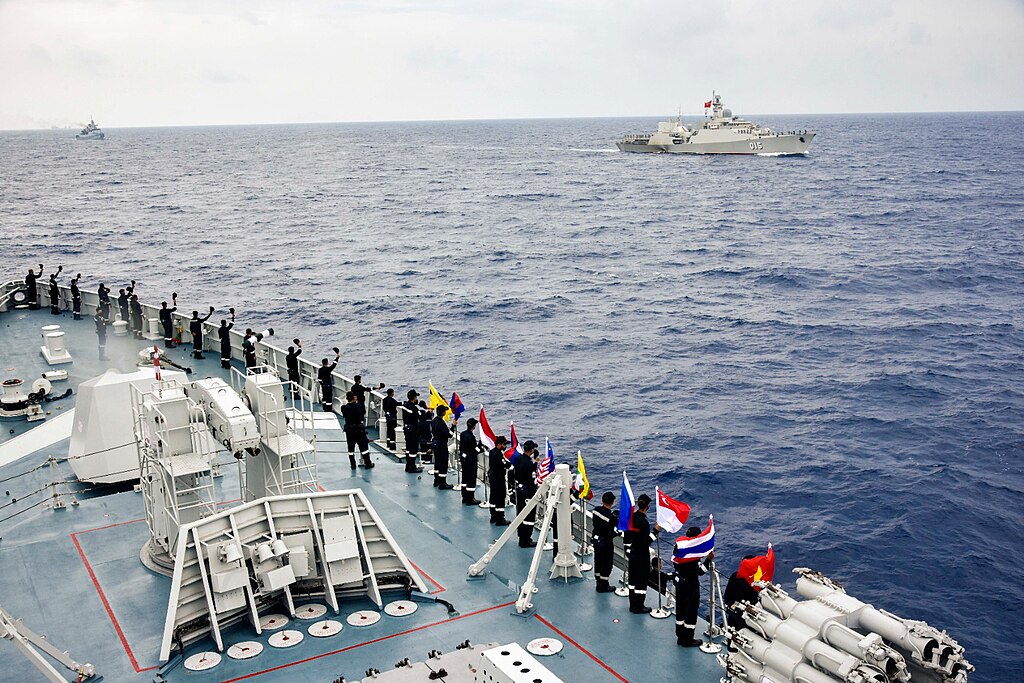
Image source: Wikimedia Commons.
For example, through the ADMM-Plus mechanism. The ADMM-Plus brings together ASEAN member states and its dialogue partners (including India) to foster practical defence and military cooperation through its seven Expert Working Groups (EWGs), including one on maritime security. As highlighted by the ADMM-Plus EWG on HADR’s focus on climate security during its current term, there seems to be an increased interest in convening and promoting more collaborative climate action between militaries. Considering climate change is a multi-sectoral issue, this may be an opportunity for collaboration between the ADMM-Plus EWG on HADR and the ADMM-Plus EWG on Maritime Security. This could take the form of joint exercises and workshop sessions. After all, there is precedent, with joint exercises between the EWG on Maritime Security and Counter-Terrorism having been conducted previously.
Beyond state-level mechanisms, knowledge-sharing can also take place at the Track II level between think tanks. For example, the 14th Annual Dialogue and Workshop between the S. Rajaratnam School of International Studies (RSIS), Singapore, and the National Maritime Foundation (NMF), India, which was recently held in Singapore, provided an opportunity for the discussion of maritime issues of common interest to both states. This included bilateral relations, security priorities in the broader Indo-Pacific, as well as emerging issues such as climate change.
As we approach four decades of partnership between ASEAN and India, this relationship has only become of increasing significance as their shared geopolitical landscape becomes increasingly fraught. The Indo-Pacific region – with its strategic sea lanes, global hotspots and balance of power considerations – is increasingly becoming a central arena in which several geopolitical rivalries are playing out. It is, therefore, in the best interests of ASEAN and India to further strengthen their relationship, promoting regional stability in a worryingly volatile space. Considering the impacts of climate change on the vast coastal domain of Southeast Asia and India – and the long-standing history of cooperation in this area of maritime security – this is a strategic avenue for ASEAN and India to work together, further strengthening their relationship.
Nanthini is an Associate Research Fellow in the Humanitarian Assistance and Disaster Relief Programme at the Institute for Defence and Strategic Studies, S. Rajaratnam School of International Studies (RSIS).
KEY TAKEAWAYS
• Maritime security has traditionally been a key area of cooperation for ASEAN and India.
• Considering the sizeable coastal regions and maritime domains of Southeast Asia and India, climate change is likely to have significant implications for them.
• ASEAN and India could build on pre-existing maritime mechanisms, such as the ADMM-Plus Experts’ Working Groups (EWGs) on Maritime Security and Track II-level interactions, to use as an avenue to share knowledge and enhance cooperation on climate change.
COMMENTARY
In 2027, ASEAN and India will mark 35 years of formal relations. A key focus for this partnership is their shared interest in maritime security, with 2026 having been designated as the “ASEAN-India Year of Maritime Cooperation”. While this encompasses a wide range of issues, from counter-piracy in key shipping lanes to vital blue economy challenges, climate change is climbing up the ranks of shared priorities as a matter of increasing urgency.
Considering their sizeable coastal regions and maritime domain, climate change is likely to have significant implications for ASEAN and India. As traditional donor countries struggle to maintain their previous momentum in global climate action, there is a need for ASEAN and India to look elsewhere to deal with transboundary climate issues. Considering their shared concerns over the impending climate change-induced maritime security challenges in the Indo-Pacific region, this is an opportunity to build on pre-existing partnerships with each other, further developing multinational climate partnerships.
The ASEAN-India Relationship
From being “Sectoral Dialogue Partners” in 1992, to a full “Dialogue Partnership” in 1995 and later, a Comprehensive Strategic Partnership in 2022, the relationship between ASEAN-India has been growing from strength to strength.
For ASEAN, India is a key partner – one of its seven Comprehensive Strategic Partners – with deep ties particularly in terms of trade and security. While the links between ASEAN and India have been relatively restricted – particularly when compared to other ASEAN Dialogue Partners such as Japan and China, this seems to be changing. For ASEAN member states, there has been a shift in their perception, with India’s strategic standing seeming to be on an upward trajectory. In particular, India with its multi-alignment strategy seems to be increasingly attractive as a like-minded “ally” amidst rising tensions and uncertainties in the geopolitical landscape.
For India, ASEAN has been the cornerstone of its “Act East” policy – a foreign policy strategy aimed at deepening ties with ASEAN and its individual member states through various mechanisms, including participation in several multilateral forums such as the ASEAN-India Summit and the ASEAN Defence Ministers’ Meeting Plus (ADMM-Plus). Bilateral engagements, high-level visits and participation in joint military exercises in areas such as maritime security and trade form part of these interactions.
Working together on climate action would therefore be another link between ASEAN and India. This would further shore up India’s credentials as a strategic partner and increase its presence in the region – particularly as climate change is increasingly highlighted as the top challenge faced by Southeast Asia.
Maritime Security: The Climate Angle
It is clear that climate change will alter the security dynamics of the Indo-Pacific region. Southeast Asia has been highlighted as one of the regions most vulnerable to climate change. Along with Myanmar and the Philippines, India is also among the top 10 countries most affected by climate change from 1995 to 2024. Indonesia’s capital, Jakarta, is the fastest-sinking city in the world. Bangkok and Manila in Southeast Asia, as well as Chennai and Mumbai in India, are not far behind.
Militaries themselves are no less affected, with naval bases and other critical maritime infrastructure becoming increasingly vulnerable to inundation and erosion. Rising sea levels could potentially alter physical formations marking political boundaries such as exclusive economic zones. The implications are significant – affecting livelihoods, increasing the likelihood of mass displacement, and challenging international norms. If not managed effectively, this is likely to exacerbate existing volatilities and vulnerabilities, overwhelming the ability of states in a region already dealing with its fair share of challenges.
Maritime security has traditionally been a significant area of cooperation for ASEAN and India. A cornerstone of their relationship, India has been involved in several ASEAN maritime initiatives, including contributing personnel to the Information Fusion Centre, a regional maritime security centre situated at Changi Naval Base in Singapore, participating in bilateral and multilateral maritime exercises such as the 2023 ASEAN–India Maritime Exercise and the annual India-Indonesian Samudra Shakti exercise, as well as coordinated patrols with ASEAN member states.
However, securing the Indo-Pacific will also need to go beyond military bases and counter-operations. The long-term maritime security needs of the region must be considered, with specific climate policies. Both the ASEAN Maritime Outlook and India’s SAGAR (now MAHASAGAR) strategy are on the right path, as seen in their emphasis on the need to consider climate change as a key maritime priority. This is reinforced in the recent Plan of Action to Implement the ASEAN-India Comprehensive Strategic Partnership (2026–2030), which highlights the need to strengthen cooperation on climate change and humanitarian assistance and disaster relief (HADR) under maritime cooperation, underscoring the symbiotic relationship between these issues.
Moving Forward
Engagement on climate action is therefore an opportunity to deepen the ASEAN-India relationship. For example, this could occur through the development of information-sharing mechanisms to share climate intelligence that would help better understand and manage their shared maritime domain. This could then be used in joint exercises and coordinated patrols to assess military readiness and integrate climate security into national and regional security strategies. This can take place at the state level through various ASEAN-led mechanisms.
Image source: Wikimedia Commons.
For example, through the ADMM-Plus mechanism. The ADMM-Plus brings together ASEAN member states and its dialogue partners (including India) to foster practical defence and military cooperation through its seven Expert Working Groups (EWGs), including one on maritime security. As highlighted by the ADMM-Plus EWG on HADR’s focus on climate security during its current term, there seems to be an increased interest in convening and promoting more collaborative climate action between militaries. Considering climate change is a multi-sectoral issue, this may be an opportunity for collaboration between the ADMM-Plus EWG on HADR and the ADMM-Plus EWG on Maritime Security. This could take the form of joint exercises and workshop sessions. After all, there is precedent, with joint exercises between the EWG on Maritime Security and Counter-Terrorism having been conducted previously.
Beyond state-level mechanisms, knowledge-sharing can also take place at the Track II level between think tanks. For example, the 14th Annual Dialogue and Workshop between the S. Rajaratnam School of International Studies (RSIS), Singapore, and the National Maritime Foundation (NMF), India, which was recently held in Singapore, provided an opportunity for the discussion of maritime issues of common interest to both states. This included bilateral relations, security priorities in the broader Indo-Pacific, as well as emerging issues such as climate change.
As we approach four decades of partnership between ASEAN and India, this relationship has only become of increasing significance as their shared geopolitical landscape becomes increasingly fraught. The Indo-Pacific region – with its strategic sea lanes, global hotspots and balance of power considerations – is increasingly becoming a central arena in which several geopolitical rivalries are playing out. It is, therefore, in the best interests of ASEAN and India to further strengthen their relationship, promoting regional stability in a worryingly volatile space. Considering the impacts of climate change on the vast coastal domain of Southeast Asia and India – and the long-standing history of cooperation in this area of maritime security – this is a strategic avenue for ASEAN and India to work together, further strengthening their relationship.
Nanthini is an Associate Research Fellow in the Humanitarian Assistance and Disaster Relief Programme at the Institute for Defence and Strategic Studies, S. Rajaratnam School of International Studies (RSIS).