


16 March 2026
IP26043 | From Conflict to Collaboration: The Rempang Dispute and Indonesia’s Reinvented Transmigration Policy

KEY TAKEAWAYS
• The Rempang episode reflects long-standing challenges in Indonesia’s land governance and transmigration policies.
• Indonesia’s new transmigration framework is architecturally better, but architecture alone does not guarantee outcomes.
• Rempang is simultaneously the site of the conflict and the flagship of the solution, making the Barelang pilot uniquely high stakes.
COMMENTARY
In September 2023, the island of Rempang in Indonesia’s Riau Islands province became the centre of one of the country’s most visible land conflicts in recent years. The Indonesian government had announced the Rempang Eco-City project – a multi-billion-dollar special economic zone backed by Chinese investment – intended to attract foreign capital and reduce economic concentration on Java. To make way for the development, thousands of residents from at least 16 traditional villages were informed that they would need to relocate.
The affected communities, predominantly indigenous Malay communities, had lived on the island for generations. Many lacked formal land titles despite long-standing customary claims. Their resistance was not merely due to economic reasons. For these communities, Rempang was an ancestral homeland, and relocation raised concerns about the preservation of community identity and historical ties to the land. When protests escalated, security forces deployed tear gas to disperse demonstrators, and images from the incident circulated widely in the media, drawing significant public attention.
The conflict prompted a parliamentary inquiry in which House of Representatives (DPR) Commission VI questioned the government’s handling of the project and called on authorities not to rush resettlement before compensation and replacement housing had been secured. Yet several important questions remained regarding land rights, consultation processes, and the legal framework governing the project. The episode quickly became a national controversy and reignited debate about land governance, development policy, and the treatment of customary communities.
Historical Context: Indonesia’s Transmigration Policy
The Rempang grievances are not new to Indonesia. They echo criticisms levelled at the national transmigration programme (transmigrasi) for decades. Originating in the Dutch colonial period in 1905 in Lampung and massively expanding under then-President Suharto’s New Order regime, the programme relocated millions of mostly Javanese families to the outer islands of Sumatra, Kalimantan, Sulawesi, and Papua. Its goals were demographic relief, land development, and national unity. Its principal measure of success was numerical: how many families could be relocated.
The outcomes of the programme were mixed. Alongside successes in opening new agricultural land and supporting pioneer communities, the programme also generated significant social and environmental costs. In some cases, the programme also generated tensions over customary adat land (indigenous land), particularly where traditional tenure arrangements were not formally recognised, as the legal framework of the time did not recognise them. Environmental pressures accompanied the large-scale conversion of forested land, particularly in Sumatra and Kalimantan. In the post-Suharto transition, social tensions between transmigrant settlers and host communities in parts of Kalimantan and Maluku underscored the importance of integration planning which had not always been prioritised. The World Bank, which co-financed elements of the programme during this period, engaged extensively in reviewing its design and outcomes, and the lessons drawn from that process have since informed a more cautious and community-centred approach to resettlement practice internationally.
A Reinvented Policy: Prabowo’s Administration Framework
In July 2025, Indonesia’s Minister of Transmigration announced a fundamental reorientation of the programme under President Prabowo Subianto. The new framework replaced demographic redistribution with integrated economic development as its core objective. The measure of success shifted from how many families are relocated to how many people achieve sustainable livelihoods. The vehicle for this ambition is the Kawasan Ekonomi Transmigrasi Terintegrasi (KETT) – a model of integrated development zones where housing, industry, education, and environmental planning are designed together, with the long-term vision of evolving into self-sufficient regional cities.
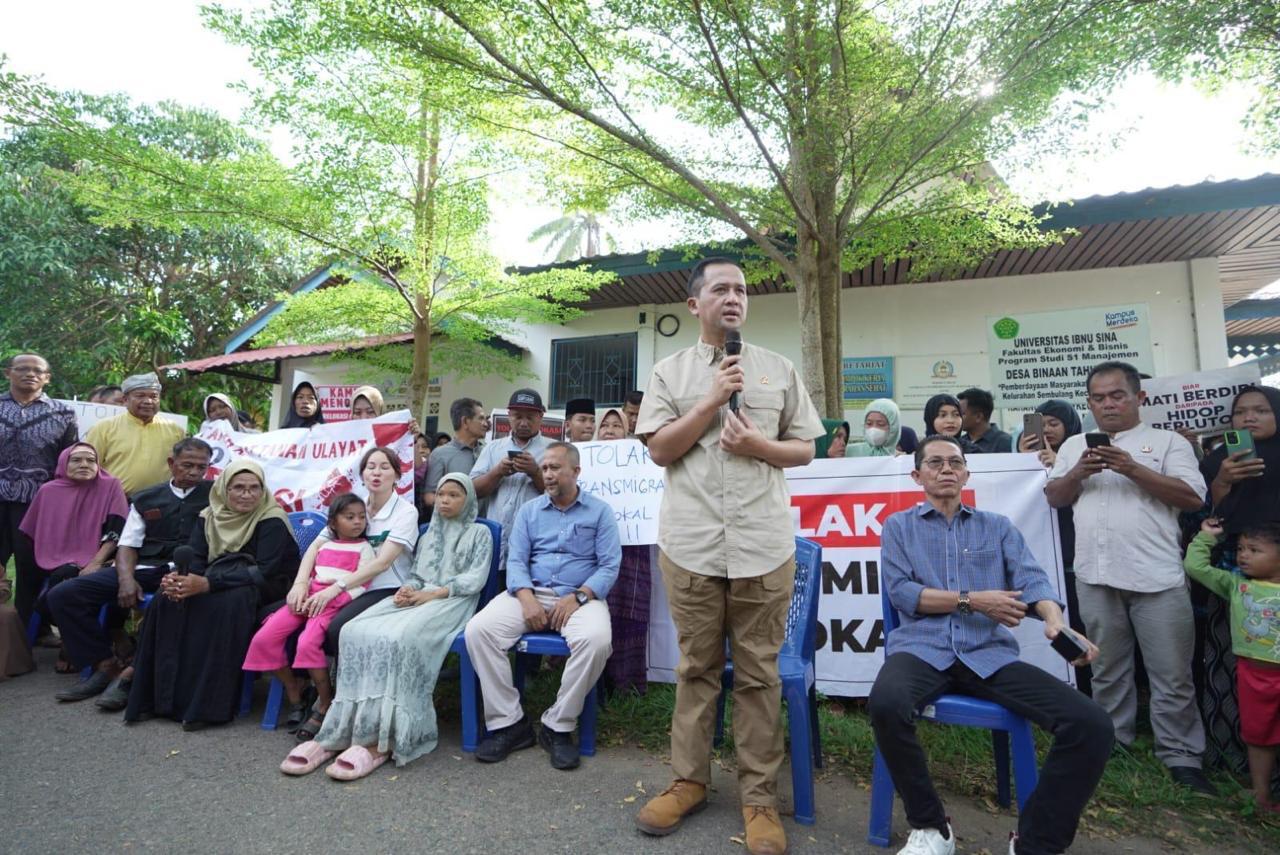
Image source: Ministry of Transmigration, Indonesia.
The policy is operationalised through five flagship programmes known as the “5T”. Trans Tuntas addresses land certification, converting customary land into documented private assets. Trans Patriot deploys university teams for community research and mentoring. Trans Karya Nusa focuses on job creation. Trans Gotong Royong builds government-business-academic partnerships. Most significant for communities such as those in Rempang, Trans Lokal explicitly positions indigenous and local residents as stakeholders rather than passive recipients of development.
The Riau Islands province, including Barelang and Rempang itself, has been designated as the flagship pilot for this new approach. Officially gazetted as the Kawasan Transmigrasi Barelang in September 2025, early implementation has included the issuance of 227 land title certificates to transmigrant family heads, the deployment of a Patriot Expedition Team from seven national universities, and the construction of a residential complex to support a scholarship programme launching in 2026. The reform reflects Jakarta’s attempt to distance contemporary development policy from the contentious legacy associated with earlier transmigration programmes.
Solution or Repackaging? A Critical Assessment
The new framework contains improvements over its predecessor. The shift away from numerical relocation targets, the emphasis on land certification, and the stated commitment to community participation in Trans Lokal all address structural failures that characterised the Suharto-era programme. If implemented diligently, these elements could provide Rempang’s communities with the tenure security, economic opportunity, and participatory voice they were denied before.
The concerns that gave rise to the Rempang conflict have not disappeared, but the new transmigration framework offers a strong institutional architecture for addressing them. The issues highlighted during the 2023 conflict – including land security, consultation processes, and the balance between development timelines and community interests – are precisely the issues the new framework is hoping to address. The reformed policy speaks directly to each of these: Trans Tuntas provides a formal mechanism for securing land titles; Trans Lokal seeks to position indigenous and local communities as active stakeholders in development planning.
The tension between investment-led development and community rights will not resolve itself automatically, but the KETT framework at least provides a structure within which tension can be managed rather than ignored. Whether this potential is realised will depend on consistent political will and the robustness of implementation on the ground. The Barelang pilot, with Rempang at its heart, is precisely the opportunity to demonstrate that development and community rights need not be in conflict.
Indonesia’s reinvented transmigration policy represents a meaningful evolution, but evolution in stated policy does not guarantee transformation in practice. For Rempang’s communities, a genuine solution requires more than a rebranded framework applied to the site of their displacement. It requires sustained engagement with affected communities, co-designed development that places their rights at the centre, and a political commitment to hold the line when investor interests and community rights diverge. Whether the Barelang pilot can demonstrate how large-scale development and community interests can be balanced remains an important question for policymakers.
Syed Huzaifah Bin Othman Alkaff is an Associate Research Fellow of the Indonesia Programme at the Institute of Defence and Strategic Studies (IDSS), S. Rajaratnam School of International Studies (RSIS). Sayed Fauzan Riyadi is an Associate Professor, International Relations Department, Raja Ali Haji Maritim University (UMRAH), Riau Islands.
KEY TAKEAWAYS
• The Rempang episode reflects long-standing challenges in Indonesia’s land governance and transmigration policies.
• Indonesia’s new transmigration framework is architecturally better, but architecture alone does not guarantee outcomes.
• Rempang is simultaneously the site of the conflict and the flagship of the solution, making the Barelang pilot uniquely high stakes.
COMMENTARY
In September 2023, the island of Rempang in Indonesia’s Riau Islands province became the centre of one of the country’s most visible land conflicts in recent years. The Indonesian government had announced the Rempang Eco-City project – a multi-billion-dollar special economic zone backed by Chinese investment – intended to attract foreign capital and reduce economic concentration on Java. To make way for the development, thousands of residents from at least 16 traditional villages were informed that they would need to relocate.
The affected communities, predominantly indigenous Malay communities, had lived on the island for generations. Many lacked formal land titles despite long-standing customary claims. Their resistance was not merely due to economic reasons. For these communities, Rempang was an ancestral homeland, and relocation raised concerns about the preservation of community identity and historical ties to the land. When protests escalated, security forces deployed tear gas to disperse demonstrators, and images from the incident circulated widely in the media, drawing significant public attention.
The conflict prompted a parliamentary inquiry in which House of Representatives (DPR) Commission VI questioned the government’s handling of the project and called on authorities not to rush resettlement before compensation and replacement housing had been secured. Yet several important questions remained regarding land rights, consultation processes, and the legal framework governing the project. The episode quickly became a national controversy and reignited debate about land governance, development policy, and the treatment of customary communities.
Historical Context: Indonesia’s Transmigration Policy
The Rempang grievances are not new to Indonesia. They echo criticisms levelled at the national transmigration programme (transmigrasi) for decades. Originating in the Dutch colonial period in 1905 in Lampung and massively expanding under then-President Suharto’s New Order regime, the programme relocated millions of mostly Javanese families to the outer islands of Sumatra, Kalimantan, Sulawesi, and Papua. Its goals were demographic relief, land development, and national unity. Its principal measure of success was numerical: how many families could be relocated.
The outcomes of the programme were mixed. Alongside successes in opening new agricultural land and supporting pioneer communities, the programme also generated significant social and environmental costs. In some cases, the programme also generated tensions over customary adat land (indigenous land), particularly where traditional tenure arrangements were not formally recognised, as the legal framework of the time did not recognise them. Environmental pressures accompanied the large-scale conversion of forested land, particularly in Sumatra and Kalimantan. In the post-Suharto transition, social tensions between transmigrant settlers and host communities in parts of Kalimantan and Maluku underscored the importance of integration planning which had not always been prioritised. The World Bank, which co-financed elements of the programme during this period, engaged extensively in reviewing its design and outcomes, and the lessons drawn from that process have since informed a more cautious and community-centred approach to resettlement practice internationally.
A Reinvented Policy: Prabowo’s Administration Framework
In July 2025, Indonesia’s Minister of Transmigration announced a fundamental reorientation of the programme under President Prabowo Subianto. The new framework replaced demographic redistribution with integrated economic development as its core objective. The measure of success shifted from how many families are relocated to how many people achieve sustainable livelihoods. The vehicle for this ambition is the Kawasan Ekonomi Transmigrasi Terintegrasi (KETT) – a model of integrated development zones where housing, industry, education, and environmental planning are designed together, with the long-term vision of evolving into self-sufficient regional cities.
Image source: Ministry of Transmigration, Indonesia.
The policy is operationalised through five flagship programmes known as the “5T”. Trans Tuntas addresses land certification, converting customary land into documented private assets. Trans Patriot deploys university teams for community research and mentoring. Trans Karya Nusa focuses on job creation. Trans Gotong Royong builds government-business-academic partnerships. Most significant for communities such as those in Rempang, Trans Lokal explicitly positions indigenous and local residents as stakeholders rather than passive recipients of development.
The Riau Islands province, including Barelang and Rempang itself, has been designated as the flagship pilot for this new approach. Officially gazetted as the Kawasan Transmigrasi Barelang in September 2025, early implementation has included the issuance of 227 land title certificates to transmigrant family heads, the deployment of a Patriot Expedition Team from seven national universities, and the construction of a residential complex to support a scholarship programme launching in 2026. The reform reflects Jakarta’s attempt to distance contemporary development policy from the contentious legacy associated with earlier transmigration programmes.
Solution or Repackaging? A Critical Assessment
The new framework contains improvements over its predecessor. The shift away from numerical relocation targets, the emphasis on land certification, and the stated commitment to community participation in Trans Lokal all address structural failures that characterised the Suharto-era programme. If implemented diligently, these elements could provide Rempang’s communities with the tenure security, economic opportunity, and participatory voice they were denied before.
The concerns that gave rise to the Rempang conflict have not disappeared, but the new transmigration framework offers a strong institutional architecture for addressing them. The issues highlighted during the 2023 conflict – including land security, consultation processes, and the balance between development timelines and community interests – are precisely the issues the new framework is hoping to address. The reformed policy speaks directly to each of these: Trans Tuntas provides a formal mechanism for securing land titles; Trans Lokal seeks to position indigenous and local communities as active stakeholders in development planning.
The tension between investment-led development and community rights will not resolve itself automatically, but the KETT framework at least provides a structure within which tension can be managed rather than ignored. Whether this potential is realised will depend on consistent political will and the robustness of implementation on the ground. The Barelang pilot, with Rempang at its heart, is precisely the opportunity to demonstrate that development and community rights need not be in conflict.
Indonesia’s reinvented transmigration policy represents a meaningful evolution, but evolution in stated policy does not guarantee transformation in practice. For Rempang’s communities, a genuine solution requires more than a rebranded framework applied to the site of their displacement. It requires sustained engagement with affected communities, co-designed development that places their rights at the centre, and a political commitment to hold the line when investor interests and community rights diverge. Whether the Barelang pilot can demonstrate how large-scale development and community interests can be balanced remains an important question for policymakers.
Syed Huzaifah Bin Othman Alkaff is an Associate Research Fellow of the Indonesia Programme at the Institute of Defence and Strategic Studies (IDSS), S. Rajaratnam School of International Studies (RSIS). Sayed Fauzan Riyadi is an Associate Professor, International Relations Department, Raja Ali Haji Maritim University (UMRAH), Riau Islands.