
20 March 2026
IP26049 | Zebra Changing Its Stripes? The United States in Southeast Asia

KEY TAKEAWAYS
• Power, especially US power, has always been present in the rules-based order.
• Despite that, and even with Washington’s approach to Southeast Asia being one of ambivalence, Southeast Asia has long thought of the United States as a benevolent and stabilising power.
• Today, however, that belief is starting to fray, even in as strong a partner as Singapore.
COMMENTARY
US foreign policy under the second Trump administration, with the primacy it gives to US interests, seems to have shaken up the rules-based order of the international system.
The Trump administration’s words and deeds that are seen to have threatened the rules-based order include, but are not limited to, the strikes against Iran, the capture of Nicolás Maduro of Venezuela, as well as threats against Greenland and Canada.
Indeed, in the US National Security Strategy of November 2025, the term “rules-based international order”, popularised by Hillary Clinton in 2010, when she was secretary of state, appeared only once, and in quotation marks, no less.
There have, however, been many misperceptions about US interests, power and order, and how these have changed.
To be sure, the so-called Donroe Doctrine of US domination over the Western Hemisphere is nothing new. After all, it is but a portmanteau of President Trump’s first name and the historical Monroe Doctrine. It is simply that the current administration has been far more stark about it.
Nor is it the case that power has not mattered in a rules-based order. This is even more so outside of the West. Recall, for instance, US unilateralism during its “global war on terror”.
Rather, what is changing is how the United States is perceived, regardless of interests, force or rules, not just in the Americas, or in Europe, where questions of keeping the United States in the North Atlantic Treaty Organization (NATO) have always featured, but even much further away, in Southeast Asia.
To begin with, US ambivalence in the Southeast Asian region is the expected norm, with the United States “either neglectful or narrow – or both – in its thinking about Southeast Asia”, as Joseph Liow puts it.
At times, the region can be useful on certain issues, such as containing communism during the Cold War, or serving as a “second front” in the fight against terrorism. At other times, the United States pays little to no attention to it.
Notably, the Obama administration’s 2011 “pivot” or “rebalance” to the Asia-Pacific included considerable engagement with Southeast Asia. It appointed the first US ambassador to ASEAN and upgraded the annual meeting between the United States and ASEAN to the summit level. Then-President Barack Obama visited the region a staggering nine times during his two terms, missing the ASEAN meetings only once, in 2013.
Notwithstanding this greater institutionalisation of the US-Southeast Asia relationship, ambivalence persists.
The first Trump administration largely continued the “pivot” policies, though often at the bilateral rather than multilateral level. It gradually downgraded the level of US representation at ASEAN-related meetings until 2019, when at the seventh ASEAN-US Summit, only the Laotian, Thai and Vietnamese leaders showed up to meet with the US representative, Trump’s national security advisor.
In the 2025 National Security Strategy, Southeast Asia did not merit a single substantive mention.
Despite such US ambivalence, for decades, the prevalent belief among the foreign policy elites of the Southeast Asia region has been that, overall, the United States is a benign and stabilising power.
Such a belief underpins, in the words of Natasha Hamilton-Hart, “Southeast Asian support for a regional order in which the United States has exercised pre-dominant power and is thus instrumental in sustaining American power in the region”.
This belief is arguably strongest in Singapore, with the island-state being Washington’s staunchest regional partner and seeing the United States as indispensable to the “stability, security, and prosperity” of the region. Here, the Singapore case is instructive.
Three years before becoming Singapore’s first prime minister, Lee Kuan Yew had observed that he would “be sorry to see [the British presence] be supplanted by American policy”. When Lee became prime minister of a newly independent Singapore in 1965, he disclosed that Singapore had caught three Americans in 1961 for attempting to corrupt a Singapore official. Lee divulged this partly “to signal to the West that if the British pulled out”, then Singapore would “go along with Australia and New Zealand” rather than allow “American bases in Singapore”.
However, this early wariness was overridden by strategic necessity, such as with regard to US intervention in Vietnam during the Cold War. Speaking of the intervention, Lee believed the United States was “buying time” for the new governments across Southeast Asia “to solve the problems of poverty, unemployment and inequity” so that they could mitigate the attraction of communist ideals.
Economically, too, Singapore greatly valued the United States. This was both indirectly in terms of enabling trade, as well as directly in the form of investments.
Even after the end of the Cold War, Lee, speaking in 1991, was explicit in maintaining that US military presence remained necessary in the region.
Singapore’s concurrence with the US portrayal of transnational terrorism as a destabilising force globally led it to participate in the “coalition of the willing” in Operation Iraqi Freedom in 2003, though it did not provide any combat troops to the effort.
Eulogising Lee’s death in 2015, Obama called him a “true giant of history who will be remembered for generations to come as the father of modern Singapore and as one of the great strategists of Asian affairs”.
Yet, even Singapore’s belief in the United States is being tested today.
Much has been made of Singapore’s then-Minister for Defence Ng Eng Hen saying during the Munich Security Conference in February 2025 that perceptions of the United States have shifted from a state once seen as a force of “moral legitimacy” to a “landlord seeking rent”.
While this comment applies more to European and not Southeast Asian perceptions, Singapore’s Prime Minister Lawrence Wong’s reaction to the Trump administration’s “Liberation Day” tariffs was telling. The prime minister’s remark that the tariff announcement “marks a seismic change in the global order”, moving from an “era of rules-based globalisation and free trade” to “one that is more arbitrary, protectionist, and dangerous” was a more explicit warning that plans to impose tariffs were “not actions one does to a friend”.
Even Lee Hsien Loong, Wong’s predecessor and now a senior minister, expressed concern about the Trump administration’s actions. When asked about the US military action in Venezuela, he stressed that, from the viewpoint of a small country, “if that is the way the world works, we have a problem”. He added that while “to some extent, that has always been the way the world works”, the United States had “done this many times over in different parts of the world”, and when looking “at the impact of it … I do not think this is a plus”.
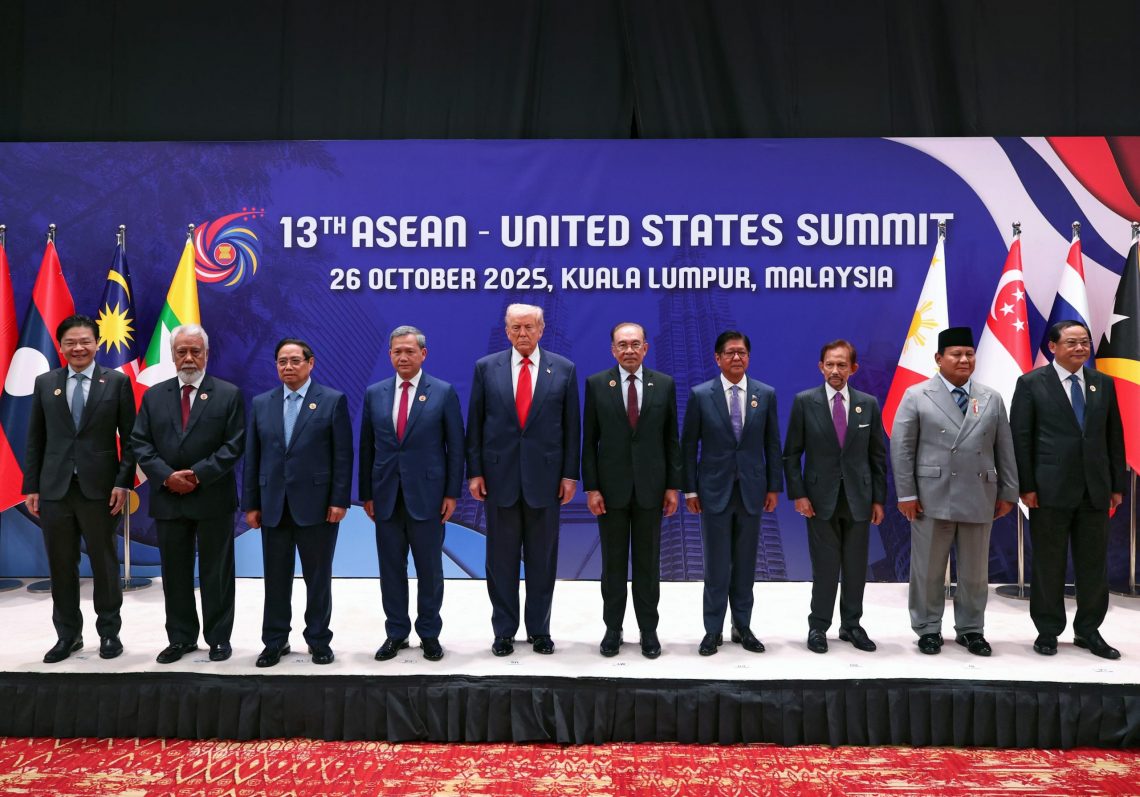
Though there is still a regional belief that the United States is a benign and stabilising power in Southeast Asia, with Wong saying during the October 2025 ASEAN-US Summit that the United States continues to be critical to “continued peace, stability and prosperity”, even in Singapore, this belief is slowly but surely starting to fray.
The unravelling belief that the United States is good for the region does not mean that Southeast Asian states will simply swap the United States for China. It is not a zero-sum game.
Instead, the increased uncertainty that accompanies such fraying is mitigated by greater emphasis on agency, which regional states, including Singapore, are increasingly emphasising.
The more dispensable the United States becomes, the more Southeast Asia must rely on itself.
Yunhan Chong was an intern at the S. Rajaratnam School of International Studies (RSIS), and is currently studying at Anglo-Chinese School (Independent). Jun Yan Chang is Assistant Professor with the Military Studies Programme and the United States Programme at RSIS.
KEY TAKEAWAYS
• Power, especially US power, has always been present in the rules-based order.
• Despite that, and even with Washington’s approach to Southeast Asia being one of ambivalence, Southeast Asia has long thought of the United States as a benevolent and stabilising power.
• Today, however, that belief is starting to fray, even in as strong a partner as Singapore.
COMMENTARY
US foreign policy under the second Trump administration, with the primacy it gives to US interests, seems to have shaken up the rules-based order of the international system.
The Trump administration’s words and deeds that are seen to have threatened the rules-based order include, but are not limited to, the strikes against Iran, the capture of Nicolás Maduro of Venezuela, as well as threats against Greenland and Canada.
Indeed, in the US National Security Strategy of November 2025, the term “rules-based international order”, popularised by Hillary Clinton in 2010, when she was secretary of state, appeared only once, and in quotation marks, no less.
There have, however, been many misperceptions about US interests, power and order, and how these have changed.
To be sure, the so-called Donroe Doctrine of US domination over the Western Hemisphere is nothing new. After all, it is but a portmanteau of President Trump’s first name and the historical Monroe Doctrine. It is simply that the current administration has been far more stark about it.
Nor is it the case that power has not mattered in a rules-based order. This is even more so outside of the West. Recall, for instance, US unilateralism during its “global war on terror”.
Rather, what is changing is how the United States is perceived, regardless of interests, force or rules, not just in the Americas, or in Europe, where questions of keeping the United States in the North Atlantic Treaty Organization (NATO) have always featured, but even much further away, in Southeast Asia.
To begin with, US ambivalence in the Southeast Asian region is the expected norm, with the United States “either neglectful or narrow – or both – in its thinking about Southeast Asia”, as Joseph Liow puts it.
At times, the region can be useful on certain issues, such as containing communism during the Cold War, or serving as a “second front” in the fight against terrorism. At other times, the United States pays little to no attention to it.
Notably, the Obama administration’s 2011 “pivot” or “rebalance” to the Asia-Pacific included considerable engagement with Southeast Asia. It appointed the first US ambassador to ASEAN and upgraded the annual meeting between the United States and ASEAN to the summit level. Then-President Barack Obama visited the region a staggering nine times during his two terms, missing the ASEAN meetings only once, in 2013.
Notwithstanding this greater institutionalisation of the US-Southeast Asia relationship, ambivalence persists.
The first Trump administration largely continued the “pivot” policies, though often at the bilateral rather than multilateral level. It gradually downgraded the level of US representation at ASEAN-related meetings until 2019, when at the seventh ASEAN-US Summit, only the Laotian, Thai and Vietnamese leaders showed up to meet with the US representative, Trump’s national security advisor.
In the 2025 National Security Strategy, Southeast Asia did not merit a single substantive mention.
Despite such US ambivalence, for decades, the prevalent belief among the foreign policy elites of the Southeast Asia region has been that, overall, the United States is a benign and stabilising power.
Such a belief underpins, in the words of Natasha Hamilton-Hart, “Southeast Asian support for a regional order in which the United States has exercised pre-dominant power and is thus instrumental in sustaining American power in the region”.
This belief is arguably strongest in Singapore, with the island-state being Washington’s staunchest regional partner and seeing the United States as indispensable to the “stability, security, and prosperity” of the region. Here, the Singapore case is instructive.
Three years before becoming Singapore’s first prime minister, Lee Kuan Yew had observed that he would “be sorry to see [the British presence] be supplanted by American policy”. When Lee became prime minister of a newly independent Singapore in 1965, he disclosed that Singapore had caught three Americans in 1961 for attempting to corrupt a Singapore official. Lee divulged this partly “to signal to the West that if the British pulled out”, then Singapore would “go along with Australia and New Zealand” rather than allow “American bases in Singapore”.
However, this early wariness was overridden by strategic necessity, such as with regard to US intervention in Vietnam during the Cold War. Speaking of the intervention, Lee believed the United States was “buying time” for the new governments across Southeast Asia “to solve the problems of poverty, unemployment and inequity” so that they could mitigate the attraction of communist ideals.
Economically, too, Singapore greatly valued the United States. This was both indirectly in terms of enabling trade, as well as directly in the form of investments.
Even after the end of the Cold War, Lee, speaking in 1991, was explicit in maintaining that US military presence remained necessary in the region.
Singapore’s concurrence with the US portrayal of transnational terrorism as a destabilising force globally led it to participate in the “coalition of the willing” in Operation Iraqi Freedom in 2003, though it did not provide any combat troops to the effort.
Eulogising Lee’s death in 2015, Obama called him a “true giant of history who will be remembered for generations to come as the father of modern Singapore and as one of the great strategists of Asian affairs”.
Yet, even Singapore’s belief in the United States is being tested today.
Much has been made of Singapore’s then-Minister for Defence Ng Eng Hen saying during the Munich Security Conference in February 2025 that perceptions of the United States have shifted from a state once seen as a force of “moral legitimacy” to a “landlord seeking rent”.
While this comment applies more to European and not Southeast Asian perceptions, Singapore’s Prime Minister Lawrence Wong’s reaction to the Trump administration’s “Liberation Day” tariffs was telling. The prime minister’s remark that the tariff announcement “marks a seismic change in the global order”, moving from an “era of rules-based globalisation and free trade” to “one that is more arbitrary, protectionist, and dangerous” was a more explicit warning that plans to impose tariffs were “not actions one does to a friend”.
Even Lee Hsien Loong, Wong’s predecessor and now a senior minister, expressed concern about the Trump administration’s actions. When asked about the US military action in Venezuela, he stressed that, from the viewpoint of a small country, “if that is the way the world works, we have a problem”. He added that while “to some extent, that has always been the way the world works”, the United States had “done this many times over in different parts of the world”, and when looking “at the impact of it … I do not think this is a plus”.
Though there is still a regional belief that the United States is a benign and stabilising power in Southeast Asia, with Wong saying during the October 2025 ASEAN-US Summit that the United States continues to be critical to “continued peace, stability and prosperity”, even in Singapore, this belief is slowly but surely starting to fray.
The unravelling belief that the United States is good for the region does not mean that Southeast Asian states will simply swap the United States for China. It is not a zero-sum game.
Instead, the increased uncertainty that accompanies such fraying is mitigated by greater emphasis on agency, which regional states, including Singapore, are increasingly emphasising.
The more dispensable the United States becomes, the more Southeast Asia must rely on itself.
Yunhan Chong was an intern at the S. Rajaratnam School of International Studies (RSIS), and is currently studying at Anglo-Chinese School (Independent). Jun Yan Chang is Assistant Professor with the Military Studies Programme and the United States Programme at RSIS.