

26 March 2026
IP26053 | Navigating Falling Aid Flows in Southeast Asia: The Need to Invest in Political Will

KEY TAKEAWAYS
• Aid in Southeast Asia is set to further decrease as traditional donors announce aid cuts amid already falling levels of global aid.
• An emerging challenge for Southeast Asia is the entrenchment of the development divide among ASEAN member states as an effect of uneven aid flows.
• ASEAN member states need to further invest in their aid ecosystem, politically and financially.
COMMENTARY
With constant trade disruptions, global economic slowdown, conflicts at historic highs, and looming international instability, global volatility is at an all-time high. This lack of predictability is encouraging states to increasingly prioritise immediate benefits over possible long-term commitments – particularly in areas such as humanitarian affairs, where donor states can use aid to secure favourable strategic outcomes with recipient states. This is further intensified by the wave of aid cuts that are set to reduce already declining global aid flows.
Southeast Asia, which is no stranger to foreign aid, is being affected by these global headwinds. With the pool of foreign aid now set to decline further, there needs to be an urgent reckoning within ASEAN on the current realities of the aid system and its impacts on ASEAN’s development trajectory. To strengthen ASEAN’s aid ecosystem, it is increasingly critical for ASEAN member states to look inwards for solutions to these challenges.
Current Global Aid Outlook
This rise of a more transactional approach to aid is highlighted by the increasing primacy of national interests. Aid is increasingly becoming a tool in the arsenal of foreign policy, rather than an end in and of itself. This has been highlighted most recently with the USAID freeze, where the government emphasised the need to “refocus on American national interests” and ensure foreign assistance was “efficient and consistent” with US foreign policy under an “American First agenda” – explicitly linking aid to strategic priorities. A recent report noted that US officials were considering linking HIV aid discussions in Zambia to access to the country’s mineral reserves.
The global aid system is also facing declining international aid flows. In 2024, official development assistance (ODA) from the OECD countries decreased for the first time since COVID-19. In Southeast Asia, this decline is only set to continue, with the wave of aid cuts announced for 2026 by traditional donor countries, including the United States, United Kingdom, France and Germany – four countries that together had accounted for nearly two-thirds of total ODA over the last decade. While the contributions of Asian donors, including China and Japan, have stayed steady, there has been little indication of potential increases from these states in order to fill the gaps that will be left by these looming aid cuts. Southeast Asia therefore is likely to be affected, with a projected drop of more than US$2 billion by 2026 to US$26.5 billion, significantly reducing aid flows into the region.
Potential Entrenchment of Southeast Asia’s Development Gap
A reduction in foreign aid, whether humanitarian or developmental, can have detrimental short- and long-term consequences for the region. This includes a potential loss of lives, loss of welfare and loss of development and critical infrastructure.
We are already seeing uneven aid flows in Southeast Asia. The region’s smaller economies such as Laos and Myanmar already experience some of the highest – and rising – levels of poverty, but have simultaneously faced declining aid flows. On the contrary, aid to higher-income countries such as Indonesia and the Philippines has remained steady. While the reduction of aid is attributed to internal factors such as Myanmar’s military coup and Laos’ mounting debt burden, other contributing factors may include the more developed financial infrastructure and overall larger economies of these higher-income countries, which attract more ODA.
These lower-income countries are also likely to be more exposed to the looming aid cuts. The majority of the aid provided to them comes in the form of grants and/or non-concessional loans – which is where we are seeing the decline in aid funding. As the aid cuts hit the region, these uneven aid flows may intensify, potentially further entrenching existing development disparities between lower- and higher-income ASEAN member states, undermining the region’s long-term equity, stability and resilience.
Maintaining the ASEAN Aid Ecosystem
Rather than depending on other external actors to fill this gap in aid flows to the region, ASEAN member states should look inwards within the bloc. With the increasing transnationalism of the aid system, there is a risk that aid may become advantage-based, rather than needs-based. Such advantages may take the form of greater economic returns through access to trade, geopolitical influence, or the promotion of political priorities. In Africa, US aid is increasingly tied to conditional agreements, including greater private sector involvement. This highlights the risks of over-reliance on external actors for Southeast Asia.
As such, there is a rising need for member states to invest in the ASEAN aid ecosystem. Political will is key in this endeavour. As Singapore’s Minister for Foreign Affairs has said, ASEAN must “improve [its] collective value proposition and collective resilience” to navigate this uncertain landscape, and it is the member states that must first invest in themselves.
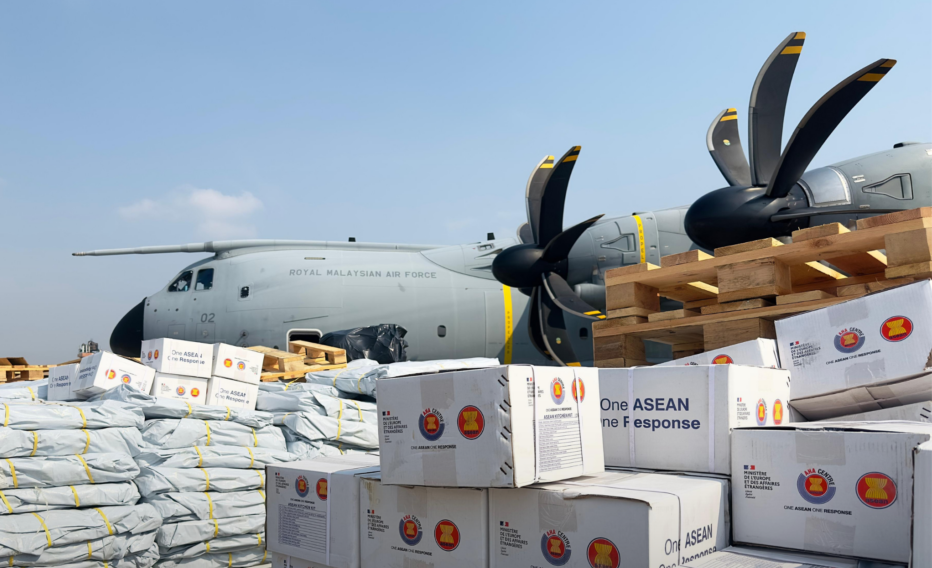
Image credit: AHA Centre.
As ASEAN’s main sectoral body for disaster management in the region, the ASEAN Committee on Disaster Management should lead this refresh. For a start, it needs to look into funding for the ASEAN Coordinating Centre for Humanitarian Assistance on Disaster Management (AHA Centre), ASEAN’s Jakarta-based coordinating centre for disaster management. It may be time to discuss further increasing member state contributions to make up for the funding deficit at the AHA Centre between ASEAN member state contributions and ASEAN Dialogue Partner contributions. While this is a large ask of the ASEAN member states, the urgency of the impending aid shortfall requires a swift response. Moreover, this has been done before, indicating a willingness to rise to the occasion when required.
Political investment is key as well. This could take the form of seconding high-level civil service staff from ASEAN member states to serve in the ASEAN Secretariat and AHA Centre, as well greater consideration of ASEAN priorities in national policymaking. Considering ASEAN’s relative success in disaster management, this is a good base on which to further develop and strengthen the idea of internal unity within ASEAN.
ASEAN member states must step up diplomatically and invest in the bloc’s architecture to build greater resilience – one capable of shielding Southeast Asian countries from global headwinds. With a collective voice, ASEAN member states can chart their own futures.
S. Nanthini is an Associate Research Fellow in the Humanitarian Assistance and Disaster Relief Programme at the Institute for Defence and Strategic Studies, S. Rajaratnam School of International Studies (RSIS).
KEY TAKEAWAYS
• Aid in Southeast Asia is set to further decrease as traditional donors announce aid cuts amid already falling levels of global aid.
• An emerging challenge for Southeast Asia is the entrenchment of the development divide among ASEAN member states as an effect of uneven aid flows.
• ASEAN member states need to further invest in their aid ecosystem, politically and financially.
COMMENTARY
With constant trade disruptions, global economic slowdown, conflicts at historic highs, and looming international instability, global volatility is at an all-time high. This lack of predictability is encouraging states to increasingly prioritise immediate benefits over possible long-term commitments – particularly in areas such as humanitarian affairs, where donor states can use aid to secure favourable strategic outcomes with recipient states. This is further intensified by the wave of aid cuts that are set to reduce already declining global aid flows.
Southeast Asia, which is no stranger to foreign aid, is being affected by these global headwinds. With the pool of foreign aid now set to decline further, there needs to be an urgent reckoning within ASEAN on the current realities of the aid system and its impacts on ASEAN’s development trajectory. To strengthen ASEAN’s aid ecosystem, it is increasingly critical for ASEAN member states to look inwards for solutions to these challenges.
Current Global Aid Outlook
This rise of a more transactional approach to aid is highlighted by the increasing primacy of national interests. Aid is increasingly becoming a tool in the arsenal of foreign policy, rather than an end in and of itself. This has been highlighted most recently with the USAID freeze, where the government emphasised the need to “refocus on American national interests” and ensure foreign assistance was “efficient and consistent” with US foreign policy under an “American First agenda” – explicitly linking aid to strategic priorities. A recent report noted that US officials were considering linking HIV aid discussions in Zambia to access to the country’s mineral reserves.
The global aid system is also facing declining international aid flows. In 2024, official development assistance (ODA) from the OECD countries decreased for the first time since COVID-19. In Southeast Asia, this decline is only set to continue, with the wave of aid cuts announced for 2026 by traditional donor countries, including the United States, United Kingdom, France and Germany – four countries that together had accounted for nearly two-thirds of total ODA over the last decade. While the contributions of Asian donors, including China and Japan, have stayed steady, there has been little indication of potential increases from these states in order to fill the gaps that will be left by these looming aid cuts. Southeast Asia therefore is likely to be affected, with a projected drop of more than US$2 billion by 2026 to US$26.5 billion, significantly reducing aid flows into the region.
Potential Entrenchment of Southeast Asia’s Development Gap
A reduction in foreign aid, whether humanitarian or developmental, can have detrimental short- and long-term consequences for the region. This includes a potential loss of lives, loss of welfare and loss of development and critical infrastructure.
We are already seeing uneven aid flows in Southeast Asia. The region’s smaller economies such as Laos and Myanmar already experience some of the highest – and rising – levels of poverty, but have simultaneously faced declining aid flows. On the contrary, aid to higher-income countries such as Indonesia and the Philippines has remained steady. While the reduction of aid is attributed to internal factors such as Myanmar’s military coup and Laos’ mounting debt burden, other contributing factors may include the more developed financial infrastructure and overall larger economies of these higher-income countries, which attract more ODA.
These lower-income countries are also likely to be more exposed to the looming aid cuts. The majority of the aid provided to them comes in the form of grants and/or non-concessional loans – which is where we are seeing the decline in aid funding. As the aid cuts hit the region, these uneven aid flows may intensify, potentially further entrenching existing development disparities between lower- and higher-income ASEAN member states, undermining the region’s long-term equity, stability and resilience.
Maintaining the ASEAN Aid Ecosystem
Rather than depending on other external actors to fill this gap in aid flows to the region, ASEAN member states should look inwards within the bloc. With the increasing transnationalism of the aid system, there is a risk that aid may become advantage-based, rather than needs-based. Such advantages may take the form of greater economic returns through access to trade, geopolitical influence, or the promotion of political priorities. In Africa, US aid is increasingly tied to conditional agreements, including greater private sector involvement. This highlights the risks of over-reliance on external actors for Southeast Asia.
As such, there is a rising need for member states to invest in the ASEAN aid ecosystem. Political will is key in this endeavour. As Singapore’s Minister for Foreign Affairs has said, ASEAN must “improve [its] collective value proposition and collective resilience” to navigate this uncertain landscape, and it is the member states that must first invest in themselves.
Image credit: AHA Centre.
As ASEAN’s main sectoral body for disaster management in the region, the ASEAN Committee on Disaster Management should lead this refresh. For a start, it needs to look into funding for the ASEAN Coordinating Centre for Humanitarian Assistance on Disaster Management (AHA Centre), ASEAN’s Jakarta-based coordinating centre for disaster management. It may be time to discuss further increasing member state contributions to make up for the funding deficit at the AHA Centre between ASEAN member state contributions and ASEAN Dialogue Partner contributions. While this is a large ask of the ASEAN member states, the urgency of the impending aid shortfall requires a swift response. Moreover, this has been done before, indicating a willingness to rise to the occasion when required.
Political investment is key as well. This could take the form of seconding high-level civil service staff from ASEAN member states to serve in the ASEAN Secretariat and AHA Centre, as well greater consideration of ASEAN priorities in national policymaking. Considering ASEAN’s relative success in disaster management, this is a good base on which to further develop and strengthen the idea of internal unity within ASEAN.
ASEAN member states must step up diplomatically and invest in the bloc’s architecture to build greater resilience – one capable of shielding Southeast Asian countries from global headwinds. With a collective voice, ASEAN member states can chart their own futures.
S. Nanthini is an Associate Research Fellow in the Humanitarian Assistance and Disaster Relief Programme at the Institute for Defence and Strategic Studies, S. Rajaratnam School of International Studies (RSIS).