


02 April 2026
IP26057 | Beyond the Alignment Scorecard: Malaysia and the United States

KEY TAKEAWAYS
• Malaysia-US relations are often misread through a simplistic lens of major-power competition that obscures a deeper, structurally embedded partnership.
• While economic and defence ties remain substantial, domestic political constraints and sensitivities, particularly over the Middle East, continue to shape Malaysia’s approach.
• The relationship needs to be understood on its own terms, reflecting Malaysia’s need to balance material interests with domestic political realities.
COMMENTARY
There is a persistent tendency in academic and journalistic discourse to reduce the foreign policy of Southeast Asian countries to a simple trilemma: alignment with the United States, alignment with China, or some indeterminate position in between. Whether in colour-coded maps or elite opinion polling, there is an understandable urge to present a clear bottom line. Yet this impulse obscures more than it reveals.
This framing has been particularly distorting in the case of Malaysia’s relations with the United States. The US-China lens flattens what is in fact a relationship that is deeper and more durable than such scorecards suggest. Understanding it requires looking beyond the headlines.
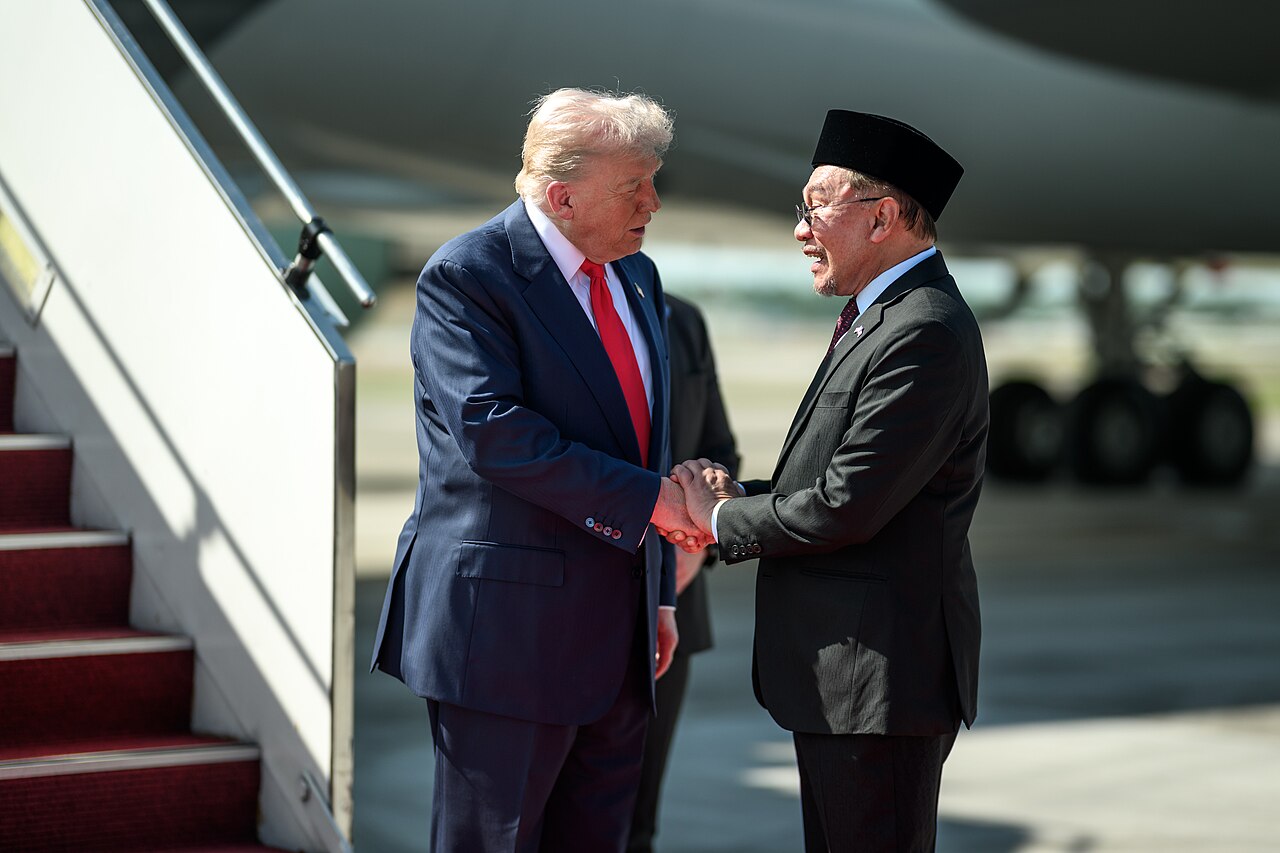
Image source: Wikimedia Commons.
Deeper Than It Looks
The substance of the Malaysia-US relationship becomes clearer in the numbers. The United States is Malaysia’s second-largest export market, and bilateral trade in goods has continued to grow despite turbulence, reaching an estimated US$88.5 billion in 2025, up from US$80.2 billion in 2024. American firms are the largest source of foreign investment into Malaysia, with around RM200 billion (US$50 billion) in announced investments since 2021. More than 300,000 jobs are linked to US investment, typically at wages well above the national manufacturing average.
Yet, these figures understate the relationship’s depth. Foreign direct investment data records the immediate source of funds rather than the ultimate one, and much of American capital enters Malaysia through subsidiaries in intermediary hubs such as Singapore or the Netherlands. Large multinationals also expand through retained earnings that rarely appear in headline inflows. The result is a systematic undercounting of the American economic presence.
Much of this activity is not readily visible as it is embedded in contract manufacturing, integrated supply chains and regional operations run out of Malaysia. The semiconductor industry illustrates this best. Malaysia accounts for around 13% of global chip assembly and testing, and nearly 20% of the semiconductors that enter the United States are eventually packaged there, a fact that became apparent during the COVID-19 pandemic, when disruptions in Malaysia rippled through American factory floors.
This presence extends to leadership. US firms are more willing than their peers to place Malaysians at the helm of local operations, across companies such as Intel, Texas Instruments, Western Digital, Google, Equinix and Microsoft. More than half of these are run by Malaysians.
The defence relationship is similarly underestimated. The two militaries conduct around 14 bilateral and multilateral exercises annually, more than Malaysia undertakes with any other partner. This reflects, in part, the breadth of opportunities the United States is able to offer rather than a simple measure of relative importance, but Malaysia’s consistent participation is nonetheless telling. According to American officials, Malaysia has received more than US$270 million in US maritime security assistance since 2018, alongside successive vessel transfers. This points to a partnership that has grown steadily in scope and complexity.
But It’s Complicated
Yet the relationship has never been entirely comfortable for Malaysia, whose foreign policy establishment remains ambivalent about the American military presence in Asia, inclined to see it as a source of instability as much as deterrence. This reflects a post-colonial sensibility, a tradition that has made a virtue of independence from great-power patronage, and the pull of Muslim solidarity. Washington’s conduct in the Middle East has sharpened public resentment towards the United States among the Malay-Muslim majority. No Malaysian government, however pragmatically inclined, can ignore this.
The war in Iran sharpens these tensions, but less straightforwardly than often assumed. There is sympathy for Iran among Malaysia’s Muslim majority, and strikes on Iranian cities have provoked anger. But it is tempered by the Sunni-Shi’a divide. Shi’a teachings are formally proscribed under state fatwas, and there is antipathy towards Shi’ism in parts of Malaysian religious and political life. At the same time, most Malaysians have no lived experience of sectarian conflict and tend to see Iran as a fellow Muslim country rather than a Shi’a one.
Economic ties tell a different story. Two-way trade with Iran amounted to around RM2.6 billion, or roughly US$570 million, in 2024, less than 0.1% of Malaysia’s total trade. Malaysian banks, mindful of US secondary sanctions and compliance requirements, tend to keep their distance from Iranian businesses based on their own risk assessments. The effect has been a measurable chill on ordinary engagement. In 2021, Iran’s ambassador to Malaysia lamented that the number of Iranians living in Malaysia had fallen to fewer than 10,000, down from around 120,000 a decade earlier.
At sea, things are murkier. Tankers from Iran’s “dark fleet” operate in waters off eastern Johor. Crude is transferred via ship-to-ship operations, then shipped onward, mostly to China. Chinese customs data has at times shown imports of Malaysian-origin oil exceeding Malaysia’s own production, a gap widely attributed to Iranian crude being re-labelled. Malaysia denies that it is a “silent enabler”. Enforcement has been intermittent, and officials point to jurisdictional limits in existing laws, which are being updated. The government has taken steps to strengthen oversight, and the issue remains under active management.
The instinct towards non-alignment runs deeper still. Malaysia was among the architects of ASEAN’s Zone of Peace, Freedom and Neutrality declaration of 1971 and has never fully shed the worldview that animates it. Formal alignment with any great power remains politically toxic in a way that has no equivalent in, for example, the Philippines or Thailand. This reflects genuine elite ambivalence, reinforced by a public broadly sceptical of American intentions in Asia and beyond.
The second Trump administration has sharpened these sentiments. The Agreement on Reciprocal Trade, signed between Kuala Lumpur and Washington in October 2025, has attracted domestic criticism as it is widely seen as reflecting an asymmetry in bargaining power. Malaysian policymakers have nonetheless concluded that an imperfect arrangement is preferable to operating without one.
Prime Minister Anwar Ibrahim has pursued a strategy of personal engagement with President Donald Trump, marked by seven phone calls and more than five hours of cumulative contact, much of it during Malaysia’s ASEAN chairmanship in 2025. It is an approach calibrated less to affinity than to damage limitation. Trump’s visit to Kuala Lumpur for the ASEAN-led summits, where he presided over the Cambodia-Thailand peace accords, underscored that transactional diplomacy can still yield results.
Conclusion
What emerges is not a Malaysia drifting towards or away from the United States, but a country managing a relationship of real material consequence under persistent domestic constraint. The durability of economic and defence ties sits alongside political ambivalence that cannot be wished away. Approaches that prioritise neat, binary explanations struggle to capture this coexistence. A clearer reading lies in how Malaysia sustains substantive cooperation while absorbing the frictions that accompany it.
Shahriman Lockman is Director (Special Projects) at the Institute of Strategic and International Studies, Malaysia. He was recently Visiting Senior Fellow with the Malaysia Programme at the S. Rajaratnam School of International Studies (RSIS).
KEY TAKEAWAYS
• Malaysia-US relations are often misread through a simplistic lens of major-power competition that obscures a deeper, structurally embedded partnership.
• While economic and defence ties remain substantial, domestic political constraints and sensitivities, particularly over the Middle East, continue to shape Malaysia’s approach.
• The relationship needs to be understood on its own terms, reflecting Malaysia’s need to balance material interests with domestic political realities.
COMMENTARY
There is a persistent tendency in academic and journalistic discourse to reduce the foreign policy of Southeast Asian countries to a simple trilemma: alignment with the United States, alignment with China, or some indeterminate position in between. Whether in colour-coded maps or elite opinion polling, there is an understandable urge to present a clear bottom line. Yet this impulse obscures more than it reveals.
This framing has been particularly distorting in the case of Malaysia’s relations with the United States. The US-China lens flattens what is in fact a relationship that is deeper and more durable than such scorecards suggest. Understanding it requires looking beyond the headlines.
Image source: Wikimedia Commons.
Deeper Than It Looks
The substance of the Malaysia-US relationship becomes clearer in the numbers. The United States is Malaysia’s second-largest export market, and bilateral trade in goods has continued to grow despite turbulence, reaching an estimated US$88.5 billion in 2025, up from US$80.2 billion in 2024. American firms are the largest source of foreign investment into Malaysia, with around RM200 billion (US$50 billion) in announced investments since 2021. More than 300,000 jobs are linked to US investment, typically at wages well above the national manufacturing average.
Yet, these figures understate the relationship’s depth. Foreign direct investment data records the immediate source of funds rather than the ultimate one, and much of American capital enters Malaysia through subsidiaries in intermediary hubs such as Singapore or the Netherlands. Large multinationals also expand through retained earnings that rarely appear in headline inflows. The result is a systematic undercounting of the American economic presence.
Much of this activity is not readily visible as it is embedded in contract manufacturing, integrated supply chains and regional operations run out of Malaysia. The semiconductor industry illustrates this best. Malaysia accounts for around 13% of global chip assembly and testing, and nearly 20% of the semiconductors that enter the United States are eventually packaged there, a fact that became apparent during the COVID-19 pandemic, when disruptions in Malaysia rippled through American factory floors.
This presence extends to leadership. US firms are more willing than their peers to place Malaysians at the helm of local operations, across companies such as Intel, Texas Instruments, Western Digital, Google, Equinix and Microsoft. More than half of these are run by Malaysians.
The defence relationship is similarly underestimated. The two militaries conduct around 14 bilateral and multilateral exercises annually, more than Malaysia undertakes with any other partner. This reflects, in part, the breadth of opportunities the United States is able to offer rather than a simple measure of relative importance, but Malaysia’s consistent participation is nonetheless telling. According to American officials, Malaysia has received more than US$270 million in US maritime security assistance since 2018, alongside successive vessel transfers. This points to a partnership that has grown steadily in scope and complexity.
But It’s Complicated
Yet the relationship has never been entirely comfortable for Malaysia, whose foreign policy establishment remains ambivalent about the American military presence in Asia, inclined to see it as a source of instability as much as deterrence. This reflects a post-colonial sensibility, a tradition that has made a virtue of independence from great-power patronage, and the pull of Muslim solidarity. Washington’s conduct in the Middle East has sharpened public resentment towards the United States among the Malay-Muslim majority. No Malaysian government, however pragmatically inclined, can ignore this.
The war in Iran sharpens these tensions, but less straightforwardly than often assumed. There is sympathy for Iran among Malaysia’s Muslim majority, and strikes on Iranian cities have provoked anger. But it is tempered by the Sunni-Shi’a divide. Shi’a teachings are formally proscribed under state fatwas, and there is antipathy towards Shi’ism in parts of Malaysian religious and political life. At the same time, most Malaysians have no lived experience of sectarian conflict and tend to see Iran as a fellow Muslim country rather than a Shi’a one.
Economic ties tell a different story. Two-way trade with Iran amounted to around RM2.6 billion, or roughly US$570 million, in 2024, less than 0.1% of Malaysia’s total trade. Malaysian banks, mindful of US secondary sanctions and compliance requirements, tend to keep their distance from Iranian businesses based on their own risk assessments. The effect has been a measurable chill on ordinary engagement. In 2021, Iran’s ambassador to Malaysia lamented that the number of Iranians living in Malaysia had fallen to fewer than 10,000, down from around 120,000 a decade earlier.
At sea, things are murkier. Tankers from Iran’s “dark fleet” operate in waters off eastern Johor. Crude is transferred via ship-to-ship operations, then shipped onward, mostly to China. Chinese customs data has at times shown imports of Malaysian-origin oil exceeding Malaysia’s own production, a gap widely attributed to Iranian crude being re-labelled. Malaysia denies that it is a “silent enabler”. Enforcement has been intermittent, and officials point to jurisdictional limits in existing laws, which are being updated. The government has taken steps to strengthen oversight, and the issue remains under active management.
The instinct towards non-alignment runs deeper still. Malaysia was among the architects of ASEAN’s Zone of Peace, Freedom and Neutrality declaration of 1971 and has never fully shed the worldview that animates it. Formal alignment with any great power remains politically toxic in a way that has no equivalent in, for example, the Philippines or Thailand. This reflects genuine elite ambivalence, reinforced by a public broadly sceptical of American intentions in Asia and beyond.
The second Trump administration has sharpened these sentiments. The Agreement on Reciprocal Trade, signed between Kuala Lumpur and Washington in October 2025, has attracted domestic criticism as it is widely seen as reflecting an asymmetry in bargaining power. Malaysian policymakers have nonetheless concluded that an imperfect arrangement is preferable to operating without one.
Prime Minister Anwar Ibrahim has pursued a strategy of personal engagement with President Donald Trump, marked by seven phone calls and more than five hours of cumulative contact, much of it during Malaysia’s ASEAN chairmanship in 2025. It is an approach calibrated less to affinity than to damage limitation. Trump’s visit to Kuala Lumpur for the ASEAN-led summits, where he presided over the Cambodia-Thailand peace accords, underscored that transactional diplomacy can still yield results.
Conclusion
What emerges is not a Malaysia drifting towards or away from the United States, but a country managing a relationship of real material consequence under persistent domestic constraint. The durability of economic and defence ties sits alongside political ambivalence that cannot be wished away. Approaches that prioritise neat, binary explanations struggle to capture this coexistence. A clearer reading lies in how Malaysia sustains substantive cooperation while absorbing the frictions that accompany it.
Shahriman Lockman is Director (Special Projects) at the Institute of Strategic and International Studies, Malaysia. He was recently Visiting Senior Fellow with the Malaysia Programme at the S. Rajaratnam School of International Studies (RSIS).