


08 April 2026
IP26058 | France’s Military AI Ambitions: Between Sovereignty and Global Leadership

KEY TAKEAWAYS
• Technological sovereignty is emerging as a key pillar of France’s military artificial intelligence (AI) doctrine, signalling the country’s assessment of the highly interdependent, globalised and contested AI supply chain.
• France is home to a large defence industrial and technological base, offering a strong foundation for the development of indigenous and sovereign AI capabilities.
• By developing sovereign military AI, France is seeking not only to secure its own capabilities and strategic position but also to become an alternative technology provider amid confrontation between China and the United States over critical technologies.
COMMENTARY
In November 2025, France’s Council of Ministers announced the replacement of Emmanuel Chiva, chief executive of the French Defence Procurement Agency (Direction Générale de l’Armement, DGA), by Patrick Pailloux, the former director-general of France’s National Cybersecurity Agency (Agence Nationale de la Sécurité des Systèmes d’Information, ANSSI) and director of Technical Operations at France’s External Security Agency (Direction Générale de la Sécurité Extérieure, DGSE). This appointment is more than a routine administrative reshuffle; it signals an evolution in France’s military technological trajectory.
Chiva’s appointment to head the DGA in 2022 marked a break with tradition. As an entrepreneur with expertise in artificial intelligence (AI), his appointment was indicative of France’s push towards innovation, start-up integration, and rapid experimentation within the Ministry of the Armed Forces. It also signalled a prioritisation of embedding AI within future warfighting capabilities. His replacement by Pailloux points to France’s shift from experimentation to securing and institutionalising AI capabilities within its defence architecture.
The war in Ukraine has underscored the operational centrality of AI in sensor fusion, electronic warfare, targeting processes and drone operations. For French defence planners, the conflict has reinforced the need for resilient systems capable of functioning under degraded or contested conditions. AI is therefore no longer an emerging innovation but is increasingly a structural component of military operational capabilities.
Nevertheless, France’s ambition to develop sovereign military AI is unfolding within a contested global technological ecosystem dominated by the United States and China. Many elements of the AI supply chain for France remain concentrated in foreign hands, raising a central question: To what extent does the country’s military AI strategy achieve technological sovereignty?
Developing Sovereign AI Capabilities
France’s 2024 military AI strategy set the stage for greater emphasis on technological sovereignty, but it also raised the question of what this means in practice. This strategy aims to achieve sovereignty by relying on domestically developed technologies and network infrastructure, supported by both government institutions and the local private sector.
To support this effort, the Military Programming Law (Loi de Programmation Militaire, LPM) 2024–2030 has allocated approximately US$480 billion to the armed forces, with US$150 million dedicated to defence AI. The government plans to double this budget before the end of this law, reaching US$2.3 billion. While France cannot compete financially with major AI superpowers, this investment aims to support its strategic goal of developing sovereign AI.
France possesses a large defence industrial and technological base, which includes giants such as Capgemini, Dassault Aviation, MBDA, Thales and Safran. These firms provide key infrastructure and a secure data environment to train sensitive models across defence applications without relying on foreign providers. Integrating AI into domestically developed platforms like Dassault Aviation’s Rafale fighter aircraft will help ensure that the implementation of AI is protected by domestic standards.
Additionally, specific bureaucratic capacity dedicated to military AI has been created through the Ministerial Agency for Defense Artificial Intelligence (Agence Ministérielle de l’Intelligence Artificielle de Défense, AMIAD) set up in 2024. Its mission is to accelerate and scale the deployment of AI within the Ministry of the Armed Forces.
AMIAD will also help France navigate the trade-offs between research, technological innovation and the operational needs of the armed forces. AMIAD’s Pendragon project, which aims to create a combat unit comprising autonomous AI-enabled robots, is an example of how AI is generating tangible impact for the military.
France has also followed other countries in adopting large language models (LLMs) for defence purposes, but has emphasised the use of domestically developed models by Mistral AI over those by foreign companies such as OpenAI and Anthropic.
In late 2024, France’s Ministry of the Armed Forces launched the GenIAI platform. It provides the ministry’s workforce with access to LLM-enabled services, such as translation, document synthesis and administrative support within the ministry’s secure “Intradef” network. GenIAI has already reached over 100,000 users, demonstrating that sovereignty is defined less by isolation than by control over data environments and deployment conditions.
Industrial Sovereignty and Its Limits
France’s sovereignty efforts related to military AI are also being shaped by consolidation within the private sector, particularly involving defence giants. For example, in 2024, Safran acquired the AI company Preligens (renamed Safran.AI), giving it access to advanced geospatial AI capabilities. Similarly, cooperation between Thales and the Naval Group through the CortAIx initiative seeks to embed sovereign AI into naval combat systems. These developments illustrate a strategy of vertical integration, embedding AI into existing defence platforms being developed domestically.
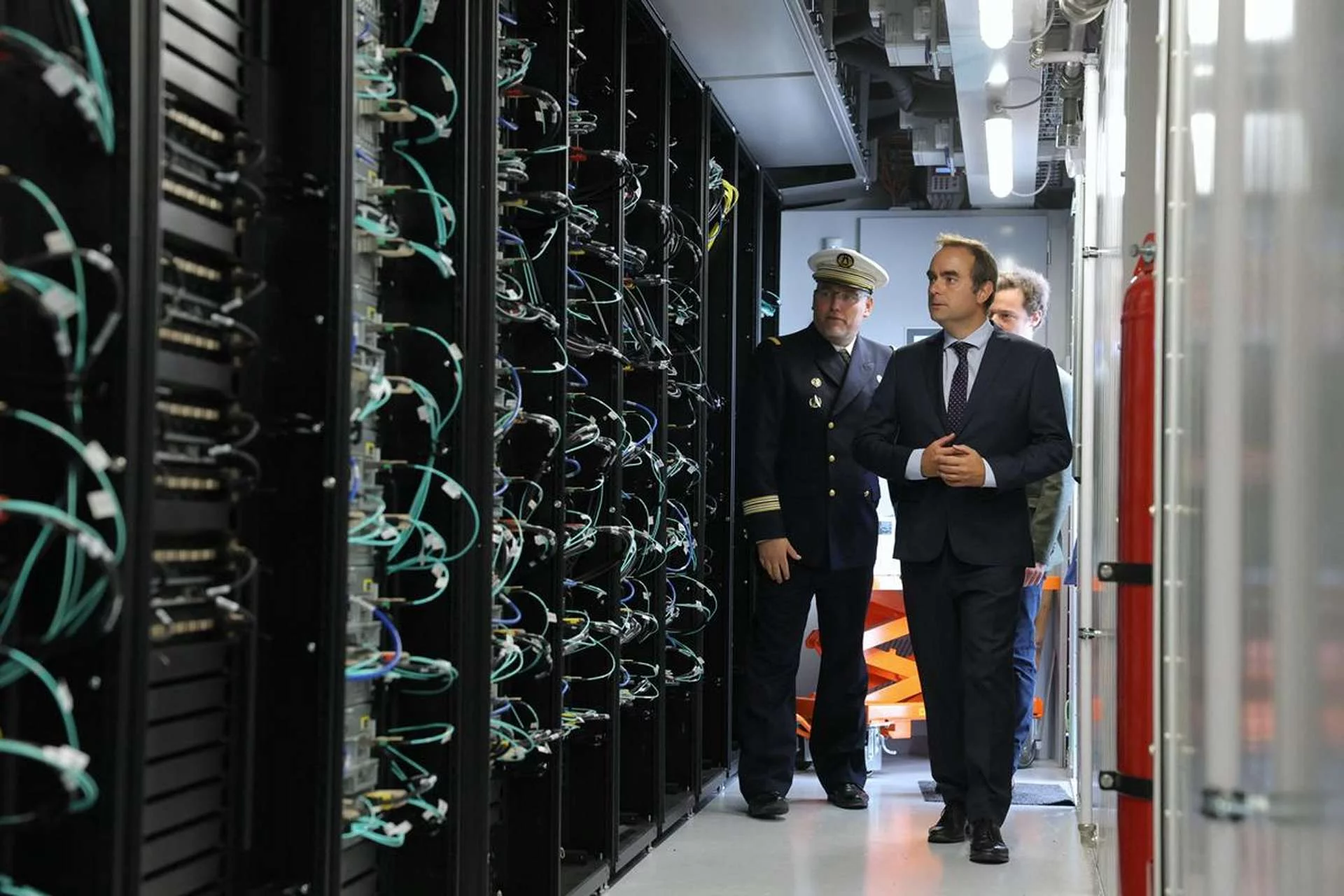
However, France’s ability to achieve technological sovereignty in military AI encounters structural limits at the hardware level. This is illustrated by the ASGARD supercomputer operating since September 2025, which is Europe’s most powerful supercomputer dedicated to defence AI. Although its software layer is managed by Orange and its operation is fully under French control, it was designed by Hewlett-Packard, an American company, and powered by GPU chips from Nvidia, which is headquartered in the United States.
The Ministry of the Armed Forces has acknowledged this structural dependency, arguing for a twofold trajectory towards sovereignty: adopting rigorous data security standards when dealing with foreign companies, while building European industrial capacity to produce its own advanced hardware in the long run. France must therefore continue to partner with the European Union and NATO to sustain efforts to develop sovereign AI.
France as an Alternative Supplier of Military AI
Alongside its ambitions to develop sovereign AI, France is also seeking influence internationally. By hosting multilateral governance forums such as the AI Action Summit in 2025, France has positioned itself as a key player in discussions on military AI governance.
While France cannot rival America or China on technological scale, it can shape standards and offer an alternative to the superpowers as a supplier of military AI. This “third way” is therefore not simply about competing for the third spot on the podium, but rather a strategy of differentiation to promote innovation outside of existing spheres of influence.
However, France’s ability to sustain this “third way” remains constrained by structural asymmetries in three areas: capital markets, advanced semiconductor production, and computing infrastructure. France’s model may achieve operational autonomy for its military, but systemic technological independence remains unlikely.
Operational Autonomy over Sovereignty
France’s military AI strategy does not aim to achieve technological autarky. Instead, it reflects a strategy of bounded sovereignty within an interdependent, globalised and contested supply chain ecosystem for AI. By exercising institutional control through its defence industrial and technological base, France’s military can enhance operational autonomy and security. However, hardware dependencies and supply chain constraints limit the scope of complete technological independence. France’s military AI trajectory also highlights a broader challenge in the current technological world order, where sovereignty should not be defined by isolation, but by the capacity to manage interdependence under conditions of asymmetrical capabilities.
Marine Ourahli is a Senior Analyst with the Military Transformations Programme at the S. Rajaratnam School of International Studies (RSIS). Maÿlis Mennesson is a research intern with the MTP and a master’s student in International Affairs at King’s College London.
KEY TAKEAWAYS
• Technological sovereignty is emerging as a key pillar of France’s military artificial intelligence (AI) doctrine, signalling the country’s assessment of the highly interdependent, globalised and contested AI supply chain.
• France is home to a large defence industrial and technological base, offering a strong foundation for the development of indigenous and sovereign AI capabilities.
• By developing sovereign military AI, France is seeking not only to secure its own capabilities and strategic position but also to become an alternative technology provider amid confrontation between China and the United States over critical technologies.
COMMENTARY
In November 2025, France’s Council of Ministers announced the replacement of Emmanuel Chiva, chief executive of the French Defence Procurement Agency (Direction Générale de l’Armement, DGA), by Patrick Pailloux, the former director-general of France’s National Cybersecurity Agency (Agence Nationale de la Sécurité des Systèmes d’Information, ANSSI) and director of Technical Operations at France’s External Security Agency (Direction Générale de la Sécurité Extérieure, DGSE). This appointment is more than a routine administrative reshuffle; it signals an evolution in France’s military technological trajectory.
Chiva’s appointment to head the DGA in 2022 marked a break with tradition. As an entrepreneur with expertise in artificial intelligence (AI), his appointment was indicative of France’s push towards innovation, start-up integration, and rapid experimentation within the Ministry of the Armed Forces. It also signalled a prioritisation of embedding AI within future warfighting capabilities. His replacement by Pailloux points to France’s shift from experimentation to securing and institutionalising AI capabilities within its defence architecture.
The war in Ukraine has underscored the operational centrality of AI in sensor fusion, electronic warfare, targeting processes and drone operations. For French defence planners, the conflict has reinforced the need for resilient systems capable of functioning under degraded or contested conditions. AI is therefore no longer an emerging innovation but is increasingly a structural component of military operational capabilities.
Nevertheless, France’s ambition to develop sovereign military AI is unfolding within a contested global technological ecosystem dominated by the United States and China. Many elements of the AI supply chain for France remain concentrated in foreign hands, raising a central question: To what extent does the country’s military AI strategy achieve technological sovereignty?
Developing Sovereign AI Capabilities
France’s 2024 military AI strategy set the stage for greater emphasis on technological sovereignty, but it also raised the question of what this means in practice. This strategy aims to achieve sovereignty by relying on domestically developed technologies and network infrastructure, supported by both government institutions and the local private sector.
To support this effort, the Military Programming Law (Loi de Programmation Militaire, LPM) 2024–2030 has allocated approximately US$480 billion to the armed forces, with US$150 million dedicated to defence AI. The government plans to double this budget before the end of this law, reaching US$2.3 billion. While France cannot compete financially with major AI superpowers, this investment aims to support its strategic goal of developing sovereign AI.
France possesses a large defence industrial and technological base, which includes giants such as Capgemini, Dassault Aviation, MBDA, Thales and Safran. These firms provide key infrastructure and a secure data environment to train sensitive models across defence applications without relying on foreign providers. Integrating AI into domestically developed platforms like Dassault Aviation’s Rafale fighter aircraft will help ensure that the implementation of AI is protected by domestic standards.
Additionally, specific bureaucratic capacity dedicated to military AI has been created through the Ministerial Agency for Defense Artificial Intelligence (Agence Ministérielle de l’Intelligence Artificielle de Défense, AMIAD) set up in 2024. Its mission is to accelerate and scale the deployment of AI within the Ministry of the Armed Forces.
AMIAD will also help France navigate the trade-offs between research, technological innovation and the operational needs of the armed forces. AMIAD’s Pendragon project, which aims to create a combat unit comprising autonomous AI-enabled robots, is an example of how AI is generating tangible impact for the military.
France has also followed other countries in adopting large language models (LLMs) for defence purposes, but has emphasised the use of domestically developed models by Mistral AI over those by foreign companies such as OpenAI and Anthropic.
In late 2024, France’s Ministry of the Armed Forces launched the GenIAI platform. It provides the ministry’s workforce with access to LLM-enabled services, such as translation, document synthesis and administrative support within the ministry’s secure “Intradef” network. GenIAI has already reached over 100,000 users, demonstrating that sovereignty is defined less by isolation than by control over data environments and deployment conditions.
Industrial Sovereignty and Its Limits
France’s sovereignty efforts related to military AI are also being shaped by consolidation within the private sector, particularly involving defence giants. For example, in 2024, Safran acquired the AI company Preligens (renamed Safran.AI), giving it access to advanced geospatial AI capabilities. Similarly, cooperation between Thales and the Naval Group through the CortAIx initiative seeks to embed sovereign AI into naval combat systems. These developments illustrate a strategy of vertical integration, embedding AI into existing defence platforms being developed domestically.
However, France’s ability to achieve technological sovereignty in military AI encounters structural limits at the hardware level. This is illustrated by the ASGARD supercomputer operating since September 2025, which is Europe’s most powerful supercomputer dedicated to defence AI. Although its software layer is managed by Orange and its operation is fully under French control, it was designed by Hewlett-Packard, an American company, and powered by GPU chips from Nvidia, which is headquartered in the United States.
The Ministry of the Armed Forces has acknowledged this structural dependency, arguing for a twofold trajectory towards sovereignty: adopting rigorous data security standards when dealing with foreign companies, while building European industrial capacity to produce its own advanced hardware in the long run. France must therefore continue to partner with the European Union and NATO to sustain efforts to develop sovereign AI.
France as an Alternative Supplier of Military AI
Alongside its ambitions to develop sovereign AI, France is also seeking influence internationally. By hosting multilateral governance forums such as the AI Action Summit in 2025, France has positioned itself as a key player in discussions on military AI governance.
While France cannot rival America or China on technological scale, it can shape standards and offer an alternative to the superpowers as a supplier of military AI. This “third way” is therefore not simply about competing for the third spot on the podium, but rather a strategy of differentiation to promote innovation outside of existing spheres of influence.
However, France’s ability to sustain this “third way” remains constrained by structural asymmetries in three areas: capital markets, advanced semiconductor production, and computing infrastructure. France’s model may achieve operational autonomy for its military, but systemic technological independence remains unlikely.
Operational Autonomy over Sovereignty
France’s military AI strategy does not aim to achieve technological autarky. Instead, it reflects a strategy of bounded sovereignty within an interdependent, globalised and contested supply chain ecosystem for AI. By exercising institutional control through its defence industrial and technological base, France’s military can enhance operational autonomy and security. However, hardware dependencies and supply chain constraints limit the scope of complete technological independence. France’s military AI trajectory also highlights a broader challenge in the current technological world order, where sovereignty should not be defined by isolation, but by the capacity to manage interdependence under conditions of asymmetrical capabilities.
Marine Ourahli is a Senior Analyst with the Military Transformations Programme at the S. Rajaratnam School of International Studies (RSIS). Maÿlis Mennesson is a research intern with the MTP and a master’s student in International Affairs at King’s College London.