


15 April 2026
IP26060 | Manila-ASPECT and ASEAN Disaster Governance: Can ASEAN Act Faster?

KEY TAKEAWAYS
• The Manila-ASPECT Framework’s strategic value lies in its potential to reduce decision latency in times of uncertainty.
• Standardised response triggers can reduce ambiguity and delay, but they must remain adaptive to account for the unpredictable nature of disasters across Southeast Asia.
• The bigger challenge for ASEAN’s disaster governance is no longer capability development but identifying a faster, unified response mechanism.
COMMENTARY
The Philippines, one of the countries most exposed to disasters, assumed the ASEAN chairmanship in 2026. Its experience with typhoons, floods and other crises gives it credibility and urgency, particularly as ASEAN enters a new five-year work programme for the ASEAN Agreement on Disaster Management and Emergency Response (AADMER). One of the chair’s flagship initiatives – the Manila-ASEAN Strategic Protocol for Emergency and Comprehensive Transformation (ASPECT) – took centre stage during the first quarter of 2026 at the 35th meeting of the ASEAN Socio-Cultural Community Council (ASCC). Manila will push for its adoption this year.
The ambition is to strengthen regional response and coordination, but ASEAN has no shortage of such policies promising precisely that. The critical issue is whether Manila-ASPECT addresses a persistent regional challenge: decision latency under uncertainty. If the Philippines intends to leave a lasting mark on ASEAN disaster governance, the framework must do more than re-state established principles and mechanisms; rather, it must improve how fast, and under what conditions, regional action is triggered.
More than being an initiative, Manila-ASPECT is a recognition that regional risk is outpacing resilience. As climate change intensifies extreme weather events, disasters are increasingly cascading across borders and sectors, and there is reason to expect faster regional action. This raises an important question for ASEAN, less about the necessity of new frameworks than about whether existing arrangements can deliver timely collective action.
The Promise and Perils
The Manila-ASPECT Framework promises to standardise regional interoperability with clear “trigger points” that define the scale of response and the right moment for regional help and assistance from dialogue partners, commensurate with the disaster. It is said to include more seamless data sharing, logistics coordination and cross-border processes, as well as a push for people-oriented, rights-based disaster response.
The parametric insurance scheme disbursed by SEADRIF, an ASEAN+3 disaster response insurance facility in partnership with the World Bank, demonstrates that trigger-based mechanisms work. A sum of US$3 million was disbursed to Lao PDR following Typhoon YAGI in 2024, which benefitted more than 500,000 people across seven provinces. The sum was disbursed when predefined flood thresholds were met. If such logic from rule-based triggers can be extended to other hazards and to operational ASEAN response mechanisms, it could strengthen Manila-ASPECT’s proposed trigger-based approach.
The clarity from Manila-ASPECT’s trigger mechanism could address critiques about ASEAN’s decision-making latency during periods of uncertainty. During Typhoon Haiyan in 2013, the ASEAN response was criticised for lagging behind that of extra-regional countries, while in the 2018 Central Sulawesi tsunami, coordination was hampered by layers of bureaucracy. Additionally, as sovereignty and regional consensus are major considerations before regional assistance can be provided to member states in need of assistance, Manila-ASPECT could frame international assistance as procedural, part of a stronger sense of regional solidarity to support national capacity. This would reduce ambiguity in the process of offering and receiving assistance, consequently reducing delay.
However, rigid trigger mechanisms risk brittleness. During the 2018 Palu-Donggala tsunami in Indonesia, reliance on conventional earthquake-tsunami scenarios proved costly when an unconventional strike-slip earthquake generated tsunami waves faster and higher than predicted. The damage was compounded by an earthquake-triggered power outage that disabled SMS-based early warning systems and prevented messages from reaching victims on time. The cascade of unmet triggers, coupled with liquefaction and landslides, reportedly resulted in catastrophic damage. These cases illustrate how rigid mechanisms can fail when disasters exceed anticipated thresholds.
Where Duplication Lurks
The disaster management system in the region is already substantial. AADMER, ratified in 2005 and entered into force in 2009, is a legally binding regional treaty that aims to strengthen collective disaster risk reduction and emergency response. To operationalise the agreement, ASEAN agreed on establishing the ASEAN Coordinating Centre for Humanitarian Assistance on disaster management (AHA Centre). The AHA Centre has served as a regional coordination hub, not only for managing emergency response and logistics but also for building regional disaster management capacity. Building on the 2013 Brunei Declaration and “One ASEAN, One Response” vision, adopted in 2014, ASEAN developed the ASEAN Joint Disaster Response Plan (AJDRP) for “timely, at-scale” asset and capacity mobilisation and scenario-based planning, and the regional standby arrangements SOP (SASOP) for standardised coordination.
Against this backdrop, several proposals in Manila-ASPECT appear familiar. The proposed “trigger points” for commensurate response and activation risk duplicating the AJDRP’s activation levels, which detail the responsible agency and corresponding actions to be taken. “Seamless data sharing” seems to rework the AADMER Article 7 provision on information sharing, which includes disaster early warning and disaster risk assessments, including ensuring functional communication networks and public awareness and preparedness. “Logistics coordination” mirrors existing SASOP procedures for both requests and offers of assistance, while “cross-border processes” echo the “One ASEAN, One Response” declaration with the vision of operationalising with speed, scale and solidarity for faster response and greater resources mobilised.
However, duplication alone is not the core problem. If Manila-ASPECT becomes another procedural layer, it may introduce additional administrative complexity and worsen decision latency, without improving outcomes. Its strategic value will depend on whether it integrates existing mechanisms into a clearer and faster decision pathway rather than creating parallel structures.
The Challenge for Manila
For Manila-ASPECT to have substantive impact, it must first prioritise integration over expansion. Rather than introducing new standalone mechanisms, the framework must integrate AADMER obligations, with AJDRP planning, SASOP procedures, and the AHA Centre’s coordinating capacity into a unified response process. Second, the framework should embed flexible adaptation in its proposed trigger mechanism. Flexible adaptation would be more appropriate for the region’s operational reality, given the current landscape of cascading hazards, compounding risks, and growing humanitarian needs. Lastly, Manila-ASPECT must overcome institutional inertia and survive or gain traction beyond the Philippines’ chairmanship.
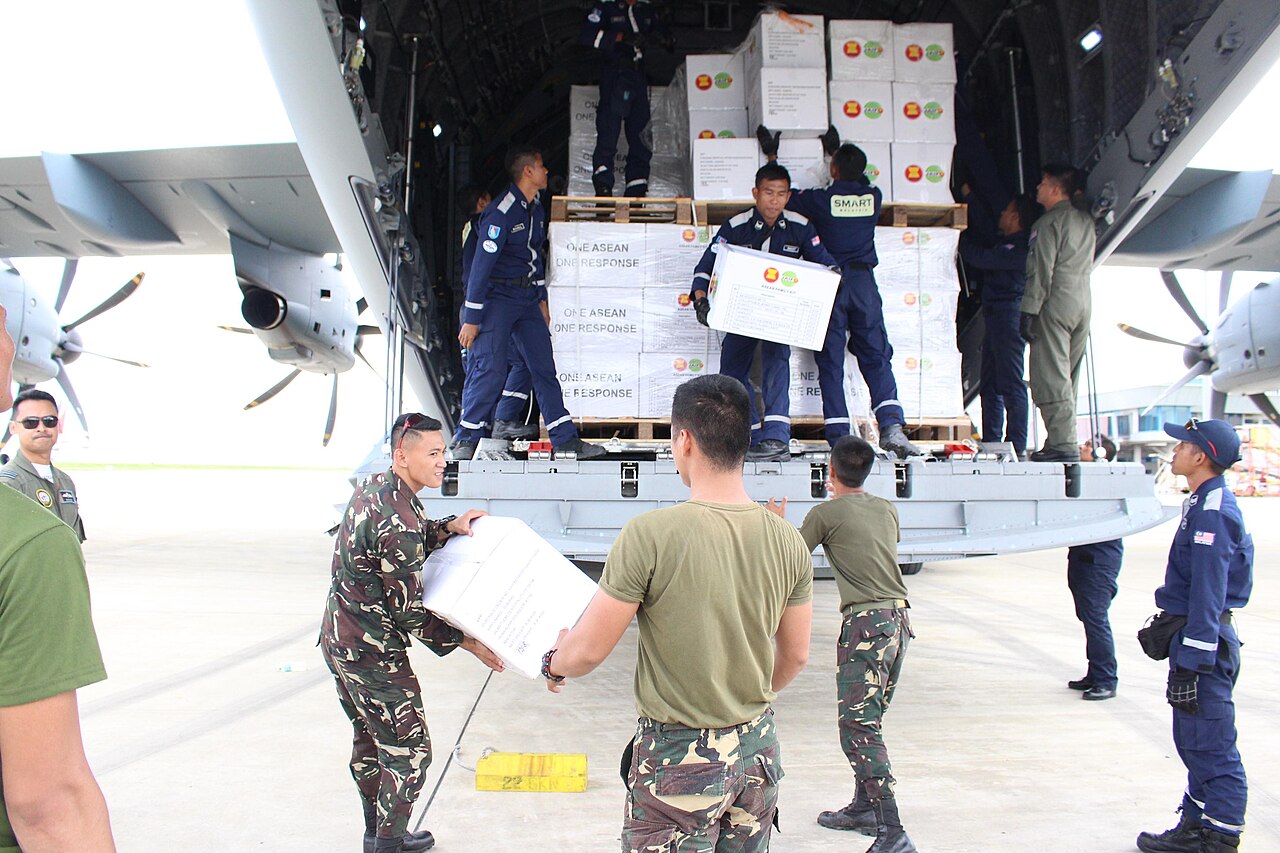
Image source: Wikimedia Commons.
Ultimately, Manila-ASPECT represents an opportunity to shift ASEAN disaster governance from coordination to anticipation. The framework’s success will not be measured by its adoption in 2026, but by whether future disasters see ASEAN acting quicker, mobilising more efficiently, and responding more effectively as a region in times of uncertainty. If successful, Manila-ASPECT could mark the moment ASEAN disaster cooperation moves from reacting together post-disaster towards a stronger showcase of solidarity even before a disaster strikes.
Keith Paolo C. Landicho is an Associate Research Fellow with the Humanitarian Assistance and Disaster Relief (HADR) Programme at the Institute of Defence and Strategic Studies (IDSS), S. Rajaratnam School of International Studies (RSIS).
KEY TAKEAWAYS
• The Manila-ASPECT Framework’s strategic value lies in its potential to reduce decision latency in times of uncertainty.
• Standardised response triggers can reduce ambiguity and delay, but they must remain adaptive to account for the unpredictable nature of disasters across Southeast Asia.
• The bigger challenge for ASEAN’s disaster governance is no longer capability development but identifying a faster, unified response mechanism.
COMMENTARY
The Philippines, one of the countries most exposed to disasters, assumed the ASEAN chairmanship in 2026. Its experience with typhoons, floods and other crises gives it credibility and urgency, particularly as ASEAN enters a new five-year work programme for the ASEAN Agreement on Disaster Management and Emergency Response (AADMER). One of the chair’s flagship initiatives – the Manila-ASEAN Strategic Protocol for Emergency and Comprehensive Transformation (ASPECT) – took centre stage during the first quarter of 2026 at the 35th meeting of the ASEAN Socio-Cultural Community Council (ASCC). Manila will push for its adoption this year.
The ambition is to strengthen regional response and coordination, but ASEAN has no shortage of such policies promising precisely that. The critical issue is whether Manila-ASPECT addresses a persistent regional challenge: decision latency under uncertainty. If the Philippines intends to leave a lasting mark on ASEAN disaster governance, the framework must do more than re-state established principles and mechanisms; rather, it must improve how fast, and under what conditions, regional action is triggered.
More than being an initiative, Manila-ASPECT is a recognition that regional risk is outpacing resilience. As climate change intensifies extreme weather events, disasters are increasingly cascading across borders and sectors, and there is reason to expect faster regional action. This raises an important question for ASEAN, less about the necessity of new frameworks than about whether existing arrangements can deliver timely collective action.
The Promise and Perils
The Manila-ASPECT Framework promises to standardise regional interoperability with clear “trigger points” that define the scale of response and the right moment for regional help and assistance from dialogue partners, commensurate with the disaster. It is said to include more seamless data sharing, logistics coordination and cross-border processes, as well as a push for people-oriented, rights-based disaster response.
The parametric insurance scheme disbursed by SEADRIF, an ASEAN+3 disaster response insurance facility in partnership with the World Bank, demonstrates that trigger-based mechanisms work. A sum of US$3 million was disbursed to Lao PDR following Typhoon YAGI in 2024, which benefitted more than 500,000 people across seven provinces. The sum was disbursed when predefined flood thresholds were met. If such logic from rule-based triggers can be extended to other hazards and to operational ASEAN response mechanisms, it could strengthen Manila-ASPECT’s proposed trigger-based approach.
The clarity from Manila-ASPECT’s trigger mechanism could address critiques about ASEAN’s decision-making latency during periods of uncertainty. During Typhoon Haiyan in 2013, the ASEAN response was criticised for lagging behind that of extra-regional countries, while in the 2018 Central Sulawesi tsunami, coordination was hampered by layers of bureaucracy. Additionally, as sovereignty and regional consensus are major considerations before regional assistance can be provided to member states in need of assistance, Manila-ASPECT could frame international assistance as procedural, part of a stronger sense of regional solidarity to support national capacity. This would reduce ambiguity in the process of offering and receiving assistance, consequently reducing delay.
However, rigid trigger mechanisms risk brittleness. During the 2018 Palu-Donggala tsunami in Indonesia, reliance on conventional earthquake-tsunami scenarios proved costly when an unconventional strike-slip earthquake generated tsunami waves faster and higher than predicted. The damage was compounded by an earthquake-triggered power outage that disabled SMS-based early warning systems and prevented messages from reaching victims on time. The cascade of unmet triggers, coupled with liquefaction and landslides, reportedly resulted in catastrophic damage. These cases illustrate how rigid mechanisms can fail when disasters exceed anticipated thresholds.
Where Duplication Lurks
The disaster management system in the region is already substantial. AADMER, ratified in 2005 and entered into force in 2009, is a legally binding regional treaty that aims to strengthen collective disaster risk reduction and emergency response. To operationalise the agreement, ASEAN agreed on establishing the ASEAN Coordinating Centre for Humanitarian Assistance on disaster management (AHA Centre). The AHA Centre has served as a regional coordination hub, not only for managing emergency response and logistics but also for building regional disaster management capacity. Building on the 2013 Brunei Declaration and “One ASEAN, One Response” vision, adopted in 2014, ASEAN developed the ASEAN Joint Disaster Response Plan (AJDRP) for “timely, at-scale” asset and capacity mobilisation and scenario-based planning, and the regional standby arrangements SOP (SASOP) for standardised coordination.
Against this backdrop, several proposals in Manila-ASPECT appear familiar. The proposed “trigger points” for commensurate response and activation risk duplicating the AJDRP’s activation levels, which detail the responsible agency and corresponding actions to be taken. “Seamless data sharing” seems to rework the AADMER Article 7 provision on information sharing, which includes disaster early warning and disaster risk assessments, including ensuring functional communication networks and public awareness and preparedness. “Logistics coordination” mirrors existing SASOP procedures for both requests and offers of assistance, while “cross-border processes” echo the “One ASEAN, One Response” declaration with the vision of operationalising with speed, scale and solidarity for faster response and greater resources mobilised.
However, duplication alone is not the core problem. If Manila-ASPECT becomes another procedural layer, it may introduce additional administrative complexity and worsen decision latency, without improving outcomes. Its strategic value will depend on whether it integrates existing mechanisms into a clearer and faster decision pathway rather than creating parallel structures.
The Challenge for Manila
For Manila-ASPECT to have substantive impact, it must first prioritise integration over expansion. Rather than introducing new standalone mechanisms, the framework must integrate AADMER obligations, with AJDRP planning, SASOP procedures, and the AHA Centre’s coordinating capacity into a unified response process. Second, the framework should embed flexible adaptation in its proposed trigger mechanism. Flexible adaptation would be more appropriate for the region’s operational reality, given the current landscape of cascading hazards, compounding risks, and growing humanitarian needs. Lastly, Manila-ASPECT must overcome institutional inertia and survive or gain traction beyond the Philippines’ chairmanship.
Image source: Wikimedia Commons.
Ultimately, Manila-ASPECT represents an opportunity to shift ASEAN disaster governance from coordination to anticipation. The framework’s success will not be measured by its adoption in 2026, but by whether future disasters see ASEAN acting quicker, mobilising more efficiently, and responding more effectively as a region in times of uncertainty. If successful, Manila-ASPECT could mark the moment ASEAN disaster cooperation moves from reacting together post-disaster towards a stronger showcase of solidarity even before a disaster strikes.
Keith Paolo C. Landicho is an Associate Research Fellow with the Humanitarian Assistance and Disaster Relief (HADR) Programme at the Institute of Defence and Strategic Studies (IDSS), S. Rajaratnam School of International Studies (RSIS).