

22 April 2026
IP26062 | France and South Korea at 140: Cordial, but Underexplored Relations

KEY TAKEAWAYS
• French President Emmanuel Macron visited Seoul on 2–3 April 2026 as France and South Korea celebrated 140 years of diplomatic relations – marked by cordiality, even amity, yet still largely underexplored.
• Despite elevating their bilateral relationship to a “global strategic partnership”, the two countries’ ties fall short of their potential – modest in economic scope, limited in political ambition, and overshadowed in defence by industrial competition.
• Amid global geopolitical turmoil and growing American unpredictability, the case for a deeper partnership has never been stronger for both countries.
COMMENTARY
On 3 April, French President Emmanuel Macron was warmly embraced by South Korean President Lee Jae Myung in the courtyard of the Blue House, South Korea’s presidential residence. The purpose of Macron’s visit – the first such visit by a French president since 2015 – was to celebrate the 140th anniversary of the establishment of diplomatic relations between France and Korea. The celebratory summit between the two leaders culminated in the elevation of the bilateral relationship to a “global strategic partnership”. Despite much fanfare, however, their ties thus far have been limited and episodic at best, owing to their diverging strategic priorities – hence the cordial but underexplored relationship. Yet this situation might change. With an increasingly unpredictable American foreign policy in Eurasia, the two key countries in Asia and Europe have much more to cooperate on.
A Brief History of the Bilateral Relationship
The beginning of the relationship between the two countries was not entirely a positive one. The first contacts were established in the early 19th century by French Catholic priests sent to evangelise the Korean people. The Korean government did not take well to the evangelising efforts: its persecution eventually led to the massacre of French priests and local converts. In response, France launched a punitive expedition in 1866. French troops withdrew after a few weeks, taking with them hundreds of records of Korean royal protocols, the Uigwe, which they returned only in 2010.
Around the time of the French expedition, colonial competition among European powers was intensifying across East Asia. As a major player, France sought its own sphere of influence in Indochina and signed treaties with China (1844) and Japan (1858) to establish diplomatic and commercial ties. In contrast, Korea’s Joseon dynasty had long pursued a policy of seclusion, which led to Westerners dubbing Korea the “Hermit Kingdom”. It repelled not only the French (1866) but also the Americans later (1871). However, by the 1880s, Korea could no longer stay isolated. It therefore signed the Treaty of Amity, Commerce and Navigation with France in 1886, heralding the beginning of a formal relationship. Yet this relationship was short-lived, owing to Korea’s colonisation by Japan in 1910.
Fast forwarding to the 20th century, both France and Korea were destroyed by foreign powers – and out of the ashes emerged a new relationship. While France quickly re-emerged as a major power, obtaining the status of a victor of World War 2, Korea was divided into north and south shortly after independence against the backdrop of the Cold War.
Once the Korean War began in 1950, France dispatched over 3,000 troops under UN command to fight communism, uphold alliances and secure US backing in Indochina. Led by Ralph Monclar, French troops fought bravely against Chinese forces, suffering heavy losses (over 260 killed in action). Upon arriving in Seoul earlier this month, Macron made it a point to honour the fallen at the Korean War Memorial.
As the Cold War thawed somewhat in the 1970s, Paris and Seoul sought greater autonomy from Washington, creating an opportunity for cooperation. France supported South Korea’s early nuclear energy programme, leading in 1981 to the establishment of the Joint Coordinating Committee on Nuclear Energy, which is still active over 40 years later.
A Cordial but Underexploited Relationship
Today, the two countries maintain solid ties across a wide range of sectors – culture, science, artificial intelligence (AI), aerospace, automobiles, energy and critical technologies – underpinned by around 30 bilateral dialogue frameworks, three of which operate at ministerial level. The elevation of their ties to a “global strategic partnership” during Macron’s visit exemplifies their cordial relationship.
However, the relationship remains largely underexploited. On the security front, despite a few port calls, air stopovers as part of the PEGASE mission, and French contribution to the multinational effort to enforce UN sanctions on North Korea (Enforcement Coordination Cell), substantive operational interactions have yet to develop. Bilateral trade, hovering at around €13 billion in 2025, remains modest: Korea ranks only as France’s 19th export market, France is South Korea’s 17th supplier, and South Korea sits at a distant 29th among destinations for French investment – figures that place France well behind Germany, South Korea’s largest European trading partner. Most importantly, Seoul has remained deeply anchored in its alliance with Washington, which serves as the bedrock of its national security, leaving limited space for the French defence industry to gain a foothold.
Yet the two countries’ converging synergies suggest a far greater potential. France brings a structuring AI ecosystem, unrivalled civilian nuclear expertise in Europe, and rare diplomatic reach. South Korea, for its part, controls critical nodes of the global economy – semiconductors, batteries, shipbuilding – and has quietly built one of the world’s most competitive defence industries. Regarding the latter domain, despite complementary industrial bases – French naval nuclear and weapons systems, South Korean ground platforms and munitions – the two countries lack a credible co-production framework and are often in competition. Targeted cross-investment in dual-use sectors like telecoms and AI will test their genuine willingness to cooperate.
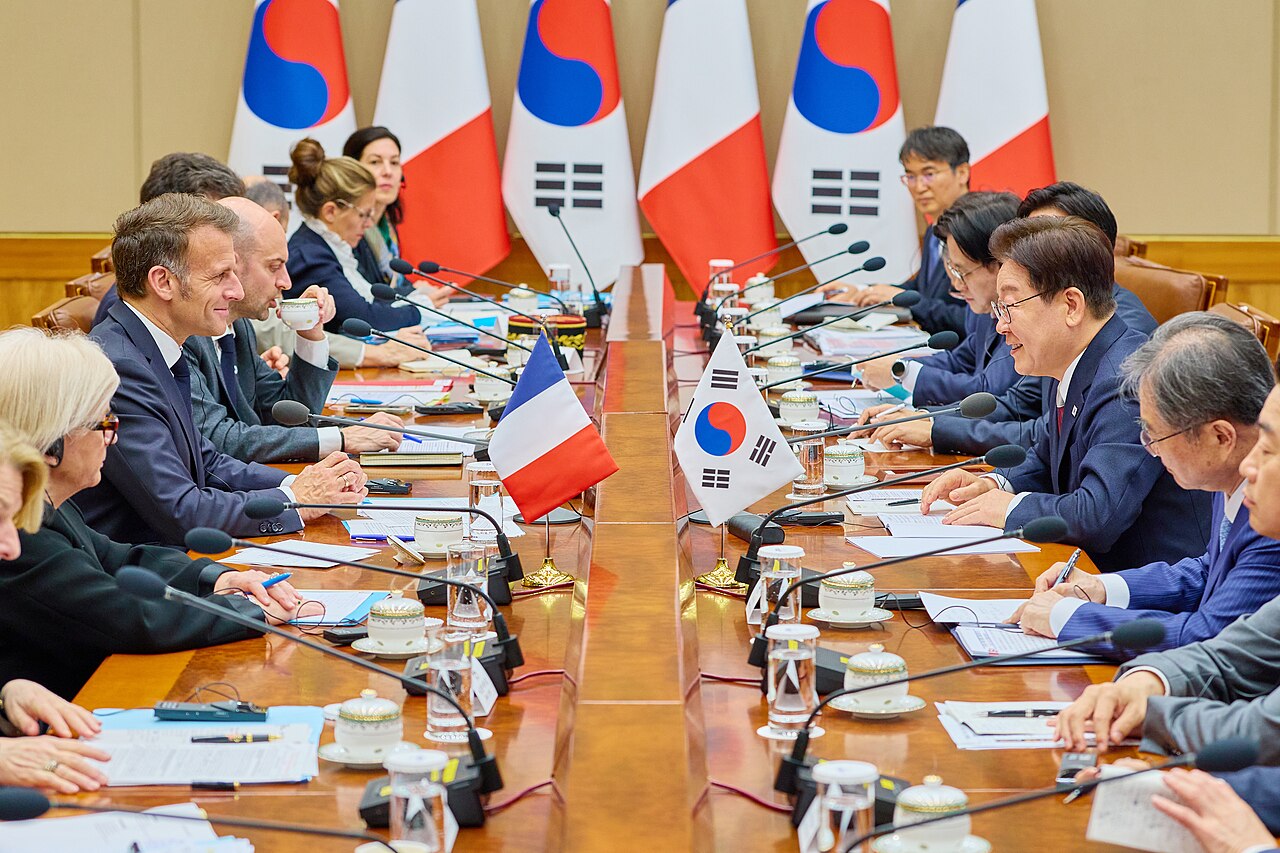
Image credit: Republic of Korea, CC BY-SA 4.0, via Wikimedia Commons.
Strategic Alignment
In addition, the two countries may find additional avenues of cooperation considering recent geopolitical developments: the ongoing wars in Ukraine and Iran, China’s growing assertiveness in the East and South China Seas and, above all, America’s increasingly uncertain security commitments. France and South Korea have strong capacity to uphold a rules-based order: both are major economic and military powers, liberal democracies that support international law, with solid legitimacy and significant soft power.
With Washington’s reliability no longer guaranteed, South Korea faces a choice it can no longer defer: pursuing a broader recalibration of its international relations. Seoul has recently sought to cultivate partnerships with credible third parties to widen its room for manoeuvre amid the intensifying US-China rivalry.
France fits this calculus in a distinctive way. It is a major industrial democracy with a military presence in the Indo-Pacific. Macron has relentlessly positioned himself as the architect of a “coalition of independents”, a vision he articulated most forcefully in his keynote speech at the Shangri-La Dialogue 2025 – one of sovereign democracies converging around shared values, free from dependence on any hegemonic power. In Seoul, he did not hold back, taking aim at Washington’s tariff hikes, its attempts to impose extraterritorial jurisdiction across swathes of the global economy, and Beijing’s drive to control critical value chains through massive state subsidies. “We do not want to be the vassals of two hegemonic powers”, he declared.
From Declaration to Substance?
While neither Seoul nor Paris is opting out of the American security architecture, both parties realise the need to strengthen their own postures while enhancing cooperation between themselves. The question is whether both sides can move beyond carefully worded joint declarations and translate converging interests into a partnership with real strategic substance – that is, beyond the existing cordial, but underexplored relationship.
Paco Milhiet is a Visiting Fellow with the South Asia Programme at the S. Rajaratnam School of International Studies (RSIS). Jaehan Park is an Assistant Professor in International Relations at the S. Rajaratnam School of International Studies (RSIS) and a Fellow of the Edwin O. Reischauer Center for East Asian Studies at the Johns Hopkins School of Advanced International Studies (SAIS).
KEY TAKEAWAYS
• French President Emmanuel Macron visited Seoul on 2–3 April 2026 as France and South Korea celebrated 140 years of diplomatic relations – marked by cordiality, even amity, yet still largely underexplored.
• Despite elevating their bilateral relationship to a “global strategic partnership”, the two countries’ ties fall short of their potential – modest in economic scope, limited in political ambition, and overshadowed in defence by industrial competition.
• Amid global geopolitical turmoil and growing American unpredictability, the case for a deeper partnership has never been stronger for both countries.
COMMENTARY
On 3 April, French President Emmanuel Macron was warmly embraced by South Korean President Lee Jae Myung in the courtyard of the Blue House, South Korea’s presidential residence. The purpose of Macron’s visit – the first such visit by a French president since 2015 – was to celebrate the 140th anniversary of the establishment of diplomatic relations between France and Korea. The celebratory summit between the two leaders culminated in the elevation of the bilateral relationship to a “global strategic partnership”. Despite much fanfare, however, their ties thus far have been limited and episodic at best, owing to their diverging strategic priorities – hence the cordial but underexplored relationship. Yet this situation might change. With an increasingly unpredictable American foreign policy in Eurasia, the two key countries in Asia and Europe have much more to cooperate on.
A Brief History of the Bilateral Relationship
The beginning of the relationship between the two countries was not entirely a positive one. The first contacts were established in the early 19th century by French Catholic priests sent to evangelise the Korean people. The Korean government did not take well to the evangelising efforts: its persecution eventually led to the massacre of French priests and local converts. In response, France launched a punitive expedition in 1866. French troops withdrew after a few weeks, taking with them hundreds of records of Korean royal protocols, the Uigwe, which they returned only in 2010.
Around the time of the French expedition, colonial competition among European powers was intensifying across East Asia. As a major player, France sought its own sphere of influence in Indochina and signed treaties with China (1844) and Japan (1858) to establish diplomatic and commercial ties. In contrast, Korea’s Joseon dynasty had long pursued a policy of seclusion, which led to Westerners dubbing Korea the “Hermit Kingdom”. It repelled not only the French (1866) but also the Americans later (1871). However, by the 1880s, Korea could no longer stay isolated. It therefore signed the Treaty of Amity, Commerce and Navigation with France in 1886, heralding the beginning of a formal relationship. Yet this relationship was short-lived, owing to Korea’s colonisation by Japan in 1910.
Fast forwarding to the 20th century, both France and Korea were destroyed by foreign powers – and out of the ashes emerged a new relationship. While France quickly re-emerged as a major power, obtaining the status of a victor of World War 2, Korea was divided into north and south shortly after independence against the backdrop of the Cold War.
Once the Korean War began in 1950, France dispatched over 3,000 troops under UN command to fight communism, uphold alliances and secure US backing in Indochina. Led by Ralph Monclar, French troops fought bravely against Chinese forces, suffering heavy losses (over 260 killed in action). Upon arriving in Seoul earlier this month, Macron made it a point to honour the fallen at the Korean War Memorial.
As the Cold War thawed somewhat in the 1970s, Paris and Seoul sought greater autonomy from Washington, creating an opportunity for cooperation. France supported South Korea’s early nuclear energy programme, leading in 1981 to the establishment of the Joint Coordinating Committee on Nuclear Energy, which is still active over 40 years later.
A Cordial but Underexploited Relationship
Today, the two countries maintain solid ties across a wide range of sectors – culture, science, artificial intelligence (AI), aerospace, automobiles, energy and critical technologies – underpinned by around 30 bilateral dialogue frameworks, three of which operate at ministerial level. The elevation of their ties to a “global strategic partnership” during Macron’s visit exemplifies their cordial relationship.
However, the relationship remains largely underexploited. On the security front, despite a few port calls, air stopovers as part of the PEGASE mission, and French contribution to the multinational effort to enforce UN sanctions on North Korea (Enforcement Coordination Cell), substantive operational interactions have yet to develop. Bilateral trade, hovering at around €13 billion in 2025, remains modest: Korea ranks only as France’s 19th export market, France is South Korea’s 17th supplier, and South Korea sits at a distant 29th among destinations for French investment – figures that place France well behind Germany, South Korea’s largest European trading partner. Most importantly, Seoul has remained deeply anchored in its alliance with Washington, which serves as the bedrock of its national security, leaving limited space for the French defence industry to gain a foothold.
Yet the two countries’ converging synergies suggest a far greater potential. France brings a structuring AI ecosystem, unrivalled civilian nuclear expertise in Europe, and rare diplomatic reach. South Korea, for its part, controls critical nodes of the global economy – semiconductors, batteries, shipbuilding – and has quietly built one of the world’s most competitive defence industries. Regarding the latter domain, despite complementary industrial bases – French naval nuclear and weapons systems, South Korean ground platforms and munitions – the two countries lack a credible co-production framework and are often in competition. Targeted cross-investment in dual-use sectors like telecoms and AI will test their genuine willingness to cooperate.
Image credit: Republic of Korea, CC BY-SA 4.0, via Wikimedia Commons.
Strategic Alignment
In addition, the two countries may find additional avenues of cooperation considering recent geopolitical developments: the ongoing wars in Ukraine and Iran, China’s growing assertiveness in the East and South China Seas and, above all, America’s increasingly uncertain security commitments. France and South Korea have strong capacity to uphold a rules-based order: both are major economic and military powers, liberal democracies that support international law, with solid legitimacy and significant soft power.
With Washington’s reliability no longer guaranteed, South Korea faces a choice it can no longer defer: pursuing a broader recalibration of its international relations. Seoul has recently sought to cultivate partnerships with credible third parties to widen its room for manoeuvre amid the intensifying US-China rivalry.
France fits this calculus in a distinctive way. It is a major industrial democracy with a military presence in the Indo-Pacific. Macron has relentlessly positioned himself as the architect of a “coalition of independents”, a vision he articulated most forcefully in his keynote speech at the Shangri-La Dialogue 2025 – one of sovereign democracies converging around shared values, free from dependence on any hegemonic power. In Seoul, he did not hold back, taking aim at Washington’s tariff hikes, its attempts to impose extraterritorial jurisdiction across swathes of the global economy, and Beijing’s drive to control critical value chains through massive state subsidies. “We do not want to be the vassals of two hegemonic powers”, he declared.
From Declaration to Substance?
While neither Seoul nor Paris is opting out of the American security architecture, both parties realise the need to strengthen their own postures while enhancing cooperation between themselves. The question is whether both sides can move beyond carefully worded joint declarations and translate converging interests into a partnership with real strategic substance – that is, beyond the existing cordial, but underexplored relationship.
Paco Milhiet is a Visiting Fellow with the South Asia Programme at the S. Rajaratnam School of International Studies (RSIS). Jaehan Park is an Assistant Professor in International Relations at the S. Rajaratnam School of International Studies (RSIS) and a Fellow of the Edwin O. Reischauer Center for East Asian Studies at the Johns Hopkins School of Advanced International Studies (SAIS).