


06 May 2026
IP26065 | Fiscal Recentralisation and Its Uneven Impact in the Riau Islands

KEY TAKEAWAYS
• Fiscal recentralisation is hitting Indonesia’s Riau Islands (KEPRI) province disproportionately hard as it stalls social and infrastructure spending.
• A core–periphery divide is widening as the free trade zone–shielded economy of KEPRI’s largest city, Batam, booms while the provincial capital, Tanjung Pinang, and the outer islands face budgetary crisis.
• The Archipelagic Provinces Bill is a critical first step to mitigate Jakarta-driven fiscal shocks, but the bill alone cannot resolve the deeper structural challenges that the province faces.
COMMENTARY
Indonesia’s Riau Islands (KEPRI) province offers one of the starkest illustrations of how fiscal recentralisation under President Prabowo Subianto is reshaping Indonesia’s regional governance landscape. Yet the picture is not simply one of a province losing funding. It is instead a picture of how austerity widens the existing fracture between KEPRI’s industrial core of Batam and its archipelagic periphery, with direct consequences for the future of local and regional governance 25 years after Indonesia’s “big bang” decentralisation, a key political promise of Reformasi.
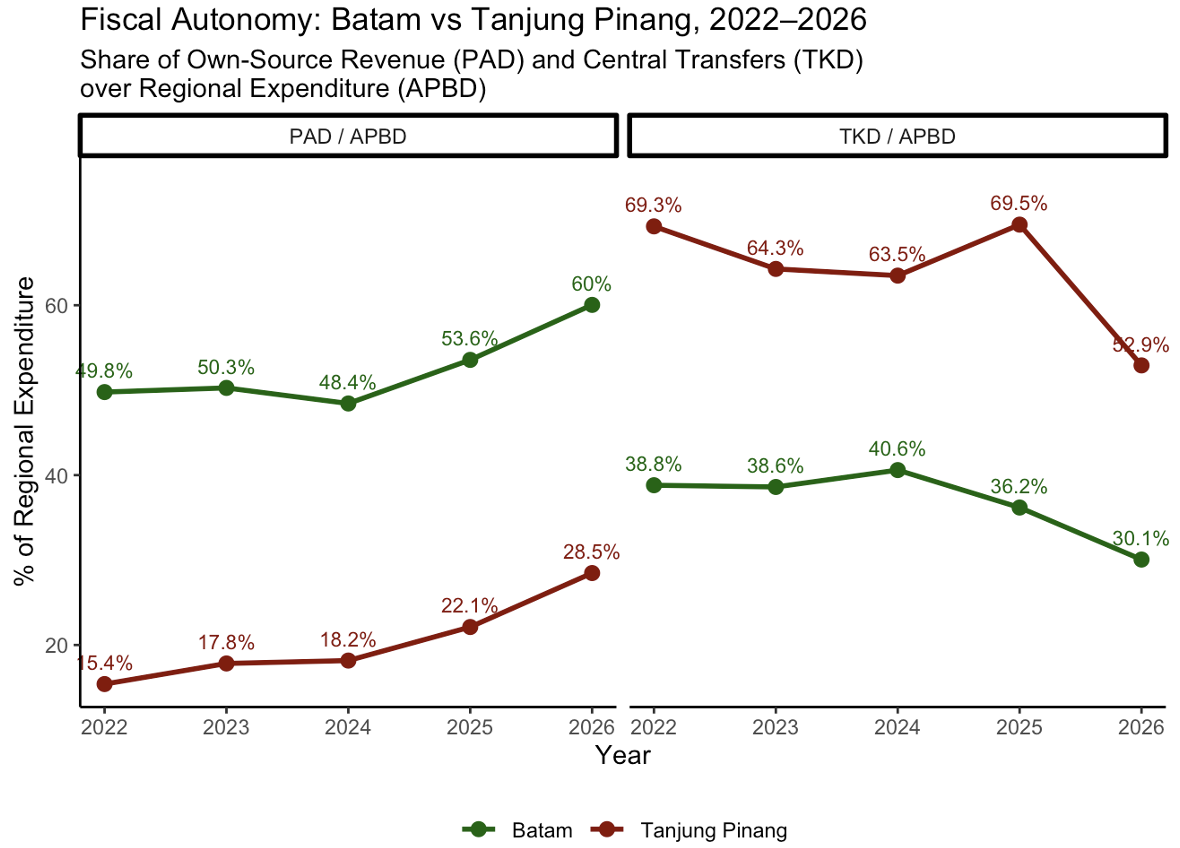
The fiscal structure of KEPRI’s two major cities reveals the scale of divergence. Batam’s own-source revenue (PAD) as a share of regional expenditure climbed from 49.8% in 2022 to 60% in 2026, while its dependence on central fiscal transfers (TKD) fell from 38.8% to just 30.1% over the same period. Operating as a free trade zone under the jurisdiction of the Batam Development Board (BP Batam), the city functions as a quasi-independent extension of the central government, relatively insulated from provincial budget shocks. Statistics Indonesia (BPS) data confirmed that Batam’s economic growth reached 6.76% in 2025, outperforming the national average of 5.11% and constituting a 66.44% share of KEPRI’s total gross regional domestic product.
Tanjung Pinang, the provincial capital, presents the mirror image. Its PAD share languished between 15.4 and 28.5% over the same period, while central transfers consistently financed over 60% of its budget, peaking at 69.5% in 2025 before a sharp correction to 52.9% in 2026. As Batam’s FTZ-driven tax base underwrites ever-greater fiscal autonomy, the provincial capital remains structurally tethered to Jakarta’s disbursement cycle and fundamentally unable to self-finance the infrastructure and services its residents require.
Unpacking the Fiscal Shock to KEPRI
This divergence has been dramatically accelerated by the issuance of Presidential Instruction (Inpres) No. 1/2025, which mandated a sweeping Rp 306.69 trillion (US$17.75 billion) reduction in state and regional spending. While officially framed as an efficiency drive, the policy functions as fiscal recentralisation, reallocating budgetary resources towards centrally determined priorities such as Prabowo’s Free Nutritious Meals initiative and Red–White Cooperatives.
For KEPRI, the impact is acute. Its TKD allocation was slashed by Rp 534 billion, bringing the total down to Rp 1.467 trillion and forcing a downward revision of the 2026 regional budget from the 2025 figure of Rp 3.933 trillion to Rp 3.544 trillion. The statutory formula for calculating the General Allocation Fund (DAU), i.e., the block grants to the provinces and districts to reduce fiscal imbalances, remains tied to land area and population density, structurally undervaluing a province whose territory comprises 96% sea. Speaking to the media, former KEPRI Provincial Regional Secretary Adi Prihantara said that the Special Allocation Funds-Physical (DAK-Fisik; i.e., funds earmarked for tangible infrastructure) for KEPRI suffered targeted reductions: Rp 39.55 billion from provincial road infrastructure, Rp 25.89 billion from marine transportation, and Rp 30.5 billion from fisheries (based on Ministry of Finance Decree (KMK) No. 29/2025). For island communities dependent on cross-island connectivity for economic survival, these are not marginal trims.
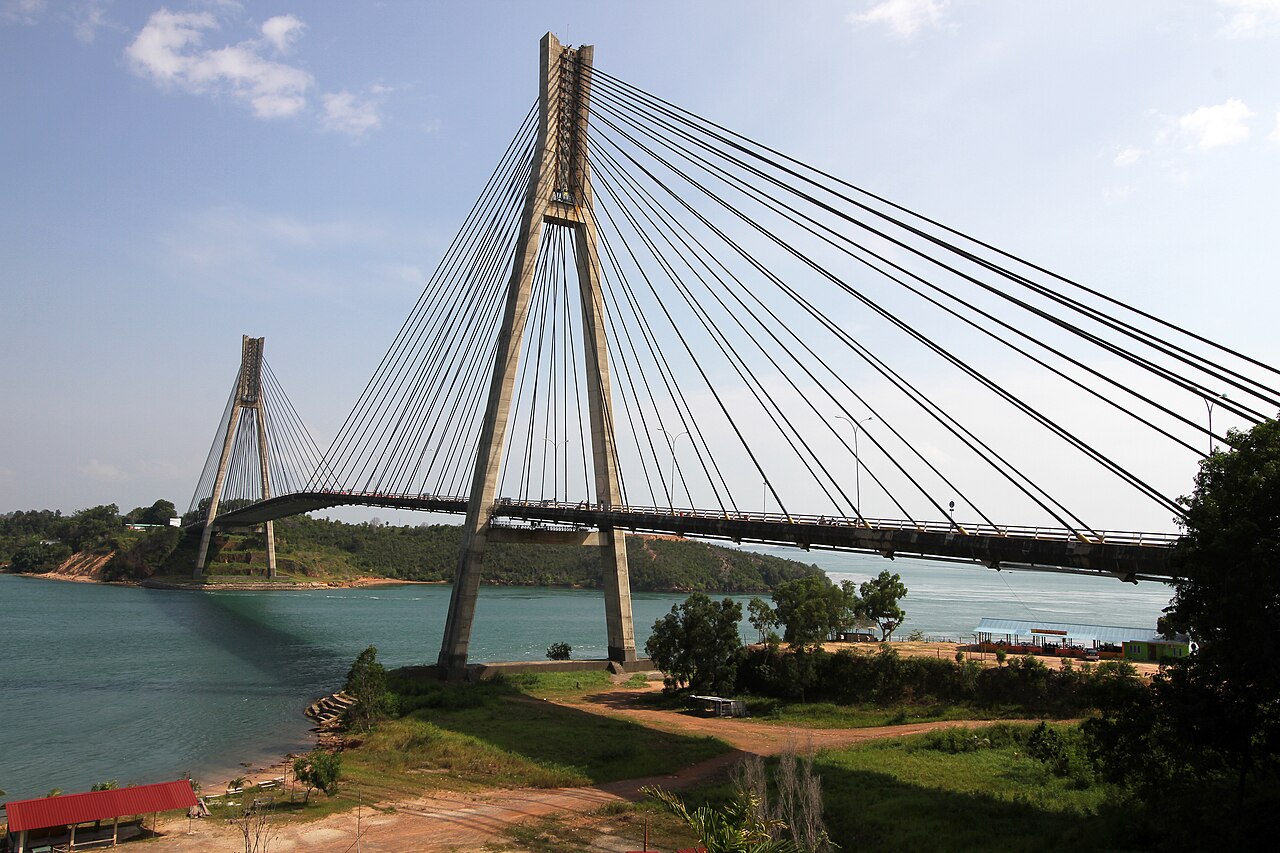
The exclusion of the Batam–Bintan Bridge from the 2026 national budget, despite completed technical designs, exemplifies the consequences. The bridge was projected to integrate the Batam-Bintan-Karimun Free Trade Zone into a unified economic corridor, potentially transforming Bintan’s growth trajectory. Instead, the project has been left to pursue funding through complex public–private partnership schemes, placing the financing burden squarely on a province already facing a revenue shortfall.
Debt as a Stopgap, Social Spending at Zero
The consequences for KEPRI’s outlying communities are already visible. Early 2026 financial data from the Ministry of Finance show that while the provincial government is meeting its personnel expenditure obligations, no disbursements of social assistance, subsidies and grants have been made. The programmes most directly tied to community welfare are thus the first to stall under fiscal pressure.
This matters acutely in KEPRI’s outer islands, where civil servant salaries and direct social assistance function as the primary economic anchor, sustaining local demand for goods and services. For instance, the KEPRI provincial government operates free transit houses (rumah singgah) in Jakarta and Batam for outer island residents needing specialist medical referrals, a locally designed service that no centrally administered programme replicates. When provincial social assistance disbursement drops to zero, programmes such as these are the first at risk.
To augment its finances and prevent complete collapse of social and infrastructural spending, Indonesia’s provincial and regency administrations are turning to loan facilities from government-backed lenders such as PT Sarana Multi Infrastruktur, a state-owned enterprise dedicated to providing long-term financing and advisory services for Indonesian infrastructure development. While such loans secure short-term survival for critical connectivity and social programmes, they may lead to long-term fiscal strain as future budgets come under increasing pressure from debt servicing.
The Archipelagic Provinces Bill as a Partial Remedy
KEPRI’s leadership has not been passive. In alliance with the Association of Archipelagic and Coastal Regional Governments (ASPEKSINDO), Governor Ansar Ahmad intensified the campaign for the Archipelagic Provinces Bill (RUU Daerah Kepulauan), which would create a maritime-weighted fiscal framework for Indonesia’s island provinces. The campaign secured inclusion in the 2025 National Legislation Programme Priority, and in January 2026, a Presidential Letter formally advanced the bill into parliament’s plenary session. A special committee has since been formed to deliberate the legislation.
Yet the bill is an incomplete fix. A revised DAU formula cannot resolve the structural dualism between Batam’s booming core and the stagnating periphery, nor can it absorb the compounding pressures of migration-driven urbanisation, including housing deficits, overburdened infrastructure, and rising property crime. In a climate of aggressive central austerity, however, codifying geographic fairness into law remains an indispensable first step towards preserving basic governance capabilities in one of Indonesia’s most strategically positioned provinces. How KEPRI navigates this gap will serve as an early test of whether Indonesia’s fiscal recentralisation can sustain governance in its most exposed frontier provinces amid growing external pressures.
Muhammad Garda Ramadhito is an Associate Research Fellow with the Indonesia Programme, S. Rajaratnam School of International Studies (RSIS).
KEY TAKEAWAYS
• Fiscal recentralisation is hitting Indonesia’s Riau Islands (KEPRI) province disproportionately hard as it stalls social and infrastructure spending.
• A core–periphery divide is widening as the free trade zone–shielded economy of KEPRI’s largest city, Batam, booms while the provincial capital, Tanjung Pinang, and the outer islands face budgetary crisis.
• The Archipelagic Provinces Bill is a critical first step to mitigate Jakarta-driven fiscal shocks, but the bill alone cannot resolve the deeper structural challenges that the province faces.
COMMENTARY
Indonesia’s Riau Islands (KEPRI) province offers one of the starkest illustrations of how fiscal recentralisation under President Prabowo Subianto is reshaping Indonesia’s regional governance landscape. Yet the picture is not simply one of a province losing funding. It is instead a picture of how austerity widens the existing fracture between KEPRI’s industrial core of Batam and its archipelagic periphery, with direct consequences for the future of local and regional governance 25 years after Indonesia’s “big bang” decentralisation, a key political promise of Reformasi.
The fiscal structure of KEPRI’s two major cities reveals the scale of divergence. Batam’s own-source revenue (PAD) as a share of regional expenditure climbed from 49.8% in 2022 to 60% in 2026, while its dependence on central fiscal transfers (TKD) fell from 38.8% to just 30.1% over the same period. Operating as a free trade zone under the jurisdiction of the Batam Development Board (BP Batam), the city functions as a quasi-independent extension of the central government, relatively insulated from provincial budget shocks. Statistics Indonesia (BPS) data confirmed that Batam’s economic growth reached 6.76% in 2025, outperforming the national average of 5.11% and constituting a 66.44% share of KEPRI’s total gross regional domestic product.
Tanjung Pinang, the provincial capital, presents the mirror image. Its PAD share languished between 15.4 and 28.5% over the same period, while central transfers consistently financed over 60% of its budget, peaking at 69.5% in 2025 before a sharp correction to 52.9% in 2026. As Batam’s FTZ-driven tax base underwrites ever-greater fiscal autonomy, the provincial capital remains structurally tethered to Jakarta’s disbursement cycle and fundamentally unable to self-finance the infrastructure and services its residents require.
Unpacking the Fiscal Shock to KEPRI
This divergence has been dramatically accelerated by the issuance of Presidential Instruction (Inpres) No. 1/2025, which mandated a sweeping Rp 306.69 trillion (US$17.75 billion) reduction in state and regional spending. While officially framed as an efficiency drive, the policy functions as fiscal recentralisation, reallocating budgetary resources towards centrally determined priorities such as Prabowo’s Free Nutritious Meals initiative and Red–White Cooperatives.
For KEPRI, the impact is acute. Its TKD allocation was slashed by Rp 534 billion, bringing the total down to Rp 1.467 trillion and forcing a downward revision of the 2026 regional budget from the 2025 figure of Rp 3.933 trillion to Rp 3.544 trillion. The statutory formula for calculating the General Allocation Fund (DAU), i.e., the block grants to the provinces and districts to reduce fiscal imbalances, remains tied to land area and population density, structurally undervaluing a province whose territory comprises 96% sea. Speaking to the media, former KEPRI Provincial Regional Secretary Adi Prihantara said that the Special Allocation Funds-Physical (DAK-Fisik; i.e., funds earmarked for tangible infrastructure) for KEPRI suffered targeted reductions: Rp 39.55 billion from provincial road infrastructure, Rp 25.89 billion from marine transportation, and Rp 30.5 billion from fisheries (based on Ministry of Finance Decree (KMK) No. 29/2025). For island communities dependent on cross-island connectivity for economic survival, these are not marginal trims.
The exclusion of the Batam–Bintan Bridge from the 2026 national budget, despite completed technical designs, exemplifies the consequences. The bridge was projected to integrate the Batam-Bintan-Karimun Free Trade Zone into a unified economic corridor, potentially transforming Bintan’s growth trajectory. Instead, the project has been left to pursue funding through complex public–private partnership schemes, placing the financing burden squarely on a province already facing a revenue shortfall.
Debt as a Stopgap, Social Spending at Zero
The consequences for KEPRI’s outlying communities are already visible. Early 2026 financial data from the Ministry of Finance show that while the provincial government is meeting its personnel expenditure obligations, no disbursements of social assistance, subsidies and grants have been made. The programmes most directly tied to community welfare are thus the first to stall under fiscal pressure.
This matters acutely in KEPRI’s outer islands, where civil servant salaries and direct social assistance function as the primary economic anchor, sustaining local demand for goods and services. For instance, the KEPRI provincial government operates free transit houses (rumah singgah) in Jakarta and Batam for outer island residents needing specialist medical referrals, a locally designed service that no centrally administered programme replicates. When provincial social assistance disbursement drops to zero, programmes such as these are the first at risk.
To augment its finances and prevent complete collapse of social and infrastructural spending, Indonesia’s provincial and regency administrations are turning to loan facilities from government-backed lenders such as PT Sarana Multi Infrastruktur, a state-owned enterprise dedicated to providing long-term financing and advisory services for Indonesian infrastructure development. While such loans secure short-term survival for critical connectivity and social programmes, they may lead to long-term fiscal strain as future budgets come under increasing pressure from debt servicing.
The Archipelagic Provinces Bill as a Partial Remedy
KEPRI’s leadership has not been passive. In alliance with the Association of Archipelagic and Coastal Regional Governments (ASPEKSINDO), Governor Ansar Ahmad intensified the campaign for the Archipelagic Provinces Bill (RUU Daerah Kepulauan), which would create a maritime-weighted fiscal framework for Indonesia’s island provinces. The campaign secured inclusion in the 2025 National Legislation Programme Priority, and in January 2026, a Presidential Letter formally advanced the bill into parliament’s plenary session. A special committee has since been formed to deliberate the legislation.
Yet the bill is an incomplete fix. A revised DAU formula cannot resolve the structural dualism between Batam’s booming core and the stagnating periphery, nor can it absorb the compounding pressures of migration-driven urbanisation, including housing deficits, overburdened infrastructure, and rising property crime. In a climate of aggressive central austerity, however, codifying geographic fairness into law remains an indispensable first step towards preserving basic governance capabilities in one of Indonesia’s most strategically positioned provinces. How KEPRI navigates this gap will serve as an early test of whether Indonesia’s fiscal recentralisation can sustain governance in its most exposed frontier provinces amid growing external pressures.
Muhammad Garda Ramadhito is an Associate Research Fellow with the Indonesia Programme, S. Rajaratnam School of International Studies (RSIS).