


21 May 2026
IP26067 | Prabowo’s Defence Challenge: Making “Triple Helix” Work

KEY TAKEAWAYS
• Past experience with Indonesia’s Minimum Essential Force (MEF) arms modernisation programme demonstrates the constraints of meaningful progress with a defence budget of less than 1% of GDP.
• Fostering research and development through a “triple helix” model involving multi-actor cooperation has emerged as a viable solution to support Indonesia’s arms modernisation ambitions under the Optimum Essential Force programme, the successor to the MEF.
• To optimise outcomes under the triple helix cooperation model, the Indonesian government must ensure that the Ministry of Defence plays a central role in guiding the partnership. Strengthening the research ecosystem and promoting specialisation through a clear division of labour between academia and industry is also necessary to enhance the effectiveness of such cooperation.
COMMENTARY
Arms modernisation and strengthening the defence industry have long been priorities of the Indonesian government, and particularly the current government led by President Prabowo Subianto. However, achieving the country’s arms modernisation ambitions remains an elusive objective, with the defence budget hovering below 1% of GDP. Despite the 2025 spike in military spending, it is questionable whether arms modernisation will progress rapidly enough as the increase coincided with the organisational expansion of the Indonesian military (TNI).
Against this background, the notion of “triple helix” cooperation – a defence R&D collaboration involving three players, namely, state agencies, the defence industry, and universities – has emerged as a means of supporting the development of the national defence industry and advancing TNI’s arms modernisation ambitions. Despite such collaboration, some challenges remain: the lack of commitment on the part of the Defence Ministry in promoting cross-institution defence R&D, an underdeveloped research ecosystem, and an unclear division of labour between academia and industry.
The Emergence of Triple Helix Collaboration
In 2020, then President Joko Widodo (“Jokowi”) outlined his intention to turn defence spending into defence investment to stimulate the economy. The notion of triple helix cooperation emerged then as a means of supporting that ambition. The model could arguably generate greater economic impact than simply acquiring defence technology through procurement. A prime benefit is the potential emergence of spin-off products, that is, military technology repurposed for civilian use.
Subsequently, in 2022, Prabowo Subianto, who was then defence minister, signed an agreement with Indonesia’s National Research and Innovation Agency (BRIN) to tap the agency’s research and innovation capacity to support national defence technology. Prabowo was also committed to developing science, technology, engineering, and mathematics (STEM) education, which he saw as the foundation of future national sovereignty. After assuming the presidency, Prabowo, through the Ministry of Higher Education, Science and Technology, initiated the Indonesian Science, Technology, and Industry Convention (KSTI) in August 2025, which brought together academia, government and industry to discuss a coherent strategy for STEM development in Indonesia. Two months earlier, in line with Prabowo’s emphasis on technological sovereignty, the Indonesian Defence University developed a nano-satellite (RIDU-Sat).
While these are important initiatives, maximising the benefits of triple helix cooperation to advance the arms modernisation agenda requires addressing the shortcomings highlighted earlier.
Optimising Indonesia’s Triple Helix Environment
First, the Indonesian Defence Ministry must ensure its centrality in driving collaboration between academia, industry and government. Although regulatory frameworks – such as Law No. 16/2012 on the Defence Industry and Minister of Defence Regulation No. 12/2021 – provide guidance, collaboration remains fragmented, lacking coordination. Universities often pursue research that is disconnected from military needs, while industry faces commercialisation challenges and policy inconsistency. Consequently, there is a risk that promising research will fail to generate deployable and mass-producible defence technologies. Furthermore, the evolution of military technology towards network-centric warfare (NCW) and emergence of automation technology, combined with the diversity of Indonesia’s existing defence equipment – sourced from multiple countries and manufacturers – necessitate stronger leadership from the Defence Ministry. Its centrality in setting direction, formulating clear guidelines and supervising cooperation is important to ensure alignment between academia, the defence industry and end users.
Second, it is important that Indonesia establish a conducive research ecosystem broadly – and in the defence sector specifically. All elements within the triple helix should adopt the National Long-Term Development Plan (RPJPN) 2025–2045 for the defence sector as the primary reference for strategic planning. This overarching framework must subsequently be translated into coherent and continuous planning down to the tactical level.
Third, establishing collaboration between the three sets of players within the triple helix ecosystem calls for a clear division of labour between academia and industry, particularly in terms of technology readiness levels or tingkat kesiapterapan teknologi (TRL). The TRL system divides research into three stages: basic research, applied research and research development. In order to maximise outcomes, a division of labour is necessary. The university sector should focus more on the first two stages, where its expertise lies, while the defence industry can focus on the development stage, including product commercialisation. However, academic institutions’ unwillingness to share intellectual property rights with other parties is often perceived as one of the main culprits that hinder collaboration with other agencies.
Triple Helix and Optimum Essential Force
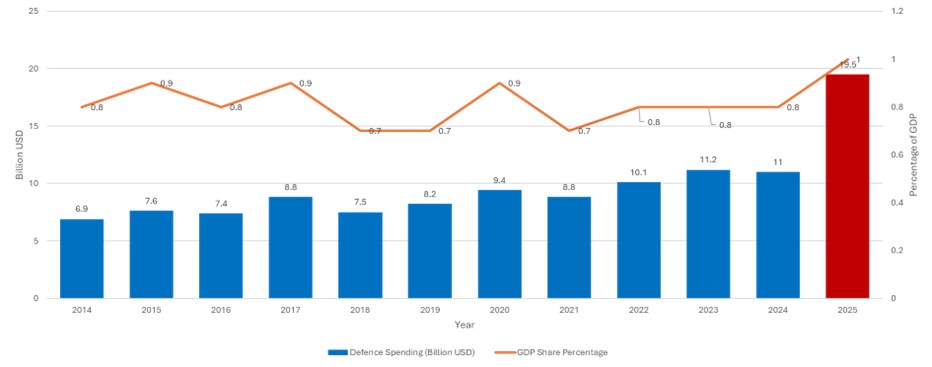
With competing government priorities, Indonesia’s military spending from time to time has been hovering below 1% of the country’s GDP, the exception being 2025, when projected spending was expected to reach 1% of GDP (see Figure 1). The country’s experience with the Minimum Essential Force (MEF) arms modernisation programme, which was concluded in 2024, showed that with defence spending under 1% of GDP, MEF targets could not be reached. The Indonesian government is now toying with the idea of boosting the defence budget to about 1.5% of GDP.
Figure 1: Indonesia’s Defence Spending 2014–2014 and 2025 Defence Spending Projectiont
Data source: SIPRI (Stockholm International Peace Research Institute) Military Expenditure Database
Triple helix cooperation may be able to help alleviate the constraints of Indonesia’s limited defence budget that had hobbled the MEF programme. The budget for defence R&D may no longer need to depend solely on the defence budget as the financial burden can be shared with other institutions. Moreover, the dual-use nature of some military technologies may attract investments from the private sector.
Another advantage of the triple helix cooperation model is that it can help to accelerate the indigenisation of emerging military technologies. Furthermore, it will expand the talent pool for accelerating arms modernisation by involving the academic sector.
For the academic sector, the successful establishment of triple helix cooperation will allow it to master cutting-edge technology. In addition, triple helix cooperation will serve as an important learning experience for scientists in universities as they will have the opportunity to apply their academic knowledge.
In short, triple helix cooperation can help to accelerate the arms modernisation agenda, particularly under the current Optimum Essential Force programme, while also developing the academic sector and expanding the indigenous talent pool. However, its success requires strong commitment as well as resilience and patience from all actors operating under the framework.
Adhi Priamarizki is a Research Fellow with the Indonesia Programme, S. Rajaratnam School of International Studies (RSIS). Edna Caroline is the co-founder of Indonesia Strategic and Defence Studies and a PhD student at RSIS.
KEY TAKEAWAYS
• Past experience with Indonesia’s Minimum Essential Force (MEF) arms modernisation programme demonstrates the constraints of meaningful progress with a defence budget of less than 1% of GDP.
• Fostering research and development through a “triple helix” model involving multi-actor cooperation has emerged as a viable solution to support Indonesia’s arms modernisation ambitions under the Optimum Essential Force programme, the successor to the MEF.
• To optimise outcomes under the triple helix cooperation model, the Indonesian government must ensure that the Ministry of Defence plays a central role in guiding the partnership. Strengthening the research ecosystem and promoting specialisation through a clear division of labour between academia and industry is also necessary to enhance the effectiveness of such cooperation.
COMMENTARY
Arms modernisation and strengthening the defence industry have long been priorities of the Indonesian government, and particularly the current government led by President Prabowo Subianto. However, achieving the country’s arms modernisation ambitions remains an elusive objective, with the defence budget hovering below 1% of GDP. Despite the 2025 spike in military spending, it is questionable whether arms modernisation will progress rapidly enough as the increase coincided with the organisational expansion of the Indonesian military (TNI).
Against this background, the notion of “triple helix” cooperation – a defence R&D collaboration involving three players, namely, state agencies, the defence industry, and universities – has emerged as a means of supporting the development of the national defence industry and advancing TNI’s arms modernisation ambitions. Despite such collaboration, some challenges remain: the lack of commitment on the part of the Defence Ministry in promoting cross-institution defence R&D, an underdeveloped research ecosystem, and an unclear division of labour between academia and industry.
The Emergence of Triple Helix Collaboration
In 2020, then President Joko Widodo (“Jokowi”) outlined his intention to turn defence spending into defence investment to stimulate the economy. The notion of triple helix cooperation emerged then as a means of supporting that ambition. The model could arguably generate greater economic impact than simply acquiring defence technology through procurement. A prime benefit is the potential emergence of spin-off products, that is, military technology repurposed for civilian use.
Subsequently, in 2022, Prabowo Subianto, who was then defence minister, signed an agreement with Indonesia’s National Research and Innovation Agency (BRIN) to tap the agency’s research and innovation capacity to support national defence technology. Prabowo was also committed to developing science, technology, engineering, and mathematics (STEM) education, which he saw as the foundation of future national sovereignty. After assuming the presidency, Prabowo, through the Ministry of Higher Education, Science and Technology, initiated the Indonesian Science, Technology, and Industry Convention (KSTI) in August 2025, which brought together academia, government and industry to discuss a coherent strategy for STEM development in Indonesia. Two months earlier, in line with Prabowo’s emphasis on technological sovereignty, the Indonesian Defence University developed a nano-satellite (RIDU-Sat).
While these are important initiatives, maximising the benefits of triple helix cooperation to advance the arms modernisation agenda requires addressing the shortcomings highlighted earlier.
Optimising Indonesia’s Triple Helix Environment
First, the Indonesian Defence Ministry must ensure its centrality in driving collaboration between academia, industry and government. Although regulatory frameworks – such as Law No. 16/2012 on the Defence Industry and Minister of Defence Regulation No. 12/2021 – provide guidance, collaboration remains fragmented, lacking coordination. Universities often pursue research that is disconnected from military needs, while industry faces commercialisation challenges and policy inconsistency. Consequently, there is a risk that promising research will fail to generate deployable and mass-producible defence technologies. Furthermore, the evolution of military technology towards network-centric warfare (NCW) and emergence of automation technology, combined with the diversity of Indonesia’s existing defence equipment – sourced from multiple countries and manufacturers – necessitate stronger leadership from the Defence Ministry. Its centrality in setting direction, formulating clear guidelines and supervising cooperation is important to ensure alignment between academia, the defence industry and end users.
Second, it is important that Indonesia establish a conducive research ecosystem broadly – and in the defence sector specifically. All elements within the triple helix should adopt the National Long-Term Development Plan (RPJPN) 2025–2045 for the defence sector as the primary reference for strategic planning. This overarching framework must subsequently be translated into coherent and continuous planning down to the tactical level.
Third, establishing collaboration between the three sets of players within the triple helix ecosystem calls for a clear division of labour between academia and industry, particularly in terms of technology readiness levels or tingkat kesiapterapan teknologi (TRL). The TRL system divides research into three stages: basic research, applied research and research development. In order to maximise outcomes, a division of labour is necessary. The university sector should focus more on the first two stages, where its expertise lies, while the defence industry can focus on the development stage, including product commercialisation. However, academic institutions’ unwillingness to share intellectual property rights with other parties is often perceived as one of the main culprits that hinder collaboration with other agencies.
Triple Helix and Optimum Essential Force
With competing government priorities, Indonesia’s military spending from time to time has been hovering below 1% of the country’s GDP, the exception being 2025, when projected spending was expected to reach 1% of GDP (see Figure 1). The country’s experience with the Minimum Essential Force (MEF) arms modernisation programme, which was concluded in 2024, showed that with defence spending under 1% of GDP, MEF targets could not be reached. The Indonesian government is now toying with the idea of boosting the defence budget to about 1.5% of GDP.
Figure 1: Indonesia’s Defence Spending 2014–2014 and 2025 Defence Spending Projectiont
Data source: SIPRI (Stockholm International Peace Research Institute) Military Expenditure Database
Triple helix cooperation may be able to help alleviate the constraints of Indonesia’s limited defence budget that had hobbled the MEF programme. The budget for defence R&D may no longer need to depend solely on the defence budget as the financial burden can be shared with other institutions. Moreover, the dual-use nature of some military technologies may attract investments from the private sector.
Another advantage of the triple helix cooperation model is that it can help to accelerate the indigenisation of emerging military technologies. Furthermore, it will expand the talent pool for accelerating arms modernisation by involving the academic sector.
For the academic sector, the successful establishment of triple helix cooperation will allow it to master cutting-edge technology. In addition, triple helix cooperation will serve as an important learning experience for scientists in universities as they will have the opportunity to apply their academic knowledge.
In short, triple helix cooperation can help to accelerate the arms modernisation agenda, particularly under the current Optimum Essential Force programme, while also developing the academic sector and expanding the indigenous talent pool. However, its success requires strong commitment as well as resilience and patience from all actors operating under the framework.
Adhi Priamarizki is a Research Fellow with the Indonesia Programme, S. Rajaratnam School of International Studies (RSIS). Edna Caroline is the co-founder of Indonesia Strategic and Defence Studies and a PhD student at RSIS.