


02 June 2026
IP26069 | Reopening Hormuz: The Case for European Leadership

KEY TAKEAWAYS
• Iran’s proposed transit charges for the Strait of Hormuz raise wider concerns over freedom of navigation and the legal status of straits used for international navigation.
• A multinational military mission led by the United Kingdom and France is poised to deploy to the region to support passage through the strait.
• Restoring shipping confidence will take more than a military mission, but it is a good start.
COMMENTARY
Amid its continuing stand-off with the United States and Israel, Iran launched the Persian Gulf Strait Authority on 23 May to oversee the Strait of Hormuz (SoH), ostensibly to manage transit charges. Iranian authorities have characterised these as “fees” rather than “tolls”, framing them as necessary for “secure navigation and taking measures to preserve national security”. Oman, which also borders the strait, has held talks with Iran on this matter but has not endorsed the charges.
Iran’s stance on the SoH raises both legal and operational concerns. Under Article 38(1) of the United Nations Convention on the Law of the Sea (UNCLOS), straits used for international navigation should remain open, with all ships and aircraft enjoying the right of unimpeded transit passage. In light of continuing US-Iran tensions, the situation in the SoH clearly requires capable leadership and concrete action.
An Overdue European-led Response
Earlier, on 17 April, France and the United Kingdom convened a meeting of 51 countries, including the Gulf states Iraq and Bahrain, to discuss mounting an independent defensive mission to support passage through the SoH. The joint statement issued at the end of the meeting called for the “unconditional, unrestricted and immediate re-opening” of the strait. A follow-on meeting on 22–23 April brought together planners from 44 nations, advancing the issue from diplomatic signalling to practical mission design. The proposed Multinational Military Mission (MMM) has since taken shape, with numerous countries announcing asset commitments, culminating in the United Kingdom’s 12 May announcement that reaffirmed its leadership role, including as part of a multinational headquarters to coordinate efforts.
Transit Situation in the Strait of Hormuz
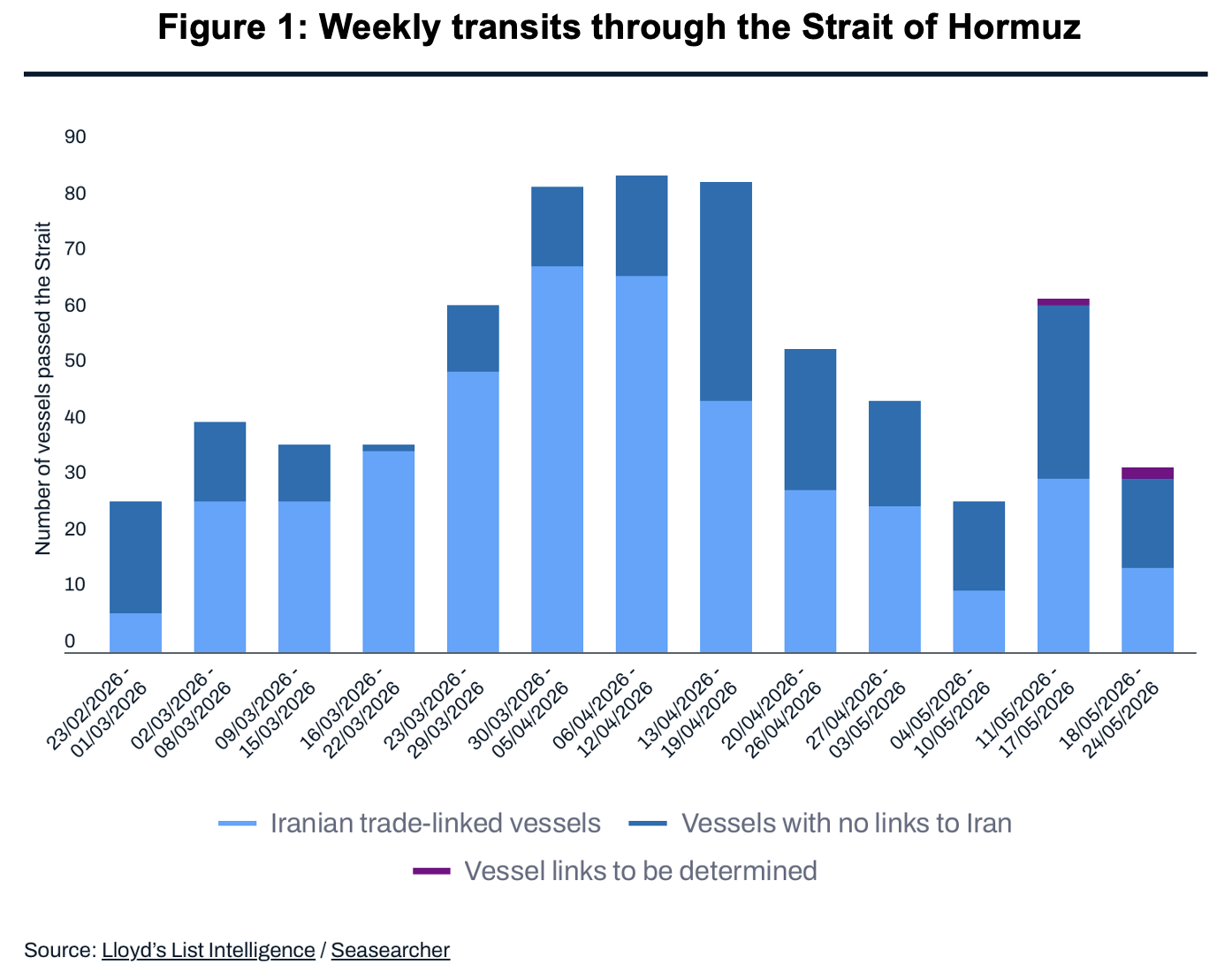
Before the crisis, the SoH averaged 120 ship transits daily. This number fell to 6.9 daily transits after the war began as ships feared becoming collateral damage amid repeated incidents. Rising insurance premiums, particularly war-risk premiums for individual voyages, further affected commercial viability, with overall transits remaining well below 10% of normal levels. As the crisis continued, some shippers began negotiating with the Iranian authorities, who on 23 March had declared tolls for the safe transit of ships not belonging to the United States or its allies. While overall transits remained low, transits by vessels linked to Iranian trade interests began to increase. Adding to the uncertainty within the shipping community, Project Freedom, which US President Donald Trump had announced on 4 May to signal that the waterway could reopen under American protection, was abruptly suspended just a day later. (See Figure 1 for the weekly transit numbers till 24 May 2026.)
Modality of the MMM
Against this backdrop, the European-led MMM should be seen not merely as a tactical military deployment but as the start of an international effort to rebuild a maritime security architecture capable of restoring confidence in freedom of navigation. An MMM co-led by France and the United Kingdom is a step in the right direction, given their command credibility and long-standing Middle East presence: France offers ALINDIEN, its Indian Ocean maritime command linked to French forces stationed in Abu Dhabi, while the United Kingdom Maritime Trade Operations (UKMTO) – a UK-based maritime security centre – provides a recognised shipping interface, built on more than 25 years of experience.
The MMM is likely to draw on the European Union’s Operation ASPIDES, established in February 2024 to protect freedom of navigation and commercial shipping from attacks by the Iran-aligned Houthi rebels in Yemen. ASPIDES now operates from the Red Sea to the Gulf and a large part of the northwest Indian Ocean and has assumed the tasks previously handled by the European Maritime Awareness in the Strait of Hormuz (EMASoH) initiative.
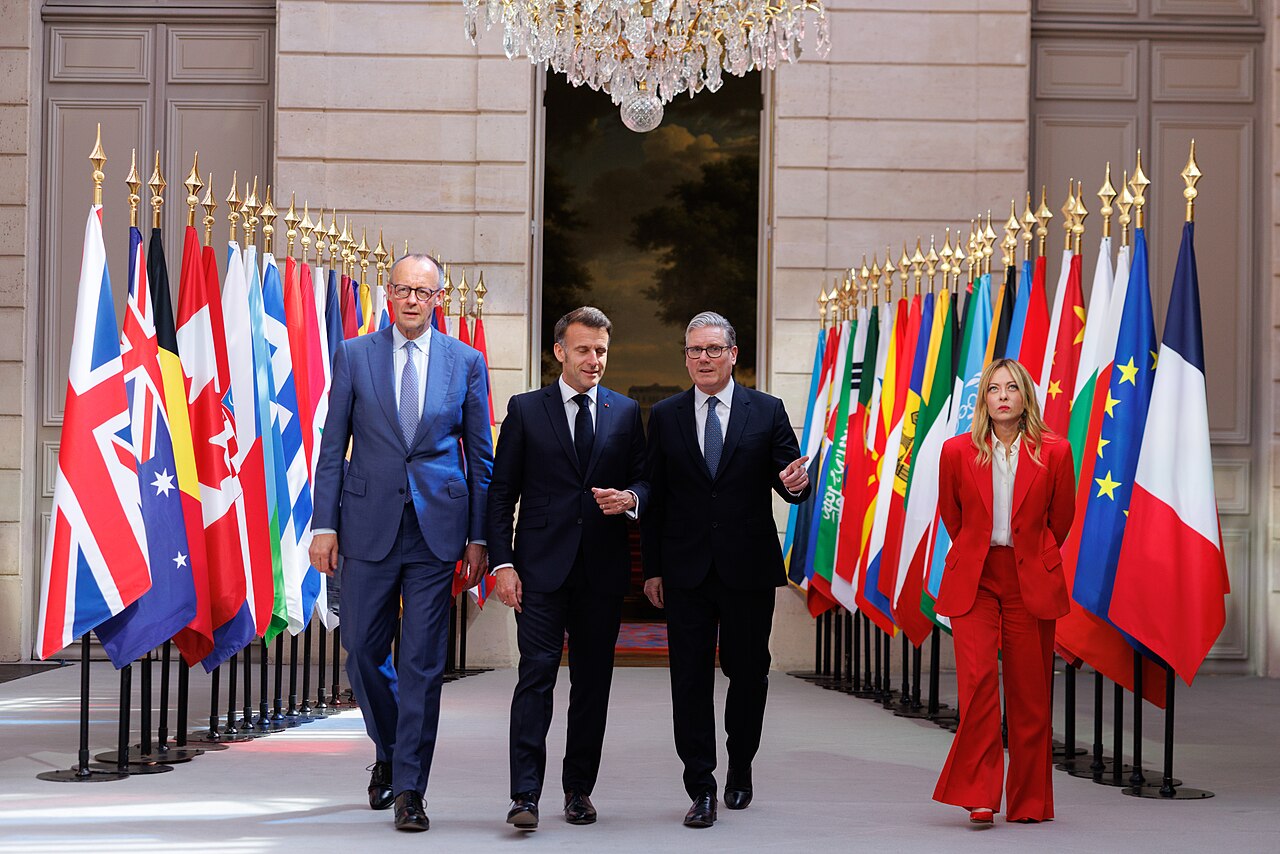
Image credit: Number 10, OGL 3, via Wikimedia Commons.
Addressing the Multidimensional Threats
Iran was reported to have begun laying sea mines in the SoH during the crisis, prompting US strikes on Iranian minelayers. Given that the SoH is a constrained maritime space, the addition of a mine threat means that the MMM would need to address a spectrum of threats: naval mines, fast attack small boats, one-way attack drones, loitering munitions, and the possibility of missile strikes against merchant vessels and the warships escorting them.
Mines
Open-source assessments place Iran’s sea mine inventory in the range of several thousand mines, encompassing limpet, moored, bottom-influence, and drifting designs. The precise number matters less than the operational effect, since the area would have to be treated as mine-laid. Mine clearance operations would entail a combination of detection, classification and neutralisation methods, with shipping routes needing to be cleared, verified and monitored continuously.
Small Boats
Iran’s fast attack craft are a known threat, with the ability to conduct quick attacks and lay mines. With fishing vessels, harbour craft and logistics boats moving near shipping lanes, distinguishing ships with hostile intent will be challenging. Rules of engagement would have to be based on a suspicious vessel’s speed, manoeuvre, weapons posture and response to warnings.
Air Threats
Air and missile threats add another layer of operational complexity. Warships are capable of effective point defence, that is, the use of short-range systems to protect an individual ship against threats. But in an escort mission, it is area defence – the outer defensive shield that enables a naval task force to intercept hostile aircraft and missiles at ranges of tens or hundreds of kilometres – that would be challenging. While experience from the Red Sea is instructive, the scale and intensity of threats in the SoH are likely to be the MMM’s biggest challenge.
Assets Commitment
Thus far, the announced commitments point to a layered force package. The United Kingdom has put forward assets comprising autonomous mine-hunting equipment, supported by mine-clearance specialists, based aboard the dock landing ship RFA Lyme Bay, as well as the Type 45 air-defence destroyer HMS Dragon and Typhoon jets to conduct air patrols over the SoH. France has committed the Charles de Gaulle carrier group (which is already in theatre), probably supported by its Rafale fighters based at Al Dhafra airbase in the UAE. (The HMS Dragon has, in fact, joined the French carrier group.) Belgium has committed its minehunters, while Italy has committed to sending two minehunters, a patrol vessel and a logistics support vessel. The only non-European country to have committed assets so far is Australia, which has agreed to send an E-7 airborne early warning aircraft. A multi-year operation is likely to require further contributions resembling other multinational maritime missions: headquarters staff, rotating national assets, independently deployed assets coordinated with the MMM, and specialist expertise for shipping engagement.
Reassuring Shipping
Ultimately, any operation to reopen the SoH needs the support of the shipping community, such as shipowners, masters, charterers, and Protection and Indemnity (P&I) clubs, whose decisions ultimately determine the commercial viability of transits. A convoy schedule that looks sound to military planners will matter little if the maritime industry remains unconvinced that transit risks have fallen to an acceptable level. This is where existing mechanisms linking navies to shippers are important. The UKMTO is already a contact for merchant shipping and could form the core operation centre for the MMM. It could be reinforced by entities such as the Joint Maritime Information Center (JMIC), which provides unclassified risk information to shipping, and the Information Fusion Centre, a regional maritime security centre hosted by the Singapore Navy. The key to reassuring shipping involves timely threat assessments, clear convoy schedules, and reliable emergency response arrangements. Regular engagement with key stakeholders such as the International Maritime Organization and major maritime insurers such as Lloyd’s will also be needed.
Conclusion
While the MMM is likely to deploy only once conditions in the SoH stabilise, it will be a defining component of the emerging maritime security architecture. What matters most is capable leadership and concrete action to reopen the Strait. Restoring confidence requires more than military deployments. It is about demonstrating that transits are secure and underpinned by law and order at sea.
Chong De Xian is an Associate Research Fellow in the Maritime Security Programme at the S. Rajaratnam School of International Studies (RSIS). Nicholas Lim is a Senior Fellow at RSIS and a former Republic of Singapore Navy officer with more than 30 years of service.
KEY TAKEAWAYS
• Iran’s proposed transit charges for the Strait of Hormuz raise wider concerns over freedom of navigation and the legal status of straits used for international navigation.
• A multinational military mission led by the United Kingdom and France is poised to deploy to the region to support passage through the strait.
• Restoring shipping confidence will take more than a military mission, but it is a good start.
COMMENTARY
Amid its continuing stand-off with the United States and Israel, Iran launched the Persian Gulf Strait Authority on 23 May to oversee the Strait of Hormuz (SoH), ostensibly to manage transit charges. Iranian authorities have characterised these as “fees” rather than “tolls”, framing them as necessary for “secure navigation and taking measures to preserve national security”. Oman, which also borders the strait, has held talks with Iran on this matter but has not endorsed the charges.
Iran’s stance on the SoH raises both legal and operational concerns. Under Article 38(1) of the United Nations Convention on the Law of the Sea (UNCLOS), straits used for international navigation should remain open, with all ships and aircraft enjoying the right of unimpeded transit passage. In light of continuing US-Iran tensions, the situation in the SoH clearly requires capable leadership and concrete action.
An Overdue European-led Response
Earlier, on 17 April, France and the United Kingdom convened a meeting of 51 countries, including the Gulf states Iraq and Bahrain, to discuss mounting an independent defensive mission to support passage through the SoH. The joint statement issued at the end of the meeting called for the “unconditional, unrestricted and immediate re-opening” of the strait. A follow-on meeting on 22–23 April brought together planners from 44 nations, advancing the issue from diplomatic signalling to practical mission design. The proposed Multinational Military Mission (MMM) has since taken shape, with numerous countries announcing asset commitments, culminating in the United Kingdom’s 12 May announcement that reaffirmed its leadership role, including as part of a multinational headquarters to coordinate efforts.
Transit Situation in the Strait of Hormuz
Before the crisis, the SoH averaged 120 ship transits daily. This number fell to 6.9 daily transits after the war began as ships feared becoming collateral damage amid repeated incidents. Rising insurance premiums, particularly war-risk premiums for individual voyages, further affected commercial viability, with overall transits remaining well below 10% of normal levels. As the crisis continued, some shippers began negotiating with the Iranian authorities, who on 23 March had declared tolls for the safe transit of ships not belonging to the United States or its allies. While overall transits remained low, transits by vessels linked to Iranian trade interests began to increase. Adding to the uncertainty within the shipping community, Project Freedom, which US President Donald Trump had announced on 4 May to signal that the waterway could reopen under American protection, was abruptly suspended just a day later. (See Figure 1 for the weekly transit numbers till 24 May 2026.)
Modality of the MMM
Against this backdrop, the European-led MMM should be seen not merely as a tactical military deployment but as the start of an international effort to rebuild a maritime security architecture capable of restoring confidence in freedom of navigation. An MMM co-led by France and the United Kingdom is a step in the right direction, given their command credibility and long-standing Middle East presence: France offers ALINDIEN, its Indian Ocean maritime command linked to French forces stationed in Abu Dhabi, while the United Kingdom Maritime Trade Operations (UKMTO) – a UK-based maritime security centre – provides a recognised shipping interface, built on more than 25 years of experience.
The MMM is likely to draw on the European Union’s Operation ASPIDES, established in February 2024 to protect freedom of navigation and commercial shipping from attacks by the Iran-aligned Houthi rebels in Yemen. ASPIDES now operates from the Red Sea to the Gulf and a large part of the northwest Indian Ocean and has assumed the tasks previously handled by the European Maritime Awareness in the Strait of Hormuz (EMASoH) initiative.
Image credit: Number 10, OGL 3, via Wikimedia Commons.
Addressing the Multidimensional Threats
Iran was reported to have begun laying sea mines in the SoH during the crisis, prompting US strikes on Iranian minelayers. Given that the SoH is a constrained maritime space, the addition of a mine threat means that the MMM would need to address a spectrum of threats: naval mines, fast attack small boats, one-way attack drones, loitering munitions, and the possibility of missile strikes against merchant vessels and the warships escorting them.
Mines
Open-source assessments place Iran’s sea mine inventory in the range of several thousand mines, encompassing limpet, moored, bottom-influence, and drifting designs. The precise number matters less than the operational effect, since the area would have to be treated as mine-laid. Mine clearance operations would entail a combination of detection, classification and neutralisation methods, with shipping routes needing to be cleared, verified and monitored continuously.
Small Boats
Iran’s fast attack craft are a known threat, with the ability to conduct quick attacks and lay mines. With fishing vessels, harbour craft and logistics boats moving near shipping lanes, distinguishing ships with hostile intent will be challenging. Rules of engagement would have to be based on a suspicious vessel’s speed, manoeuvre, weapons posture and response to warnings.
Air Threats
Air and missile threats add another layer of operational complexity. Warships are capable of effective point defence, that is, the use of short-range systems to protect an individual ship against threats. But in an escort mission, it is area defence – the outer defensive shield that enables a naval task force to intercept hostile aircraft and missiles at ranges of tens or hundreds of kilometres – that would be challenging. While experience from the Red Sea is instructive, the scale and intensity of threats in the SoH are likely to be the MMM’s biggest challenge.
Assets Commitment
Thus far, the announced commitments point to a layered force package. The United Kingdom has put forward assets comprising autonomous mine-hunting equipment, supported by mine-clearance specialists, based aboard the dock landing ship RFA Lyme Bay, as well as the Type 45 air-defence destroyer HMS Dragon and Typhoon jets to conduct air patrols over the SoH. France has committed the Charles de Gaulle carrier group (which is already in theatre), probably supported by its Rafale fighters based at Al Dhafra airbase in the UAE. (The HMS Dragon has, in fact, joined the French carrier group.) Belgium has committed its minehunters, while Italy has committed to sending two minehunters, a patrol vessel and a logistics support vessel. The only non-European country to have committed assets so far is Australia, which has agreed to send an E-7 airborne early warning aircraft. A multi-year operation is likely to require further contributions resembling other multinational maritime missions: headquarters staff, rotating national assets, independently deployed assets coordinated with the MMM, and specialist expertise for shipping engagement.
Reassuring Shipping
Ultimately, any operation to reopen the SoH needs the support of the shipping community, such as shipowners, masters, charterers, and Protection and Indemnity (P&I) clubs, whose decisions ultimately determine the commercial viability of transits. A convoy schedule that looks sound to military planners will matter little if the maritime industry remains unconvinced that transit risks have fallen to an acceptable level. This is where existing mechanisms linking navies to shippers are important. The UKMTO is already a contact for merchant shipping and could form the core operation centre for the MMM. It could be reinforced by entities such as the Joint Maritime Information Center (JMIC), which provides unclassified risk information to shipping, and the Information Fusion Centre, a regional maritime security centre hosted by the Singapore Navy. The key to reassuring shipping involves timely threat assessments, clear convoy schedules, and reliable emergency response arrangements. Regular engagement with key stakeholders such as the International Maritime Organization and major maritime insurers such as Lloyd’s will also be needed.
Conclusion
While the MMM is likely to deploy only once conditions in the SoH stabilise, it will be a defining component of the emerging maritime security architecture. What matters most is capable leadership and concrete action to reopen the Strait. Restoring confidence requires more than military deployments. It is about demonstrating that transits are secure and underpinned by law and order at sea.
Chong De Xian is an Associate Research Fellow in the Maritime Security Programme at the S. Rajaratnam School of International Studies (RSIS). Nicholas Lim is a Senior Fellow at RSIS and a former Republic of Singapore Navy officer with more than 30 years of service.