


09 June 2026
IP26071 | A Proactive Japan Deepens Pragmatic Cooperation with Southeast Asia

KEY TAKEAWAYS
• Japan has deepened its engagement with Southeast Asia, concluding wide-ranging agreements across the energy, security and defence sectors in the first half of 2026 alone.
• Because Japan is widely seen as a reliable regional partner, its proactive approach is likely to resonate well with countries in the region.
• Nevertheless, Japan will have to navigate several tensions to ensure that its commitments translate into tangible outcomes – among them, maintaining sufficient capacity, managing the pace and framing of security cooperation, and reconciling its alliance obligations with an independent regional agenda.
COMMENTARY
The first half of 2026 has seen Japan emerge as one of Southeast Asia’s most active and consequential partners. Tokyo’s engagements have been notable not only for their breadth – spanning the economic security, energy, and defence sectors – but also for their practical import. This push comes against a backdrop of growing regional anxieties: heightened great power competition, perceived US disengagement, and mounting global economic volatility.
As countries in Southeast Asia seek partners committed to a stable and prosperous regional order, Japan’s standing as a dependable regional partner means its active outreach is likely to be well received. For Southeast Asian countries wary of being forced to choose between Washington and Beijing, Tokyo offers an attractive proposition: meaningful cooperation without the weight of great power politics. The central question now is whether Japan can match ambition with delivery.
Southeast Asia Takes Centre Stage
Japan has placed regional economic security at the heart of its refreshed Free and Open Indo-Pacific (FOIP) strategy. Japanese Prime Minister Sanae Takaichi opted to unveil the updated framework in an address at Vietnam National University during her state visit to Vietnam in early May, signalling Southeast Asia’s importance to Tokyo’s regional vision. The 2026 iteration of FOIP represented a more substantive shift than the 2023 revision, reflecting Japan’s resolve to respond to an increasingly urgent strategic environment through concrete mechanisms. Central to the updated framework is an emphasis on building regional “resilience”: strengthening energy and critical materials supply chains and advancing artificial intelligence and digital communications infrastructure in close cooperation with partner countries. While rooted in Japan’s own strategic imperatives, these priorities speak directly to the practical pressures facing Southeast Asian countries – chief among them the supply chain disruptions stemming from the ongoing Middle East crisis and the accelerating pace of technological change.
In the same address, Takaichi drew an explicit connection between secure sea lanes, freedom of navigation and supply chain resilience. Pointing to Japan’s existing maritime capacity-building contributions in Southeast Asia under the Official Security Assistance (OSA) programme, she pledged to expand its scope to better safeguard the region’s sea lanes and supply chains. As a whole, these commitments signal Japan’s intent to anchor its regional partnerships in tangible, security-driven economic cooperation.
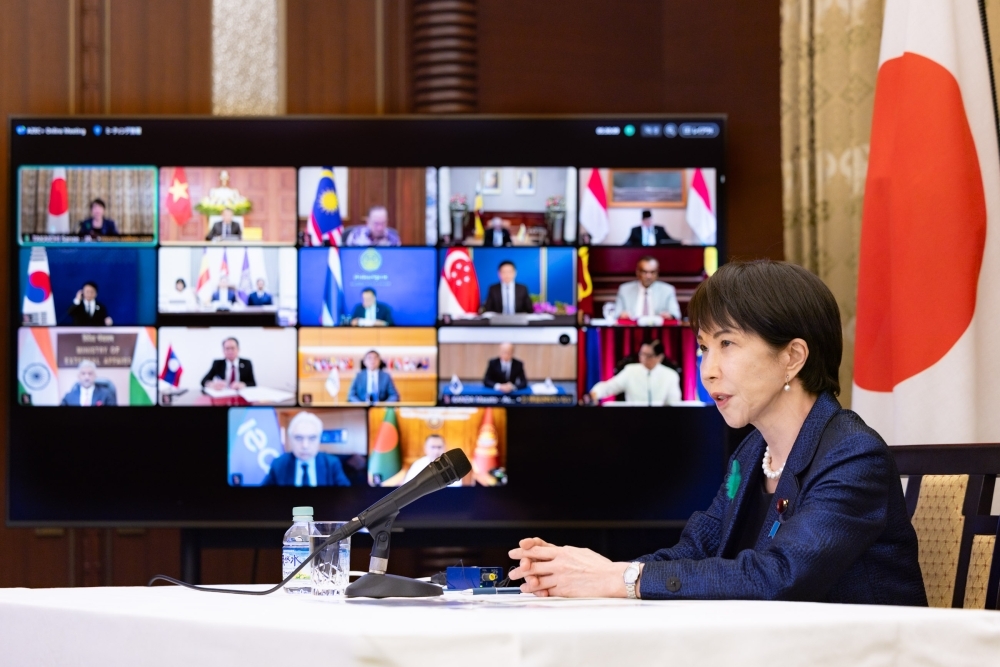
On the energy front, Japan introduced the Partnership on Wide Energy and Resources Resilience (POWERR) Asia initiative at the Asia Zero Emission Community (AZEC) Plus Summit on Energy Resilience, held virtually in April, two weeks before Takaichi’s official visit to Vietnam. This involves a US$10 billion support package that addresses both immediate and long-term regional energy challenges: in the near term, it supports fuel procurement and supply chain continuity, while over the longer term it aims to strengthen stockpiling capacities and diversify energy sources. POWERR Asia is intended to complement the upgraded AZEC framework, now known as AZEC 2.0. When Japan launched AZEC in 2023, the initiative focused heavily on charting decarbonisation pathways across the region. AZEC 2.0 marks a shift in emphasis towards a more practical, economically grounded approach to energy transition.
The composition of the AZEC Plus Summit itself reflected the breadth of Japan’s regional ambitions. Leaders from 10 ASEAN member states, along with their counterparts from Australia, Bangladesh and South Korea, attended the high-level virtual meeting, as did representatives from the International Energy Agency (IEA), Asian Development Bank (ADB), and Japan’s Economic Research Institute for ASEAN and East Asia (ERIA) – underscoring Japan’s role as a driving force for multilateral partnerships to tackle the region’s pressing energy challenges.
Japan has also deepened its defence ties across Southeast Asia, with the Philippines and Indonesia standing out as the two most significant partners in this effort. Japan’s relationship with the Philippines has advanced on several fronts. The Japan-Philippines Reciprocal Access Agreement (RAA), which came into force in September 2025, laid the groundwork for the Acquisition and Cross-Servicing Agreement (ACSA) signed in January. Together, the two agreements have progressively expanded the operational and logistical basis for joint military activity. This was most visibly demonstrated at Exercise Balikatan this year, where Japan deployed around 1,400 Self-Defense Force (SDF) personnel as combat participants for the first time, including in live-fire drills. Also, following Japan’s revision of its defence export guidelines in April, both countries have initiated discussions on the transfer of surplus Abukuma-class destroyers to the Philippine Navy. The two countries are poised to launch negotiations on a General Security of Military Information Agreement (GSOMIA), which would facilitate the sharing of classified defence information.
Indonesia too has emerged as a prospective beneficiary of Japan’s loosened defence export restrictions. At a defence ministers’ meeting in Jakarta in May, the two countries signed a defence cooperation agreement covering the development of military personnel, disaster mitigation and defence industry collaboration. Crucially, both sides agreed to explore cooperation on defence equipment and technology with a view to enhancing maritime deterrence, opening the door to future Japanese arms transfers. The agreement also established an Integrated Defence Dialogue Mechanism to institutionalise bilateral exchanges between senior defence officials and operational-level engagements between the SDF and Indonesia’s armed forces.
Across both relationships, the pattern is consistent: Japan is steadily converting diplomatic goodwill into concrete defence commitments, underpinning these partnerships with a growing web of bilateral agreements, joint exercises, and an expanding role as a defence equipment supplier to the region.
Navigating Key Tensions
Japan’s efforts to strengthen pragmatic cooperation with Southeast Asia are noteworthy, but sustaining this momentum will require careful management of several tensions.
The first is the issue of capacity. Japan has to ensure it has sufficient diplomatic, economic and military resources to honour its commitments across multiple fronts simultaneously. Overextension risks undermining the quality and consistency of its regional engagements. With Japan’s hard-won regional reputation at stake, Takaichi’s administration will also need to maintain domestic political will and public support for an ambitious agenda. Should Tokyo be perceived as offering rhetoric without substance, it risks eroding the goodwill it has spent decades cultivating in the region.
The second tension concerns the pace and framing of security cooperation. Japan’s expanding defence footprint may unsettle some Southeast Asian countries that retain a heightened sensitivity to what they perceive as increasing militarisation in the region. Japan will need to approach defence cooperation incrementally and clearly communicate its rationale. This challenge is compounded by the fact that many countries in the region maintain close economic ties with China and are careful not to be seen as drifting too close to Japan, particularly given its formal alliance with the United States and the current state of strained Sino-Japanese relations.
Finally, the US factor looms over Japan’s regional agenda. As a formal ally of Washington, Tokyo is exposed to the risk that shifts in US policy could constrain or complicate Japan’s own regional calculus. Striking the right balance between alliance commitments and an independent regional agenda will be essential if Japan is to be seen as a reliable and consistent partner in Southeast Asia.
Conclusion
Japan’s recent engagements across Southeast Asia reflect a clear resolve to deepen its role in the regional architecture and to work in concert with partner countries in advancing shared interests. The challenge ahead lies in sustaining this momentum by deploying its diplomatic and economic tools effectively to ensure that Japan’s commitments continue to translate into positive, tangible outcomes for the region.
Sarah Soh is an Associate Research Fellow in the Regional Security Architecture Programme at the Institute of Defence and Strategic Studies (IDSS), S Rajaratnam School of International Studies (RSIS).
KEY TAKEAWAYS
• Japan has deepened its engagement with Southeast Asia, concluding wide-ranging agreements across the energy, security and defence sectors in the first half of 2026 alone.
• Because Japan is widely seen as a reliable regional partner, its proactive approach is likely to resonate well with countries in the region.
• Nevertheless, Japan will have to navigate several tensions to ensure that its commitments translate into tangible outcomes – among them, maintaining sufficient capacity, managing the pace and framing of security cooperation, and reconciling its alliance obligations with an independent regional agenda.
COMMENTARY
The first half of 2026 has seen Japan emerge as one of Southeast Asia’s most active and consequential partners. Tokyo’s engagements have been notable not only for their breadth – spanning the economic security, energy, and defence sectors – but also for their practical import. This push comes against a backdrop of growing regional anxieties: heightened great power competition, perceived US disengagement, and mounting global economic volatility.
As countries in Southeast Asia seek partners committed to a stable and prosperous regional order, Japan’s standing as a dependable regional partner means its active outreach is likely to be well received. For Southeast Asian countries wary of being forced to choose between Washington and Beijing, Tokyo offers an attractive proposition: meaningful cooperation without the weight of great power politics. The central question now is whether Japan can match ambition with delivery.
Southeast Asia Takes Centre Stage
Japan has placed regional economic security at the heart of its refreshed Free and Open Indo-Pacific (FOIP) strategy. Japanese Prime Minister Sanae Takaichi opted to unveil the updated framework in an address at Vietnam National University during her state visit to Vietnam in early May, signalling Southeast Asia’s importance to Tokyo’s regional vision. The 2026 iteration of FOIP represented a more substantive shift than the 2023 revision, reflecting Japan’s resolve to respond to an increasingly urgent strategic environment through concrete mechanisms. Central to the updated framework is an emphasis on building regional “resilience”: strengthening energy and critical materials supply chains and advancing artificial intelligence and digital communications infrastructure in close cooperation with partner countries. While rooted in Japan’s own strategic imperatives, these priorities speak directly to the practical pressures facing Southeast Asian countries – chief among them the supply chain disruptions stemming from the ongoing Middle East crisis and the accelerating pace of technological change.
In the same address, Takaichi drew an explicit connection between secure sea lanes, freedom of navigation and supply chain resilience. Pointing to Japan’s existing maritime capacity-building contributions in Southeast Asia under the Official Security Assistance (OSA) programme, she pledged to expand its scope to better safeguard the region’s sea lanes and supply chains. As a whole, these commitments signal Japan’s intent to anchor its regional partnerships in tangible, security-driven economic cooperation.
On the energy front, Japan introduced the Partnership on Wide Energy and Resources Resilience (POWERR) Asia initiative at the Asia Zero Emission Community (AZEC) Plus Summit on Energy Resilience, held virtually in April, two weeks before Takaichi’s official visit to Vietnam. This involves a US$10 billion support package that addresses both immediate and long-term regional energy challenges: in the near term, it supports fuel procurement and supply chain continuity, while over the longer term it aims to strengthen stockpiling capacities and diversify energy sources. POWERR Asia is intended to complement the upgraded AZEC framework, now known as AZEC 2.0. When Japan launched AZEC in 2023, the initiative focused heavily on charting decarbonisation pathways across the region. AZEC 2.0 marks a shift in emphasis towards a more practical, economically grounded approach to energy transition.
The composition of the AZEC Plus Summit itself reflected the breadth of Japan’s regional ambitions. Leaders from 10 ASEAN member states, along with their counterparts from Australia, Bangladesh and South Korea, attended the high-level virtual meeting, as did representatives from the International Energy Agency (IEA), Asian Development Bank (ADB), and Japan’s Economic Research Institute for ASEAN and East Asia (ERIA) – underscoring Japan’s role as a driving force for multilateral partnerships to tackle the region’s pressing energy challenges.
Japan has also deepened its defence ties across Southeast Asia, with the Philippines and Indonesia standing out as the two most significant partners in this effort. Japan’s relationship with the Philippines has advanced on several fronts. The Japan-Philippines Reciprocal Access Agreement (RAA), which came into force in September 2025, laid the groundwork for the Acquisition and Cross-Servicing Agreement (ACSA) signed in January. Together, the two agreements have progressively expanded the operational and logistical basis for joint military activity. This was most visibly demonstrated at Exercise Balikatan this year, where Japan deployed around 1,400 Self-Defense Force (SDF) personnel as combat participants for the first time, including in live-fire drills. Also, following Japan’s revision of its defence export guidelines in April, both countries have initiated discussions on the transfer of surplus Abukuma-class destroyers to the Philippine Navy. The two countries are poised to launch negotiations on a General Security of Military Information Agreement (GSOMIA), which would facilitate the sharing of classified defence information.
Indonesia too has emerged as a prospective beneficiary of Japan’s loosened defence export restrictions. At a defence ministers’ meeting in Jakarta in May, the two countries signed a defence cooperation agreement covering the development of military personnel, disaster mitigation and defence industry collaboration. Crucially, both sides agreed to explore cooperation on defence equipment and technology with a view to enhancing maritime deterrence, opening the door to future Japanese arms transfers. The agreement also established an Integrated Defence Dialogue Mechanism to institutionalise bilateral exchanges between senior defence officials and operational-level engagements between the SDF and Indonesia’s armed forces.
Across both relationships, the pattern is consistent: Japan is steadily converting diplomatic goodwill into concrete defence commitments, underpinning these partnerships with a growing web of bilateral agreements, joint exercises, and an expanding role as a defence equipment supplier to the region.
Navigating Key Tensions
Japan’s efforts to strengthen pragmatic cooperation with Southeast Asia are noteworthy, but sustaining this momentum will require careful management of several tensions.
The first is the issue of capacity. Japan has to ensure it has sufficient diplomatic, economic and military resources to honour its commitments across multiple fronts simultaneously. Overextension risks undermining the quality and consistency of its regional engagements. With Japan’s hard-won regional reputation at stake, Takaichi’s administration will also need to maintain domestic political will and public support for an ambitious agenda. Should Tokyo be perceived as offering rhetoric without substance, it risks eroding the goodwill it has spent decades cultivating in the region.
The second tension concerns the pace and framing of security cooperation. Japan’s expanding defence footprint may unsettle some Southeast Asian countries that retain a heightened sensitivity to what they perceive as increasing militarisation in the region. Japan will need to approach defence cooperation incrementally and clearly communicate its rationale. This challenge is compounded by the fact that many countries in the region maintain close economic ties with China and are careful not to be seen as drifting too close to Japan, particularly given its formal alliance with the United States and the current state of strained Sino-Japanese relations.
Finally, the US factor looms over Japan’s regional agenda. As a formal ally of Washington, Tokyo is exposed to the risk that shifts in US policy could constrain or complicate Japan’s own regional calculus. Striking the right balance between alliance commitments and an independent regional agenda will be essential if Japan is to be seen as a reliable and consistent partner in Southeast Asia.
Conclusion
Japan’s recent engagements across Southeast Asia reflect a clear resolve to deepen its role in the regional architecture and to work in concert with partner countries in advancing shared interests. The challenge ahead lies in sustaining this momentum by deploying its diplomatic and economic tools effectively to ensure that Japan’s commitments continue to translate into positive, tangible outcomes for the region.
Sarah Soh is an Associate Research Fellow in the Regional Security Architecture Programme at the Institute of Defence and Strategic Studies (IDSS), S Rajaratnam School of International Studies (RSIS).