


11 June 2026
IP26072 | US-Indonesia Major Defence Cooperation Partnership on Autonomous Military Systems

KEY TAKEAWAYS
• The recently unveiled Major Defence Cooperation Partnership (MDCP) between the United States and Indonesia is not a strategic alignment pact; rather, it is a capability-building framework.
• The MDCP is likely to focus on autonomous military systems owing to a combination of geostrategic recalibration, lesson-learnt from the ongoing war in Ukraine, defence technology liberalisation and growing Indonesian industrial readiness.
• Whether the bilateral defence initiative succeeds will depend on the extent to which US industry is willing to share military technologies, Indonesia’s capacity to absorb foreign know-how, and the political space between Jakarta’s need for deeper cooperation with the United States and Indonesia’s strategic autonomy imperative.
COMMENTARY
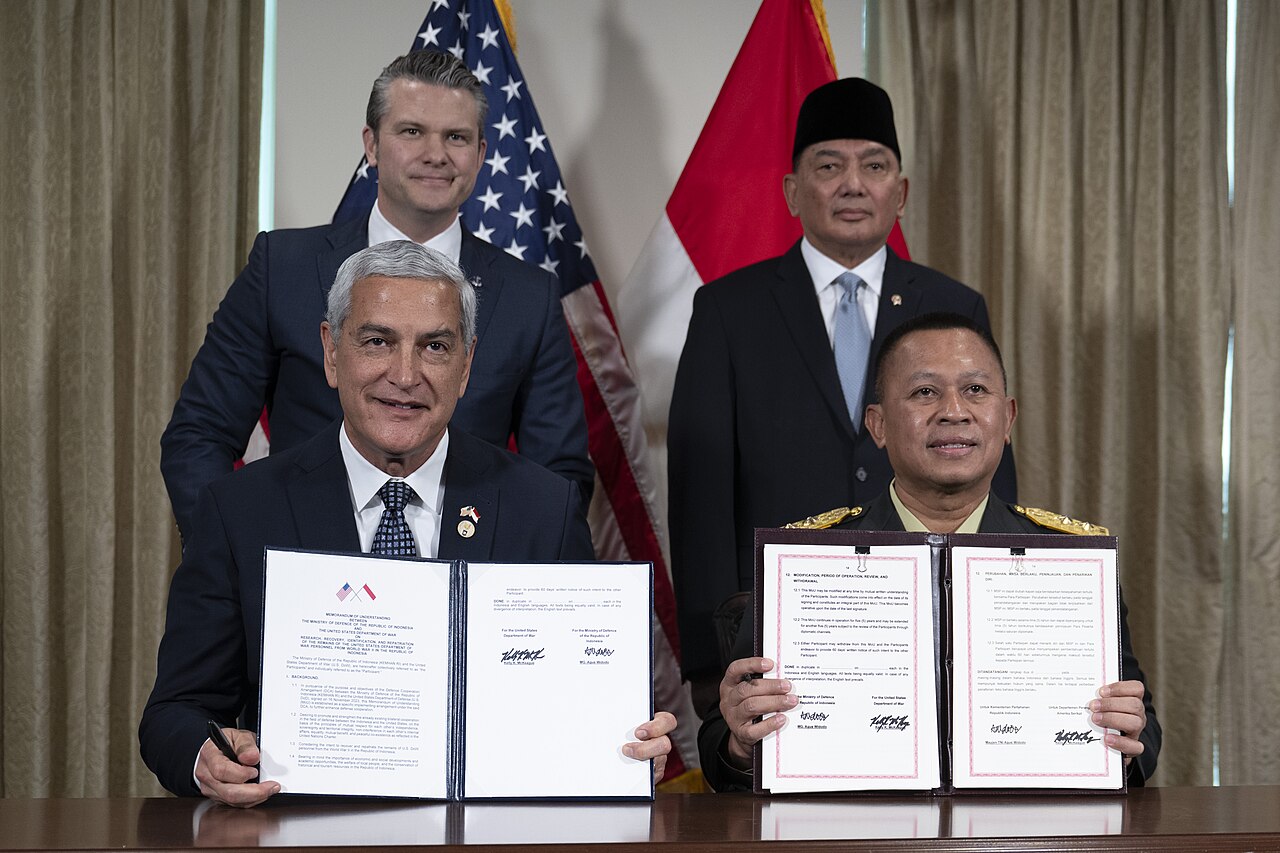
The 13 April joint statement between the US secretary of war and Indonesian defence minister announcing the establishment of their Major Defence Cooperation Partnership (MDCP) is brief and – it seems – deliberately ambiguous. The substance of the MDCP, as announced, is organised around three foundational pillars – military modernisation and capacity-building; professional military education and training; and exercises and operational cooperation.
Among “cutting-edge” initiatives that the two countries will consider co-developing are “sophisticated asymmetric capabilities pioneering next-generation defence technologies in the maritime, subsurface and autonomous systems domains”. This paper argues that autonomous systems will emerge as the central focus of the MDCP. This judgement rests less on the wording of the framework’s announcement than on the direction that US capability and industrial incentives are now pointing towards.
Forces Shaping the MDCP
The key driver behind the MDCP appears to be the United States’ strategic recalibration in the Indo-Pacific. President Donald Trump’s second administration expects US allies and partners to take primary responsibility for defending their own territories and near-seas while US forces concentrate on deterring China. A more capable Indonesia therefore eases the load on American resources, making the MDCP useful to Washington.
Jakarta, for its part, has had a shift in its thinking – from strategic ambiguity towards more practical security cooperation with a major power. China’s low-intensity but persistent maritime incursions are outpacing Jakarta’s capability development in the Indonesia-claimed North Natuna Sea. That gap creates a demand for affordable, sustainable maritime patrol capabilities without raising the risk of escalation. In this respect, if autonomous systems are the focus of the MDCP, as this paper argues, then the partnership neatly fits Jakarta’s operational requirements.
A key factor that suggests autonomous technology will be the focus of the MDCP is the US Department of War’s assessment that low-cost autonomous systems could help the US military counter China’s military advantage in numbers. This assessment was based on a lesson drawn from the ongoing Ukraine-Russia conflict, in which Ukraine has been able to use large numbers of “low-cost attritable systems” to counter Russia’s military might. The US government has since developed the Replicator and Collaborative Combat Aircraft programmes, which have produced classes of loitering munitions, unmanned surface vessels and uncrewed underwater vehicles. The Pentagon’s turn towards autonomous weapons to fight asymmetric wars underpins this paper’s assessment that maritime, subsurface and autonomous systems will be the focus of the MDCP. For Washington, a partnership with Indonesia is doubly attractive: it eases the burden on US forces in the Indo-Pacific, while opening an additional market for an industrial base that needs scale to stay viable.
Combined with the maturing of the United States’ autonomous technology is the loosening of US defence-export rules. The Missile Technology Control Regime (MTCR), an informal political understanding among 35 countries to limit the export of missiles and missile technology, traditionally placed large uncrewed aerial systems in the same category as the rocket systems used to deliver weapons of mass destruction and subjected them to a “strong presumption of denial” for export. In 2025, Washington changed that policy so that advanced US drones are now reviewed for export much like manned combat aircraft. This regulatory change creates an export opportunity for uncrewed military systems that prospective buyers – such as Indonesia – can exploit through the MDCP.
Indonesia’s growing capacity to absorb foreign technology may be another factor in the US decision to partner with it in developing autonomous technologies. While producing high-end weapons systems – such as jet fighters and submarines – may be a challenge, Indonesian strategic industries have arguably reached the point where they can co-develop and co-produce uncrewed platforms. Recent achievements include domestic assembly of six Turkish Anka-S drones and a planned local manufacturing facility for Bayraktar unmanned aircraft.
Two milestones stand out. PT Dirgantara Indonesia (PT DI) conducted a test flight of the Black Eagle drone in July 2025, making Indonesia the only Southeast Asian country with an indigenous medium-altitude, long-endurance drone programme. Three months later, PT PAL demonstrated the KSOT-008 autonomous submarine, placing Indonesia among the handful of states with extra-large uncrewed underwater vessels. Both examples showcase an industry that can increasingly absorb foreign technologies, not just import finished weapons systems.
Issues Determining the Success of the MDCP
Indonesia’s favoured way of defence industrial capability-building has been the joint venture. An example in this respect is the Republikorp-Baykar collaboration for producing Turkish drones. It is the likely model for how the MDCP could be implemented. This approach lets Jakarta pursue its long-standing preference for self-reliance while taking advantage of opportunities created by great power competition. In practice, it is a buyer playing off competing suppliers against one another to secure the best co-production and technology-transfer terms.
Nonetheless, three key issues will determine whether the MDCP leads to real Indonesian capability in the uncrewed and autonomous domains.
The first is how far American defence firms are willing to share technology. Licensed assembly work only leaves Jakarta dependent on US technology, whereas the transfer of genuine design and system integration know-how could result in Indonesian capability uplift. The reference in the MDCP joint statement to co-development will mean little until US technology-release rules – the Export Administration Regulations, International Traffic in Arms Regulations, and the Countering America’s Adversaries Through Sanctions Act – are applied to specific transfers.
The observable indicators in this regard could include: first, the Department of War’s budget request for Indonesia-related foreign military financing; second, any Department of State arms-transfer notification involving uncrewed platforms destined for Jakarta; and third, announcements relating to US-Indonesian industrial partnerships.
The second issue is the extent to which the Indonesian defence industry can absorb American technology. Indonesia can build airframes and hulls and is moving into systems integration, but it remains weak in propulsion, sensors and autonomy software.
Whether local arms manufacturers can absorb transferred technology – rather than just bolt it on – depends on Indonesia’s ability to address two fundamental problems. First, Indonesia’s defence budget is still modest, at roughly 0.8% of GDP. Second, arms purchases have been undertaken in a retail approach – buying small batches of equipment from multiple suppliers, leaving a mix of incompatible hardware that is hard to integrate and maintain.
The third issue is the political space within which the Prabowo administration can deepen its partnership with the United States without conceding Indonesia’s strategic autonomy. The official text of the MDCP announcement twice invokes the phrase “mutual respect and national sovereignty” – the kind of rhetoric that Jakarta consistently uses to fend off charges of alignment. Deeper cooperation with Washington must not be seen as choosing a side, whether domestically or in Beijing. The Prabowo administration has space to work with the United States precisely because the MDCP is confined to capabilities that do not look like coalition-building. Push beyond that, and the political cost rises sharply.
A Caveat
In sum, the MDCP allows a bilateral tethering. While the United States draws the Indonesian military into deeper interoperability without antagonising China, Indonesia can retain its bebas aktif or strategic autonomy and extract defence capabilities without the cost of alignment.
However, the biggest risk is an implementation gap. The bilateral defence initiative lists no specific platforms, no delivery timelines and no financial commitment. This comes down to one question: will concrete programmes and funding emerge from its official announcement?
What happens in the next 18 months will be the litmus test of whether Washington and Jakarta can turn the MDCP joint statement into operational terms. Otherwise, it risks becoming a diplomatic artefact – a high-profile announcement with limited follow-through.
And everyone should take note that Beijing is keenly watching from the horizon.
Iis Gindarsah is a Research Fellow with the Indonesia Programme at the Institute of Defence and Strategic Studies (IDSS), S. Rajaratnam School of International Studies (RSIS).
KEY TAKEAWAYS
• The recently unveiled Major Defence Cooperation Partnership (MDCP) between the United States and Indonesia is not a strategic alignment pact; rather, it is a capability-building framework.
• The MDCP is likely to focus on autonomous military systems owing to a combination of geostrategic recalibration, lesson-learnt from the ongoing war in Ukraine, defence technology liberalisation and growing Indonesian industrial readiness.
• Whether the bilateral defence initiative succeeds will depend on the extent to which US industry is willing to share military technologies, Indonesia’s capacity to absorb foreign know-how, and the political space between Jakarta’s need for deeper cooperation with the United States and Indonesia’s strategic autonomy imperative.
COMMENTARY
The 13 April joint statement between the US secretary of war and Indonesian defence minister announcing the establishment of their Major Defence Cooperation Partnership (MDCP) is brief and – it seems – deliberately ambiguous. The substance of the MDCP, as announced, is organised around three foundational pillars – military modernisation and capacity-building; professional military education and training; and exercises and operational cooperation.
Among “cutting-edge” initiatives that the two countries will consider co-developing are “sophisticated asymmetric capabilities pioneering next-generation defence technologies in the maritime, subsurface and autonomous systems domains”. This paper argues that autonomous systems will emerge as the central focus of the MDCP. This judgement rests less on the wording of the framework’s announcement than on the direction that US capability and industrial incentives are now pointing towards.
Forces Shaping the MDCP
The key driver behind the MDCP appears to be the United States’ strategic recalibration in the Indo-Pacific. President Donald Trump’s second administration expects US allies and partners to take primary responsibility for defending their own territories and near-seas while US forces concentrate on deterring China. A more capable Indonesia therefore eases the load on American resources, making the MDCP useful to Washington.
Jakarta, for its part, has had a shift in its thinking – from strategic ambiguity towards more practical security cooperation with a major power. China’s low-intensity but persistent maritime incursions are outpacing Jakarta’s capability development in the Indonesia-claimed North Natuna Sea. That gap creates a demand for affordable, sustainable maritime patrol capabilities without raising the risk of escalation. In this respect, if autonomous systems are the focus of the MDCP, as this paper argues, then the partnership neatly fits Jakarta’s operational requirements.
A key factor that suggests autonomous technology will be the focus of the MDCP is the US Department of War’s assessment that low-cost autonomous systems could help the US military counter China’s military advantage in numbers. This assessment was based on a lesson drawn from the ongoing Ukraine-Russia conflict, in which Ukraine has been able to use large numbers of “low-cost attritable systems” to counter Russia’s military might. The US government has since developed the Replicator and Collaborative Combat Aircraft programmes, which have produced classes of loitering munitions, unmanned surface vessels and uncrewed underwater vehicles. The Pentagon’s turn towards autonomous weapons to fight asymmetric wars underpins this paper’s assessment that maritime, subsurface and autonomous systems will be the focus of the MDCP. For Washington, a partnership with Indonesia is doubly attractive: it eases the burden on US forces in the Indo-Pacific, while opening an additional market for an industrial base that needs scale to stay viable.
Combined with the maturing of the United States’ autonomous technology is the loosening of US defence-export rules. The Missile Technology Control Regime (MTCR), an informal political understanding among 35 countries to limit the export of missiles and missile technology, traditionally placed large uncrewed aerial systems in the same category as the rocket systems used to deliver weapons of mass destruction and subjected them to a “strong presumption of denial” for export. In 2025, Washington changed that policy so that advanced US drones are now reviewed for export much like manned combat aircraft. This regulatory change creates an export opportunity for uncrewed military systems that prospective buyers – such as Indonesia – can exploit through the MDCP.
Indonesia’s growing capacity to absorb foreign technology may be another factor in the US decision to partner with it in developing autonomous technologies. While producing high-end weapons systems – such as jet fighters and submarines – may be a challenge, Indonesian strategic industries have arguably reached the point where they can co-develop and co-produce uncrewed platforms. Recent achievements include domestic assembly of six Turkish Anka-S drones and a planned local manufacturing facility for Bayraktar unmanned aircraft.
Two milestones stand out. PT Dirgantara Indonesia (PT DI) conducted a test flight of the Black Eagle drone in July 2025, making Indonesia the only Southeast Asian country with an indigenous medium-altitude, long-endurance drone programme. Three months later, PT PAL demonstrated the KSOT-008 autonomous submarine, placing Indonesia among the handful of states with extra-large uncrewed underwater vessels. Both examples showcase an industry that can increasingly absorb foreign technologies, not just import finished weapons systems.
Issues Determining the Success of the MDCP
Indonesia’s favoured way of defence industrial capability-building has been the joint venture. An example in this respect is the Republikorp-Baykar collaboration for producing Turkish drones. It is the likely model for how the MDCP could be implemented. This approach lets Jakarta pursue its long-standing preference for self-reliance while taking advantage of opportunities created by great power competition. In practice, it is a buyer playing off competing suppliers against one another to secure the best co-production and technology-transfer terms.
Nonetheless, three key issues will determine whether the MDCP leads to real Indonesian capability in the uncrewed and autonomous domains.
The first is how far American defence firms are willing to share technology. Licensed assembly work only leaves Jakarta dependent on US technology, whereas the transfer of genuine design and system integration know-how could result in Indonesian capability uplift. The reference in the MDCP joint statement to co-development will mean little until US technology-release rules – the Export Administration Regulations, International Traffic in Arms Regulations, and the Countering America’s Adversaries Through Sanctions Act – are applied to specific transfers.
The observable indicators in this regard could include: first, the Department of War’s budget request for Indonesia-related foreign military financing; second, any Department of State arms-transfer notification involving uncrewed platforms destined for Jakarta; and third, announcements relating to US-Indonesian industrial partnerships.
The second issue is the extent to which the Indonesian defence industry can absorb American technology. Indonesia can build airframes and hulls and is moving into systems integration, but it remains weak in propulsion, sensors and autonomy software.
Whether local arms manufacturers can absorb transferred technology – rather than just bolt it on – depends on Indonesia’s ability to address two fundamental problems. First, Indonesia’s defence budget is still modest, at roughly 0.8% of GDP. Second, arms purchases have been undertaken in a retail approach – buying small batches of equipment from multiple suppliers, leaving a mix of incompatible hardware that is hard to integrate and maintain.
The third issue is the political space within which the Prabowo administration can deepen its partnership with the United States without conceding Indonesia’s strategic autonomy. The official text of the MDCP announcement twice invokes the phrase “mutual respect and national sovereignty” – the kind of rhetoric that Jakarta consistently uses to fend off charges of alignment. Deeper cooperation with Washington must not be seen as choosing a side, whether domestically or in Beijing. The Prabowo administration has space to work with the United States precisely because the MDCP is confined to capabilities that do not look like coalition-building. Push beyond that, and the political cost rises sharply.
A Caveat
In sum, the MDCP allows a bilateral tethering. While the United States draws the Indonesian military into deeper interoperability without antagonising China, Indonesia can retain its bebas aktif or strategic autonomy and extract defence capabilities without the cost of alignment.
However, the biggest risk is an implementation gap. The bilateral defence initiative lists no specific platforms, no delivery timelines and no financial commitment. This comes down to one question: will concrete programmes and funding emerge from its official announcement?
What happens in the next 18 months will be the litmus test of whether Washington and Jakarta can turn the MDCP joint statement into operational terms. Otherwise, it risks becoming a diplomatic artefact – a high-profile announcement with limited follow-through.
And everyone should take note that Beijing is keenly watching from the horizon.
Iis Gindarsah is a Research Fellow with the Indonesia Programme at the Institute of Defence and Strategic Studies (IDSS), S. Rajaratnam School of International Studies (RSIS).