


08 July 2026
IP26078 | After MOU 44: Managing the Thailand-Cambodia Maritime Dispute Through Conciliation

KEY TAKEAWAYS
• UNCLOS compulsory conciliation has created a formal legal track for the Thailand-Cambodia maritime dispute, with its immediate value resting on whether it can help manage the post-MOU 44 governance vacuum in the Overlapping Claims Area (OCA) through practical interim arrangements.
• With Thailand suspending bilateral talks, conciliation will provide a neutral channel for surfacing operational maritime concerns and exploring interim arrangements where direct engagement is politically difficult.
• Resource issues give the dispute strategic weight and political sensitivity, making conciliation useful for keeping energy expectations realistic, managing fisheries-related incidents, and framing safeguards against escalation as neutral measures.
COMMENTARY
Cambodia’s initiation of compulsory conciliation under the United Nations Convention on the Law of the Sea (UNCLOS) has moved the Thailand-Cambodia maritime dispute into a new phase. With both sides appointing conciliators, the process has shifted from notification to the formation of a commission that can examine both the legal boundary dispute and the underlying maritime issues linked to it. The dispute now has a formal legal track, but the larger policy problem remains: how should both sides manage the Overlapping Claims Area (OCA) after Thailand’s termination of Memorandum of Understanding (MOU) 44? The maritime dispute resurfaced during the most serious downturn in bilateral relations in years, following the armed clashes along the land border in 2025 and later the December ceasefire. While the land and maritime files are legally distinct, they are politically connected, and any incident at sea would be read against the recent fighting ashore. The central risk is that confrontation spreads from land to sea before the wider relationship has stabilised.
From MOU 44 to Conciliation
MOU 44, signed by Thailand and Cambodia in 2001 to provide a framework for managing overlapping maritime claims and possible joint energy development in the Gulf of Thailand, ties sovereignty-sensitive delimitation to joint development within a single arrangement. Although it produced little progress over more than two decades and became vulnerable to nationalist criticism in Thailand, it performed a stabilising function by giving both sides an agreed platform for managing the dispute, sustaining dialogue, and keeping interactions within a recognised diplomatic framework. Once Thailand terminated the memorandum, both sides lost the only agreed framework that brought those tracks together.
Compulsory conciliation fills part of that gap, but not by operating like a court or arbitral tribunal. Unlike adjudication or arbitration, conciliation is not confined to drawing a boundary line. A commission can examine the parties’ legal and factual positions, identify the underlying issues linked to the maritime dispute, and recommend terms for an amicable settlement. These could include interim arrangements, incident management, offshore resources, and communication between the relevant agencies. While its recommendations will not bind either government, the process provides a neutral channel for managing the dispute while final delimitation remains unresolved.
Keeping Working-Level Issues on the Table
In participating in conciliation, Thailand has stated that it will halt other bilateral talks with Cambodia while the process is underway. Even so, practical maritime concerns can still be brought into the conciliation process where direct bilateral engagement is politically difficult. Technical and operational inputs from navies, maritime enforcement agencies, fisheries departments, and hydrographic authorities would be without prejudice to either side’s legal claim, while helping the conciliators identify potential flashpoints and the practical safeguards that may be needed while the boundary remains unsettled. This also has a basis within UNCLOS: Articles 74(3) and 83(3) require states, pending final delimitation, to make every effort to enter into provisional arrangements of a practical nature, and to avoid actions that jeopardise or hamper the final agreement. Those obligations remain relevant because conciliation does not itself settle the boundary, and the maritime area remains disputed while the process unfolds.
Managing Maritime Risks Through Conciliation
The most practical starting point for such provisional arrangements is incident prevention. The commission can use the operational concerns surfaced through the conciliation process to identify mechanisms that reduce incident risk near the OCA, including direct clarification channels, temporary encounter protocols, or commission-facilitated procedures for incident management. Such arrangements will reduce ambiguity and constrain unilateral actions when patrols, enforcement actions, or other sensitive activities are detected, thereby lowering the risk that a tactical incident escalates into a sovereignty crisis or a maritime extension of the conflict on land.
Keeping Resource Issues Manageable
The OCA’s potential oil and gas resources give the dispute much of its strategic weight and will likely be central to the conciliation process. Alongside the boundary question, the commission will have to address how resources might be managed in an area where legal claims, economic interests, and domestic politics overlap. This makes conciliation a useful neutral channel for examining resource-governance options, including development after delimitation, joint development pending delimitation, or other agreed arrangements. These options should be treated as long-term governance choices, with economic gains understood as a longer-term possibility. Even under improved conditions, development would require years of technical, financial, and commercial preparation.
The Gulf of Thailand is also a working maritime space where fisheries and coastal livelihoods remain part of the operating environment. Fisheries-related encounters naturally generate more routine contact between state authorities and coastal communities, and detentions or allegations of encroachment can quickly become politically charged when relations are tense. Both sides must therefore focus first on basic incident-management measures: exchanging information on enforcement actions, verifying vessel identities, and creating channels to resolve fishing-vessel incidents before they escalate
The viability of these resource and incident-management measures will depend on how they are politically framed. With domestic sentiments already hardened since the border clashes, even limited cooperation at sea may be construed as weakness or a concession. This is where conciliation has political value: by routing sensitive proposals through a neutral commission, practical measures can be presented less as bilateral trade-offs and more as steps needed to keep the process viable. Framed this way, practical maritime safeguards are easier to defend as neutral measures to prevent escalation, without implying concessions on sovereignty or resources.
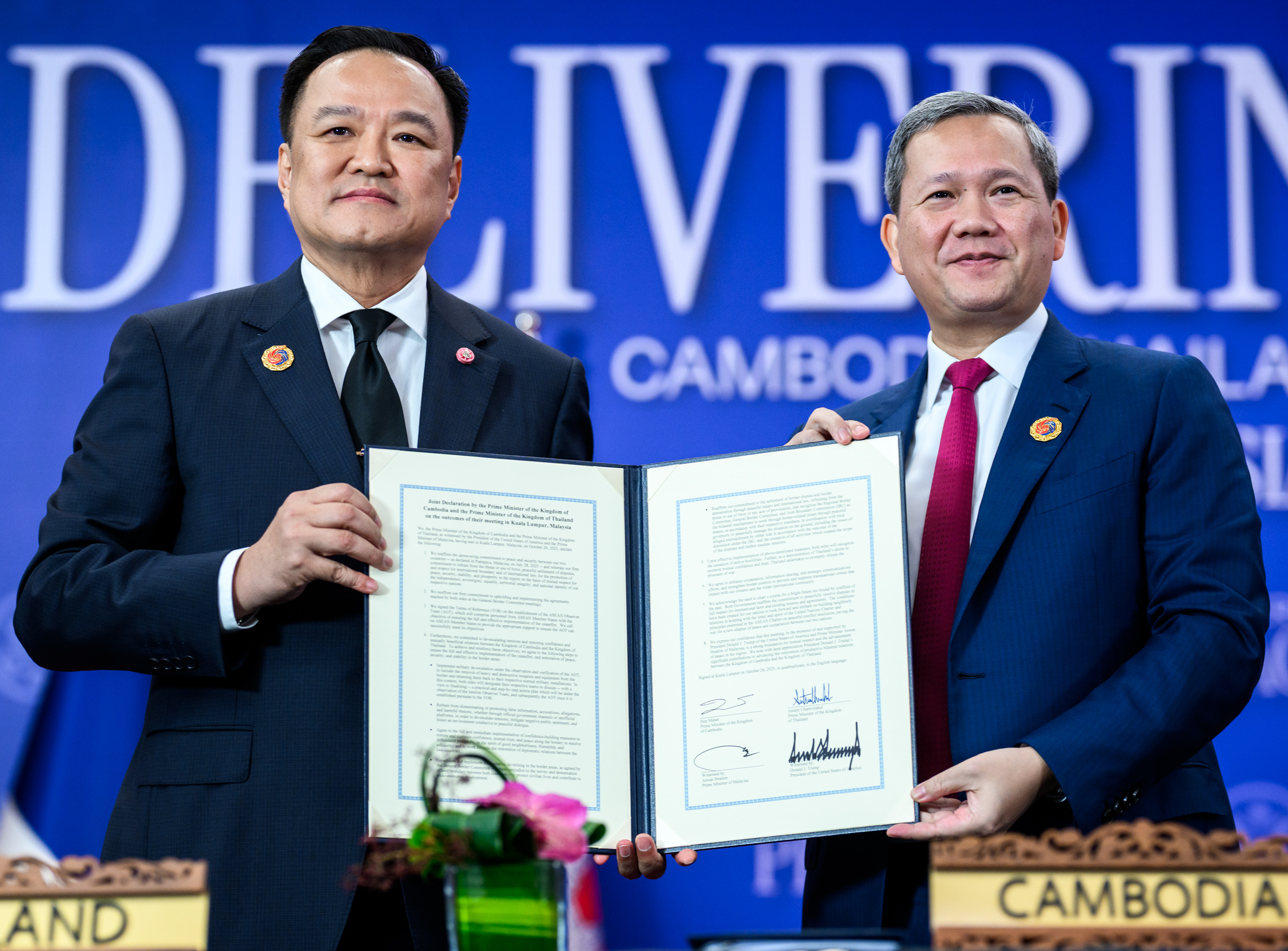
Image source: Wikimedia Commons.
Keeping ASEAN’s Role Practical
As the conciliation process will inevitably be shaped by the wider political climate, ASEAN’s role should remain focused on preserving conditions for restraint. Its more immediate value lies in supporting restraint around the land border where it has already deployed observers, and helping keep the ceasefire on track. This will reduce the risk that tensions ashore shape the maritime process, while preserving the political space needed for conciliation to manage the OCA dispute.
The significance of conciliation lies not only in the possibility of a final boundary settlement, but also in its capacity to keep the dispute manageable while that outcome remains out of reach. The end of MOU 44 has left Thailand and Cambodia without an agreed framework for handling the OCA, even as the land ceasefire remains fragile and political sentiment on both sides has hardened. In this context, the commission will be invaluable in its ability to identify practical interim arrangements, reduce incident risks, and place sensitive proposals within a neutral process that neither side needs to frame as a concession. In this way, conciliation can help prevent maritime tensions from undermining the wider de-escalation effort, while preserving space for a more durable settlement on delimitation and resource development.
Chong De Xian is an Associate Research Fellow in the Maritime Security Programme at the S. Rajaratnam School of International Studies (RSIS).
KEY TAKEAWAYS
• UNCLOS compulsory conciliation has created a formal legal track for the Thailand-Cambodia maritime dispute, with its immediate value resting on whether it can help manage the post-MOU 44 governance vacuum in the Overlapping Claims Area (OCA) through practical interim arrangements.
• With Thailand suspending bilateral talks, conciliation will provide a neutral channel for surfacing operational maritime concerns and exploring interim arrangements where direct engagement is politically difficult.
• Resource issues give the dispute strategic weight and political sensitivity, making conciliation useful for keeping energy expectations realistic, managing fisheries-related incidents, and framing safeguards against escalation as neutral measures.
COMMENTARY
Cambodia’s initiation of compulsory conciliation under the United Nations Convention on the Law of the Sea (UNCLOS) has moved the Thailand-Cambodia maritime dispute into a new phase. With both sides appointing conciliators, the process has shifted from notification to the formation of a commission that can examine both the legal boundary dispute and the underlying maritime issues linked to it. The dispute now has a formal legal track, but the larger policy problem remains: how should both sides manage the Overlapping Claims Area (OCA) after Thailand’s termination of Memorandum of Understanding (MOU) 44? The maritime dispute resurfaced during the most serious downturn in bilateral relations in years, following the armed clashes along the land border in 2025 and later the December ceasefire. While the land and maritime files are legally distinct, they are politically connected, and any incident at sea would be read against the recent fighting ashore. The central risk is that confrontation spreads from land to sea before the wider relationship has stabilised.
From MOU 44 to Conciliation
MOU 44, signed by Thailand and Cambodia in 2001 to provide a framework for managing overlapping maritime claims and possible joint energy development in the Gulf of Thailand, ties sovereignty-sensitive delimitation to joint development within a single arrangement. Although it produced little progress over more than two decades and became vulnerable to nationalist criticism in Thailand, it performed a stabilising function by giving both sides an agreed platform for managing the dispute, sustaining dialogue, and keeping interactions within a recognised diplomatic framework. Once Thailand terminated the memorandum, both sides lost the only agreed framework that brought those tracks together.
Compulsory conciliation fills part of that gap, but not by operating like a court or arbitral tribunal. Unlike adjudication or arbitration, conciliation is not confined to drawing a boundary line. A commission can examine the parties’ legal and factual positions, identify the underlying issues linked to the maritime dispute, and recommend terms for an amicable settlement. These could include interim arrangements, incident management, offshore resources, and communication between the relevant agencies. While its recommendations will not bind either government, the process provides a neutral channel for managing the dispute while final delimitation remains unresolved.
Keeping Working-Level Issues on the Table
In participating in conciliation, Thailand has stated that it will halt other bilateral talks with Cambodia while the process is underway. Even so, practical maritime concerns can still be brought into the conciliation process where direct bilateral engagement is politically difficult. Technical and operational inputs from navies, maritime enforcement agencies, fisheries departments, and hydrographic authorities would be without prejudice to either side’s legal claim, while helping the conciliators identify potential flashpoints and the practical safeguards that may be needed while the boundary remains unsettled. This also has a basis within UNCLOS: Articles 74(3) and 83(3) require states, pending final delimitation, to make every effort to enter into provisional arrangements of a practical nature, and to avoid actions that jeopardise or hamper the final agreement. Those obligations remain relevant because conciliation does not itself settle the boundary, and the maritime area remains disputed while the process unfolds.
Managing Maritime Risks Through Conciliation
The most practical starting point for such provisional arrangements is incident prevention. The commission can use the operational concerns surfaced through the conciliation process to identify mechanisms that reduce incident risk near the OCA, including direct clarification channels, temporary encounter protocols, or commission-facilitated procedures for incident management. Such arrangements will reduce ambiguity and constrain unilateral actions when patrols, enforcement actions, or other sensitive activities are detected, thereby lowering the risk that a tactical incident escalates into a sovereignty crisis or a maritime extension of the conflict on land.
Keeping Resource Issues Manageable
The OCA’s potential oil and gas resources give the dispute much of its strategic weight and will likely be central to the conciliation process. Alongside the boundary question, the commission will have to address how resources might be managed in an area where legal claims, economic interests, and domestic politics overlap. This makes conciliation a useful neutral channel for examining resource-governance options, including development after delimitation, joint development pending delimitation, or other agreed arrangements. These options should be treated as long-term governance choices, with economic gains understood as a longer-term possibility. Even under improved conditions, development would require years of technical, financial, and commercial preparation.
The Gulf of Thailand is also a working maritime space where fisheries and coastal livelihoods remain part of the operating environment. Fisheries-related encounters naturally generate more routine contact between state authorities and coastal communities, and detentions or allegations of encroachment can quickly become politically charged when relations are tense. Both sides must therefore focus first on basic incident-management measures: exchanging information on enforcement actions, verifying vessel identities, and creating channels to resolve fishing-vessel incidents before they escalate
The viability of these resource and incident-management measures will depend on how they are politically framed. With domestic sentiments already hardened since the border clashes, even limited cooperation at sea may be construed as weakness or a concession. This is where conciliation has political value: by routing sensitive proposals through a neutral commission, practical measures can be presented less as bilateral trade-offs and more as steps needed to keep the process viable. Framed this way, practical maritime safeguards are easier to defend as neutral measures to prevent escalation, without implying concessions on sovereignty or resources.
Image source: Wikimedia Commons.
Keeping ASEAN’s Role Practical
As the conciliation process will inevitably be shaped by the wider political climate, ASEAN’s role should remain focused on preserving conditions for restraint. Its more immediate value lies in supporting restraint around the land border where it has already deployed observers, and helping keep the ceasefire on track. This will reduce the risk that tensions ashore shape the maritime process, while preserving the political space needed for conciliation to manage the OCA dispute.
The significance of conciliation lies not only in the possibility of a final boundary settlement, but also in its capacity to keep the dispute manageable while that outcome remains out of reach. The end of MOU 44 has left Thailand and Cambodia without an agreed framework for handling the OCA, even as the land ceasefire remains fragile and political sentiment on both sides has hardened. In this context, the commission will be invaluable in its ability to identify practical interim arrangements, reduce incident risks, and place sensitive proposals within a neutral process that neither side needs to frame as a concession. In this way, conciliation can help prevent maritime tensions from undermining the wider de-escalation effort, while preserving space for a more durable settlement on delimitation and resource development.
Chong De Xian is an Associate Research Fellow in the Maritime Security Programme at the S. Rajaratnam School of International Studies (RSIS).