


10 July 2026
IP26079 | The Iran War and the Defence of the Global Maritime Order

KEY TAKEAWAYS
• The widespread impact of the ongoing wars in Ukraine and Iran suggests that globalisation and interconnectedness remain key features of the global economic system.
• This interconnectedness, however, results in many potential, sometimes hidden, vulnerabilities, all of which may constitute single points of failure for the entire system that discontented states can exploit.
• The mixed outcomes of both the Ukraine and Iran wars may incentivise discontented states, as well as non-state actors, to deploy economic instruments to improve their positions within the international trading system.
COMMENTARY
The rise of competitive great power politics, particularly but not exclusively between the United States, China and Russia, has raised doubts about the future of the rules-based order and the globalised trading system on which it depends. These doubts stem from the growth of protectionist sentiment and an apparently increasing readiness to weaponise the processes of trade. A bleaker, more atomised, world of a few trading blocs in cut-throat competition, both willing and able to exploit the resources of the world’s small outsiders, seems in prospect. The long-term benefits of globalisation, namely the raised living standards around the world that support the political stability necessary for cooperative action against common threats like pandemics and climate change, seem increasingly at risk.
But, perhaps paradoxically, Russia’s invasion of Ukraine or the war between Israel, the United States and Iran do not support such gloomy predictions, though both present clear and substantial challenges. Firstly, neither conflict seems likely to secure the objectives that its instigators anticipated, and they all have had to pay a much higher price in lives, military equipment, economic damage and political costs than they expected. These consequences seem unlikely to incentivise other discontented countries to follow their example. Instead, they may seek to pursue their aims by other less kinetic, and at first sight less damaging, economic means.
Secondly, both wars, but especially the Iran war, have vividly demonstrated just how interconnected the world’s economy actually still is, despite the claimed decay of globalisation. Iran’s closure of the Strait of Hormuz to the shipping that keeps the system going has inflicted extensive damage on the economies of the Gulf states, Asia, Africa, Europe and even the United States itself. The reason for this is simple. Among other commodities, some 20% of the world’s oil (much of it for Asia), fertiliser and diesel for the farmers of Africa, Southeast Asia and South America, liquefied natural gas for Europe, even helium for South Korea’s chip-makers all reach their markets around the world via the strait. As a result, UNCTAD expects a significant slowdown in the growth of the global economy. No one benefits from this and no one can avoid its consequences. The scale and variety of that damage is considerable. Economic interconnectedness has turned a local war into a seismic global event. This demonstrable interconnectedness means it is in everyone’s interest to maintain the basics of the trading system.
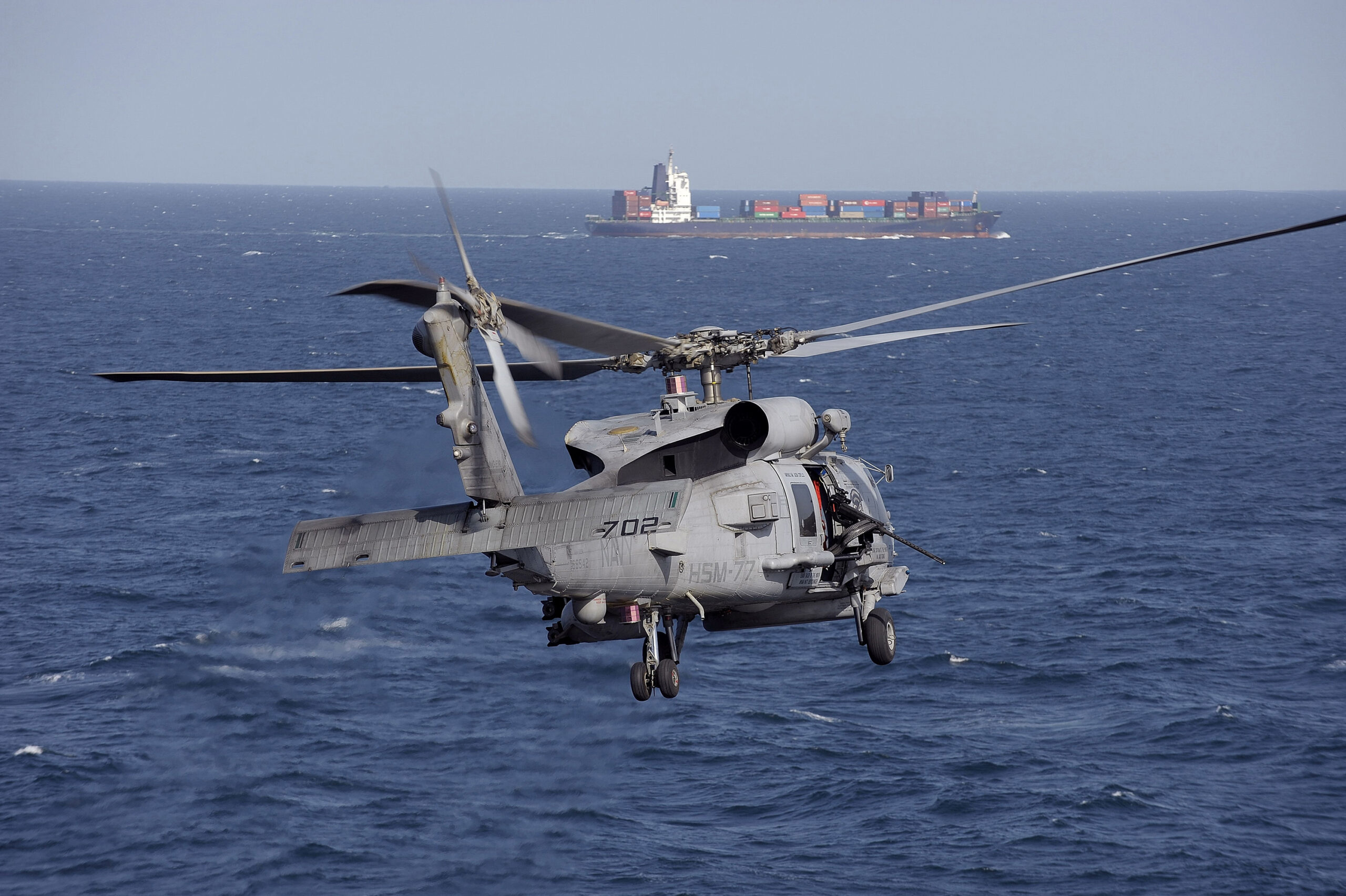
Image source: Wikimedia Commons.
Inherent, but Unexpected, Vulnerabilities of the Global Trading System
However, that global trading system has multiple vulnerabilities, most of them generated by the search for business efficiency. The economic principle of “comparative advantage” outlined 200 years ago by the economist David Ricardo, for example, encourages countries to produce what they are good at and import everything else. This in turn encourages a cost-cutting “just-enough-just-in-time” approach that increases trade dependencies on other countries, advances distributed manufacturing across countries and de-emphasises the maintenance of expensive national stockpiles. The overall effect makes the system efficient but multiplies the vulnerable links between its components. It reduces national resilience and makes everyone more susceptible to supply-chain disruption.
The same commercial approach fosters the development of mega-ships and megaports. Such accidents as one ship getting stuck in the Suez Canal or another colliding with a bridge in Baltimore reveal the extent to which the system comprises a multitude of single points of failure, any of which could have serious consequences. Of course, the complexity and adaptability of the shipping industry allow it to cope, to a greater or lesser extent, and sometimes even prosper from such consequences. Even so, it remains in everyone’s ultimate interest to maintain the laws, regulations and operational protocols that sustain the system, and particularly that of the shipping on which it relies.
This still allows, however, discontented countries and non-state actors like the Houthis of Yemen to seek to improve their position within the global trading system, rather than simply destroy it, by aggressive, but carefully calibrated, manipulation of the market. Iran’s closure of the Strait of Hormuz is an excellent illustration of this, transforming the power relationship between it and the United States. In the longer term, sanctions campaigns such as the American one on Iran or the West’s on Russia, in consequence of its invasion of Ukraine, are intended to have the same coercive effect. And, in the shorter term, so does China’s manipulation of rare earth exports to Japan.
The aim behind this weaponisation of trade is to exert strategic effect on the adversary through economic coercion that nonetheless falls short of seriously endangering the trading system itself, or of taking on the costs, risks and unpredictability of full-scale conflict. Success depends on careful balancing between the inevitably contrasting strategic and commercial approaches to trade. The first is aimed at strategic effect, the second at making money. Economic coercion is usually based on identifying and then exploiting such tensions as the adversary’s weak spots and vulnerabilities; these can often be found in the links, or seams, between the multitude of components in the system, whether these exist as particular trades, countries, geographic settings, sea uses or operational procedures. The interfaces between these elements are usually points of exploitable weakness.
Tugs and Towage – An Unexpected, and Overlooked, Vulnerability
Tugs and towage represent a key element in the maritime infrastructure, and are just one such interface – an overlooked weak link in the system that needs to be defended; indeed, the European Union recently identified them as critical to both its security and prosperity. These vessels are essential for cost-effective port operations in getting big ships out of small spaces. Sea-going tugs are crucial to the rescue of stricken tankers and containerships and often serve strategic purposes as well. However, their low freeboard, small crews and tendency to operate close to land make them susceptible to criminal action; between 2008 and 2023, ReCAAP identified 283 attacks on tugs in Southeast Asia. They are also vulnerable, potentially, to coercive manipulation by hostile forces, whether by physical assault, cyber-attack, sabotage, GPS spoofing or the insidious undermining of a country’s sovereign capacity to operate them strategically.
This is a far more complicated issue than it first appears. For example, in December 2024, when the Russia-linked Eagle S oil tanker was intercepted by the Finnish authorities for suspected damage to the Estlink 2 undersea cable to Estonia, a Finnish tug was requested to stand by as the suspected offender was moved to Finland’s territorial waters. Reportedly, only in retrospect did the tug operator realise that by conforming to an apparent requisitioning order, he was in fact invalidating his war-risk insurance. Because no such possibility had been anticipated, the tug was involved in a potentially hazardous situation, very possibly without insurance.
Hidden Complexities and Vulnerabilities – Why Shadow Fleet Operations Are Enemies of Mankind
This connection between marine insurance and anti-shadow fleet action is just a tiny illustration of the hidden complexities and vulnerabilities in a trading system that comprises myriad constituents and interests, all linked together. Each critical interface provides the unscrupulous with gaps they can exploit. Dealing with these vulnerabilities and sustaining a global order that ultimately is in everyone’s interest, accordingly, demands a whole-of-nation, rather than merely whole-of-government, response that constructively balances all manner of strategic and commercial interests. It involves deciding whether and when shadow fleet operations and tug security should be regarded as security matters for the military or constabulary ones for coastguards and their equivalents – or both.
The same logic applies to the need for international cooperation to prop up a potentially sagging world order. The management of interdependence is a better option than protectionism and the illusory pursuit of economic autarchy. While globalisation will almost certainly survive, its long-term health is more questionable. Given the likelihood that the real operators of the Eagle S will escape serious prosecution and given the importance of keeping the maritime order going, there is much to be said for more robust defence of the free seas, the development of alternative options and greater pressure on the increasing number of those who undermine its protocols. Instead of treating them as mere rule-breakers, or rule-benders, they perhaps should be regarded more like pirates – as hostis humani generis, a legal term for enemies of mankind – and treated accordingly.
Geoffrey Till is Emeritus Professor of Maritime Studies at King’s College, London, and Adviser to the Maritime Security Programme at the S. Rajaratnam School of International Studies (RSIS).
KEY TAKEAWAYS
• The widespread impact of the ongoing wars in Ukraine and Iran suggests that globalisation and interconnectedness remain key features of the global economic system.
• This interconnectedness, however, results in many potential, sometimes hidden, vulnerabilities, all of which may constitute single points of failure for the entire system that discontented states can exploit.
• The mixed outcomes of both the Ukraine and Iran wars may incentivise discontented states, as well as non-state actors, to deploy economic instruments to improve their positions within the international trading system.
COMMENTARY
The rise of competitive great power politics, particularly but not exclusively between the United States, China and Russia, has raised doubts about the future of the rules-based order and the globalised trading system on which it depends. These doubts stem from the growth of protectionist sentiment and an apparently increasing readiness to weaponise the processes of trade. A bleaker, more atomised, world of a few trading blocs in cut-throat competition, both willing and able to exploit the resources of the world’s small outsiders, seems in prospect. The long-term benefits of globalisation, namely the raised living standards around the world that support the political stability necessary for cooperative action against common threats like pandemics and climate change, seem increasingly at risk.
But, perhaps paradoxically, Russia’s invasion of Ukraine or the war between Israel, the United States and Iran do not support such gloomy predictions, though both present clear and substantial challenges. Firstly, neither conflict seems likely to secure the objectives that its instigators anticipated, and they all have had to pay a much higher price in lives, military equipment, economic damage and political costs than they expected. These consequences seem unlikely to incentivise other discontented countries to follow their example. Instead, they may seek to pursue their aims by other less kinetic, and at first sight less damaging, economic means.
Secondly, both wars, but especially the Iran war, have vividly demonstrated just how interconnected the world’s economy actually still is, despite the claimed decay of globalisation. Iran’s closure of the Strait of Hormuz to the shipping that keeps the system going has inflicted extensive damage on the economies of the Gulf states, Asia, Africa, Europe and even the United States itself. The reason for this is simple. Among other commodities, some 20% of the world’s oil (much of it for Asia), fertiliser and diesel for the farmers of Africa, Southeast Asia and South America, liquefied natural gas for Europe, even helium for South Korea’s chip-makers all reach their markets around the world via the strait. As a result, UNCTAD expects a significant slowdown in the growth of the global economy. No one benefits from this and no one can avoid its consequences. The scale and variety of that damage is considerable. Economic interconnectedness has turned a local war into a seismic global event. This demonstrable interconnectedness means it is in everyone’s interest to maintain the basics of the trading system.
Image source: Wikimedia Commons.
Inherent, but Unexpected, Vulnerabilities of the Global Trading System
However, that global trading system has multiple vulnerabilities, most of them generated by the search for business efficiency. The economic principle of “comparative advantage” outlined 200 years ago by the economist David Ricardo, for example, encourages countries to produce what they are good at and import everything else. This in turn encourages a cost-cutting “just-enough-just-in-time” approach that increases trade dependencies on other countries, advances distributed manufacturing across countries and de-emphasises the maintenance of expensive national stockpiles. The overall effect makes the system efficient but multiplies the vulnerable links between its components. It reduces national resilience and makes everyone more susceptible to supply-chain disruption.
The same commercial approach fosters the development of mega-ships and megaports. Such accidents as one ship getting stuck in the Suez Canal or another colliding with a bridge in Baltimore reveal the extent to which the system comprises a multitude of single points of failure, any of which could have serious consequences. Of course, the complexity and adaptability of the shipping industry allow it to cope, to a greater or lesser extent, and sometimes even prosper from such consequences. Even so, it remains in everyone’s ultimate interest to maintain the laws, regulations and operational protocols that sustain the system, and particularly that of the shipping on which it relies.
This still allows, however, discontented countries and non-state actors like the Houthis of Yemen to seek to improve their position within the global trading system, rather than simply destroy it, by aggressive, but carefully calibrated, manipulation of the market. Iran’s closure of the Strait of Hormuz is an excellent illustration of this, transforming the power relationship between it and the United States. In the longer term, sanctions campaigns such as the American one on Iran or the West’s on Russia, in consequence of its invasion of Ukraine, are intended to have the same coercive effect. And, in the shorter term, so does China’s manipulation of rare earth exports to Japan.
The aim behind this weaponisation of trade is to exert strategic effect on the adversary through economic coercion that nonetheless falls short of seriously endangering the trading system itself, or of taking on the costs, risks and unpredictability of full-scale conflict. Success depends on careful balancing between the inevitably contrasting strategic and commercial approaches to trade. The first is aimed at strategic effect, the second at making money. Economic coercion is usually based on identifying and then exploiting such tensions as the adversary’s weak spots and vulnerabilities; these can often be found in the links, or seams, between the multitude of components in the system, whether these exist as particular trades, countries, geographic settings, sea uses or operational procedures. The interfaces between these elements are usually points of exploitable weakness.
Tugs and Towage – An Unexpected, and Overlooked, Vulnerability
Tugs and towage represent a key element in the maritime infrastructure, and are just one such interface – an overlooked weak link in the system that needs to be defended; indeed, the European Union recently identified them as critical to both its security and prosperity. These vessels are essential for cost-effective port operations in getting big ships out of small spaces. Sea-going tugs are crucial to the rescue of stricken tankers and containerships and often serve strategic purposes as well. However, their low freeboard, small crews and tendency to operate close to land make them susceptible to criminal action; between 2008 and 2023, ReCAAP identified 283 attacks on tugs in Southeast Asia. They are also vulnerable, potentially, to coercive manipulation by hostile forces, whether by physical assault, cyber-attack, sabotage, GPS spoofing or the insidious undermining of a country’s sovereign capacity to operate them strategically.
This is a far more complicated issue than it first appears. For example, in December 2024, when the Russia-linked Eagle S oil tanker was intercepted by the Finnish authorities for suspected damage to the Estlink 2 undersea cable to Estonia, a Finnish tug was requested to stand by as the suspected offender was moved to Finland’s territorial waters. Reportedly, only in retrospect did the tug operator realise that by conforming to an apparent requisitioning order, he was in fact invalidating his war-risk insurance. Because no such possibility had been anticipated, the tug was involved in a potentially hazardous situation, very possibly without insurance.
Hidden Complexities and Vulnerabilities – Why Shadow Fleet Operations Are Enemies of Mankind
This connection between marine insurance and anti-shadow fleet action is just a tiny illustration of the hidden complexities and vulnerabilities in a trading system that comprises myriad constituents and interests, all linked together. Each critical interface provides the unscrupulous with gaps they can exploit. Dealing with these vulnerabilities and sustaining a global order that ultimately is in everyone’s interest, accordingly, demands a whole-of-nation, rather than merely whole-of-government, response that constructively balances all manner of strategic and commercial interests. It involves deciding whether and when shadow fleet operations and tug security should be regarded as security matters for the military or constabulary ones for coastguards and their equivalents – or both.
The same logic applies to the need for international cooperation to prop up a potentially sagging world order. The management of interdependence is a better option than protectionism and the illusory pursuit of economic autarchy. While globalisation will almost certainly survive, its long-term health is more questionable. Given the likelihood that the real operators of the Eagle S will escape serious prosecution and given the importance of keeping the maritime order going, there is much to be said for more robust defence of the free seas, the development of alternative options and greater pressure on the increasing number of those who undermine its protocols. Instead of treating them as mere rule-breakers, or rule-benders, they perhaps should be regarded more like pirates – as hostis humani generis, a legal term for enemies of mankind – and treated accordingly.
Geoffrey Till is Emeritus Professor of Maritime Studies at King’s College, London, and Adviser to the Maritime Security Programme at the S. Rajaratnam School of International Studies (RSIS).