


13 July 2026
IP26080 | International Disaster Law: Between Prevention and Response

KEY TAKEAWAYS
• The United Nations General Assembly has committed to finalising a treaty on the Protection of Persons in the Event of Disasters by the end of 2027.
• Stakeholders need to consider laying solid foundations for this emerging body of law, including clear understandings of the disaster management cycle, and how and why disasters occur.
• Emphasis must be placed on the prevention of disasters – effective prevention can only happen once there is acceptance that disasters are shaped by human action – or inaction.
COMMENTARY
Resolution 79/128 of the United Nations General Assembly marked a significant milestone for international disaster law. The decision to move forward with developing a legally binding treaty on the Protection of Persons in the Event of Disasters (PPED) by the end of 2027 has set the stage for the opportunity to not only enhance international cooperation but also to do so in an area that often requires swift collective action. This is a welcome development amid setbacks to the multilateral system, and a major win for those who, for decades, had been advocating for the strengthening of international disaster legal frameworks. The proposed treaty on the PPED is to be based on the International Law Commission’s Draft Articles on the PPED (Draft Articles) adopted in 2016.
International Disaster Law and the Treaty
International disaster law, unlike other areas of public international law such as international refugee or maritime law, is still in a nascent phase. It is an emerging area of law that has clear intersections with other bodies of international law, including environmental law and forced displacement law, as well as human rights and humanitarian law. The boundaries of international disaster law are, however, still evolving as more academic research, state practice and opinions, and humanitarian action and policies emerge. This is not to say that this body of law should not be taken seriously yet. On the contrary, it is during this development phase that international actors can and should carefully consider the foundations on which this body of law is being developed and their implications.
Since work towards finalising the treaty on the PPED began, states have been in negotiation to determine the contours of international cooperation on disasters. Discussions centre on the rights, duties and obligations of states and other relevant actors. Several prominent issues have emerged that acutely reflect state priorities and interests. Unsurprisingly, issues of sovereignty and non-interference have received overwhelming attention. States have not only emphasised the right of an affected state to request and consent to external assistance but have also made clear that, having received such requests, states must not be obliged to assist. States have reasoned that consideration should be given to the “needs, capabilities and situations of the States involved”. This principle is similarly reflected and enshrined in Article 3(3) of the ASEAN Agreement on Disaster Management and Emergency Response (AADMER) 2005 – the world’s first international legally binding instrument on disasters.
Disaster Risk Reduction – “Natural Disasters” and Prevention
While states have pointed to the importance of “disaster risk reduction, risk management, prevention and preparation”, there is a need for more emphasis and nuanced discussions on the matter. In particular, a clear understanding of the stages within the disaster management cycle must be reflected in the law, alongside long-term commitments to prevent and mitigate disasters. In order to do so, stakeholders must first understand that the term “natural disaster” is a misnomer and define the term “disaster” accordingly. Disasters involving natural hazards occur only when such natural events intersect with exposure and vulnerability that are shaped by human action or inaction. Understanding and accepting the realities of how and why disasters occur will then give true meaning to Articles 9 and 10 of the Draft Articles that set out the duties of states to reduce disaster risks and the primary role of the state in protecting persons.
Furthermore, preventing and mitigating disasters not only fulfil states’ obligation and duty to protect; emphasis on this pre-disaster phase contributes to precedence in the practice of international law, demonstrating that the prevention of harm is just as consequential as accountability for and recovery from it. Legal and humanitarian scholars and practitioners who work on genocide, for instance, frequently lament the insufficient attention, emphasis and action given to the prevention of the crime. The situation is similar to the implementation of Common Article 1 of the Geneva Conventions, which calls on states to “undertake to respect and to ensure respect” for the Geneva Conventions. Reinforcing the commitment to disaster risk reduction would moreover further enhance the scope of cooperation between states beyond the relief phase. Positive and consistent engagement between states is a welcome move in a world that now faces serious challenges to multilateralism.
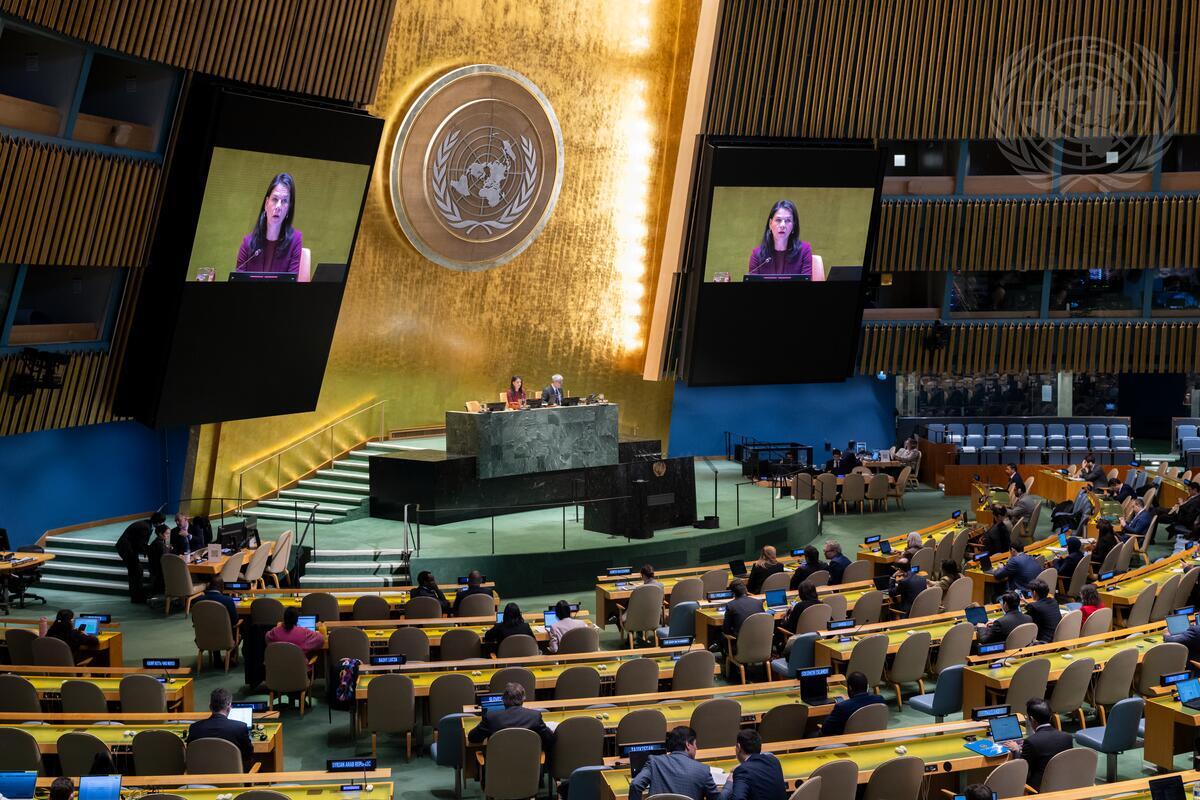
Image credit: UN Photo/Manuel Elías.
As the adage goes, “prevention is better than cure”. Crafting laws on well-conceived foundations serves the purpose of international law in promoting peace and order by paving the way for states to fulfil their obligations to protect. Such protection is always best achieved by preventing harm and suffering in the first place rather than trying to alleviate them.
Junli Lim is a Research Fellow with the Humanitarian and Disaster Relief Programme, Institute of Defence and Strategic Studies (IDSS), S. Rajaratnam School of International Studies (RSIS).
KEY TAKEAWAYS
• The United Nations General Assembly has committed to finalising a treaty on the Protection of Persons in the Event of Disasters by the end of 2027.
• Stakeholders need to consider laying solid foundations for this emerging body of law, including clear understandings of the disaster management cycle, and how and why disasters occur.
• Emphasis must be placed on the prevention of disasters – effective prevention can only happen once there is acceptance that disasters are shaped by human action – or inaction.
COMMENTARY
Resolution 79/128 of the United Nations General Assembly marked a significant milestone for international disaster law. The decision to move forward with developing a legally binding treaty on the Protection of Persons in the Event of Disasters (PPED) by the end of 2027 has set the stage for the opportunity to not only enhance international cooperation but also to do so in an area that often requires swift collective action. This is a welcome development amid setbacks to the multilateral system, and a major win for those who, for decades, had been advocating for the strengthening of international disaster legal frameworks. The proposed treaty on the PPED is to be based on the International Law Commission’s Draft Articles on the PPED (Draft Articles) adopted in 2016.
International Disaster Law and the Treaty
International disaster law, unlike other areas of public international law such as international refugee or maritime law, is still in a nascent phase. It is an emerging area of law that has clear intersections with other bodies of international law, including environmental law and forced displacement law, as well as human rights and humanitarian law. The boundaries of international disaster law are, however, still evolving as more academic research, state practice and opinions, and humanitarian action and policies emerge. This is not to say that this body of law should not be taken seriously yet. On the contrary, it is during this development phase that international actors can and should carefully consider the foundations on which this body of law is being developed and their implications.
Since work towards finalising the treaty on the PPED began, states have been in negotiation to determine the contours of international cooperation on disasters. Discussions centre on the rights, duties and obligations of states and other relevant actors. Several prominent issues have emerged that acutely reflect state priorities and interests. Unsurprisingly, issues of sovereignty and non-interference have received overwhelming attention. States have not only emphasised the right of an affected state to request and consent to external assistance but have also made clear that, having received such requests, states must not be obliged to assist. States have reasoned that consideration should be given to the “needs, capabilities and situations of the States involved”. This principle is similarly reflected and enshrined in Article 3(3) of the ASEAN Agreement on Disaster Management and Emergency Response (AADMER) 2005 – the world’s first international legally binding instrument on disasters.
Disaster Risk Reduction – “Natural Disasters” and Prevention
While states have pointed to the importance of “disaster risk reduction, risk management, prevention and preparation”, there is a need for more emphasis and nuanced discussions on the matter. In particular, a clear understanding of the stages within the disaster management cycle must be reflected in the law, alongside long-term commitments to prevent and mitigate disasters. In order to do so, stakeholders must first understand that the term “natural disaster” is a misnomer and define the term “disaster” accordingly. Disasters involving natural hazards occur only when such natural events intersect with exposure and vulnerability that are shaped by human action or inaction. Understanding and accepting the realities of how and why disasters occur will then give true meaning to Articles 9 and 10 of the Draft Articles that set out the duties of states to reduce disaster risks and the primary role of the state in protecting persons.
Furthermore, preventing and mitigating disasters not only fulfil states’ obligation and duty to protect; emphasis on this pre-disaster phase contributes to precedence in the practice of international law, demonstrating that the prevention of harm is just as consequential as accountability for and recovery from it. Legal and humanitarian scholars and practitioners who work on genocide, for instance, frequently lament the insufficient attention, emphasis and action given to the prevention of the crime. The situation is similar to the implementation of Common Article 1 of the Geneva Conventions, which calls on states to “undertake to respect and to ensure respect” for the Geneva Conventions. Reinforcing the commitment to disaster risk reduction would moreover further enhance the scope of cooperation between states beyond the relief phase. Positive and consistent engagement between states is a welcome move in a world that now faces serious challenges to multilateralism.
Image credit: UN Photo/Manuel Elías.
As the adage goes, “prevention is better than cure”. Crafting laws on well-conceived foundations serves the purpose of international law in promoting peace and order by paving the way for states to fulfil their obligations to protect. Such protection is always best achieved by preventing harm and suffering in the first place rather than trying to alleviate them.
Junli Lim is a Research Fellow with the Humanitarian and Disaster Relief Programme, Institute of Defence and Strategic Studies (IDSS), S. Rajaratnam School of International Studies (RSIS).