


11 March 2026
CO26040 | Before the Nine-Dash Line: France’s Sovereignty Claims in the South China Sea (1930-1956)

SYNOPSIS
As the colonial power in Indochina (1862-1954), France formally asserted sovereignty over the Paracel and Spratly Islands during the 1930s. However, the geopolitical upheavals of the Second World War and the process of decolonisation progressively undermined French ambitions, ultimately leading to its withdrawal from the region. This brief, ambiguous, and contested presence foreshadowed contemporary disputes in the South China Sea.
COMMENTARY
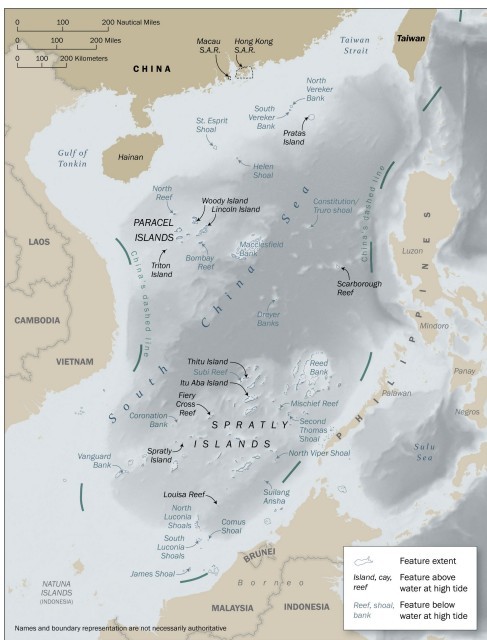
Covering nearly 3.5 million square kilometres, the South China Sea is dotted with a multitude of maritime features – islands, islets, rocks, low-tide elevations, reefs, and cays – that have long attracted competing claims from regional powers. From the early twentieth century onward, Japan, amid imperial expansion, showed growing interest in these strategically located, guano-rich islands. The declining Qing dynasty of China likewise sought to assert its presence in the area to counter Japanese imperialist ambitions. Another actor, already established in the region, would soon turn its attention to these contested waters: France.
French Indochina and the South China Sea
Driven by a triple ambition – religious, commercial, and strategic – France began its conquest of Indochina in 1858 with the siege of Tourane (Da Nang). This led to the gradual colonisation of the entire Indochinese peninsula: Cochinchina became a colony in 1862, the Kingdom of Cambodia a protectorate in 1863, followed by Annam and Tonkin in 1884, the Chinese enclave of Kouang-Tchéou-Wan in 1898, and, finally, Laos in 1899. As for the islands in the South China Sea, they initially attracted little interest from French administrators because of the risks they posed.
The French government of Indochina was primarily concerned about the status of Hainan Island, which could pose a threat if a hostile power controlled it. This is why an agreement was reached in 1897, in which China undertook not to cede Hainan to a third country. The status of the Paracels, which the French Navy regularly visited, was considered marginal. Only Japan’s growing activism in the region prompted French authorities to reconsider the value of these islands. After establishing itself in Taiwan since the Sino-Japanese War of 1894-1895, Tokyo quietly supported private entrepreneurs who invested in the South China Sea islands to exploit guano.
As the pre-World War II geopolitical order in Asia emerged, France openly claimed sovereignty over the Paracel and Spratly Islands from 1930 onwards.
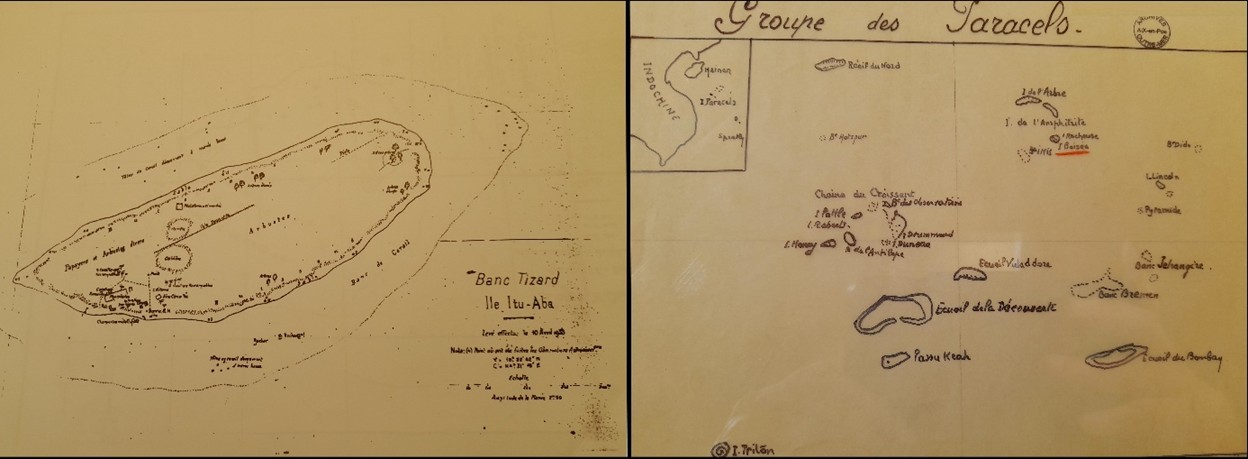
On the left, map of Itu Iba (aka Taiping Island, Spratly islands) in 1933. Source: Archives du ministère de l’Europe et des affaires étrangères, La Courneuve.
On the right, map of the Paracels. Source: Archives nationales d’outre-mer (ANOM) Aix-en-Provence.
The Paracels: A Franco-Annamese Claim
Located 300 kilometres southeast of Hainan Island, the Paracel Islands comprise some 130 maritime features. Known to Annamese and Hainanese fishermen, these islands were never permanently inhabited because they were inhospitable and hazardous to navigation. They initially attracted little attention from the French colonial authorities.
However, by the early twentieth century, amid China’s decline and Japan’s growing assertiveness, French authorities gradually formulated a sovereignty claim over the archipelago. Paris justified its ambitions by invoking the historical rights on behalf of the Annamese Empire. Vietnamese sources predating the colonial period record regular visits to the archipelago by Annamese fishermen and suggest effective administration under Vietnamese Emperor Gia Long from 1816 onwards.
With China refusing to recognise Annamese rights and promoting its own historical narrative, French diplomacy submitted a proposal for international arbitration to the Nationalist government of Chiang Kai-shek in 1937, but the initiative was rejected. Later that year, as Japan began its invasion of mainland China, France dispatched a vessel to the Paracels to formally assert its claim of possession.
A few hundred kilometres further south, in the Spratly Islands, similar dynamics were at play, albeit with some differences in detail.
The Spratlys: A Possession in the Name of France Alone
The Spratly Islands consist of about twenty emergent structures and around a hundred reefs. Located off the main Singapore-Hong Kong route, they attracted even less interest from the French authorities than the Paracels.
Similarly, Paris reconsidered the area in response to the growing Japanese presence. Like other archipelagos in the South China Sea, Japanese entrepreneurs exploited guano, notably on Itu Aba, from the beginning of the 20th century. The French authorities were also concerned that Tokyo would establish a seaplane base. In 1930, a French gunboat officially took possession of Spratly Island, one of the islands in the cluster. The operation was repeated in 1933 on five other islands, triggering a protest from Tokyo.
Unlike the Paracels, this claim was made in the name of France alone, and the Spratlys were administratively attached to Baria in Cochinchina – a colony whose legal status differed from that of Annam (a protectorate). As the archipelago increasingly became a source of tension between Paris and Tokyo, the French government proposed referring the dispute to international arbitration, but Japan had other plans.
Japanese Occupation and French Eviction
In 1939, Japanese forces invaded Hainan, the Paracels, and the Spratlys. As France capitulated in Europe, the situation in Indochina became confused, with the Japanese entering the territory in 1940. Admiral Decoux, the Governor-General of Indochina, loyal to the Vichy government, collaborated with Japanese forces while maintaining minimal autonomy. A surprising manifestation of this ambiguous situation occurred in the Paracels, where Japanese workers and Franco-Annamite soldiers cohabited on Woody Island throughout the war.
At the end of hostilities, with Japan defeated and neutralised, the Sino-French dispute over the Paracels briefly resumed. In 1947, just days apart, Chinese and French forces occupied Woody and Pattle Islands. Ultimately, under the Franco-Vietnamese agreement of 8 March 1949, Paris officially transferred control of Pattle Island to Saigon.
The situation in the Spratlys diverged. While the Geneva Accords in 1954 acknowledged Vietnam’s independence and sovereignty, some in Paris considered that these islands had never been part of the Annamese empire and could therefore be legally distinguished from Vietnam. France could thus maintain a degree of regional influence by keeping troops and a base in Cam Ranh. This position, however, did not last. President Ngô Đình Diệm demanded the withdrawal of the remaining 30,000 French soldiers. The final visits by French vessels to the Paracels and Spratlys took place in 1956.
What Remains of the French Presence?
Traces of the French presence are still visible in toponyms, particularly in the Paracels islands, such as the Amphitrite Group – named after a French ship that navigated in the area in 1698. “Ile Boisée” (Woody Island) is another example of a French toponym still in use in some documents today.
Regarding current territorial claims, Vietnamese authorities rely extensively on French documentation, as well as on historical acts of possession and administrative and military occupation, to support their claims. On the Chinese side, these historical occupations are described as invasions or acts of aggression, although French archives are sometimes cited when they serve Beijing’s narrative.
During the various stages leading to Vietnam’s independence in 1954, France initially recognised Saigon’s sovereignty over the Paracels, and its navy visited the archipelago on behalf of the South Vietnamese government until 1956. After that date, Paris consistently and cautiously refrained from taking a firm position on sovereignty issues over the maritime features in the South China Sea, including the Paracels and Spratly islands.
Although no longer a sovereign actor in Southeast Asia, France continues to be a resident power in the Indo-Pacific. The French Navy, thus, navigates the South China Sea two to three times annually. Its posture is notably less confrontational than that of some other Western powers: It does not undertake FONOPs specifically to challenge contested maritime claims.
However, Paris frequently reminds, along with other European countries, of the need to uphold freedom and rights of navigation in and overflight above the South China Sea in accordance with the United Nations Convention on the Law of the Sea (UNCLOS).
Ultimately, the scattered islets of the Paracels and Spratly Islands, where France once claimed sovereignty, symbolise – on a miniature scale – the imperial ambitions, illusions of power, and inevitable retreat of the French colonial enterprise in Asia.
About the Authors
Paco Milhiet is a Visiting Fellow with the South Asia Programme at the S. Rajaratnam School of International Studies (RSIS), Nanyang Technological University (NTU). Didier Ortolland is a former French diplomat and head of the Law of the Sea division in the Legal Directorate of the Ministry of European and Foreign Affairs (2016-2021). His recent book, “Les mers de Chine – géopolitique, confrontation et droit international” (L’Harmattan, 2024), discusses the historical and legal aspects of the South China Sea.
SYNOPSIS
As the colonial power in Indochina (1862-1954), France formally asserted sovereignty over the Paracel and Spratly Islands during the 1930s. However, the geopolitical upheavals of the Second World War and the process of decolonisation progressively undermined French ambitions, ultimately leading to its withdrawal from the region. This brief, ambiguous, and contested presence foreshadowed contemporary disputes in the South China Sea.
COMMENTARY
Covering nearly 3.5 million square kilometres, the South China Sea is dotted with a multitude of maritime features – islands, islets, rocks, low-tide elevations, reefs, and cays – that have long attracted competing claims from regional powers. From the early twentieth century onward, Japan, amid imperial expansion, showed growing interest in these strategically located, guano-rich islands. The declining Qing dynasty of China likewise sought to assert its presence in the area to counter Japanese imperialist ambitions. Another actor, already established in the region, would soon turn its attention to these contested waters: France.
French Indochina and the South China Sea
Driven by a triple ambition – religious, commercial, and strategic – France began its conquest of Indochina in 1858 with the siege of Tourane (Da Nang). This led to the gradual colonisation of the entire Indochinese peninsula: Cochinchina became a colony in 1862, the Kingdom of Cambodia a protectorate in 1863, followed by Annam and Tonkin in 1884, the Chinese enclave of Kouang-Tchéou-Wan in 1898, and, finally, Laos in 1899. As for the islands in the South China Sea, they initially attracted little interest from French administrators because of the risks they posed.
The French government of Indochina was primarily concerned about the status of Hainan Island, which could pose a threat if a hostile power controlled it. This is why an agreement was reached in 1897, in which China undertook not to cede Hainan to a third country. The status of the Paracels, which the French Navy regularly visited, was considered marginal. Only Japan’s growing activism in the region prompted French authorities to reconsider the value of these islands. After establishing itself in Taiwan since the Sino-Japanese War of 1894-1895, Tokyo quietly supported private entrepreneurs who invested in the South China Sea islands to exploit guano.
As the pre-World War II geopolitical order in Asia emerged, France openly claimed sovereignty over the Paracel and Spratly Islands from 1930 onwards.
On the left, map of Itu Iba (aka Taiping Island, Spratly islands) in 1933. Source: Archives du ministère de l’Europe et des affaires étrangères, La Courneuve.
On the right, map of the Paracels. Source: Archives nationales d’outre-mer (ANOM) Aix-en-Provence.
The Paracels: A Franco-Annamese Claim
Located 300 kilometres southeast of Hainan Island, the Paracel Islands comprise some 130 maritime features. Known to Annamese and Hainanese fishermen, these islands were never permanently inhabited because they were inhospitable and hazardous to navigation. They initially attracted little attention from the French colonial authorities.
However, by the early twentieth century, amid China’s decline and Japan’s growing assertiveness, French authorities gradually formulated a sovereignty claim over the archipelago. Paris justified its ambitions by invoking the historical rights on behalf of the Annamese Empire. Vietnamese sources predating the colonial period record regular visits to the archipelago by Annamese fishermen and suggest effective administration under Vietnamese Emperor Gia Long from 1816 onwards.
With China refusing to recognise Annamese rights and promoting its own historical narrative, French diplomacy submitted a proposal for international arbitration to the Nationalist government of Chiang Kai-shek in 1937, but the initiative was rejected. Later that year, as Japan began its invasion of mainland China, France dispatched a vessel to the Paracels to formally assert its claim of possession.
A few hundred kilometres further south, in the Spratly Islands, similar dynamics were at play, albeit with some differences in detail.
The Spratlys: A Possession in the Name of France Alone
The Spratly Islands consist of about twenty emergent structures and around a hundred reefs. Located off the main Singapore-Hong Kong route, they attracted even less interest from the French authorities than the Paracels.
Similarly, Paris reconsidered the area in response to the growing Japanese presence. Like other archipelagos in the South China Sea, Japanese entrepreneurs exploited guano, notably on Itu Aba, from the beginning of the 20th century. The French authorities were also concerned that Tokyo would establish a seaplane base. In 1930, a French gunboat officially took possession of Spratly Island, one of the islands in the cluster. The operation was repeated in 1933 on five other islands, triggering a protest from Tokyo.
Unlike the Paracels, this claim was made in the name of France alone, and the Spratlys were administratively attached to Baria in Cochinchina – a colony whose legal status differed from that of Annam (a protectorate). As the archipelago increasingly became a source of tension between Paris and Tokyo, the French government proposed referring the dispute to international arbitration, but Japan had other plans.
Japanese Occupation and French Eviction
In 1939, Japanese forces invaded Hainan, the Paracels, and the Spratlys. As France capitulated in Europe, the situation in Indochina became confused, with the Japanese entering the territory in 1940. Admiral Decoux, the Governor-General of Indochina, loyal to the Vichy government, collaborated with Japanese forces while maintaining minimal autonomy. A surprising manifestation of this ambiguous situation occurred in the Paracels, where Japanese workers and Franco-Annamite soldiers cohabited on Woody Island throughout the war.
At the end of hostilities, with Japan defeated and neutralised, the Sino-French dispute over the Paracels briefly resumed. In 1947, just days apart, Chinese and French forces occupied Woody and Pattle Islands. Ultimately, under the Franco-Vietnamese agreement of 8 March 1949, Paris officially transferred control of Pattle Island to Saigon.
The situation in the Spratlys diverged. While the Geneva Accords in 1954 acknowledged Vietnam’s independence and sovereignty, some in Paris considered that these islands had never been part of the Annamese empire and could therefore be legally distinguished from Vietnam. France could thus maintain a degree of regional influence by keeping troops and a base in Cam Ranh. This position, however, did not last. President Ngô Đình Diệm demanded the withdrawal of the remaining 30,000 French soldiers. The final visits by French vessels to the Paracels and Spratlys took place in 1956.
What Remains of the French Presence?
Traces of the French presence are still visible in toponyms, particularly in the Paracels islands, such as the Amphitrite Group – named after a French ship that navigated in the area in 1698. “Ile Boisée” (Woody Island) is another example of a French toponym still in use in some documents today.
Regarding current territorial claims, Vietnamese authorities rely extensively on French documentation, as well as on historical acts of possession and administrative and military occupation, to support their claims. On the Chinese side, these historical occupations are described as invasions or acts of aggression, although French archives are sometimes cited when they serve Beijing’s narrative.
During the various stages leading to Vietnam’s independence in 1954, France initially recognised Saigon’s sovereignty over the Paracels, and its navy visited the archipelago on behalf of the South Vietnamese government until 1956. After that date, Paris consistently and cautiously refrained from taking a firm position on sovereignty issues over the maritime features in the South China Sea, including the Paracels and Spratly islands.
Although no longer a sovereign actor in Southeast Asia, France continues to be a resident power in the Indo-Pacific. The French Navy, thus, navigates the South China Sea two to three times annually. Its posture is notably less confrontational than that of some other Western powers: It does not undertake FONOPs specifically to challenge contested maritime claims.
However, Paris frequently reminds, along with other European countries, of the need to uphold freedom and rights of navigation in and overflight above the South China Sea in accordance with the United Nations Convention on the Law of the Sea (UNCLOS).
Ultimately, the scattered islets of the Paracels and Spratly Islands, where France once claimed sovereignty, symbolise – on a miniature scale – the imperial ambitions, illusions of power, and inevitable retreat of the French colonial enterprise in Asia.
About the Authors
Paco Milhiet is a Visiting Fellow with the South Asia Programme at the S. Rajaratnam School of International Studies (RSIS), Nanyang Technological University (NTU). Didier Ortolland is a former French diplomat and head of the Law of the Sea division in the Legal Directorate of the Ministry of European and Foreign Affairs (2016-2021). His recent book, “Les mers de Chine – géopolitique, confrontation et droit international” (L’Harmattan, 2024), discusses the historical and legal aspects of the South China Sea.


