


14 April 2026
CO26079 | ASEAN’s Economic Agenda: Towards Greater Strategic Agency?

SYNOPSIS
As the global landscape becomes more fragmented, ASEAN’s challenge is no longer simply to remain open, but to translate its economic integration into greater strategic agency. With successive chairmanships held by the Philippines and Singapore, ASEAN could begin repositioning itself as a more deliberate geoeconomic actor.
COMMENTARY
The international environment that underpinned ASEAN’s post-Cold War success is changing. An economic model built on open markets, expanding supply chains, rising cross-border investment, and broadly favourable conditions for integration is now under strain from tariffs, export controls, investment screening, and green industrial competition. While markets remain global, the rules and networks that sustain them are being reshaped by geopolitical competition.
Even so, ASEAN enters this more fragmented period with considerable economic weight. Its collective GDP is around US$4 trillion, and ASEAN’s own long-term plans project that it could become the world’s fourth-largest economy by 2045 if it deepens integration and adapts more effectively to a changing external environment. The region also remains attractive to investors: According to the ASEAN Investment Report 2025, foreign direct investment inflows reached US$226 billion in 2024, despite weaker global investment conditions.
The Philippines’ 2026 Chairmanship – Kick-starting ASEAN’s Economic Agenda
ASEAN’s continued economic relevance shifts the debate from whether the region can withstand fragmentation to how it should reposition its economic agenda in response. ASEAN’s policy response already reflects that shift. Adopted under the ASEAN Community Vision 2045, the ASEAN Economic Community (AEC) Strategic Plan 2026–2030 sets out a roadmap for a “single and future-ready economy” organised around six strategic goals: stronger intra-ASEAN trade, deeper services and financial integration, digital transformation, improved connectivity, supply-chain resilience, the green transition, and a stronger position in global value chains.
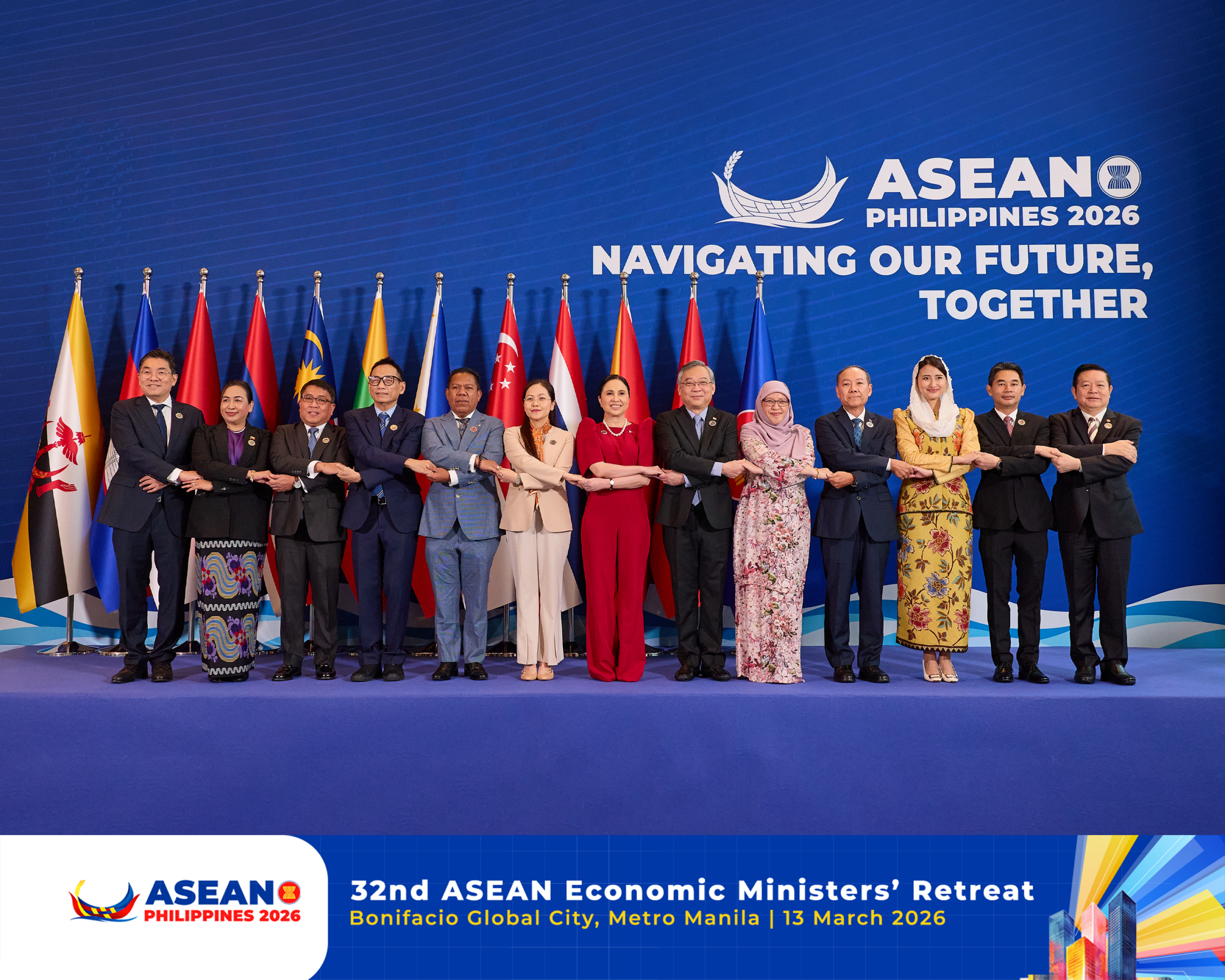
As the first chair to work under ASEAN’s new long-term economic framework, the Philippines is tasked with kick-starting the operationalisation of measures under the AEC Strategic Plan 2026-2030. Manila has approached this by anchoring the new agenda in continuity and by aiming to narrow the broad regional vision into a more focused set of actionable Priority Economic Deliverables (PEDs) with clearer institutional and sectoral definitions.
By aligning the rollout of new priorities with ongoing sectoral and ministerial work in economic cooperation, tourism, energy, and socio-cultural engagement, Manila is effectively embedding the new framework into processes that already have bureaucratic momentum and political buy-in. Meanwhile, the PEDs – an ASEAN Leaders’ Declaration on Strategic Trade Management, an ASEAN Centre of Excellence for MSMEs, the ASEAN Digital Economy Framework Agreement (DEFA), an ASEAN Centre of Excellence for Creative Industries, and a regional roadmap for semiconductors and critical minerals – are designed to respond to concrete pressures already reshaping ASEAN’s economic environment.
Strategic trade management, for instance, reflects the need to oversee sensitive goods and technologies more carefully as export controls expand and competition over strategic supply chains intensifies. DEFA speaks to the scale of ASEAN’s digital opportunity: Southeast Asia’s digital economy is already worth about US$300 billion and could reach US$1 trillion by 2030, with some projections suggesting that DEFA’s successful implementation could raise that figure even higher.
Despite accounting for more than 97 per cent of all businesses in Southeast Asia and 85 per cent of employment, most MSMEs still lack the support needed to grow, particularly in financing, mentorship, and network-building. The MSME PED, therefore, aims to better integrate the smaller firms into regional value chains. Meanwhile, banking on the region’s strength in semiconductors and electronics, the Semiconductor Roadmap aims to link ASEAN’s future competitiveness to a sector that is increasingly shaping global supply chains and industrial policy.
Singapore’s 2027 Chairmanship – Consolidating ASEAN’s Economic Agenda
The handover of the ASEAN Chairmanship to Singapore in 2027 could be consequential in shifting ASEAN’s economic agenda from early implementation to strategic consolidation. As a trade-driven and globalised “connector country”, Singapore has a strong interest not only in preserving ASEAN’s openness but also in making it more organised, interoperable, and strategically useful. With the rise of Singapore’s digital economy — from 17 per cent of GDP in 2022 to close to 20 per cent in 2024 — the country increasingly treats digital integration, trusted data flows, cybersecurity, and digital infrastructure as core economic issues rather than secondary policy concerns.
Singapore has also pushed practical forms of cross-border interoperability that could be scaled regionally. Singapore’s linkage of PayNow with Thailand’s PromptPay shows how digital connectivity can reduce friction in everyday transactions, while its nationwide e-invoicing network – introduced in 2019 through the Pan-European Public Procurement On-Line (PEPPOL) framework – demonstrates how common standards can streamline the electronic exchange of business documents across borders. Significantly, Singapore became the first PEPPOL Authority outside Europe and the first National Authority in Asia to adopt the standard, underscoring its role in operationalising digital integration.
For ASEAN, these efforts offer a practical model of integration built on common standards, lower transaction costs, and more predictable cross-border processes for firms, especially MSMEs. Such capacity would help reduce internal friction and strengthen ASEAN’s ability to shape standards and bargain more effectively with external partners.
The wider significance of the Philippines-Singapore chairmanship sequence lies not only in implementing new priorities, but in turning them into a more coherent regional strategy at a time when trade, technology, and industrial policy are increasingly politicised. More broadly, it can be seen as the opening phase of a longer Philippines-Singapore-Thailand progression, positioning Singapore’s 2027 chairmanship less as a standalone moment than as a bridge between early implementation and longer-term regional consolidation.
Thailand’s role in long-term ASEAN agenda-setting has at times been constrained by domestic political uncertainty. However, a more uncertain external environment, narrowing market options, and stronger Chinese economic pressure may create greater incentives for Bangkok to become more ASEAN-centred in advancing the AEC through the ASEAN Community Vision 2045.
About the Author
Nazia Hussain is an Associate Research Fellow at the Centre for Multilateralism Studies (CMS) at S. Rajaratnam School of International Studies (RSIS), Nanyang Technological University (NTU), Singapore.
SYNOPSIS
As the global landscape becomes more fragmented, ASEAN’s challenge is no longer simply to remain open, but to translate its economic integration into greater strategic agency. With successive chairmanships held by the Philippines and Singapore, ASEAN could begin repositioning itself as a more deliberate geoeconomic actor.
COMMENTARY
The international environment that underpinned ASEAN’s post-Cold War success is changing. An economic model built on open markets, expanding supply chains, rising cross-border investment, and broadly favourable conditions for integration is now under strain from tariffs, export controls, investment screening, and green industrial competition. While markets remain global, the rules and networks that sustain them are being reshaped by geopolitical competition.
Even so, ASEAN enters this more fragmented period with considerable economic weight. Its collective GDP is around US$4 trillion, and ASEAN’s own long-term plans project that it could become the world’s fourth-largest economy by 2045 if it deepens integration and adapts more effectively to a changing external environment. The region also remains attractive to investors: According to the ASEAN Investment Report 2025, foreign direct investment inflows reached US$226 billion in 2024, despite weaker global investment conditions.
The Philippines’ 2026 Chairmanship – Kick-starting ASEAN’s Economic Agenda
ASEAN’s continued economic relevance shifts the debate from whether the region can withstand fragmentation to how it should reposition its economic agenda in response. ASEAN’s policy response already reflects that shift. Adopted under the ASEAN Community Vision 2045, the ASEAN Economic Community (AEC) Strategic Plan 2026–2030 sets out a roadmap for a “single and future-ready economy” organised around six strategic goals: stronger intra-ASEAN trade, deeper services and financial integration, digital transformation, improved connectivity, supply-chain resilience, the green transition, and a stronger position in global value chains.
As the first chair to work under ASEAN’s new long-term economic framework, the Philippines is tasked with kick-starting the operationalisation of measures under the AEC Strategic Plan 2026-2030. Manila has approached this by anchoring the new agenda in continuity and by aiming to narrow the broad regional vision into a more focused set of actionable Priority Economic Deliverables (PEDs) with clearer institutional and sectoral definitions.
By aligning the rollout of new priorities with ongoing sectoral and ministerial work in economic cooperation, tourism, energy, and socio-cultural engagement, Manila is effectively embedding the new framework into processes that already have bureaucratic momentum and political buy-in. Meanwhile, the PEDs – an ASEAN Leaders’ Declaration on Strategic Trade Management, an ASEAN Centre of Excellence for MSMEs, the ASEAN Digital Economy Framework Agreement (DEFA), an ASEAN Centre of Excellence for Creative Industries, and a regional roadmap for semiconductors and critical minerals – are designed to respond to concrete pressures already reshaping ASEAN’s economic environment.
Strategic trade management, for instance, reflects the need to oversee sensitive goods and technologies more carefully as export controls expand and competition over strategic supply chains intensifies. DEFA speaks to the scale of ASEAN’s digital opportunity: Southeast Asia’s digital economy is already worth about US$300 billion and could reach US$1 trillion by 2030, with some projections suggesting that DEFA’s successful implementation could raise that figure even higher.
Despite accounting for more than 97 per cent of all businesses in Southeast Asia and 85 per cent of employment, most MSMEs still lack the support needed to grow, particularly in financing, mentorship, and network-building. The MSME PED, therefore, aims to better integrate the smaller firms into regional value chains. Meanwhile, banking on the region’s strength in semiconductors and electronics, the Semiconductor Roadmap aims to link ASEAN’s future competitiveness to a sector that is increasingly shaping global supply chains and industrial policy.
Singapore’s 2027 Chairmanship – Consolidating ASEAN’s Economic Agenda
The handover of the ASEAN Chairmanship to Singapore in 2027 could be consequential in shifting ASEAN’s economic agenda from early implementation to strategic consolidation. As a trade-driven and globalised “connector country”, Singapore has a strong interest not only in preserving ASEAN’s openness but also in making it more organised, interoperable, and strategically useful. With the rise of Singapore’s digital economy — from 17 per cent of GDP in 2022 to close to 20 per cent in 2024 — the country increasingly treats digital integration, trusted data flows, cybersecurity, and digital infrastructure as core economic issues rather than secondary policy concerns.
Singapore has also pushed practical forms of cross-border interoperability that could be scaled regionally. Singapore’s linkage of PayNow with Thailand’s PromptPay shows how digital connectivity can reduce friction in everyday transactions, while its nationwide e-invoicing network – introduced in 2019 through the Pan-European Public Procurement On-Line (PEPPOL) framework – demonstrates how common standards can streamline the electronic exchange of business documents across borders. Significantly, Singapore became the first PEPPOL Authority outside Europe and the first National Authority in Asia to adopt the standard, underscoring its role in operationalising digital integration.
For ASEAN, these efforts offer a practical model of integration built on common standards, lower transaction costs, and more predictable cross-border processes for firms, especially MSMEs. Such capacity would help reduce internal friction and strengthen ASEAN’s ability to shape standards and bargain more effectively with external partners.
The wider significance of the Philippines-Singapore chairmanship sequence lies not only in implementing new priorities, but in turning them into a more coherent regional strategy at a time when trade, technology, and industrial policy are increasingly politicised. More broadly, it can be seen as the opening phase of a longer Philippines-Singapore-Thailand progression, positioning Singapore’s 2027 chairmanship less as a standalone moment than as a bridge between early implementation and longer-term regional consolidation.
Thailand’s role in long-term ASEAN agenda-setting has at times been constrained by domestic political uncertainty. However, a more uncertain external environment, narrowing market options, and stronger Chinese economic pressure may create greater incentives for Bangkok to become more ASEAN-centred in advancing the AEC through the ASEAN Community Vision 2045.
About the Author
Nazia Hussain is an Associate Research Fellow at the Centre for Multilateralism Studies (CMS) at S. Rajaratnam School of International Studies (RSIS), Nanyang Technological University (NTU), Singapore.