

17 April 2026
CO26083 | Polarised Discourse on a Public Iftar: Christian and Secular Values in Dispute

SYNOPSIS
Recent political criticism of a public iftar in London’s Trafalgar Square has raised questions about Christian values, secularism, and Islamophobia. Narratives on religions and their practice can bring people together or divide them, and public policy cannot ignore such polarising impacts on public sentiments within any multicultural society.
COMMENTARY
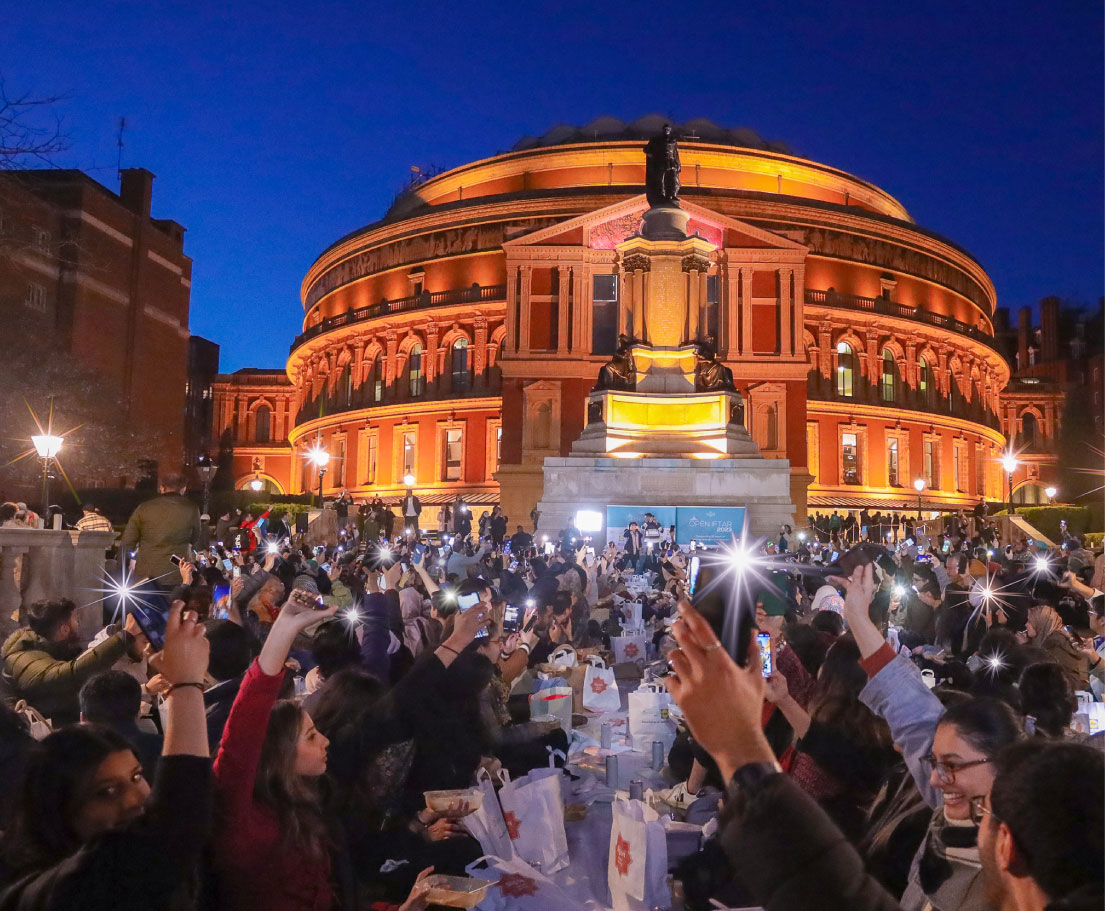
A public Iftar held in Trafalgar Square in central London on 16 March 2026 has caused quite a storm. This was the final event in a series of open iftars held across London during Ramadan this year, drawing around 3,000 people. In response, the Shadow Justice Secretary, Nick Timothy, a senior member of the Conservative Party, stated that: “Too many are too polite to say this. But mass ritual prayer in public places is an act of domination.”
Criticism of the event then followed, both from Kemi Babenoch, the Leader of the Opposition, and Nigel Farage, the head of Reform UK, whose party has been leading in the polls for some months and is a potential future Prime Minister. The latter seemingly suggested that public displays of religion should not be allowed in what he called, using a deeply problematic term, the “Judeo-Christian” UK.
In response to these criticisms, the Mayor of London, Saddiq Khan, who was at the Iftar, described himself as “heartbroken” and reminded that London and Trafalgar Square held gatherings of many religions. Meanwhile, the Prime Minister Keir Starmer suggested that the Conservatives were aligning with elements of the Far Right.
We see here a polarised debate about the place of religion, and especially Islam, in a public place.
Christian Values
One central issue raised by political actors and on social media is that allowing a large-scale Islamic event like this was an affront to the UK’s “Christian heritage”. Christian, or “Judeo-Christian”, heritage is a common dog whistle – suggestive language used in political or social discourse to convey a specific, often controversial message to a targeted audience without being noticed by the general public – in extreme-right ethno-Christian nationalist circles across Europe and elsewhere. It signals a desire that what is deemed “white culture” is foregrounded and prioritised.
This question of heritage is often linked to questions of values. It may be argued that in rejecting the iftar, far-right actors are linking themselves to a vision of Christian values that excludes and rejects other identities and traditions. Perhaps the strongest rebuke of such claims regarding this Iftar has come from the British Anglican Bishop of Kirkstall, Arun Arora.
Bishop Arora notes how he has led Christian services in his own diocese alongside not just Roman Catholics but also Jewish, Hindu, Sikh, and Muslim leaders. He promotes very different Christian values from those seemingly promulgated by the right wing, saying:
“Our call as Christians is to create room for those with whom we disagree but see in them their God-given dignity. Our call is neither to dominate nor be dominated, but rather to seek the common good and to live at peace with our neighbour – and where we disagree, to disagree well.”
He cited a 2012 speech by the then-British monarch, Queen Elizabeth II, delivered at Lambeth Palace, the London home of the Archbishop of Canterbury. Referring to the Church of England’s status as the established church of the nation, she said that this was often misunderstood. In her speech, she stated that the British system was not there “to defend Anglicanism to the exclusion of other religions,” but rather, she continued, “the church has a duty to protect the free practice of all faiths in this country.”
Both Bishop Arora and Queen Elizabeth present a very different set of Christian values and a different view of what the Christian heritage of the nation might mean than those of the far right. In Europe, too, as scholars have noted, there is often a disconnect between the values and Christianity of bishops and religious leaders and the portrayal of Christian heritage by right-wing actors across Europe.
Secular Values
The UK is not simply Christian, but, as the sociologist of religion Paul Weller has noted, is Christian, secular, and multifaith. The suggestion that large-scale religious observances be banned in public must be placed in a discourse that is secularised. Certainly, some social media commentary agreed that in what is often termed a “post-Christian” Britain, religious practice should be pushed out of the public square.
Secularism means different things to different people and manifests differently across countries and over time. For instance, the contemporary French interpretation of secularism, laïcité – establishing the strict separation of church and state, and ensuring state neutrality in religious affairs – is often seen as hostile to religion, diverging from its original intentions. However, elsewhere, secularism may be understood simply as a state of affairs that allows both minority and majority religious groups, as well as the non-religious, to interact within a relatively neutral common space.
Moreover, it is worthwhile reflecting on the concept of the post-secular espoused by Jürgen Habermas, a German public intellectual who passed away recently. In his early work, Habermas not only bequeathed us the concept of public space as a real third sphere beyond government and the private realm, but in his later work, he moved beyond his previous belief that religion should have no place in the public square. Speaking of the post-secular, Habermas argued that religious convictions should be part of public discourse like other political or cultural affiliations.
The argument to ban public prayer thus seems out of kilter not only with Christian values, especially as espoused in the British context, but also contemporary multicultural, secular democracies where, it has been argued, interfaith has become the default way of “doing religion”.
Islamophobia
Speaking at the iftar, Khan said that “being a Muslim in 2026 remains difficult” in the UK, though he was glad that Ramadan has more public visibility today. However, this very public visibility of Islam was seemingly part of the assault on British values as perceived by the far-right. Timothy, in his initial attack, describing the “domination” as typical of an Islamist “playbook”, though he did say that not everyone present was an Islamist.
An undeniable aspect of the criticism of the iftar was certainly Islamophobia, and Bishop Arora was clear on that: In his view, the language used was “definitive as an Islamophobic slur masquerading as public policy concern.”
The UK’s Attorney General, Richard Hermer, who is himself Jewish, said that the language “begs the question” of whether the critics would “have a problem if I, as a Jewish man, were praying in public? Or is it just Muslim prayer they find offensive, and contrary to ‘British values’?” Why is such outrage, he and others have noted, only raised when it is Muslims seen praying in public? Arguably, Farage implied he was only condemning Muslims praying in public, which seems to make the Islamophobia far clearer.
Saddiq Khan, a Muslim, as Mayor of London, hosted a public reenactment of the Passion of Jesus on Good Friday, 3 April, an event that has been held publicly for ten years. Not far from Trafalgar Square, an overtly Christian commemoration of Britain’s wartime dead has been held annually for decades. Trafalgar Square itself has hosted Christian, Jewish, Sikh, and Hindu events. It seems clear to many that the critics’ comments were explicitly Islamophobic.
Conclusion
In many parts of the world today religious narratives are increasingly being brought into political debate. While Habermas suggests that religious voices may be part of public debate there is a danger of an illiberal, polarised deployment of religious discourse. This often conflates religious, ethnic or racial, and nationalist sentiments into an unholy package of prejudice and hate. Politicians, media, and the public need to be aware of how religious narratives may be used both to bring people together but also to divide them. Politicians such as Nick Timothy, Kemi Babenoch, and Nigel Farage seem to think that targeting a single minority will garner them political capital. We must be alert to the affective sentiment created by polarising discourse from those who want to use religious narratives and symbols for sectarian ends and personal political advantage.
About the Author
Dr Paul Hedges is Professor of Interreligious Studies and Associate Dean (Scholarly Ecosystems) in the Studies in Inter-Religious Relations in Plural Societies (SRP) Programme, S. Rajaratnam School of International Studies (RSIS), Nanyang Technological University (NTU), Singapore, and a Life Member of Clare Hall, University of Cambridge, UK. He is currently a Visiting Fellow at the Woolf Institute, Cambridge, UK.
SYNOPSIS
Recent political criticism of a public iftar in London’s Trafalgar Square has raised questions about Christian values, secularism, and Islamophobia. Narratives on religions and their practice can bring people together or divide them, and public policy cannot ignore such polarising impacts on public sentiments within any multicultural society.
COMMENTARY
A public Iftar held in Trafalgar Square in central London on 16 March 2026 has caused quite a storm. This was the final event in a series of open iftars held across London during Ramadan this year, drawing around 3,000 people. In response, the Shadow Justice Secretary, Nick Timothy, a senior member of the Conservative Party, stated that: “Too many are too polite to say this. But mass ritual prayer in public places is an act of domination.”
Criticism of the event then followed, both from Kemi Babenoch, the Leader of the Opposition, and Nigel Farage, the head of Reform UK, whose party has been leading in the polls for some months and is a potential future Prime Minister. The latter seemingly suggested that public displays of religion should not be allowed in what he called, using a deeply problematic term, the “Judeo-Christian” UK.
In response to these criticisms, the Mayor of London, Saddiq Khan, who was at the Iftar, described himself as “heartbroken” and reminded that London and Trafalgar Square held gatherings of many religions. Meanwhile, the Prime Minister Keir Starmer suggested that the Conservatives were aligning with elements of the Far Right.
We see here a polarised debate about the place of religion, and especially Islam, in a public place.
Christian Values
One central issue raised by political actors and on social media is that allowing a large-scale Islamic event like this was an affront to the UK’s “Christian heritage”. Christian, or “Judeo-Christian”, heritage is a common dog whistle – suggestive language used in political or social discourse to convey a specific, often controversial message to a targeted audience without being noticed by the general public – in extreme-right ethno-Christian nationalist circles across Europe and elsewhere. It signals a desire that what is deemed “white culture” is foregrounded and prioritised.
This question of heritage is often linked to questions of values. It may be argued that in rejecting the iftar, far-right actors are linking themselves to a vision of Christian values that excludes and rejects other identities and traditions. Perhaps the strongest rebuke of such claims regarding this Iftar has come from the British Anglican Bishop of Kirkstall, Arun Arora.
Bishop Arora notes how he has led Christian services in his own diocese alongside not just Roman Catholics but also Jewish, Hindu, Sikh, and Muslim leaders. He promotes very different Christian values from those seemingly promulgated by the right wing, saying:
“Our call as Christians is to create room for those with whom we disagree but see in them their God-given dignity. Our call is neither to dominate nor be dominated, but rather to seek the common good and to live at peace with our neighbour – and where we disagree, to disagree well.”
He cited a 2012 speech by the then-British monarch, Queen Elizabeth II, delivered at Lambeth Palace, the London home of the Archbishop of Canterbury. Referring to the Church of England’s status as the established church of the nation, she said that this was often misunderstood. In her speech, she stated that the British system was not there “to defend Anglicanism to the exclusion of other religions,” but rather, she continued, “the church has a duty to protect the free practice of all faiths in this country.”
Both Bishop Arora and Queen Elizabeth present a very different set of Christian values and a different view of what the Christian heritage of the nation might mean than those of the far right. In Europe, too, as scholars have noted, there is often a disconnect between the values and Christianity of bishops and religious leaders and the portrayal of Christian heritage by right-wing actors across Europe.
Secular Values
The UK is not simply Christian, but, as the sociologist of religion Paul Weller has noted, is Christian, secular, and multifaith. The suggestion that large-scale religious observances be banned in public must be placed in a discourse that is secularised. Certainly, some social media commentary agreed that in what is often termed a “post-Christian” Britain, religious practice should be pushed out of the public square.
Secularism means different things to different people and manifests differently across countries and over time. For instance, the contemporary French interpretation of secularism, laïcité – establishing the strict separation of church and state, and ensuring state neutrality in religious affairs – is often seen as hostile to religion, diverging from its original intentions. However, elsewhere, secularism may be understood simply as a state of affairs that allows both minority and majority religious groups, as well as the non-religious, to interact within a relatively neutral common space.
Moreover, it is worthwhile reflecting on the concept of the post-secular espoused by Jürgen Habermas, a German public intellectual who passed away recently. In his early work, Habermas not only bequeathed us the concept of public space as a real third sphere beyond government and the private realm, but in his later work, he moved beyond his previous belief that religion should have no place in the public square. Speaking of the post-secular, Habermas argued that religious convictions should be part of public discourse like other political or cultural affiliations.
The argument to ban public prayer thus seems out of kilter not only with Christian values, especially as espoused in the British context, but also contemporary multicultural, secular democracies where, it has been argued, interfaith has become the default way of “doing religion”.
Islamophobia
Speaking at the iftar, Khan said that “being a Muslim in 2026 remains difficult” in the UK, though he was glad that Ramadan has more public visibility today. However, this very public visibility of Islam was seemingly part of the assault on British values as perceived by the far-right. Timothy, in his initial attack, describing the “domination” as typical of an Islamist “playbook”, though he did say that not everyone present was an Islamist.
An undeniable aspect of the criticism of the iftar was certainly Islamophobia, and Bishop Arora was clear on that: In his view, the language used was “definitive as an Islamophobic slur masquerading as public policy concern.”
The UK’s Attorney General, Richard Hermer, who is himself Jewish, said that the language “begs the question” of whether the critics would “have a problem if I, as a Jewish man, were praying in public? Or is it just Muslim prayer they find offensive, and contrary to ‘British values’?” Why is such outrage, he and others have noted, only raised when it is Muslims seen praying in public? Arguably, Farage implied he was only condemning Muslims praying in public, which seems to make the Islamophobia far clearer.
Saddiq Khan, a Muslim, as Mayor of London, hosted a public reenactment of the Passion of Jesus on Good Friday, 3 April, an event that has been held publicly for ten years. Not far from Trafalgar Square, an overtly Christian commemoration of Britain’s wartime dead has been held annually for decades. Trafalgar Square itself has hosted Christian, Jewish, Sikh, and Hindu events. It seems clear to many that the critics’ comments were explicitly Islamophobic.
Conclusion
In many parts of the world today religious narratives are increasingly being brought into political debate. While Habermas suggests that religious voices may be part of public debate there is a danger of an illiberal, polarised deployment of religious discourse. This often conflates religious, ethnic or racial, and nationalist sentiments into an unholy package of prejudice and hate. Politicians, media, and the public need to be aware of how religious narratives may be used both to bring people together but also to divide them. Politicians such as Nick Timothy, Kemi Babenoch, and Nigel Farage seem to think that targeting a single minority will garner them political capital. We must be alert to the affective sentiment created by polarising discourse from those who want to use religious narratives and symbols for sectarian ends and personal political advantage.
About the Author
Dr Paul Hedges is Professor of Interreligious Studies and Associate Dean (Scholarly Ecosystems) in the Studies in Inter-Religious Relations in Plural Societies (SRP) Programme, S. Rajaratnam School of International Studies (RSIS), Nanyang Technological University (NTU), Singapore, and a Life Member of Clare Hall, University of Cambridge, UK. He is currently a Visiting Fellow at the Woolf Institute, Cambridge, UK.