


02 June 2026
CO26119 | The Shangri-La Dialogue at 23: China’s Loss, Allies’ Gain

SYNOPSIS
The absence of the Chinese defence minister from the 23rd Shangri-La Dialogue last week was a lost opportunity for China to put forth its own proposition of how it views the regional security environment. To ensure their own safety, American allies and partners in the region are likely to conclude that strengthening their own defence capabilities in concert with the United States is the best way forward.
COMMENTARY
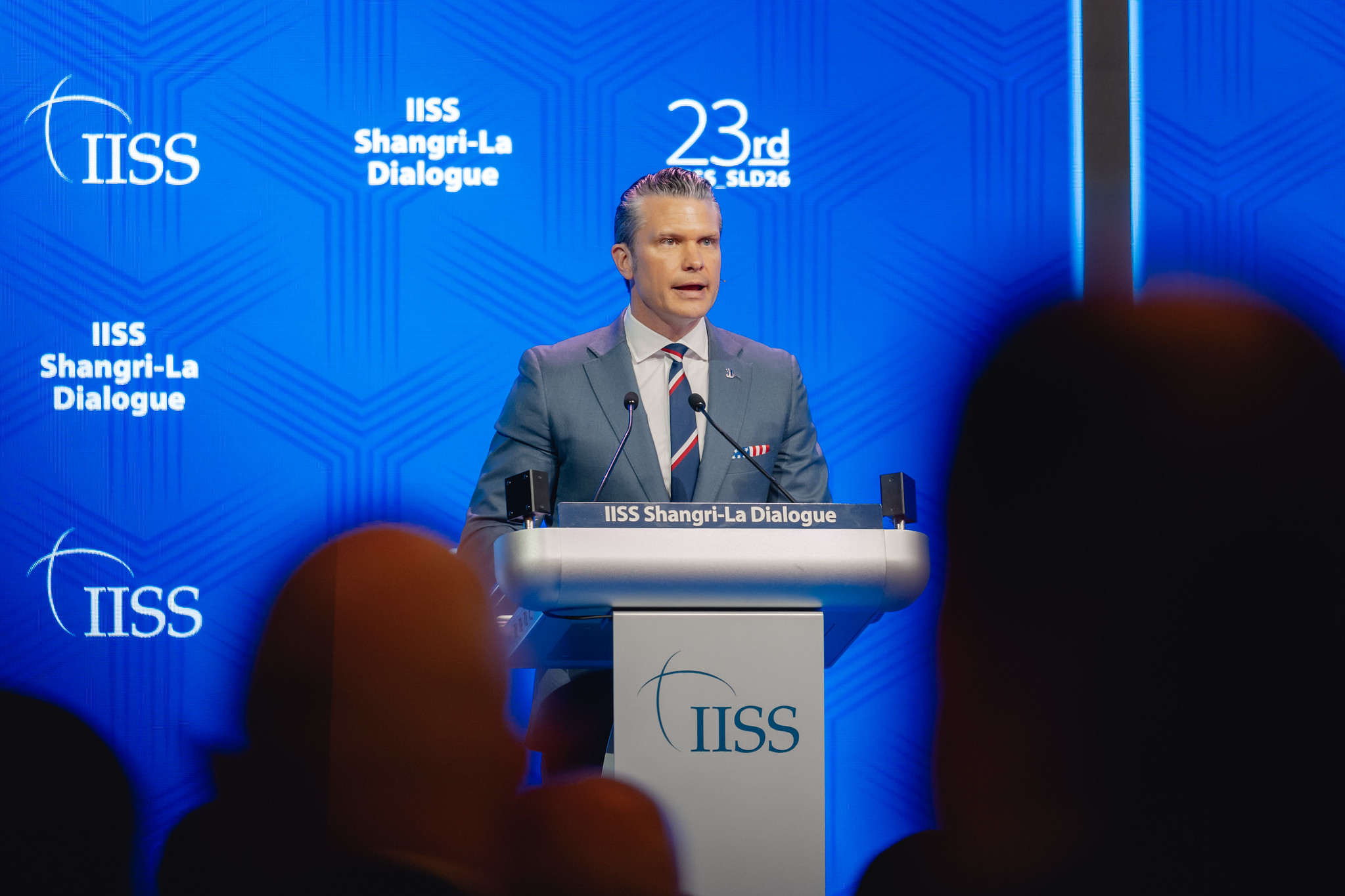
The 23rd Shangri-La Dialogue (SLD) will be best remembered for American War Secretary Pete Hegseth unambiguous exhortation that “those who long for peace must prepare for war” – a phrase that was repeated three times in his remarks.
Hegseth’s call for a “return to realism”, citing America’s “proactive and realist”, and “realist engagement” are phrases that would immediately resonate with many defence planners: power (and hard power) matters ultimately when it comes to the grand scheme of preserving peace in the region. His view that America’s leadership was one that is “confident enough to speak and walk softly while carrying a big stick” likewise is a sharp reminder that Washington retains the material ability to preserve and pursue its interests – by military means if necessary.
On the contrary, Hegseth’s veiled swipe against Western Europe for not taking their defence needs seriously was clearly on display. In his speech, Hegseth castigated European partners for ignoring their own defence needs and being “distracted by empty globalist rhetoric about the rules-based international order”. He also pointed out that attempts to “drama[tise] or “moralise” their interests – instead of pragmatically adjusting – were unwise, and reminded Western Europe to “take note”.
America Helps Those who Help Themselves
Hegseth’s speech would generally be welcomed by allies and partners in the region, especially among those who may have concerns regarding the potential swing of the balance of power in the region in favour of China. Countries mentioned in Hegseth’s list of model partners include South Korea, Japan, Indonesia, Singapore, Malaysia, Philippines, Thailand, Australia, Vietnam and India. The fact that Japan’s defence minister Shinjiro Koizumi in the ensuing Q&A posed the first question – in fluent English no less – regarding regional concerns that the US was less committed to the region, gave Hegseth the opportunity to reaffirm this commitment. This was a masterstroke in Japanese diplomacy in signalling the value of the US-Japan alliance in ensuring the region’s peace and security.
The idea then, that America would help those who help themselves was crystal clear in Hegseth’s SLD’s messaging. As Hegseth puts it, “those nations that rise to this challenge that embrace responsibility as true partners, the benefits will be clear…we will prioritise working with model allies, those nations who are most capable, clear-eyed and ready to defend their national interests. For those nations, we are moving them to the front of the line”. Far from retreating from the region or seeking some kind of G2 arrangement with China to divide the world into spheres of influence, Hegseth’s message was unambiguous: America still sees itself ruling the roost globally, and countries who desire to stay on the right side of American favour would have to do their part to justify America’s interest in them.
China’s Missed Opportunity to Showcase Discourse Power
Unfortunately, the absence of China’s defence minister Dong Jun from the SLD was a lost opportunity for Beijing to put forth its own preferred global narrative. To be fair, Beijing’s interest in the SLD can be described as lukewarm at best. Notwithstanding its previous participation in several iterations, it had always viewed the SLD as somewhat designed to put forth Western viewpoints at the expense of its own preferred narrative. Instead, it relies on the Xiangshan Forum (held annually in Beijing in the fall) to set its agenda while also pushing back against what it sees as unfair Western narratives against it.
While understandably, from a Chinese policy-making viewpoint (after all, why subject oneself to unnecessary criticism and making oneself look bad in the eyes of both domestic and international audiences), Beijing is now conceding the first-mover advantage to Washington. By allowing the US to put forth its expectations about how it sees regional partners and how allies ought to act, Beijing would find it more difficult to corral support for its political initiatives, and to assuage regional neighbours (including many in Southeast Asia) that it has no hegemonic designs towards the region. The fact that the Japanese defence minister Shinjiro Koizumi refuted Chinese accusations of “new militarism” by comparing Chinese and Japanese military capacity is another lost opportunity for the Chinese to showcase its discourse power (huayu yuan) and winning support among not just the converted but also among the sceptics. As Koizumi eloquently argued, “Think about it. There’s a country (read: China) that has a huge arsenal of nuclear weapons and strategic bombers. Japan has neither of such weapons, and yet Japan is labelled ‘new militarism’?”
Why Defence Diplomacy Still Matters
Hegseth’s strongly-worded realist stance at the SLD parallels that of Trump’s so-called transactional and less ideological approach to the practice of international politics. While his comments: “We don’t need more conferences”, “less Shangri-La”, “more ships, more subs”, may invite varying interpretations about the SLD’s value (as perceived by the US), defence diplomacy is not about to go away (with or without the SLD).
Indeed, one may argue for the need to have smaller foras to enable more sensitive topics to be put forth and/or debated. Whatever those modalities may be, issues of global defence and security are too important to be left to chance, which may result in misperceptions and miscalculations. After all, if “jaw-jaw” is still fundamentally preferable to “war-war”, as Winston Churchill puts it, then coming to the SLD or whatever other options that may exist and delivering a speech – as opposed to not doing so – still represents a valuable contribution in mitigating against even worse outcomes that not talking to one another may result in.
About the Author
Benjamin Ho is Assistant Professor and Coordinator of the China Programme at the S. Rajaratnam School of International Studies. He specialises in the study of US-China relations, the international relations of Northeast Asia and Singapore foreign policy.
SYNOPSIS
The absence of the Chinese defence minister from the 23rd Shangri-La Dialogue last week was a lost opportunity for China to put forth its own proposition of how it views the regional security environment. To ensure their own safety, American allies and partners in the region are likely to conclude that strengthening their own defence capabilities in concert with the United States is the best way forward.
COMMENTARY
The 23rd Shangri-La Dialogue (SLD) will be best remembered for American War Secretary Pete Hegseth unambiguous exhortation that “those who long for peace must prepare for war” – a phrase that was repeated three times in his remarks.
Hegseth’s call for a “return to realism”, citing America’s “proactive and realist”, and “realist engagement” are phrases that would immediately resonate with many defence planners: power (and hard power) matters ultimately when it comes to the grand scheme of preserving peace in the region. His view that America’s leadership was one that is “confident enough to speak and walk softly while carrying a big stick” likewise is a sharp reminder that Washington retains the material ability to preserve and pursue its interests – by military means if necessary.
On the contrary, Hegseth’s veiled swipe against Western Europe for not taking their defence needs seriously was clearly on display. In his speech, Hegseth castigated European partners for ignoring their own defence needs and being “distracted by empty globalist rhetoric about the rules-based international order”. He also pointed out that attempts to “drama[tise] or “moralise” their interests – instead of pragmatically adjusting – were unwise, and reminded Western Europe to “take note”.
America Helps Those who Help Themselves
Hegseth’s speech would generally be welcomed by allies and partners in the region, especially among those who may have concerns regarding the potential swing of the balance of power in the region in favour of China. Countries mentioned in Hegseth’s list of model partners include South Korea, Japan, Indonesia, Singapore, Malaysia, Philippines, Thailand, Australia, Vietnam and India. The fact that Japan’s defence minister Shinjiro Koizumi in the ensuing Q&A posed the first question – in fluent English no less – regarding regional concerns that the US was less committed to the region, gave Hegseth the opportunity to reaffirm this commitment. This was a masterstroke in Japanese diplomacy in signalling the value of the US-Japan alliance in ensuring the region’s peace and security.
The idea then, that America would help those who help themselves was crystal clear in Hegseth’s SLD’s messaging. As Hegseth puts it, “those nations that rise to this challenge that embrace responsibility as true partners, the benefits will be clear…we will prioritise working with model allies, those nations who are most capable, clear-eyed and ready to defend their national interests. For those nations, we are moving them to the front of the line”. Far from retreating from the region or seeking some kind of G2 arrangement with China to divide the world into spheres of influence, Hegseth’s message was unambiguous: America still sees itself ruling the roost globally, and countries who desire to stay on the right side of American favour would have to do their part to justify America’s interest in them.
China’s Missed Opportunity to Showcase Discourse Power
Unfortunately, the absence of China’s defence minister Dong Jun from the SLD was a lost opportunity for Beijing to put forth its own preferred global narrative. To be fair, Beijing’s interest in the SLD can be described as lukewarm at best. Notwithstanding its previous participation in several iterations, it had always viewed the SLD as somewhat designed to put forth Western viewpoints at the expense of its own preferred narrative. Instead, it relies on the Xiangshan Forum (held annually in Beijing in the fall) to set its agenda while also pushing back against what it sees as unfair Western narratives against it.
While understandably, from a Chinese policy-making viewpoint (after all, why subject oneself to unnecessary criticism and making oneself look bad in the eyes of both domestic and international audiences), Beijing is now conceding the first-mover advantage to Washington. By allowing the US to put forth its expectations about how it sees regional partners and how allies ought to act, Beijing would find it more difficult to corral support for its political initiatives, and to assuage regional neighbours (including many in Southeast Asia) that it has no hegemonic designs towards the region. The fact that the Japanese defence minister Shinjiro Koizumi refuted Chinese accusations of “new militarism” by comparing Chinese and Japanese military capacity is another lost opportunity for the Chinese to showcase its discourse power (huayu yuan) and winning support among not just the converted but also among the sceptics. As Koizumi eloquently argued, “Think about it. There’s a country (read: China) that has a huge arsenal of nuclear weapons and strategic bombers. Japan has neither of such weapons, and yet Japan is labelled ‘new militarism’?”
Why Defence Diplomacy Still Matters
Hegseth’s strongly-worded realist stance at the SLD parallels that of Trump’s so-called transactional and less ideological approach to the practice of international politics. While his comments: “We don’t need more conferences”, “less Shangri-La”, “more ships, more subs”, may invite varying interpretations about the SLD’s value (as perceived by the US), defence diplomacy is not about to go away (with or without the SLD).
Indeed, one may argue for the need to have smaller foras to enable more sensitive topics to be put forth and/or debated. Whatever those modalities may be, issues of global defence and security are too important to be left to chance, which may result in misperceptions and miscalculations. After all, if “jaw-jaw” is still fundamentally preferable to “war-war”, as Winston Churchill puts it, then coming to the SLD or whatever other options that may exist and delivering a speech – as opposed to not doing so – still represents a valuable contribution in mitigating against even worse outcomes that not talking to one another may result in.
About the Author
Benjamin Ho is Assistant Professor and Coordinator of the China Programme at the S. Rajaratnam School of International Studies. He specialises in the study of US-China relations, the international relations of Northeast Asia and Singapore foreign policy.