


08 December 2025
CO25237 | French Heritage in Singapore

SYNOPSIS
Relatively inconspicuous, French heritage in Singapore becomes apparent upon closer examination. Rooted in the Catholic legacy, it has developed in various forms over time. As France and Singapore celebrate 60 years of bilateral relations, their shared history continues to be written today.
COMMENTARY
Although France’s historical presence in the Indo-Pacific is less visible than that of other European colonial powers, it has nonetheless left enduring and still-discernible imprints across the region. From the seventeenth century onward, France pursued commercial ambitions in the Indian Ocean and Asia, establishing outposts on several islands and in India. Severely curtailed by the Seven Years’ War (1756-1763), French expansion resumed in the nineteenth century with the conquest of Indochina and the acquisition of Pacific possessions.
Within this broader Indo-Pacific endeavour, Singapore emerged as a key transit point for French officials, merchants, and missionaries. From its founding in February 1819, Singapore already bore an unexpected French imprint, as Stamford Raffles – acknowledged as the founder of modern Singapore – was accompanied by two French naturalists, Pierre-Médard Diard and Alfred Duvaucel, tasked with collecting specimens of the region’s flora and fauna.
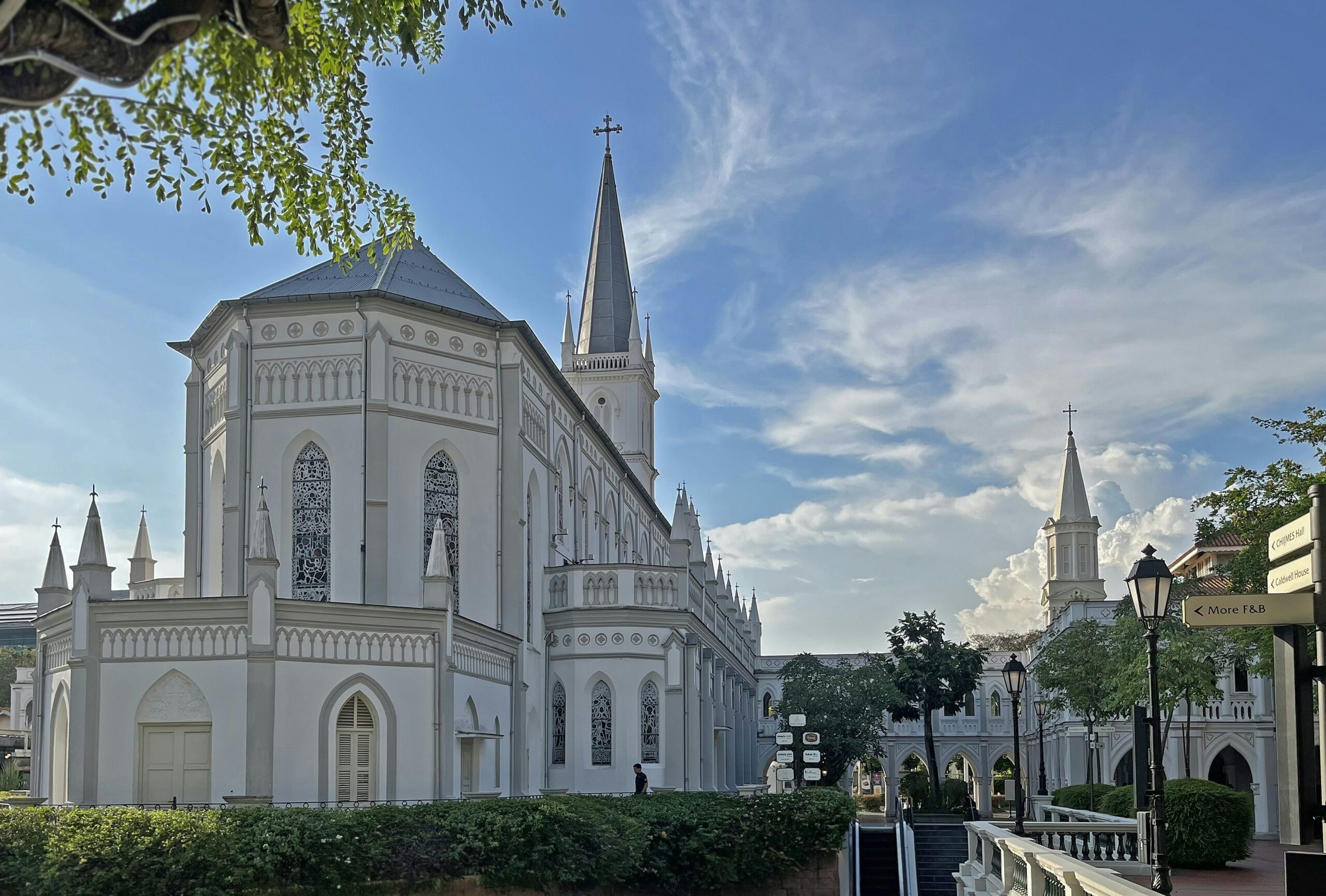
Throughout the nineteenth and early twentieth centuries, notable French navigators and writers – including Hyacinthe de Bougainville, Jules Dumont d’Urville, Pierre Loti, Victor Segalen and André Malraux – visited the city, leaving valuable accounts of the emerging economic hub. Meanwhile, Catholic missionaries settled in Singapore, establishing a spiritual and architectural legacy that remains visible to this day.
Catholicism and Churches
Colonial expansion was not only an economic or political enterprise; it also carried a religious and proselytising dimension. France – traditionally styled as the “eldest daughter of the Church” – positioned itself as a champion of Catholicism and pursued global evangelisation through numerous religious congregations. Founded in 1658-1659, the Paris Foreign Missions Society (Missions étrangères de Paris-MEP) sought specifically to evangelise non-Christian societies in Asia by establishing local churches and training indigenous clergy.
In Southeast Asia, the MEP opened its first seminary in Ayutthaya (Siam/Thailand) in 1665. Following their expulsion from Siam, its missionaries relocated to the Malay Peninsula, settling first in Malacca and Penang, from where they ministered to the small Catholic community in Singapore.
The decisive figure in Singapore was Father Jean-Marie Beurel (1813-1872), who arrived in 1839. Thanks to his relentless energy, the Cathedral of the Good Shepherd was consecrated in 1847, funded in part through donations, including one from Queen Marie-Amélie of France. As the Catholic population rose rapidly – from a few dozen in the 1820s to roughly 5,000 by 1900 – new parishes were created to serve different linguistic communities: Saints Peter and Paul (1870) for the Chinese and Indians; Our Lady of Lourdes (1888) for the Tamil community; the Sacred Heart (1910) for Hakka- and Cantonese-speaking Catholics; and Saint Teresa (1923) for the Hokkien-speaking population.
All these churches were financed and administered by French MEP priests, many of whom mastered Hokkien, Cantonese, Hakka, or Tamil. The Archdiocese of Singapore long benefited from the contributions of French missionaries; the heads of the local clergy were drawn from the MEP until 1976, when Archbishop Olçomendy retired.
Education and Schools
Beyond evangelisation, a central mission of the French Catholic clergy in Singapore was to provide education and assistance to the poor. The schools founded by French priests and nuns rapidly gained a reputation that endures to this day. Here again, Father Beurel played a decisive role by convincing the Sisters of the Holy Infant Jesus – les dames de Saint Maur – and the Brothers of the Christian Schools – the La Salle Brothers – to come to Singapore. Both congregations offered accessible, vernacular and often free education.
Saint Joseph’s Institution (SJI), opened in 1852, soon became Singapore’s first English-medium Catholic boy school and one of the city’s most prestigious institutions. The Convent of the Holy Infant Jesus (CHIJ) was founded in 1854 on Victoria Street as an orphanage and refuge for vulnerable girls, before quickly opening a free school open to all ethnic and religious communities.
Other French congregation-led initiatives followed, including Catholic High School (1935), founded by Father Edouard Becheras; the Good Shepherd Sisters (Marymount Convent, 1950) and the Marist Brothers (Maris Stella High School, 1958). These institutions promoted bilingual education (often English and Chinese) and offered access regardless of religion or ethnicity, while instilling Christian values of discipline and service.
Alongside Catholic education, the study of the French language also developed through secular institutions and gradually structured and institutionalised around the Alliance Française in 1949, and later with the creation of the “Petite École française de Singapore” which eventually evolved into today’s International French School, now home to nearly 3,000 students. France and Singapore also maintain more than 100 university partnerships, and several major French institutions – including INSEAD, ESSEC, EDHEC, and Panthéon-Assas – have established campuses in the city-state.
From Colonial Trade to Strategic Partnership
Beyond religion and education, French private companies anchored their activities in Singapore, a strategic economic hub. Several early ventures became emblematic: the Messageries Maritimes (the ancestor of CMA-CGM) opened an office in 1862 after launching the first shipping line between Marseille and Saigon via Singapore; canned food supplier Clouet Trading, founded in 1892 by Alfred Clouet, and known today as Ayam Brand; Banque d’Indochine, the central bank of French Indochina, established a branch in Singapore in 1905. In 1912, the latter rented out its basement to the French rubber manufacturer Michelin.
During the interwar period, the company Brossard Mopin Ltd, together with its Singapore-based French engineer Émile Brizay – a pioneer in the use of reinforced concrete – went on to carry out 140 construction projects across Asia, including in Singapore, such as the Capitol Building, Tanjong Pagar Railway Station, St. Teresa’s Church, and the Ford factory. Air France inaugurated the Singapore-Saigon route in 1949, followed by the Singapore-Paris connection in 1965, which today operates ten times a week.
Presently, nearly 1,000 French company subsidiaries operate in Singapore, which accounts for more than two-thirds of all French investments in Southeast Asia. The city-state is also France’s second-largest global trade surplus, after the United Kingdom. Most major French groups are present, including STMicroelectronics (the largest French employer in Singapore, with around 5,000 staff), Thales (approximately 2,100 employees), CMA-CGM (which acquired Singapore’s Neptune Orient Lines in 2016), Alstom (key furnisher of the Mass Rapid Transit system), Bouygues construction (Sport hub, Capitaspring), Dassault Systèmes, BNP Paribas, and AccorHotels. French companies now span virtually all sectors, with particularly strong positions in aerospace, electronics, finance, insurance, and business services.
A Shared History Still Being Written Today.
The milestones of the bilateral relationship between Singapore and France have left enduring historical traces. Their presence is echoed today in Singapore’s urban landscape, where several streets commemorate the shared sacrifices of the First World War: Clemenceau Avenue, Somme Road, Verdun Road, Foch Road, and Marne Road. This shared history continues to unfold in the present day. The elevation of France-Singapore relations to a Comprehensive Strategic Partnership in May 2025 – the first such partnership between Singapore and a European country – now anchors cooperation in fields such as cybersecurity, artificial intelligence, green finance, and digital transition.
The rapidly growing French community in Singapore, now numbering over 20,000 residents – a figure that has doubled since 2008 – suggests that French influence will continue to shape this multicultural city.
About the Authors
Dr Paco Milhiet is a Visiting Fellow with the South Asia Programme at the S. Rajaratnam School of International Studies (RSIS), at Nanyang Technological University (NTU), Singapore. Maxime Pilon is a French national who has been a resident of Singapore for over 20 years. He works at the International French School. He co-authored the book The French in Singapore with Daniele Weiler.
SYNOPSIS
Relatively inconspicuous, French heritage in Singapore becomes apparent upon closer examination. Rooted in the Catholic legacy, it has developed in various forms over time. As France and Singapore celebrate 60 years of bilateral relations, their shared history continues to be written today.
COMMENTARY
Although France’s historical presence in the Indo-Pacific is less visible than that of other European colonial powers, it has nonetheless left enduring and still-discernible imprints across the region. From the seventeenth century onward, France pursued commercial ambitions in the Indian Ocean and Asia, establishing outposts on several islands and in India. Severely curtailed by the Seven Years’ War (1756-1763), French expansion resumed in the nineteenth century with the conquest of Indochina and the acquisition of Pacific possessions.
Within this broader Indo-Pacific endeavour, Singapore emerged as a key transit point for French officials, merchants, and missionaries. From its founding in February 1819, Singapore already bore an unexpected French imprint, as Stamford Raffles – acknowledged as the founder of modern Singapore – was accompanied by two French naturalists, Pierre-Médard Diard and Alfred Duvaucel, tasked with collecting specimens of the region’s flora and fauna.
Throughout the nineteenth and early twentieth centuries, notable French navigators and writers – including Hyacinthe de Bougainville, Jules Dumont d’Urville, Pierre Loti, Victor Segalen and André Malraux – visited the city, leaving valuable accounts of the emerging economic hub. Meanwhile, Catholic missionaries settled in Singapore, establishing a spiritual and architectural legacy that remains visible to this day.
Catholicism and Churches
Colonial expansion was not only an economic or political enterprise; it also carried a religious and proselytising dimension. France – traditionally styled as the “eldest daughter of the Church” – positioned itself as a champion of Catholicism and pursued global evangelisation through numerous religious congregations. Founded in 1658-1659, the Paris Foreign Missions Society (Missions étrangères de Paris-MEP) sought specifically to evangelise non-Christian societies in Asia by establishing local churches and training indigenous clergy.
In Southeast Asia, the MEP opened its first seminary in Ayutthaya (Siam/Thailand) in 1665. Following their expulsion from Siam, its missionaries relocated to the Malay Peninsula, settling first in Malacca and Penang, from where they ministered to the small Catholic community in Singapore.
The decisive figure in Singapore was Father Jean-Marie Beurel (1813-1872), who arrived in 1839. Thanks to his relentless energy, the Cathedral of the Good Shepherd was consecrated in 1847, funded in part through donations, including one from Queen Marie-Amélie of France. As the Catholic population rose rapidly – from a few dozen in the 1820s to roughly 5,000 by 1900 – new parishes were created to serve different linguistic communities: Saints Peter and Paul (1870) for the Chinese and Indians; Our Lady of Lourdes (1888) for the Tamil community; the Sacred Heart (1910) for Hakka- and Cantonese-speaking Catholics; and Saint Teresa (1923) for the Hokkien-speaking population.
All these churches were financed and administered by French MEP priests, many of whom mastered Hokkien, Cantonese, Hakka, or Tamil. The Archdiocese of Singapore long benefited from the contributions of French missionaries; the heads of the local clergy were drawn from the MEP until 1976, when Archbishop Olçomendy retired.
Education and Schools
Beyond evangelisation, a central mission of the French Catholic clergy in Singapore was to provide education and assistance to the poor. The schools founded by French priests and nuns rapidly gained a reputation that endures to this day. Here again, Father Beurel played a decisive role by convincing the Sisters of the Holy Infant Jesus – les dames de Saint Maur – and the Brothers of the Christian Schools – the La Salle Brothers – to come to Singapore. Both congregations offered accessible, vernacular and often free education.
Saint Joseph’s Institution (SJI), opened in 1852, soon became Singapore’s first English-medium Catholic boy school and one of the city’s most prestigious institutions. The Convent of the Holy Infant Jesus (CHIJ) was founded in 1854 on Victoria Street as an orphanage and refuge for vulnerable girls, before quickly opening a free school open to all ethnic and religious communities.
Other French congregation-led initiatives followed, including Catholic High School (1935), founded by Father Edouard Becheras; the Good Shepherd Sisters (Marymount Convent, 1950) and the Marist Brothers (Maris Stella High School, 1958). These institutions promoted bilingual education (often English and Chinese) and offered access regardless of religion or ethnicity, while instilling Christian values of discipline and service.
Alongside Catholic education, the study of the French language also developed through secular institutions and gradually structured and institutionalised around the Alliance Française in 1949, and later with the creation of the “Petite École française de Singapore” which eventually evolved into today’s International French School, now home to nearly 3,000 students. France and Singapore also maintain more than 100 university partnerships, and several major French institutions – including INSEAD, ESSEC, EDHEC, and Panthéon-Assas – have established campuses in the city-state.
From Colonial Trade to Strategic Partnership
Beyond religion and education, French private companies anchored their activities in Singapore, a strategic economic hub. Several early ventures became emblematic: the Messageries Maritimes (the ancestor of CMA-CGM) opened an office in 1862 after launching the first shipping line between Marseille and Saigon via Singapore; canned food supplier Clouet Trading, founded in 1892 by Alfred Clouet, and known today as Ayam Brand; Banque d’Indochine, the central bank of French Indochina, established a branch in Singapore in 1905. In 1912, the latter rented out its basement to the French rubber manufacturer Michelin.
During the interwar period, the company Brossard Mopin Ltd, together with its Singapore-based French engineer Émile Brizay – a pioneer in the use of reinforced concrete – went on to carry out 140 construction projects across Asia, including in Singapore, such as the Capitol Building, Tanjong Pagar Railway Station, St. Teresa’s Church, and the Ford factory. Air France inaugurated the Singapore-Saigon route in 1949, followed by the Singapore-Paris connection in 1965, which today operates ten times a week.
Presently, nearly 1,000 French company subsidiaries operate in Singapore, which accounts for more than two-thirds of all French investments in Southeast Asia. The city-state is also France’s second-largest global trade surplus, after the United Kingdom. Most major French groups are present, including STMicroelectronics (the largest French employer in Singapore, with around 5,000 staff), Thales (approximately 2,100 employees), CMA-CGM (which acquired Singapore’s Neptune Orient Lines in 2016), Alstom (key furnisher of the Mass Rapid Transit system), Bouygues construction (Sport hub, Capitaspring), Dassault Systèmes, BNP Paribas, and AccorHotels. French companies now span virtually all sectors, with particularly strong positions in aerospace, electronics, finance, insurance, and business services.
A Shared History Still Being Written Today.
The milestones of the bilateral relationship between Singapore and France have left enduring historical traces. Their presence is echoed today in Singapore’s urban landscape, where several streets commemorate the shared sacrifices of the First World War: Clemenceau Avenue, Somme Road, Verdun Road, Foch Road, and Marne Road. This shared history continues to unfold in the present day. The elevation of France-Singapore relations to a Comprehensive Strategic Partnership in May 2025 – the first such partnership between Singapore and a European country – now anchors cooperation in fields such as cybersecurity, artificial intelligence, green finance, and digital transition.
The rapidly growing French community in Singapore, now numbering over 20,000 residents – a figure that has doubled since 2008 – suggests that French influence will continue to shape this multicultural city.
About the Authors
Dr Paco Milhiet is a Visiting Fellow with the South Asia Programme at the S. Rajaratnam School of International Studies (RSIS), at Nanyang Technological University (NTU), Singapore. Maxime Pilon is a French national who has been a resident of Singapore for over 20 years. He works at the International French School. He co-authored the book The French in Singapore with Daniele Weiler.