


06 May 2026
CO26097 | Inside Iran’s Information War on the US – AI, Propaganda, and Perception Management

SYNOPSIS
Iran’s information war against the United States employs AI-driven propaganda, cyber operations, and perception management to exploit societal divisions. Through strategic timing and platform-specific tactics, Iran contrasts US communication models with an objective to influence public opinion, undermine trust, and achieve cognitive and geopolitical advantages.
COMMENTARY
When the United States and Israel launched coordinated strikes on Iran in February 2026, they initiated not only kinetic but also cognitive operations. Alongside missiles and drone formations, these nations have engaged in a sustained and increasingly sophisticated information campaign that is reshaping how audiences worldwide perceive, process, and assign moral weight to the war.
What distinguishes this conflict from its predecessors is not merely the presence of propaganda but the unprecedented integration of generative artificial intelligence, platform-native content formats, and state-directed memetic operations into a coherent, real-time information warfare doctrine.
The world is witnessing an AI Slop Propaganda War, with the information domain constituting part of the conflict, alongside land, sea, air, and cyber operations. In the Iran-Israel-US war, this dimension has found its most operationally mature expression to date.
The Architecture of State-Directed Cognitive Warfare
Iran’s approach is particularly instructive, with its strategic communications reflecting a multilayered doctrine that has shifted from religious-ideological propaganda to operational, multidimensional information warfare.
Iran’s approach combines official state media, covert social media influence networks, and an increasing use of AI tools for audiences in the US, Israel, the Arab states, especially its Gulf neighbours, and the Iranian public itself. This multi-audience architecture is characterised by reflexive control, which seems to feed adversaries carefully curated information to induce decisions favourable to the Iranians and to deter regional partners from supporting the US-Israel coalition.
While the United States has focused its propaganda primarily on domestic audiences, Iranian content is deliberately aimed at spreading its messages globally. This strategic asymmetry reveals Tehran’s sophisticated understanding of how it could fracture the political will of its adversaries from within.
The most analytically underappreciated dimension of the current information campaigns is the creative sophistication of propaganda outputs. Iran’s information apparatus has produced a documented and catalogued body of content that warrants close examination, given the strategic nature of its format choices.
Military Messaging via Memes
Iran has deployed a range of striking propaganda formats during the conflict, many powered by AI and tailored for global audiences. One widely discussed example is a Lego-style “multiverse” video showing miniature figures of US President Donald Trump and Israeli Prime Minister Benjamin Netanyahu being attacked by Iranian forces, set to AI-generated rap music and ending with a warning message aimed at the United States.
Similarly, a satirical clip portrays Trump as a Teletubby playing with toy jets in the Oval Office, deliberately framing US leadership as childish and unserious. Alongside these, a real (non-AI) video of Islamic Revolutionary Guard Corp (IRGC) spokesman Ebrahim Zolfaghari declaring “Hey Trump, you are fired!” uses American pop-culture language to deliver a direct political message, making it highly shareable across global social media platforms.
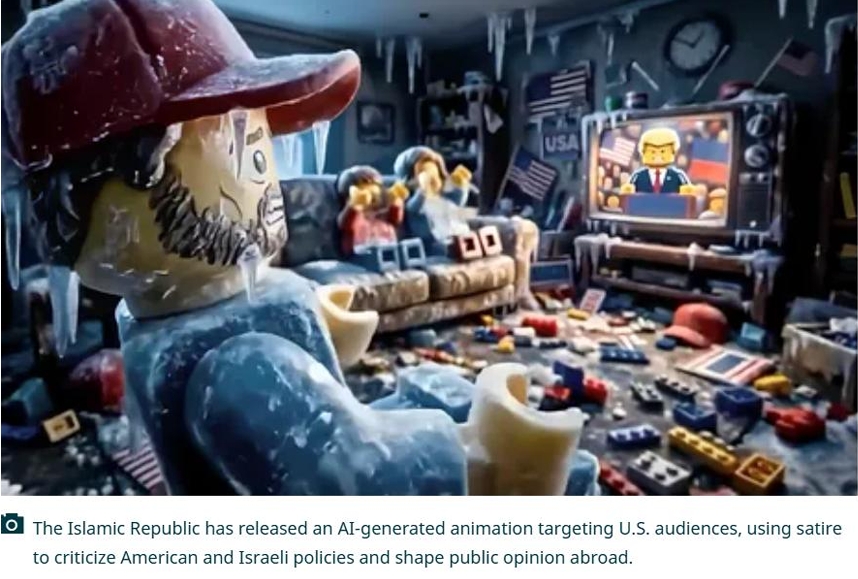
Source: Iran Wire
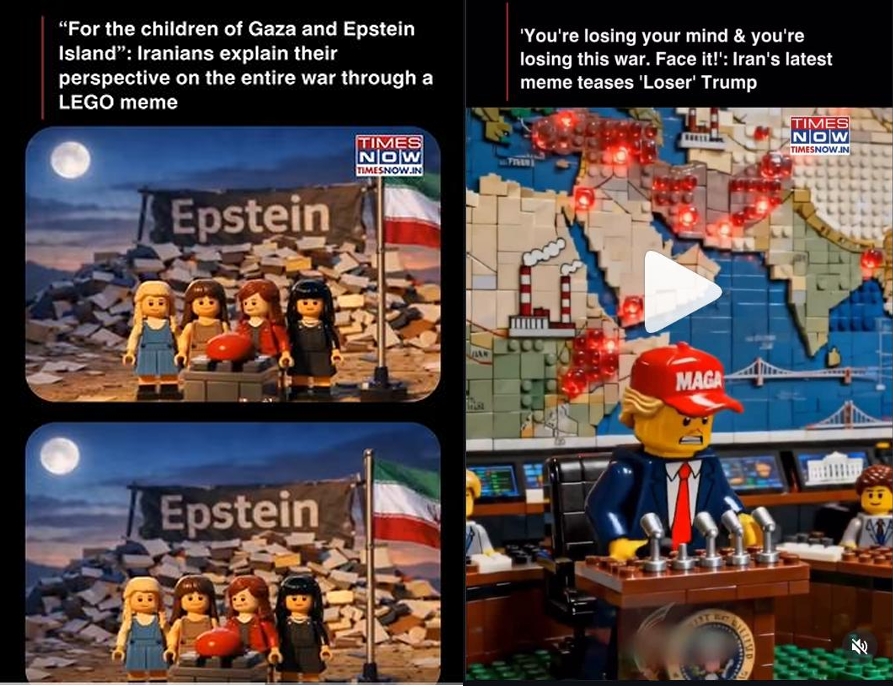
Source: Times Now
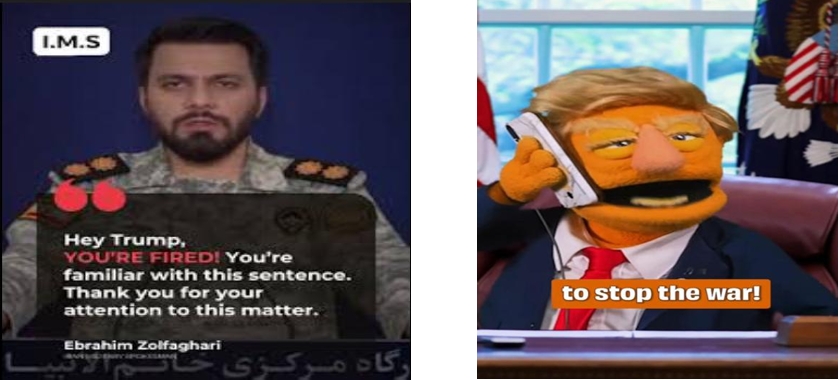
Source: Facebook Source: The New York Times
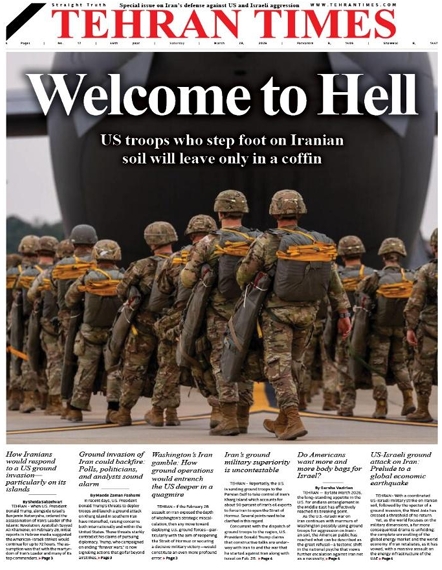
At the same time, Iran has pushed more traditional deterrence narratives through state media. Claims that the country could mobilise more than one million troops, alongside warnings of “historic hell” for US forces, aim to inflate the perceived cost of escalation.
Source: Tehran Times
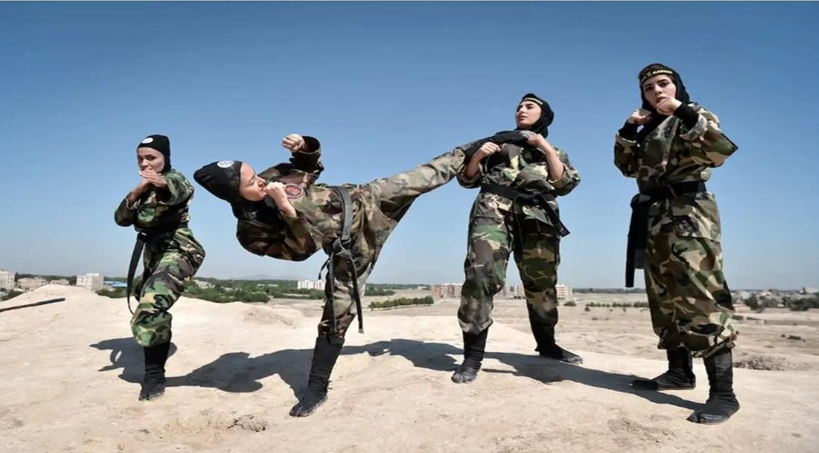
Parallel campaigns, such as footage of Iranian women training for combat, project national unity and resilience. Together, these outputs form a coordinated information warfare strategy.
Source: Middle East Monitor
The American Counter-Narrative: “Slopaganda” from the White House
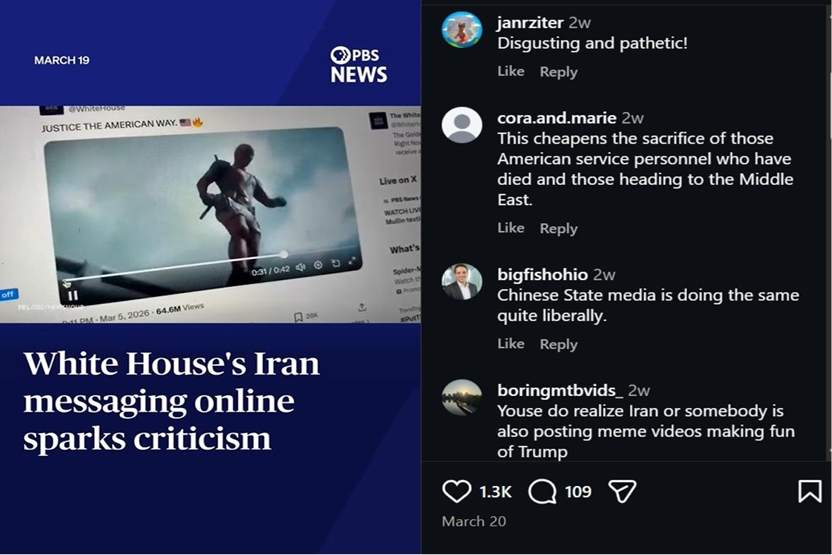
The US has also used pop culture in its messaging, but this approach has been widely criticised. The White House released videos mixing war footage with clips from movies, TV shows, and video games, along with music and dramatic effects. These videos show only successful strikes, with no damage or casualties, and focus heavily on American weapons and leadership. This style has been dubbed “slopaganda” because it comes across as exaggerated and unrealistic.
Source: Instagram
Audience Impact and the Attention Economy of War
In terms of effectiveness, the American counter-narrative appears weaker than Iran’s. US messaging is mainly aimed at its own people to build support for the war, but this has had limited success.
In contrast, Iran’s content is more targeted and uses humour effectively. As a result, Iran’s propaganda feels more relevant and engaging, whereas the US approach appears outdated and less impactful.
The downstream effects of memes and Artificial Intelligence Generated propaganda on audiences are politically consequential. War itself is being absorbed into the attention economy by becoming part of the same algorithmic stream as clips from shows, movies, and games. The White House’s own Braveheart and Mortal Kombat propaganda productions, and Iran’s Lego and Teletubby videos, inhabit the same platform spaces, and are governed by the same recommendation algorithms as entertainment content.
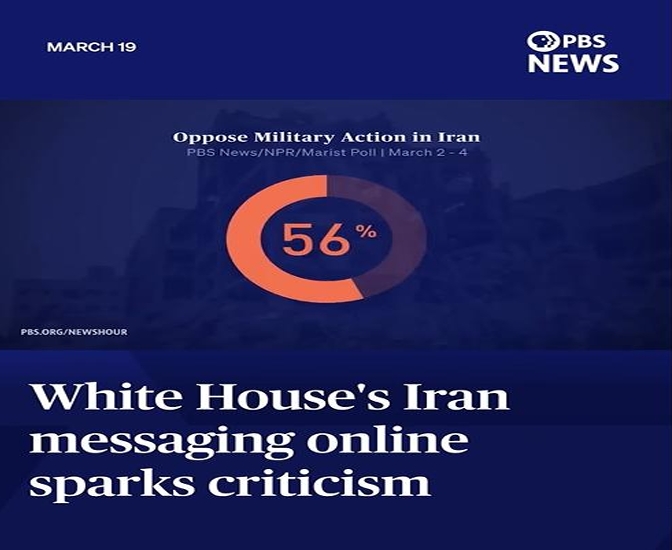
The trolling has shifted from grassroots internet culture to the centre of global politics, a shift that began with Trump. Ipsos polling shows that US public opinion is “overwhelmingly” against the war in Iran. Targeting younger audiences through formats optimised for TikTok and short-form video consumption ensures that the demographic least likely to encounter institutional media is the one most saturated with Iranian propaganda.
Source: Instagram
Brooking’s observation that “Americans are not used to seeing messages from a country the US is bombing that are directed at them” is itself a strategic insight that Iran’s information apparatus has operationalised with considerable skill.
Policy Implications
The information environment of the Iran-Israel-US conflict demands a structural response across three domains.
First, platform accountability must be redesigned for conflict contexts. The current posture of X, Meta, and TikTok – effectively one of non-intervention during an active war featuring documented state influence operations – is not neutral. It is a policy choice with strategic consequences, and democratic governments must be prepared to demand emergency content governance protocols verified through independent civil society monitoring.
Second, media literacy must be reconceptualised for the AI age. Traditional fact-checking literacy, focused on identifying misattributed or recycled content, is insufficient when adversaries produce original synthetic media in the visual style of beloved Western animation and pop culture.
The France 24 investigation into Iran’s information war found that disinformation researchers consider this the first conflict in which AI has been used intentionally and at scale to sow chaos, underscoring that the public’s existing media literacy tools are structurally inadequate for this environment.
Third, states must develop a counter-influence doctrine without replicating the epistemic damage caused by the actors they seek to counter. The White House’s gamification of war communication may achieve short-term domestic mobilisation.
But credibility, once degraded, is extraordinarily difficult to restore, and America’s long-term information power rests on the perception that its communications are more trustworthy, not merely louder, than its adversaries’.
Conclusion
The Iran-Israel-US conflict has established a new benchmark for the integration of artificial intelligence, memetic satire, and narrative warfare with the conduct of interstate conflict. A Lego-animated Trump and an IRGC general delivering a corporate dismissal in English are not fringe curiosities but data points in a structured, deliberate, and empirically measurable information campaign with clearly identifiable strategic objectives. The cognitive battlefield is no longer a secondary theatre; it is a primary arena where political will, public legitimacy, and epistemic trust are the objectives of sustained and sophisticated attack.
About the Author
Dr Soumya Awasthi is a Fellow at the Centre for Security, Strategy and Technology, Observer Research Foundation, India. Her work focuses on the intersection of technology and national security, counterterrorism, de-radicalisation, South Asian strategic studies, Afghanistan, and India’s defence and strategic policy. She holds a Doctorate from the School of International Studies (SIS) at Jawaharlal Nehru University. She is the author of several books, including the most recent, “Diverse Narratives and Shared Beliefs – Classical to Hybrid Deoband Islam in South Asia (Routledge, 2025)”.
SYNOPSIS
Iran’s information war against the United States employs AI-driven propaganda, cyber operations, and perception management to exploit societal divisions. Through strategic timing and platform-specific tactics, Iran contrasts US communication models with an objective to influence public opinion, undermine trust, and achieve cognitive and geopolitical advantages.
COMMENTARY
When the United States and Israel launched coordinated strikes on Iran in February 2026, they initiated not only kinetic but also cognitive operations. Alongside missiles and drone formations, these nations have engaged in a sustained and increasingly sophisticated information campaign that is reshaping how audiences worldwide perceive, process, and assign moral weight to the war.
What distinguishes this conflict from its predecessors is not merely the presence of propaganda but the unprecedented integration of generative artificial intelligence, platform-native content formats, and state-directed memetic operations into a coherent, real-time information warfare doctrine.
The world is witnessing an AI Slop Propaganda War, with the information domain constituting part of the conflict, alongside land, sea, air, and cyber operations. In the Iran-Israel-US war, this dimension has found its most operationally mature expression to date.
The Architecture of State-Directed Cognitive Warfare
Iran’s approach is particularly instructive, with its strategic communications reflecting a multilayered doctrine that has shifted from religious-ideological propaganda to operational, multidimensional information warfare.
Iran’s approach combines official state media, covert social media influence networks, and an increasing use of AI tools for audiences in the US, Israel, the Arab states, especially its Gulf neighbours, and the Iranian public itself. This multi-audience architecture is characterised by reflexive control, which seems to feed adversaries carefully curated information to induce decisions favourable to the Iranians and to deter regional partners from supporting the US-Israel coalition.
While the United States has focused its propaganda primarily on domestic audiences, Iranian content is deliberately aimed at spreading its messages globally. This strategic asymmetry reveals Tehran’s sophisticated understanding of how it could fracture the political will of its adversaries from within.
The most analytically underappreciated dimension of the current information campaigns is the creative sophistication of propaganda outputs. Iran’s information apparatus has produced a documented and catalogued body of content that warrants close examination, given the strategic nature of its format choices.
Military Messaging via Memes
Iran has deployed a range of striking propaganda formats during the conflict, many powered by AI and tailored for global audiences. One widely discussed example is a Lego-style “multiverse” video showing miniature figures of US President Donald Trump and Israeli Prime Minister Benjamin Netanyahu being attacked by Iranian forces, set to AI-generated rap music and ending with a warning message aimed at the United States.
Similarly, a satirical clip portrays Trump as a Teletubby playing with toy jets in the Oval Office, deliberately framing US leadership as childish and unserious. Alongside these, a real (non-AI) video of Islamic Revolutionary Guard Corp (IRGC) spokesman Ebrahim Zolfaghari declaring “Hey Trump, you are fired!” uses American pop-culture language to deliver a direct political message, making it highly shareable across global social media platforms.
Source: Iran Wire
Source: Times Now
Source: Facebook Source: The New York Times
At the same time, Iran has pushed more traditional deterrence narratives through state media. Claims that the country could mobilise more than one million troops, alongside warnings of “historic hell” for US forces, aim to inflate the perceived cost of escalation.
Source: Tehran Times
Parallel campaigns, such as footage of Iranian women training for combat, project national unity and resilience. Together, these outputs form a coordinated information warfare strategy.
Source: Middle East Monitor
The American Counter-Narrative: “Slopaganda” from the White House
The US has also used pop culture in its messaging, but this approach has been widely criticised. The White House released videos mixing war footage with clips from movies, TV shows, and video games, along with music and dramatic effects. These videos show only successful strikes, with no damage or casualties, and focus heavily on American weapons and leadership. This style has been dubbed “slopaganda” because it comes across as exaggerated and unrealistic.
Source: Instagram
Audience Impact and the Attention Economy of War
In terms of effectiveness, the American counter-narrative appears weaker than Iran’s. US messaging is mainly aimed at its own people to build support for the war, but this has had limited success.
In contrast, Iran’s content is more targeted and uses humour effectively. As a result, Iran’s propaganda feels more relevant and engaging, whereas the US approach appears outdated and less impactful.
The downstream effects of memes and Artificial Intelligence Generated propaganda on audiences are politically consequential. War itself is being absorbed into the attention economy by becoming part of the same algorithmic stream as clips from shows, movies, and games. The White House’s own Braveheart and Mortal Kombat propaganda productions, and Iran’s Lego and Teletubby videos, inhabit the same platform spaces, and are governed by the same recommendation algorithms as entertainment content.
The trolling has shifted from grassroots internet culture to the centre of global politics, a shift that began with Trump. Ipsos polling shows that US public opinion is “overwhelmingly” against the war in Iran. Targeting younger audiences through formats optimised for TikTok and short-form video consumption ensures that the demographic least likely to encounter institutional media is the one most saturated with Iranian propaganda.
Source: Instagram
Brooking’s observation that “Americans are not used to seeing messages from a country the US is bombing that are directed at them” is itself a strategic insight that Iran’s information apparatus has operationalised with considerable skill.
Policy Implications
The information environment of the Iran-Israel-US conflict demands a structural response across three domains.
First, platform accountability must be redesigned for conflict contexts. The current posture of X, Meta, and TikTok – effectively one of non-intervention during an active war featuring documented state influence operations – is not neutral. It is a policy choice with strategic consequences, and democratic governments must be prepared to demand emergency content governance protocols verified through independent civil society monitoring.
Second, media literacy must be reconceptualised for the AI age. Traditional fact-checking literacy, focused on identifying misattributed or recycled content, is insufficient when adversaries produce original synthetic media in the visual style of beloved Western animation and pop culture.
The France 24 investigation into Iran’s information war found that disinformation researchers consider this the first conflict in which AI has been used intentionally and at scale to sow chaos, underscoring that the public’s existing media literacy tools are structurally inadequate for this environment.
Third, states must develop a counter-influence doctrine without replicating the epistemic damage caused by the actors they seek to counter. The White House’s gamification of war communication may achieve short-term domestic mobilisation.
But credibility, once degraded, is extraordinarily difficult to restore, and America’s long-term information power rests on the perception that its communications are more trustworthy, not merely louder, than its adversaries’.
Conclusion
The Iran-Israel-US conflict has established a new benchmark for the integration of artificial intelligence, memetic satire, and narrative warfare with the conduct of interstate conflict. A Lego-animated Trump and an IRGC general delivering a corporate dismissal in English are not fringe curiosities but data points in a structured, deliberate, and empirically measurable information campaign with clearly identifiable strategic objectives. The cognitive battlefield is no longer a secondary theatre; it is a primary arena where political will, public legitimacy, and epistemic trust are the objectives of sustained and sophisticated attack.
About the Author
Dr Soumya Awasthi is a Fellow at the Centre for Security, Strategy and Technology, Observer Research Foundation, India. Her work focuses on the intersection of technology and national security, counterterrorism, de-radicalisation, South Asian strategic studies, Afghanistan, and India’s defence and strategic policy. She holds a Doctorate from the School of International Studies (SIS) at Jawaharlal Nehru University. She is the author of several books, including the most recent, “Diverse Narratives and Shared Beliefs – Classical to Hybrid Deoband Islam in South Asia (Routledge, 2025)”.


