


22 July 2026
NTS Bulletin July 2026

ASCC 2045: Low-wage Labour Migration and AI
Danielle Lynn Goh
The ASEAN Community Vision 2045 outlines the region’s aspirations to develop resilience, innovation and people-centredness amid a changing and more fractured global order. As part of its ambitious strategy to address existing and future ‘megatrends’, the vision looks to position the region to bolster its relevance as a global player. In the coming decades, labour migration will continue to form an integral role in realising the ASCC 2045. Of the emerging ‘megatrends’ identified, artificial intelligence (AI) will have a large impact on the future trajectory of work, and on labour migration.
Labour migration is a key driver of economic development in the region, and deeper integration across ASEAN can address issues of labour shortages, unemployment and poverty reduction. This is demonstrated through the emphasis of ASCC 2045 on the protection of migrant workers.
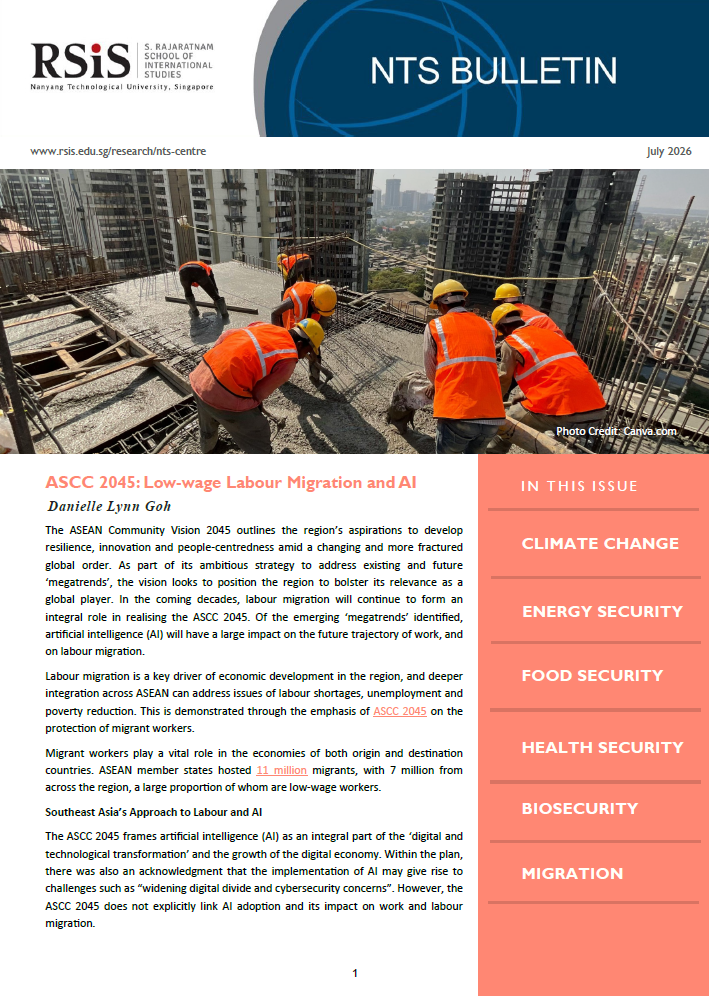
Migrant workers play a vital role in the economies of both origin and destination countries. ASEAN member states hosted 11 million migrants, with 7 million from across the region, a large proportion of whom are low-wage workers.
Southeast Asia’s Approach to Labour and AI
The ASCC 2045 frames artificial intelligence (AI) as an integral part of the ‘digital and technological transformation’ and the growth of the digital economy. Within the plan, there was also an acknowledgment that the implementation of AI may give rise to challenges such as “widening digital divide and cybersecurity concerns”. However, the ASCC 2045 does not explicitly link AI adoption and its impact on work and labour migration.
The 2024 ASEAN Guide on AI Ethics and Governance provides a more comprehensive engagement of AI and its implications on labour. While regional guidelines are nonbinding in nature, several ASEAN member states, including Singapore, Malaysia and Brunei are working toward the establishment of formal AI laws. More recently, in March 2026, Vietnam passed a regulation to address the risks posed by generative AI. Southeast Asia’s current approach to AI and labour are less fixated on the protection of jobs or workers, but rather on upskilling and addressing the misuse of AI such as deepfakes and in misinformation.
With the acceleration of AI adoption in the region, there have been concerns and anxieties about job displacement. However, the reality on the ground has demonstrated that there is no clear evidence yet that AI adoption has led to job losses on a large-scale in Southeast Asia. AI exposure is also unevenly distributed, depending on the region, sector and jobs. According to the International Labour Organization (ILO), only 3.3 percent of employment have the highest levels of exposure to generative AI. Occupations with high generative AI exposure are more concentrated on clerical industries, data entry and in finance sectors, affecting work that can be largely automated. Conversely, AI can be used to augment jobs and as tools to enhance work processes and create new employment opportunities in the development of AI technologies, however these gains are likely to be available to high-skilled workers.
Impact of AI on Low-wage Migrant Labour
The workforce has already been shaped by the emergence of AI. With increasing AI adoption, the implications of its use extend across the board of both high-skilled and low-skilled jobs. What has been less discussed are the implications of AI on low-wage migrant workers, with a significant number working in domestic work, manufacturing and construction. Low-wage migrant workers in these industries, particularly in construction and domestic work, are unlikely to be affected by job displacement, as compared to other sectors. However, the acceleration of AI, may aggravate the digital disparity that low-wage migrant workers face. Low-wage migrant workers are particularly at risk amid technological shifts, and this may result in a widened skills gap, as the new roles or skillsets driven by AI innovation require resources and educational background that low-wage migrant workers may lack. Access to AI training or upskilling programmes could also be limited or unavailable to low-wage migrant
workers, resulting in an exacerbation of the digital divide which disproportionately impacts them. Already, low-wage migrant workers face precarity with high recruitment fees, limited job mobility and wage stagnation.
At the same time, work that involves repetitive tasks such as product assembly, packaging and call centres are more exposed to the risk of automation. A 2025 UNDP report cautioned that AI could widen inequality between lower-income and higher-income countries and highlighted that women and youth are disproportionately impacted by automation, for example in factories, call centres and the garment industry.
Way Forward
AI adoption in the region has accelerated rapidly and is bound to shape the workforce and low-wage labour migration. The ASCC 2045 reflects the need for greater regional cooperation and national efforts to AI governance. Taken together with the 2024 guidelines, AI governance needs to be informed by a people-centred approach, considering the issues related to ethics, labour and social protections, and to pay closer attention to the impacts on low-wage migrant workers. To prevent a further widening of the digital gap, more opportunities should be made available for AI upskilling and reskilling. As ASEAN countries gradually build up their AI governance infrastructure, inclusivity of low-wage migrant workers in these discussions is necessary to ensure that there are sufficient legal protections and safeguards that will prevent further harms to their livelihoods, dignity and well-being.
ASCC 2045: Low-wage Labour Migration and AI
Danielle Lynn Goh
The ASEAN Community Vision 2045 outlines the region’s aspirations to develop resilience, innovation and people-centredness amid a changing and more fractured global order. As part of its ambitious strategy to address existing and future ‘megatrends’, the vision looks to position the region to bolster its relevance as a global player. In the coming decades, labour migration will continue to form an integral role in realising the ASCC 2045. Of the emerging ‘megatrends’ identified, artificial intelligence (AI) will have a large impact on the future trajectory of work, and on labour migration.
Labour migration is a key driver of economic development in the region, and deeper integration across ASEAN can address issues of labour shortages, unemployment and poverty reduction. This is demonstrated through the emphasis of ASCC 2045 on the protection of migrant workers.
Migrant workers play a vital role in the economies of both origin and destination countries. ASEAN member states hosted 11 million migrants, with 7 million from across the region, a large proportion of whom are low-wage workers.
Southeast Asia’s Approach to Labour and AI
The ASCC 2045 frames artificial intelligence (AI) as an integral part of the ‘digital and technological transformation’ and the growth of the digital economy. Within the plan, there was also an acknowledgment that the implementation of AI may give rise to challenges such as “widening digital divide and cybersecurity concerns”. However, the ASCC 2045 does not explicitly link AI adoption and its impact on work and labour migration.
The 2024 ASEAN Guide on AI Ethics and Governance provides a more comprehensive engagement of AI and its implications on labour. While regional guidelines are nonbinding in nature, several ASEAN member states, including Singapore, Malaysia and Brunei are working toward the establishment of formal AI laws. More recently, in March 2026, Vietnam passed a regulation to address the risks posed by generative AI. Southeast Asia’s current approach to AI and labour are less fixated on the protection of jobs or workers, but rather on upskilling and addressing the misuse of AI such as deepfakes and in misinformation.
With the acceleration of AI adoption in the region, there have been concerns and anxieties about job displacement. However, the reality on the ground has demonstrated that there is no clear evidence yet that AI adoption has led to job losses on a large-scale in Southeast Asia. AI exposure is also unevenly distributed, depending on the region, sector and jobs. According to the International Labour Organization (ILO), only 3.3 percent of employment have the highest levels of exposure to generative AI. Occupations with high generative AI exposure are more concentrated on clerical industries, data entry and in finance sectors, affecting work that can be largely automated. Conversely, AI can be used to augment jobs and as tools to enhance work processes and create new employment opportunities in the development of AI technologies, however these gains are likely to be available to high-skilled workers.
Impact of AI on Low-wage Migrant Labour
The workforce has already been shaped by the emergence of AI. With increasing AI adoption, the implications of its use extend across the board of both high-skilled and low-skilled jobs. What has been less discussed are the implications of AI on low-wage migrant workers, with a significant number working in domestic work, manufacturing and construction. Low-wage migrant workers in these industries, particularly in construction and domestic work, are unlikely to be affected by job displacement, as compared to other sectors. However, the acceleration of AI, may aggravate the digital disparity that low-wage migrant workers face. Low-wage migrant workers are particularly at risk amid technological shifts, and this may result in a widened skills gap, as the new roles or skillsets driven by AI innovation require resources and educational background that low-wage migrant workers may lack. Access to AI training or upskilling programmes could also be limited or unavailable to low-wage migrant
workers, resulting in an exacerbation of the digital divide which disproportionately impacts them. Already, low-wage migrant workers face precarity with high recruitment fees, limited job mobility and wage stagnation.
At the same time, work that involves repetitive tasks such as product assembly, packaging and call centres are more exposed to the risk of automation. A 2025 UNDP report cautioned that AI could widen inequality between lower-income and higher-income countries and highlighted that women and youth are disproportionately impacted by automation, for example in factories, call centres and the garment industry.
Way Forward
AI adoption in the region has accelerated rapidly and is bound to shape the workforce and low-wage labour migration. The ASCC 2045 reflects the need for greater regional cooperation and national efforts to AI governance. Taken together with the 2024 guidelines, AI governance needs to be informed by a people-centred approach, considering the issues related to ethics, labour and social protections, and to pay closer attention to the impacts on low-wage migrant workers. To prevent a further widening of the digital gap, more opportunities should be made available for AI upskilling and reskilling. As ASEAN countries gradually build up their AI governance infrastructure, inclusivity of low-wage migrant workers in these discussions is necessary to ensure that there are sufficient legal protections and safeguards that will prevent further harms to their livelihoods, dignity and well-being.