


20 April 2026
CO26085 | Peace in Motion: A Buddhist Journey for Social Cohesion in a Divided World

SYNOPSIS
A 3,700-km Buddhist peace walk across the United States is doing more than drawing attention. It offers a quietly powerful model for reflection, showing how embodied, community-based practices can meaningfully deepen social cohesion while complementing formal inter-religious structures.
COMMENTARY
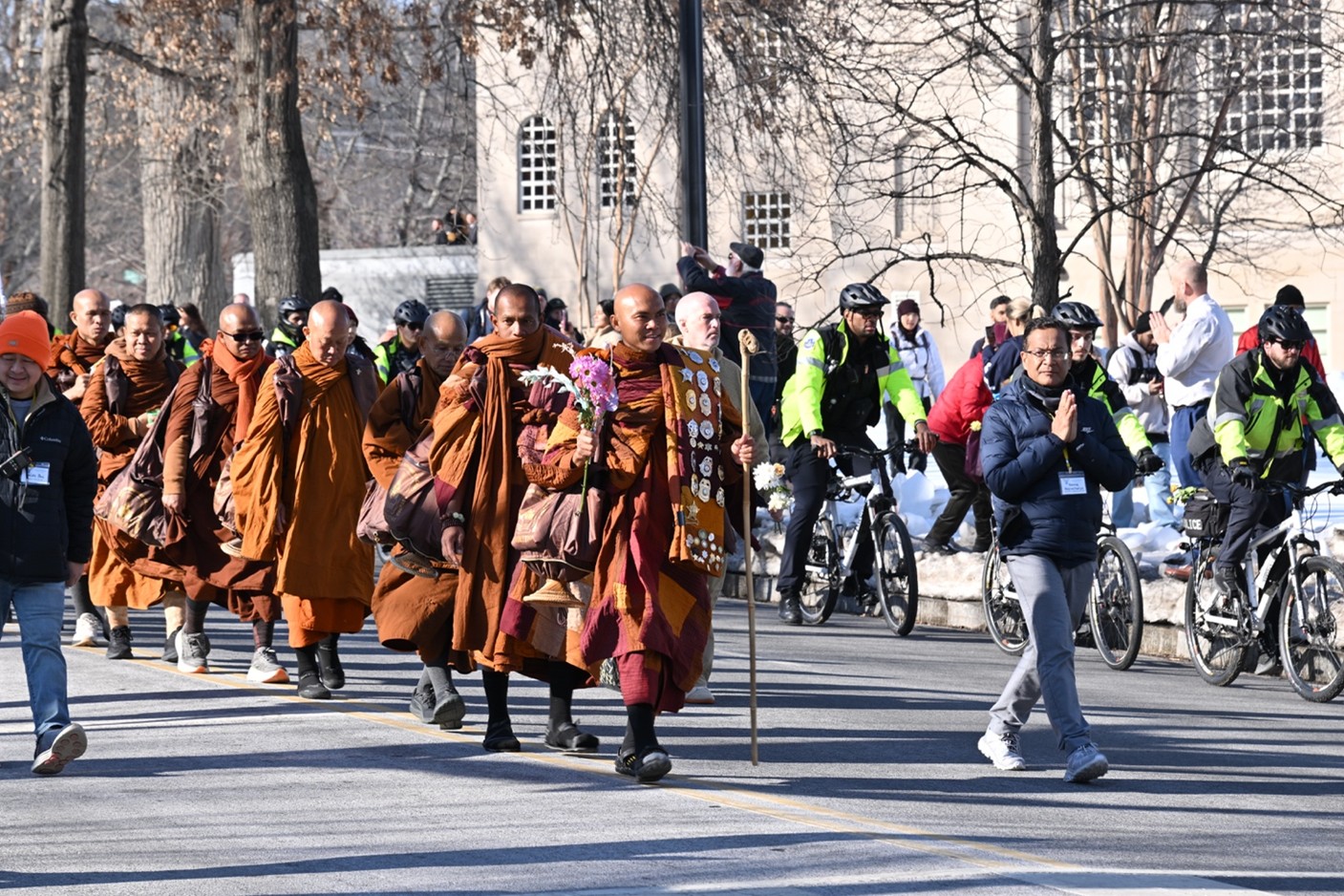
The recent Walk for Peace, a 108-day journey from 26 October 2025 to 10 February 2026, undertaken by Buddhist monastics in the United States, has drawn significant media attention. Initiated by monks from the Hương Đạo Vipassana Bhavana Center in Fort Worth, Texas, and joined by monastics from other temples, the group set out on a demanding 3,700-km journey to Washington, D.C., accompanied by a rescue dog named Aloka. The scale alone was striking. Their daily pace often exceeded 32 km. Along the way, the weather shifted, traffic thundered past, and the United States continued to argue with itself, driven by profound internal divisions.
For more than one hundred days, they moved along highways, and through suburbs and small towns. Their robes stood out against the asphalt and open sky. Strangers stopped to ask questions. Local communities, regardless of race or religion, offered meals, water, and shelter. Local and international media carried images of the pilgrimage far beyond the roadside.
Yet to describe the journey as remarkable only because of its length would miss its deeper significance. It would be easy to frame the Walk for Peace as an endurance story or a religious curiosity. But that perspective flattens what made the journey resonate. The walk mattered to Americans, global audiences, and policymakers not because it was novel, but because it redeployed a familiar Buddhist practice with unusual clarity in the public life of contemporary America. It turned discipline into a visible civic gesture.
In doing so, it is quietly reshaping how communities live in and experience a divided world.
A Tradition of Walking
Long-distance walking as a spiritual discipline has deep roots in Buddhist history. The seventh-century monk Xuanzang journeyed from China to India in search of scriptures, crossing deserts and mountains on a pilgrimage that later became emblematic of civilisational exchange. Yet his journey was not merely a long trip; It was an act of endurance and exposure to hardship, sustained by spiritual encounters, hospitality, and risk.
There is also a US precedent. In the late 1970s, Heng Sure and Heng Ch’au undertook their “Three Steps, One Bow” pilgrimage from Los Angeles to the City of Ten Thousand Buddhas in Northern California. Their slow, methodical progress brought Buddhist ascetic discipline into the American landscape. Highways became sites of encounters.
The Walk for Peace belongs to this long-standing Buddhist tradition of long-distance travel. Like earlier pilgrimages, it draws on an ancient discipline in which walking becomes both spiritual cultivation and a demonstration of faith through action and not just words. It situates moral commitment within shared landscapes, transforming roads and highways into spaces of encounter. In this sense, walking, rooted in the Buddha’s teaching journeys on foot in ancient India, is not merely a means of travel or endurance, but a disciplined spiritual practice with social meaning.
Why the Walk Captured Attention
Three dynamics help explain why the walk resonated so widely.
First, representation. For years, popular portrayals of American Buddhism tended to centre on converted communities. Recent works by scholars and Buddhist writers have sought to correct that partial picture. Demographically, most Buddhists in the United States are of Asian descent. The Walk for Peace made Asian American Buddhist life publicly visible and without polemic.
Led by Asian American monastics, the procession of saffron-robed figures moved steadily through towns where few residents may have encountered such figures before. The pilgrimage did not seek recognition. It enacted presence. In a society where minority communities often enter public discourse through crisis or controversy, this offered a different image: disciplined, calm, and self-possessed.
Second, timing. The journey unfolded amid heightened social tension in the United States. The country today is marked by sharp political polarisation, contentious debates over migration and citizenship, and a digital environment that favours quick responses and scandals. Images of confrontation circulate rapidly. Language hardens. Public life often unfolds through amplification and reaction.
Against this backdrop, the monks chose to walk slowly. They accepted offerings. They responded with gratitude. Their discipline became visible in spaces not typically associated with contemplative practice: highways, petrol stations, suburban sidewalks. Peace was not proclaimed only at the destination. It was practised into being, step by step.
In such an atmosphere, composure stood out. Observers frequently described the walk as refreshing. That response suggests how rare visible calm has become in public life. The monks’ steady pace introduced a different rhythm into civic space.
Third, human connection. No pilgrimage of this scale happens through individual will alone. Every kilometre relied on networks of generosity. Individuals offered food, water, medical care, logistical help, or a place to sleep. Over time, what appeared on a map as a line between two cities became a chain of relationships among strangers.
In a digital age defined by speed, when much social interaction is mediated through screens, the walk invited people to slow down and fostered direct, embodied encounters. Offerings were made. Gratitude was expressed. Communities that might never visit a Buddhist temple nonetheless found themselves drawn into the pilgrimage’s unfolding moral world.
Implications for the United States
Historically, journeys like this rarely produce immediate political transformation. Xuanzang did not resolve the conflicts of his era, nor did the “Three Steps, One Bow” pilgrimage end the turbulence in the United States in the 1970s.
But religious traditions often work through exemplarity. Images endure. Memory accumulates slowly. The sight of disciplined walking sustained over thousands of kilometres can broaden the range of imaginable responses to division and can recalibrate what counts as civic action. Not every intervention needs to be loud to matter.
In a divided society, exemplarity matters. The Walk for Peace expands the repertoire of participation. It demonstrates that minority religious communities can shape national conversations not only through peace activism but also through embodied presence. It reminds citizens that engagement need not always be adversarial. Slow, disciplined action can reshape the moral texture of public space.
Globally, the walk resonates because many societies face similar pressures: political polarisation, anxiety about migration, social mistrust, and digital fragmentation. In these contexts, embodied practices that cultivate restraint and generosity take on renewed relevance. Peace becomes a language that travels across borders.
Lessons for Singapore
For a small, multi-religious country like Singapore, the Walk for Peace invites reflection on community development and on policy formulation.
Singapore has invested heavily in institutional frameworks to foster inter-religious harmony. Dialogue platforms, community initiatives, and regulatory safeguards form part of a carefully managed system. These structures are essential. Yet the walk suggests that alongside institutional mechanisms, grassroots encounters and collaborations also matter.
Shared acts such as walking together, volunteering across communities, and participating in joint services’ projects can cultivate trust in ways that formal dialogue alone cannot. When communities engage in visible, disciplined cooperation, they generate shared memory and mutual recognition.
The pilgrimage also highlights the value of tempo. Singapore is often associated with efficiency and rapid development. Yet civic life benefits from spaces and initiatives that encourage real-life interaction rather than mere transit and speed. Interfaith heritage walks, community pilgrimages, and cross-cultural service efforts can slow citizens down long enough to engage meaningfully.
In a fractured world, a peace walk shows that division can be healed step by step across the ground we share. In that slow crossing of shared ground lies a quiet truth: The future of divided societies may depend less on louder arguments than on who is willing to keep walking together.
About the Author
Jack Meng-Tat Chia is the Foo Hai Associate Professor in Buddhist Studies at the National University of Singapore, where he serves as the founding chair of the Buddhist Studies Group.
SYNOPSIS
A 3,700-km Buddhist peace walk across the United States is doing more than drawing attention. It offers a quietly powerful model for reflection, showing how embodied, community-based practices can meaningfully deepen social cohesion while complementing formal inter-religious structures.
COMMENTARY
The recent Walk for Peace, a 108-day journey from 26 October 2025 to 10 February 2026, undertaken by Buddhist monastics in the United States, has drawn significant media attention. Initiated by monks from the Hương Đạo Vipassana Bhavana Center in Fort Worth, Texas, and joined by monastics from other temples, the group set out on a demanding 3,700-km journey to Washington, D.C., accompanied by a rescue dog named Aloka. The scale alone was striking. Their daily pace often exceeded 32 km. Along the way, the weather shifted, traffic thundered past, and the United States continued to argue with itself, driven by profound internal divisions.
For more than one hundred days, they moved along highways, and through suburbs and small towns. Their robes stood out against the asphalt and open sky. Strangers stopped to ask questions. Local communities, regardless of race or religion, offered meals, water, and shelter. Local and international media carried images of the pilgrimage far beyond the roadside.
Yet to describe the journey as remarkable only because of its length would miss its deeper significance. It would be easy to frame the Walk for Peace as an endurance story or a religious curiosity. But that perspective flattens what made the journey resonate. The walk mattered to Americans, global audiences, and policymakers not because it was novel, but because it redeployed a familiar Buddhist practice with unusual clarity in the public life of contemporary America. It turned discipline into a visible civic gesture.
In doing so, it is quietly reshaping how communities live in and experience a divided world.
A Tradition of Walking
Long-distance walking as a spiritual discipline has deep roots in Buddhist history. The seventh-century monk Xuanzang journeyed from China to India in search of scriptures, crossing deserts and mountains on a pilgrimage that later became emblematic of civilisational exchange. Yet his journey was not merely a long trip; It was an act of endurance and exposure to hardship, sustained by spiritual encounters, hospitality, and risk.
There is also a US precedent. In the late 1970s, Heng Sure and Heng Ch’au undertook their “Three Steps, One Bow” pilgrimage from Los Angeles to the City of Ten Thousand Buddhas in Northern California. Their slow, methodical progress brought Buddhist ascetic discipline into the American landscape. Highways became sites of encounters.
The Walk for Peace belongs to this long-standing Buddhist tradition of long-distance travel. Like earlier pilgrimages, it draws on an ancient discipline in which walking becomes both spiritual cultivation and a demonstration of faith through action and not just words. It situates moral commitment within shared landscapes, transforming roads and highways into spaces of encounter. In this sense, walking, rooted in the Buddha’s teaching journeys on foot in ancient India, is not merely a means of travel or endurance, but a disciplined spiritual practice with social meaning.
Why the Walk Captured Attention
Three dynamics help explain why the walk resonated so widely.
First, representation. For years, popular portrayals of American Buddhism tended to centre on converted communities. Recent works by scholars and Buddhist writers have sought to correct that partial picture. Demographically, most Buddhists in the United States are of Asian descent. The Walk for Peace made Asian American Buddhist life publicly visible and without polemic.
Led by Asian American monastics, the procession of saffron-robed figures moved steadily through towns where few residents may have encountered such figures before. The pilgrimage did not seek recognition. It enacted presence. In a society where minority communities often enter public discourse through crisis or controversy, this offered a different image: disciplined, calm, and self-possessed.
Second, timing. The journey unfolded amid heightened social tension in the United States. The country today is marked by sharp political polarisation, contentious debates over migration and citizenship, and a digital environment that favours quick responses and scandals. Images of confrontation circulate rapidly. Language hardens. Public life often unfolds through amplification and reaction.
Against this backdrop, the monks chose to walk slowly. They accepted offerings. They responded with gratitude. Their discipline became visible in spaces not typically associated with contemplative practice: highways, petrol stations, suburban sidewalks. Peace was not proclaimed only at the destination. It was practised into being, step by step.
In such an atmosphere, composure stood out. Observers frequently described the walk as refreshing. That response suggests how rare visible calm has become in public life. The monks’ steady pace introduced a different rhythm into civic space.
Third, human connection. No pilgrimage of this scale happens through individual will alone. Every kilometre relied on networks of generosity. Individuals offered food, water, medical care, logistical help, or a place to sleep. Over time, what appeared on a map as a line between two cities became a chain of relationships among strangers.
In a digital age defined by speed, when much social interaction is mediated through screens, the walk invited people to slow down and fostered direct, embodied encounters. Offerings were made. Gratitude was expressed. Communities that might never visit a Buddhist temple nonetheless found themselves drawn into the pilgrimage’s unfolding moral world.
Implications for the United States
Historically, journeys like this rarely produce immediate political transformation. Xuanzang did not resolve the conflicts of his era, nor did the “Three Steps, One Bow” pilgrimage end the turbulence in the United States in the 1970s.
But religious traditions often work through exemplarity. Images endure. Memory accumulates slowly. The sight of disciplined walking sustained over thousands of kilometres can broaden the range of imaginable responses to division and can recalibrate what counts as civic action. Not every intervention needs to be loud to matter.
In a divided society, exemplarity matters. The Walk for Peace expands the repertoire of participation. It demonstrates that minority religious communities can shape national conversations not only through peace activism but also through embodied presence. It reminds citizens that engagement need not always be adversarial. Slow, disciplined action can reshape the moral texture of public space.
Globally, the walk resonates because many societies face similar pressures: political polarisation, anxiety about migration, social mistrust, and digital fragmentation. In these contexts, embodied practices that cultivate restraint and generosity take on renewed relevance. Peace becomes a language that travels across borders.
Lessons for Singapore
For a small, multi-religious country like Singapore, the Walk for Peace invites reflection on community development and on policy formulation.
Singapore has invested heavily in institutional frameworks to foster inter-religious harmony. Dialogue platforms, community initiatives, and regulatory safeguards form part of a carefully managed system. These structures are essential. Yet the walk suggests that alongside institutional mechanisms, grassroots encounters and collaborations also matter.
Shared acts such as walking together, volunteering across communities, and participating in joint services’ projects can cultivate trust in ways that formal dialogue alone cannot. When communities engage in visible, disciplined cooperation, they generate shared memory and mutual recognition.
The pilgrimage also highlights the value of tempo. Singapore is often associated with efficiency and rapid development. Yet civic life benefits from spaces and initiatives that encourage real-life interaction rather than mere transit and speed. Interfaith heritage walks, community pilgrimages, and cross-cultural service efforts can slow citizens down long enough to engage meaningfully.
In a fractured world, a peace walk shows that division can be healed step by step across the ground we share. In that slow crossing of shared ground lies a quiet truth: The future of divided societies may depend less on louder arguments than on who is willing to keep walking together.
About the Author
Jack Meng-Tat Chia is the Foo Hai Associate Professor in Buddhist Studies at the National University of Singapore, where he serves as the founding chair of the Buddhist Studies Group.