


Understanding the Patterns of Youth Radicalisation in Indonesia
This article examines youth involvement in terrorist activities in Indonesia. Drawing on a newly constructed database developed by the author—the Indonesian Terrorist Inmate (ITI) Dataset—it analyses patterns in how young people radicalise and become involved in jihadist terrorist organisations in Indonesia. Specifically, it aims to answer three key questions: i) How frequently are youths involved in Indonesian jihadist terrorist organisations and networks? ii) Through which platforms and under whose influence, if any, do youths become involved? iii) What roles and tasks do youths take up once they join? The findings indicate that although youth participation has risen in the 2020s compared with the early 2000s, youths continue to constitute a relatively small share of the overall terrorist population relative to adults. The study also shows that while online platforms play a significant role in most cases of youth radicalisation, radicalisation rarely occurs exclusively online. Furthermore, once affiliated with a group, youths are no more likely than adults to take on operational roles.
Introduction
Indonesia continued to experience a declining threat level throughout 2025. On the one hand, Jemaah Islamiyah (JI)—once the country’s largest and most lethal pro-Al-Qaeda terrorist organisation—has consistently demonstrated its commitment to its disbandment decision in 2024. While concerns about possible dissent among members remain,[1] the group’s key leaders have continued to closely cooperate with Indonesia’s Special Detachment (Detasemen Khusus 88, Densus 88) to monitor and facilitate the reintegration of its former members.[2] On the other hand, Indonesia’s pro-Islamic State (IS) groups such as Jemaah Ansharut Daulah (JAD) have also remained operationally weak. While the network’s online activity has increased in the past year and some groups continue to pursue greater centralised coordination,[3] the broader milieu has neither carried out nor successfully inspired any attacks over the past three years.[4]
Despite this decline in the terrorism threat, by late 2025 authorities had grown increasingly alarmed about the risk of youth radicalisation and involvement in terrorist activities. This heightened attention was triggered in part by the SMAN 72 Jakarta bombing case, where a 17-year-old student detonated three explosives at a high school mosque while carrying toy guns marked with far-right extremist symbols.[5] Although police did not classify the attack as “terrorism” due to the perpetrator’s lack of political motivation,[6] it nonetheless underscored youths’ susceptibility to radical influences. Indeed, a week after the incident, Densus 88 announced that it had arrested five terrorist suspects who had attempted to recruit youths.[7] Additionally, it noted that over 110 children were identified as victims of attempted terrorist recruitment in 2025 – a stark difference from the 17 identified between 2011 and 2017.[8]
However, there is a lack of research and data examining the broad patterns of youths’ processes of joining and roles within Indonesian terrorist organisations and networks. While multiple large-scale surveys have explored Indonesian youths’ exposure to radical content or their support for violent jihad,[9] they do not clarify whether, or how, these attitudes translate to actual participation in violent terrorist organisations. When research does analyse this subject, it often relies only on a handful of case studies. While such qualitative approaches enable these studies to provide extensive detail on youths’ radicalisation processes—ranging from the role of the family,[10] online platforms[11] and the desire for personal connections[12]—they are limited in their ability to assess whether these observed patterns can be generalised across the wider population.
This article aims to address this gap by analysing the broad patterns of youth involvement in Indonesian terrorist organisations and networks. Specifically, it explores three key questions: i) How frequently are youths involved in terrorist organisations and networks? ii) Through which platforms and under whose influence, if any, do youths become involved? iii) What roles and tasks do youths take up once they join? To answer these questions, the study uses the author’s Indonesian Terrorist Inmate (ITI) dataset, which contains radicalisation and terrorist career information for over 400 terrorist suspects arrested between 2018 and 2019. Following this section, the article provides a literature review on Indonesian youth radicalisation, before analysing the broader patterns of youth involvement. It concludes with a discussion of the implications for the emerging phenomenon of memetic far-right inspired youth violence.
Literature Review: Youth Radicalisation and Participation in Terrorist Activities
The definition of “youth” varies considerably across Indonesian terrorism and radicalism studies. Under Indonesia’s Law No. 4/2009 on Youth, the term legally refers to individuals aged between 16 and 30.[13] However, existing research and surveys on youth radicalisation often narrow this range in their analysis, concentrating on specific subgroups such as “school-age youths”[14] or “university students.”[15] In some cases, studies also extend the category to include younger demographics, such as adolescents and early teenagers.[16] For the purposes of this article, the term “youth” is defined according to the legal age range (16-30) established by Indonesian law. Nonetheless, this literature review considers all relevant studies that address youth, regardless of whether they concentrate on specific sub-demographics or include younger age groups.
Most studies on Indonesian youth and terrorism largely focus on measuring the extent of youths’ exposure to radical ideologies. In this regard, most findings agree that a considerable proportion of youths have encountered, and to some degree sympathised with, extremist ideas. A 2010 survey by the Institute for Islamic and Peace Studies (Lembaga Kajian Islam dan Perdamaian, LaKIP), for example, reported that 48.9 percent of students in the Greater Jakarta area expressed support for “radical ideas”.[17] In 2017, a survey by the Wahid Foundation found similar results, indicating that approximately 40 percent of high school students involved in Islamic organisations (Rohis) supported the establishment of a caliphate in Indonesia.[18] That same year, research by the Alvara Research Center also found that 23.4 percent of university students supported the idea of Indonesia becoming a caliphate.[19]
However, while these studies may offer a broadly representative snapshot of the extent to which youths are exposed to radical ideologies, they do not indicate how many actually participate in terrorist activities. Notably, the limited research that examines youth participation in terrorism suggests that, contrary to levels of ideological exposure, their actual involvement in terrorist organisations remains relatively low.[20] Indeed, a graph published by Makruf and Pratiwi in 2012 showed that out of all terrorist suspects arrested between October 2002 and March 2003, only 22.4 percent were under the age of 30.[21] Similarly, several reports published by the National Counter Terrorism Agency (Badan Nasional Penanggulangan Terorisme, BNPT) in 2017 also noted that out of 1,800 terrorist suspects arrested between 2000 and 2017, “only 16 were children or teenagers” and just 11.8 percent of suspects were under the age of 21.[22]
This is not to suggest, however, that youth participation in terrorist organisations is a trivial concern. As a number of studies have noted, youth involvement in Indonesian terrorism has been a continuous problem for Indonesia.[23] Aside from the well-documented 2018 Surabaya Bombing attacks, which involved six children, youths have played key roles in numerous major Indonesian terrorist attacks.[24] In the 2002 Bali Bombings, for example, AH (21) and AO (22) played crucial roles in helping finance the attacks through fa’i (robbery).[25] Similarly, the 2009 JW Marriott Bombing involved two youths, namely NM (28) and DP (17), the latter of whom served as the attack’s suicide bomber.[26] In the 2015 Sarinah Bombing, police also arrested two teenagers: AB (17) who helped assemble the explosives for the attacks, and FL (14), who helped conceal information about one of the perpetrators.[27]
Another substantial body of work on Indonesian youth and terrorism focuses on unpacking how youths radicalise. In this regard, two factors have been identified as critical enablers of youth radicalisation. The first is the role of youths’ social networks, namely family and friends. As Haula Noor explains in her 2022 study, families that adhere to extremist ideologies frequently function as their children’s agents of ideological socialisation – often normalising radical identities for them from an early age before they have the chance to experience alternatives.[28] Similarly, Suyanto et. al.’s 2022 study also found that peers play a similar socialising role for older youths. As they noted, university students’ participation in radical networks was often less driven by their need to deepen religious beliefs, “but because of their need to socialise and build a broader network of relationships with their friends.”[29]
A second key factor in youth radicalisation that is often highlighted is the influence of online platforms. As Huda, Runturambi, and Syauqillah noted in their 2021 study, social media often becomes a key platform that introduces youths to radical content and gives them access to training materials.[30] More importantly, online spaces also often provide avenues, likely in the form of group chats and forums, where radicalising youths can interact with like-minded individuals and reinforce their sense of belonging to extremist ideologies.[31] In a more recent 2025 study, Ismail identifies similar dynamics in radicalisation cases involving minors. He characterises their recruitment as a “subtle, highly digitalised process” that typically begins on widely accessible public platforms before migrating to more private, encrypted messaging applications.[32] Although these studies offer detailed insights, their case study-based approach limits their ability to determine whether these patterns can be broadly generalised.
Patterns of Indonesian Youth Radicalisation and Involvement in Terrorism
Number of Youths Involved in Terrorist Activity
Data from the ITI Dataset[33] indicates that throughout 2018 and 2019, the majority of individuals arrested on terrorism charges were adults. That said, youth participation in terrorist activities was also considerable, albeit less prevalent. Notably, out of the 477 cases of terrorist arrest recorded in the dataset, 180 (40.2 percent) were reported to be aged 30 or under at the time of their arrest. A more detailed breakdown of their age indicates that most youths arrested were between 20 and 25 years old (52.2 percent), followed by those aged 26 to 30 (42.7 percent). Notably, while teenagers were also apprehended for terrorism-related activities during this period, they comprised only a minimal share of the total sample (0.5 percent).
Graph 1. Number of Indonesian Youths Arrested by Selective Year
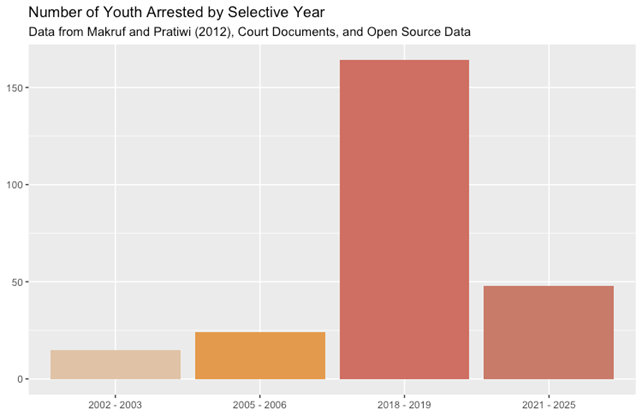
When compared with available data on terrorism arrests in the early 2000s, the ITI Dataset numbers suggest a marked rise in youth terrorist involvement in the late 2010s. Data compiled by Makruf and Pratiwi, for example, showed that between October 2002 and March 2003, police only detained 15 youths in connection with terrorist activities (see Graph 1). Similarly, from May 2005 to January 2006, just 24 youths were arrested on terrorism-related charges.[34] However, more recent arrest figures suggest that the surge in youth involvement observed in 2018-2019 may have been an outlier. Notably, of the 255 terrorism-related arrests reported between 2021 and 2025 where age data were available,[35] only 59 individuals were recorded as 30 years old or younger. While this still represents an increase compared to the early 2000s, it does not approach the notably higher figures recorded in the late 2010s.
Graph 2. Percentage of Indonesian Youths Arrested by Selective Year
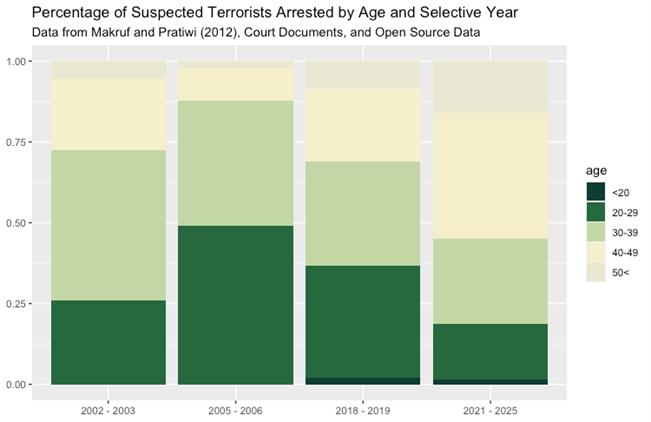
In fact, when examined in percentage terms, data suggests that youth involvement in terrorist activities has remained proportionally consistent between the early 2000s and the 2020s, despite some fluctuations in the mid-2000s and late 2010s. For instance, Makruf and Pratiwi’s data showed that, between 2002 and 2003, youths made up 25.2 percent of all terrorism-related arrests (see Graph 2).[36] Although this proportion rose to 47.9 percent between 2005 and 2006 and 40.2 percent between 2018 and 2019, it declined again in the 2020s, with youths only accounting for 23.1 percent of all recorded terrorism-related arrests between 2021 and 2025.[37] Overall, these findings suggest that while the number of youths participating in terrorist activities has increased in the 2020s, this may simply reflect the overall increase in the number of terrorist arrests during the period compared to the early 2000s.
Pathways of Youth Involvement in Terrorist Activity
Consistent with previous research on the subject, data from the ITI Dataset shows that most youths who were arrested for terrorist-related activities between 2018 and 2019 were radicalised with the assistance of a social tie. Indeed, out of the 162 youths whose radicalisation processes were recorded in the dataset, 87 percent were found to have been radicalised with the help of either an acquaintance, religious teacher, friend, or family member. It is important to note, however, that the heavy involvement of social ties in youths’ radicalisation is not unique to this age group. Social ties also played a significant role in the radicalisation processes of adults: out of the 210 adults whose radicalisation process was recorded, 91 percent were found to have been radicalised with the assistance of a social tie.
Graph 3. Number of Social Ties Effecting Radicalisation by Age Group (2018-2019)
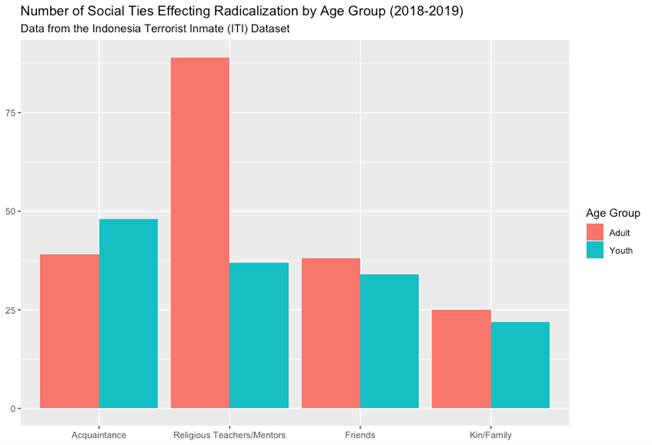
However, while social ties play a similarly prominent role in the radicalisation of both youths and adults, there is a notable difference in the type of social tie most commonly involved in their radicalisation. As Graph 3 shows, for adults, religious teachers are the most common social tie aiding their radicalisation, accounting for 46.6 percent of cases. These are typically ulamas whom these adults respect and have regularly followed through mosque sermons or Quranic study circles.[38] For youths, however, the dataset shows that acquaintances are the most common social tie involved in their radicalisation (34 percent). Unlike religious teachers, acquaintances are people with whom the individual has only limited or secondhand familiarity, with many initially encountered as strangers through online forums or mosque gatherings.[39]
As for the platforms facilitating youth radicalisation, the ITI Dataset corroborates earlier findings on the significant role of online spaces. Notably, out of the 162 youths whose radicalisation pathways were recorded in the dataset, 51.2 percent were found to have been radicalised at least in part through online platforms. Broken down in more detail, the dataset shows that the most common types of online platform involved in youths’ radicalisation are social media sites such as Instagram and Facebook (73.2 percent), followed by encrypted messaging applications such as Telegram and Whatsapp (14.6 percent), then websites and forums (12.2 percent). Notably, however, the prominence of online platforms is far less evident in adult radicalisation pathways: among the 210 adults whose radicalisation pathways were recorded, only 29 percent experienced radicalisation involving some form of online platform.
Graph 4. Number of Youth Radicalisation by Pathway (2018-2019)
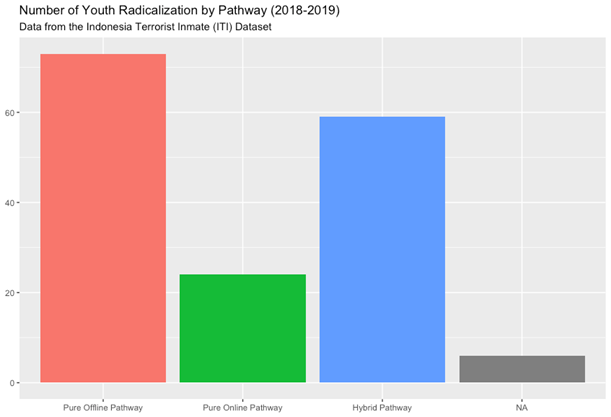
This does not mean, however, that offline pathways are insignificant in youth radicalisation. As shown in Graph 4, when examining radicalisation trajectories in their entirety, youth radicalisation that occurs through exclusively online means is relatively uncommon. Among youths recorded in the dataset, the most prevalent radicalisation pathway occurs purely offline, accounting for 45.1 percent of cases. This is followed by hybrid radicalisation pathways involving both offline and online avenues, which make up 36.4 percent of cases. In contrast, only 14.8 percent of youth radicalisation cases in the dataset occurred purely through online means. While these findings do not diminish the importance of countering radical content targeting youth online, they underscore the need for stakeholders to also address the offline environments where youth radicalisation still predominantly occurs.
Roles of Youth Involvement in Terrorist Activity
Once youths become members of a terrorist group or network, they have the same likelihood as adults of taking up operational roles. In terms of their involvement in attack plots, for example, youths and adults have the same likelihood of taking either a preparatory or execution role. As Graph 5 shows, out of the 180 youths recorded in the dataset, 23.9 percent were reported to have planned or participated in one or more attack plots. Similarly, among the 267 adults recorded, 21 percent were involved in preparing or executing at least one planned attack. These similarities also extend to youths’ and adults’ involvement in international travel. Among youths arrested for terrorism-related activities between 2018 and 2019, 11.7 percent were reported to have attempted to travel abroad. For adults, this number was a comparable 10.9 percent.
Graph 5. Operational Involvement Percentage by Age (2018-2019)
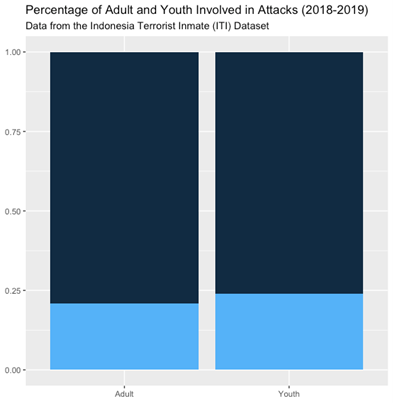
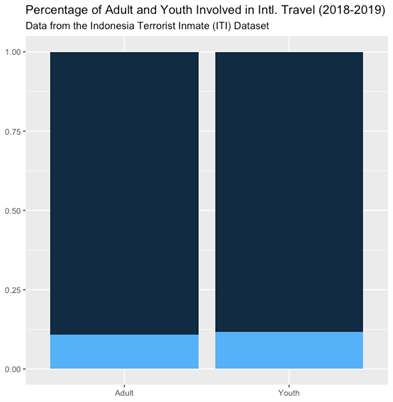
It is important to clarify, however, that this finding does not intend to suggest that the absolute number of youths involved in terrorist attacks or international travel is equivalent to that of adults. Consistent with prior observations, the dataset shows that the majority of both terrorist attack perpetrators and foreign terrorist fighter aspirants from Indonesia are adults. Indeed, the ITI Dataset finds that, between 2018 and 2019, adults constituted 56.6 percent of those involved in attacks and 58 percent of individuals who attempted to travel abroad. Interestingly, a recent 2025 BNPT report showed an even wider disparity between youths’ and adults’ involvement in terrorist operations. As they noted, of the 31 individuals arrested between 2023 and 2025 who were found to have participated in the planning or execution of attacks, 74.1 percent were adults.[40]
While the likelihood of youths and adults taking up operational roles is similar, the likelihood of them assuming managerial roles—defined as roles involving responsibility for overseeing one or more cells or divisions—differs notably. Indeed, the overall percentage of individuals who held such roles is small. Out of the 447 individuals recorded in the author’s dataset, for example, only 25.9 percent ever held a managerial role throughout their terrorist career. Notably, out of this subset, youths comprised just 17.2 percent. This disparity becomes even clearer when comparing the proportions of those appointed to a managerial role within each age group. Among the adults recorded in the dataset, for example, 36 percent were reported to have occupied a managerial role during their terrorist career. By contrast, only 11.1 percent of youths were recorded as having held such roles.
Conclusion
In conclusion, this study provides three key insights into the radicalisation and involvement of Indonesian youths into jihadist terrorist networks. First, while youth participation in terrorist activities has increased in the early 2020s compared to the early 2000s, youths still represent a relatively small proportion of the overall terrorist population when compared to adults across both periods. Second, the majority of youth radicalisation cases involve the influence of social networks and the use of online platforms. However, instances of radicalisation occurring through exclusively online means remain uncommon and are outnumbered by those occurring through exclusively offline avenues or through a hybrid combination of offline and online channels. Third, once youths join a group, they are no more likely than adults to take on operational roles. By contrast, they are considerably less likely to be appointed to managerial positions than adults.
Concerningly, Indonesia is facing not only an increase in youth involvement in jihadist terrorist groups, but also a rise in youths’ involvement in memetic, far-right-inspired violence. The earlier SMAN 72 bombing, for instance, was categorised by Densus 88 as memetic violence – referring to attacks which appropriate the aesthetic and methodologies of previous far-right violence, often carried out for personal recognition or notoriety.[41] Indeed, subsequent police statements indicate that the phenomenon was not isolated. In late December 2025, Indonesian authorities identified 68 youths who had been “exposed to neo-Nazi and white supremacist ideologies,” with several reportedly found in possession of firearms.[42] This trend continued in February 2026, when a student hurled a Molotov cocktail into his high school in West Kalimantan while carrying a backpack marked with the names of past far-right mass shooters.[43]
Although the study’s findings are drawn from youth involvement in jihadist terrorist organisations, they offer insights for addressing this emerging phenomenon of memetic far-right inspired youth violence in Indonesia. First, it is important to devise early detection mechanisms capable of identifying offline behavioural pattern changes among radicalising youths. As the dataset shows, although most instances of youth radicalisation involve online platforms, they rarely occur entirely online. In the case of jihadists, nearly all youth radicalisation processes involved interaction with other members in real-world activities. While structured offline group activities are likely less common among youths involved in far-right memetic violence—given the absence of real-world groups to facilitate it in Indonesia—this does not imply that their predominantly online radicalisation leaves no offline behavioural indicators. Supplementing online monitoring initiatives with offline prevention and detection strategies involving schools and families will therefore be crucial.
Second, it is important to address the social networks that facilitate Indonesian youths’ adoption and mimicry of far-right violence. The dataset indicates that youth radicalisation seldom occurs in isolation. In most instances, radicalising youths depend on like-minded peers not only to access extremist content but also to cultivate a sense of belonging within the community that reinforces such beliefs. In the context of jihadist groups, these peers often take the form of “acquaintances” encountered online. Similarly, several studies suggest that the radicalisation of Indonesian youths involved in far-right memetic violence also involves the role of a social network, namely the True Crime Community, through which these youths gain a sense of visibility and importance.[44] Restricting access to such environments while, more importantly, empowering alternative communities where youths can develop a sense of belonging, will be critical to curbing the future growth of far-right memetic violence among youths.
About the Author
Alif Satria is an Associate Research Fellow at the International Centre for Political Violence and Terrorism Research (ICPVTR), a constituent unit of the S. Rajaratnam School of International Studies (RSIS), Nanyang Technological University (NTU), Singapore. He can be reached at [email protected].
Thumbnail photo by Belle Co on Pexels
Citations
[1] Alif Satria and Adlini Ilma Ghaisany Sjah, “Indonesia,” Counter Terrorist Trends and Analysis 18, no. 1 (2026): 16–17.
[2] Muhlis Al Alawi and Andi Hartik, “Eks Pemimpin JI Keliling Indonesia Bimbing 8.000 Anak Buahnya Kembali ke NKRI,” Kompas, September 3, 2025, https://surabaya.kompas.com/read/2025/09/03/201311178/eks-pemimpin-ji-keliling-indonesia-bimbing-8000-anak-buahnya-kembali-ke; “Cara Eks Amir JI Para Wijyanto Ajak Napi Terorisme Bertaubat,” Tempo, August 3, 2025, https://www.tempo.co/hukum/cara-eks-amir-ji-para-wijayanto-ajak-napi-terorisme-bertaubat-2054314.
[3] Alif Satria, “Indonesian Pro-Islamic State Groups’ Attempts to Centralise Command Structures,” ICCT Analysis, September 17, 2025, https://icct.nl/publication/indonesian-pro-islamic-state-groups-attempts-centralise-command-structures; Jordan Newton, “Staying Alive: The Indonesian Pro-IS Community’s Online Resilience and the ‘Lone Actor’ Threat in 2025,” Counter Terrorist Trends and Analysis 17, no. 3 (2025): 1–2.
[4] Rahmad Nasution, “Indonesia Records Zero Terror Attacks throughout 2025,” Antara News, December 30, 2025, https://en.antaranews.com/news/398014/indonesia-records-zero-terror-attacks-throughout-2025.
[5] “Explosion at Mosque in Jakarta Injures 55 People, Teen Suspect Identified,” Channel News Asia, November 7, 2025, https://www.channelnewsasia.com/asia/jakarta-explosion-mosque-school-complex-injured-5453006.
[6] Wildan Noviansah, “Densus 88 Ungkap Fenomena ‘Memetic Violence’ di Ledakan SMAN 72 Jakarta,” Detik News, November 11, 2025, https://news.detik.com/berita/d-8205881/densus-88-ungkap-fenomena-memetic-violence-di-ledakan-sman-72-jakarta.
[7] Mohammad Final Daeng, “Terrorists Recruit Children Through Online Games, Police Chief Urges Attention,” Kompas, November 21, 2025, https://www.kompas.id/artikel/en-teroris-rekrut-anak-anak-lewat-gim-daring-kapolri-minta-jadi-perhatian-bersama.
[8] Norbertus Arya Dwiangga Martiar, “Jaringan Teroris Aktif Rekrut Anak-anak Lewat Media Sosial dan Gim Daring, Korban Ratusan,” Kompas, November 18, 2025, https://www.kompas.id/artikel/jaringan-teroris-aktif-rekrut-anak-anak-lewat-media-sosial-dan-gim-daring-ratusan-anak-jadi-korban.
[9] Suhadi and Utami Sandyarani, “International and Local Actor Collaborations to Prevent Violent Extremism Among Youth in Indonesia: Initiatives and Effectiveness,” in Countering Violent and Hateful Extremism in Indonesia: Islam, Gender, and Civil Society, ed. Greg Barton (Cham: Springer Nature, 2022), 125.
[10] Haula Noor, “Perpetuating Loyalty: Parental Influence on Early Radicalization in Indonesia,” Journal of Critical Perspectives 58, no. 2 (2022): 101–102.
[11] Amira Paripurna, Sarwirini, and Imam Subandi, “Pathway of School-Age Youth into Violent Extremist Activity and the De-Radicalization Programme in Indonesia,” International Journal of Criminal Justice Science 16, no. 1 (2021): 9.
[12] Paripurna, Sarwirini, and Subandi, “Pathway of School-Age Youth,” 7-8.
[13] Azyumardi Azra, “Indonesian Youth: Religious-Linked Violence and Terrorism,” in From the Desert to World Cities: The New Terrorism, ed. Wilhelm Hofmeister and Megha Sarmah (Konrad Adenauer Stiftung, 2015): 123.
[14] MAARIF Institute, PPIM UIN Jakarta, and UNDP Indonesia, “OSIS Rowing Between Two Reefs: School’s Policy, Radicalism, and Nationalistic Inclusivism,” CONVEY Report 1, no. 4 (2018): 10–13; Paripurna, Sarwirini, and Subandi, “Pathway of School-Age Youth,” 2–3.
[15] Mun’im Sirry, “Muslim Student Radicalism and Self-Deradicalization in Indonesia,” Islam and Christian-Muslim Relations 31, no. 2 (2020): 241–242; Bagong Suyanto, Mun’im Sirry, and Rahma Sugihartati, “Pseudo-Radicalism and the De-Radicalization of Educated Youth in Indonesia,” Studies in Conflict and Terrorism 45, no. 2 (2022): 153.
[16] Achmad Zainal Huda, A. Josias Simon Runturambi, and Muhammad Syauqillah, “Social Media as an Incubator of Youth Terrorism in Indonesia: Hybrid Threat and Warfare,” Jurnal Kajian Interdisipliner Islam Indonesia, no. 1 (2021): 24; Noor Huda Ismail, “Children, Digital Risk, and the Future of Terrorism Prevention in Indonesia,” RSIS Commentary, no. 235 (December 2025): 1–2.
[17] MAARIF Institute, PPIM UIN Jakarta, and UNDP Indonesia, “OSIS Rowing Between Two Reefs,” 7; Ben K. C. Laksana, Living Together in a Religious Plural Society: Indonesian Teachers’ and Students’ Perceptions on Citizenship, Identity, & Religious Tolerance (PhD diss., Victoria University of Wellington, 2019), 3–4.
[18] Suyanto, Sirry, and Sugihartati, Pseudo-Radicalism, 154.
[19] Sirry, Muslim Student Radicalism, 243.
[20] Azra, Indonesian Youth, 123–124.
[21] Jamhari Makruf and Mutiara Pratiwi, “Youth and Jihadi Terrorism in the Indonesian Public Attention (1999–2011),” in Youth and Terrorism: A Selection of Articles, ed. Datin Paduka Rashidah Ramli (Southeast Asia Regional Centre for Counter-Terrorism, 2012), 67.
[22] V. Arianti and Amresh Gunasingham, “Youth Militancy in Indonesia: A Perennial Problem?” Counter Terrorist Trends and Analysis 14, no. 2 (March 2022): 3.
[23] Arianti and Gunasingham, “Youth Militancy,” 1.
[24] Kumar Ramakrishna, “Children and Family Terrorism,” Cairo Review, no. 30 (2018): 18–19; Kirsten E. Schulze, “The Surabaya Bombings and the Evolution of the Jihadi Threat in Indonesia,” CTC Sentinel 11, no. 6 (2018): 1–2.
[25] Makruf and Pratiwi, “Youth and Jihadi Terrorism,” 65.
[26] Arianti and Gunasingham, “Youth Militancy,” 2; Azra, “Indonesian Youth,” 124.
[27] Paripurna, Sarwirini, and Subandi, “Pathway of School-Age Youth,” 2.
[28] Noor, “Perpetuating Loyalty,” 114–115.
[29] Suyanto, Sirry, and Sugihartati, “Pseudo-Radicalism,” 7–8.
[30] Huda, Runturambi, and Syauqillah, “Social Media,” 24.
[31] Ibid., 25.
[32] Ismail, “Children, Digital Risk,” 1.
[33] The ITI Dataset is a database the author developed which compiles data on Indonesian terrorist suspects detained between 2018 and 2019. It primarily draws its data from publicly available court documents accessed through the Indonesian Supreme Court’s website and supplements it with information from open-source media, think tank publications, and police statements. Overall, the dataset contains 447 observations (62 percent of all terrorist arrests made between 2018 and 2019). In each of these observations, the dataset recorded a total of 53 variables clustered into three categories: personal variables (e.g., demographic information, education, employment details), professional variables (e.g., radicalisation pathway, organisational affiliation, operational experience), and arrest-related variables (e.g., date and location of arrest, length of prison sentence).
[34] Makruf and Pratiwi, “Youth and Jihadi Terrorism,” 67.
[35] Data for this relies on the monitoring of online news publications done by the author between January 2021 and December 2025.
[36] Makruf and Pratiwi, “Youth and Jihadi Terrorism,” 67.
[37] Ibid.
[38] Mahkamah Agung Republik Indonesia, “Putusan Teddy Bahtera Lesmana als Abu Yasmin als Ibnu Ali Bin Ali Kodir,” Court Decision, No. 432/Pid.Sus/2019/PN.Jkt.Tim (2019): 7–8.
[39] Mahkamah Agung Republik Indonesia, “Putusan Ahmad Sugianto als Anto als Akhi Ahmad Bin
Matali,” Court Decision, No. 304/Pid.Sus/2019/PT.DKI (2019): 3-5.
[40] I-KHub Badan Nasional Penanggulangan Terorisme, Tren Terorisme Indonesia Tahun 2023 – 2025, (I-KHub, 2025): 15.
[41] Munira Mustaffa, “Cosplaying Columbine: How Memetic Violence Transformed Southeast Asia’s Extremist Threat,” GNET Insight, December 22, 2025, https://gnet-research.org/2025/12/22/cosplaying-columbine-how-memetic-violence-transformed-southeast-asias-extremist-threat/.
[42] Adhyasta Dirgantara, “Kabareskrim: 68 Anak Indonesia Terpapar Neo-Nazi dan White Supremacy,” Kompas, December 30, 2025, https://nasional.kompas.com/read/2025/12/30/14550171/kabareskrim-68-anak-indonesia-terpapar-neo-nazi-dan-white-supremacy.
[43] BBC Indonesia, “Siswa SMP Lempar Bom Molotov ke Sekolah di Kalbar – Apa Itu True Crime Community?” BBC Indonesia, February 6, 2026, https://www.bbc.com/indonesia/articles/c9wx949742qo.
[44] Chevy Atha, “The Jakarta Bombing: Youth Digital Radicalisation and the Urgent Need for Adaptive PCVE Responses,” GNET, January 7, 2026, https://gnet-research.org/2026/01/07/the-jakarta-bombing-youth-digital-radicalisation-and-the-urgent-need-for-adaptive-pcve-responses/; Adlini Ilma Ghaisany Sjah and Saddiq Basha, “SMAN 72 Jakarta Bombing in Indonesia,” Jamestown Terrorism Monitor 24, no. 2 (2026), https://jamestown.org/sman-72-school-bombing-in-indonesia/.