


02 July 2026
IP26075 | Strategic Convenience in Motion: The Deepening of Indonesia-Japan Defence Cooperation

KEY TAKEAWAYS
• The deepening defence cooperation between Japan and Indonesia reflects Tokyo’s attempt to enhance maritime security and Jakarta’s continued pragmatic approach to defence modernisation.
• For Indonesia, cooperation with Japan is best understood as a strategic convenience rather than a signal of deeper commitment to any particular alliance framework.
COMMENTARY
Indonesia and Japan have deepened their defence cooperation through a series of high-level meetings between their defence ministers, Shinjiro Koizumi and Sjafrie Sjamsoeddin. In May 2026, the two ministers signed a Defence Cooperation Arrangement (DCA), marking a significant milestone in bilateral security ties. The following month, Koizumi made a brief – less than 24-hour – visit to Indonesia to meet President Prabowo Subianto in person, signalling Tokyo’s intent to accelerate the agreement’s implementation. This paper traces the trajectory of Indonesia-Japan defence cooperation and examines its implications for regional security.
The Development of Indonesia-Japan Defence Cooperation
Back in March 2015, then-Indonesian Defence Minister Ryamizard Ryacudu signed a memorandum of understanding (MoU) with his Japanese counterpart, Gen Nakatani. The MoU focused on fostering cooperation on regional stability, military medicine, maritime security, counterterrorism, cyber defence and humanitarian assistance and disaster relief (HADR) as well as strengthening relations through regional frameworks. Since then, Japan’s defence cooperation with Indonesia has emphasised maritime security cooperation and regional stability. The participation of the Japan Ground Self-Defence Force (JGSDF) in the 2022 Super Garuda Shield (SGS), a multi-service and multilateral military exercise that originated from the Indonesia-US bilateral army exercise Garuda Shield, marked a slight shift in the focus of defence cooperation between Japan and Indonesia. The airborne training exercise in the 2022 SGS marked the first military exercise involving the Japanese and Indonesian armies, albeit alongside the US army.
The launch in April 2023 of Japan’s Official Security Assistance (OSA) marked an attempt by Tokyo to deepen its security engagement with Southeast Asian countries, including Indonesia. The OSA has emerged as a foundation for Japan’s proactive posture in Southeast Asia. Although the OSA’s official documentation outlined an intention to strengthen the deterrence capabilities of like-minded countries, the programme is primarily focused on providing non-lethal military transfers to Southeast Asia as well as capacity building. In practice, this reflects the continuation of Japan’s long-standing commitment to human security. Japan’s renewed defence policy, together with the revival of the country’s defence industry, also contributed to Tokyo’s increased engagement in the region. In the recent DCA with Indonesia, Japan offered training for military personnel and the possibility of technology transfer through a joint-development scheme.
Koizumi-Sjafrie Intensive Engagement
Following Prime Minister Sanae Takaichi’s victory last year, Japan has shown a strong commitment to playing a more active role in regional security, underscoring its support for a Free and Open Indo-Pacific (FOIP). Japan has moved to expand its security partnerships with like-minded countries through multiple channels, including OSA, its long-standing Official Development Assistance (ODA), and defence equipment transfers. Tokyo has also recently lifted its long-standing ban on the export of lethal weapons, creating greater diplomatic space for engagement with strategic partners.
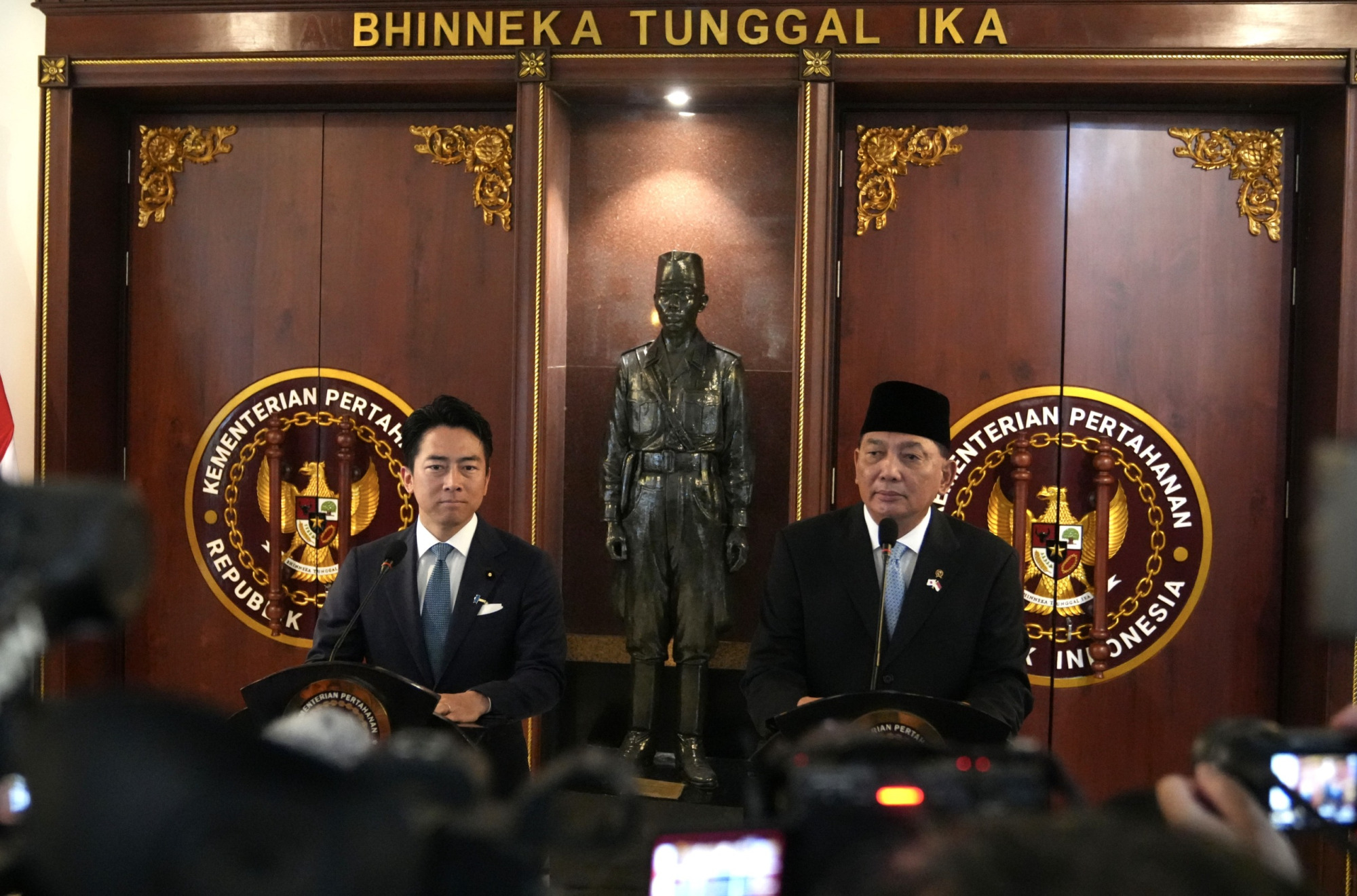
Image credit: Ministry of Defense, Republic of Indonesia.
Japan has moved quickly to enhance its defence cooperation with strategic partners in the region, including Indonesia. Koizumi and Sjafrie have held intensive meetings covering a wide range of defence cooperation issues. Since the Takaichi administration took office, the two ministers have met at least seven times, both virtually and in person (see Table 1). The frequency and intensity of these engagements reflect the Takaichi administration’s agility in defence diplomacy. Indonesia, for its part, has remained receptive to such cooperation in pursuit of its defence modernisation agenda.
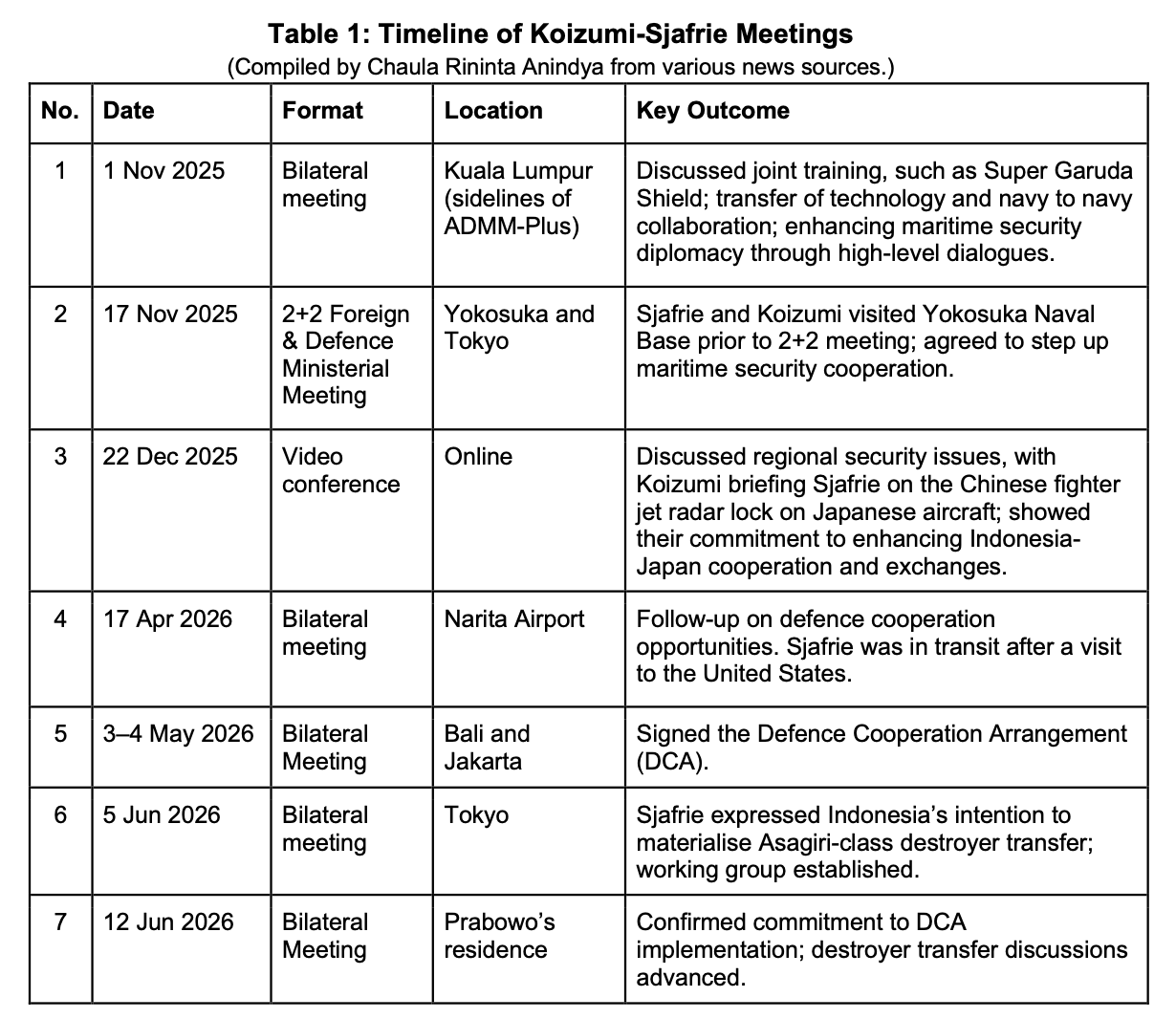
These meetings signal Japan’s intent to expand maritime security cooperation, most notably through ongoing discussions of Indonesia’s potential acquisition of the Asagiri-class destroyers. That intent is also reflected in Tokyo’s sustained practice of assigning career naval officers as defence attachés to Indonesia. The current appointee is the younger brother of his predecessor. Both are career naval officers from a family with a generational history of service in Jakarta, their father having previously held the same post. Their fluency in Bahasa Indonesia provides a considerable advantage in building institutional trust with their Indonesian counterparts.
Regional Implications
Indonesia occupies a strategic position in Japan’s regional outlook, not only as a bilateral partner but also as an agenda-setter capable of advancing Japan’s interests within Southeast Asian multilateral frameworks. The Asagiri-class transfer, however, is not without its critics. The vessels are now well over three decades old, raising legitimate questions about their residual operational value and maintenance burden. For Japan, however, the strategic value of the transfer lies less in the platforms’ age than in the interoperability, technology familiarisation and capacity-building opportunities they offer. This can be seen from Tokyo’s active defence diplomacy in offering its destroyers to key regional partners: Australia has concluded an agreement to acquire Mogami-class frigates while the Philippines is expected to procure the Abukuma-class destroyer escorts.
Any such transfer would have implications beyond hardware acquisition, facilitating closer information-sharing and coordination on freedom of navigation in the Indo-Pacific. These developments may be of concern to Beijing, which could interpret Indonesia’s procurement of Japanese naval assets as part of a broader effort to constrain China. Given Japan’s alliance with the United States, such dynamics risk exacerbating regional tensions rooted in great power competition.
Nonetheless, Indonesia’s deepening defence cooperation with Japan should not be interpreted as tantamount to Indonesia’s shift towards the US-led alliance. Jakarta’s procurement choices remain fundamentally pragmatic and oriented towards concrete defence-development objectives, implementing the Optimum Essential Force (OEF) modernisation programme and the Indonesian Navy’s coastal-defence concept, and supporting broader organisational expansion of the Indonesian Armed Forces. These objectives extend beyond the acquisition of high-end platforms to include capability development, which reflects a strategic emphasis on self-reliance and sustainment. Equally important, the coastal-defence doctrine and force enlargement requirements will generate sustained demand for trained personnel, institutional reform, and maintenance and logistics capacity rather than for equipment alone. In this respect, Japan’s offers of technical assistance and capacity building are instrumental for Indonesia, rather than a function of geopolitics. Indonesia’s response to Japan’s defence overtures will thus be a litmus test for Indonesia’s commitment to its free and active (bebas aktif) foreign policy.
For the foreseeable future, both sides have compelling reasons to sustain the momentum of their defence and security ties: Indonesia pursues capability development, while Japan advances its vision of a stable and open Indo-Pacific.
Chaula Rininta Anindya is a lecturer at the Department of International Relations, Universitas Indonesia and former Research Analyst with the Indonesia Programme, Institute of Defence and Strategic Studies, S. Rajaratnam School of International Studies (RSIS). Adhi Priamarizki is a Senior Associate Fellow with the Indonesia Programme, RSIS.
KEY TAKEAWAYS
• The deepening defence cooperation between Japan and Indonesia reflects Tokyo’s attempt to enhance maritime security and Jakarta’s continued pragmatic approach to defence modernisation.
• For Indonesia, cooperation with Japan is best understood as a strategic convenience rather than a signal of deeper commitment to any particular alliance framework.
COMMENTARY
Indonesia and Japan have deepened their defence cooperation through a series of high-level meetings between their defence ministers, Shinjiro Koizumi and Sjafrie Sjamsoeddin. In May 2026, the two ministers signed a Defence Cooperation Arrangement (DCA), marking a significant milestone in bilateral security ties. The following month, Koizumi made a brief – less than 24-hour – visit to Indonesia to meet President Prabowo Subianto in person, signalling Tokyo’s intent to accelerate the agreement’s implementation. This paper traces the trajectory of Indonesia-Japan defence cooperation and examines its implications for regional security.
The Development of Indonesia-Japan Defence Cooperation
Back in March 2015, then-Indonesian Defence Minister Ryamizard Ryacudu signed a memorandum of understanding (MoU) with his Japanese counterpart, Gen Nakatani. The MoU focused on fostering cooperation on regional stability, military medicine, maritime security, counterterrorism, cyber defence and humanitarian assistance and disaster relief (HADR) as well as strengthening relations through regional frameworks. Since then, Japan’s defence cooperation with Indonesia has emphasised maritime security cooperation and regional stability. The participation of the Japan Ground Self-Defence Force (JGSDF) in the 2022 Super Garuda Shield (SGS), a multi-service and multilateral military exercise that originated from the Indonesia-US bilateral army exercise Garuda Shield, marked a slight shift in the focus of defence cooperation between Japan and Indonesia. The airborne training exercise in the 2022 SGS marked the first military exercise involving the Japanese and Indonesian armies, albeit alongside the US army.
The launch in April 2023 of Japan’s Official Security Assistance (OSA) marked an attempt by Tokyo to deepen its security engagement with Southeast Asian countries, including Indonesia. The OSA has emerged as a foundation for Japan’s proactive posture in Southeast Asia. Although the OSA’s official documentation outlined an intention to strengthen the deterrence capabilities of like-minded countries, the programme is primarily focused on providing non-lethal military transfers to Southeast Asia as well as capacity building. In practice, this reflects the continuation of Japan’s long-standing commitment to human security. Japan’s renewed defence policy, together with the revival of the country’s defence industry, also contributed to Tokyo’s increased engagement in the region. In the recent DCA with Indonesia, Japan offered training for military personnel and the possibility of technology transfer through a joint-development scheme.
Koizumi-Sjafrie Intensive Engagement
Following Prime Minister Sanae Takaichi’s victory last year, Japan has shown a strong commitment to playing a more active role in regional security, underscoring its support for a Free and Open Indo-Pacific (FOIP). Japan has moved to expand its security partnerships with like-minded countries through multiple channels, including OSA, its long-standing Official Development Assistance (ODA), and defence equipment transfers. Tokyo has also recently lifted its long-standing ban on the export of lethal weapons, creating greater diplomatic space for engagement with strategic partners.
Image credit: Ministry of Defense, Republic of Indonesia.
Japan has moved quickly to enhance its defence cooperation with strategic partners in the region, including Indonesia. Koizumi and Sjafrie have held intensive meetings covering a wide range of defence cooperation issues. Since the Takaichi administration took office, the two ministers have met at least seven times, both virtually and in person (see Table 1). The frequency and intensity of these engagements reflect the Takaichi administration’s agility in defence diplomacy. Indonesia, for its part, has remained receptive to such cooperation in pursuit of its defence modernisation agenda.
These meetings signal Japan’s intent to expand maritime security cooperation, most notably through ongoing discussions of Indonesia’s potential acquisition of the Asagiri-class destroyers. That intent is also reflected in Tokyo’s sustained practice of assigning career naval officers as defence attachés to Indonesia. The current appointee is the younger brother of his predecessor. Both are career naval officers from a family with a generational history of service in Jakarta, their father having previously held the same post. Their fluency in Bahasa Indonesia provides a considerable advantage in building institutional trust with their Indonesian counterparts.
Regional Implications
Indonesia occupies a strategic position in Japan’s regional outlook, not only as a bilateral partner but also as an agenda-setter capable of advancing Japan’s interests within Southeast Asian multilateral frameworks. The Asagiri-class transfer, however, is not without its critics. The vessels are now well over three decades old, raising legitimate questions about their residual operational value and maintenance burden. For Japan, however, the strategic value of the transfer lies less in the platforms’ age than in the interoperability, technology familiarisation and capacity-building opportunities they offer. This can be seen from Tokyo’s active defence diplomacy in offering its destroyers to key regional partners: Australia has concluded an agreement to acquire Mogami-class frigates while the Philippines is expected to procure the Abukuma-class destroyer escorts.
Any such transfer would have implications beyond hardware acquisition, facilitating closer information-sharing and coordination on freedom of navigation in the Indo-Pacific. These developments may be of concern to Beijing, which could interpret Indonesia’s procurement of Japanese naval assets as part of a broader effort to constrain China. Given Japan’s alliance with the United States, such dynamics risk exacerbating regional tensions rooted in great power competition.
Nonetheless, Indonesia’s deepening defence cooperation with Japan should not be interpreted as tantamount to Indonesia’s shift towards the US-led alliance. Jakarta’s procurement choices remain fundamentally pragmatic and oriented towards concrete defence-development objectives, implementing the Optimum Essential Force (OEF) modernisation programme and the Indonesian Navy’s coastal-defence concept, and supporting broader organisational expansion of the Indonesian Armed Forces. These objectives extend beyond the acquisition of high-end platforms to include capability development, which reflects a strategic emphasis on self-reliance and sustainment. Equally important, the coastal-defence doctrine and force enlargement requirements will generate sustained demand for trained personnel, institutional reform, and maintenance and logistics capacity rather than for equipment alone. In this respect, Japan’s offers of technical assistance and capacity building are instrumental for Indonesia, rather than a function of geopolitics. Indonesia’s response to Japan’s defence overtures will thus be a litmus test for Indonesia’s commitment to its free and active (bebas aktif) foreign policy.
For the foreseeable future, both sides have compelling reasons to sustain the momentum of their defence and security ties: Indonesia pursues capability development, while Japan advances its vision of a stable and open Indo-Pacific.
Chaula Rininta Anindya is a lecturer at the Department of International Relations, Universitas Indonesia and former Research Analyst with the Indonesia Programme, Institute of Defence and Strategic Studies, S. Rajaratnam School of International Studies (RSIS). Adhi Priamarizki is a Senior Associate Fellow with the Indonesia Programme, RSIS.